


Nvidia CEO Jensen Huang Steps Down, and AI's New Players Lose Their "Biggest Backer"


- Key Takeaways: After Jensen Huang resigns as Nvidia CEO, the $140 billion-plus AI ecosystem investment framework he spearheaded faces contraction, and the market is repricing whether Nvidia can continue its role as the "central bank of AI."
- Key Elements:
- During his tenure, Huang invested more than $140 billion cumulatively in AI startups and cloud providers. After news of his resignation was announced, Nvidia's stock fell over 25% cumulatively in two weeks.
- CFO Colette Kress takes over as interim CEO. She has a conservative style and has repeatedly opposed deals Huang strongly championed, and is expected to slow the pace of investment.
- Investments under signed contracts (such as $5 billion for Safe Superintelligence and about $2.5 billion for Thinking Machines Lab) are expected to be unaffected.
- Deals under negotiation face uncertainties, including a $10 billion investment in Anthropic's IPO and an additional $1 billion for Figure AI.
- The $500 billion AI infrastructure financing platform has been unveiled for months without facilitating a single deal. Nvidia's 25% backstop ratio is lower than Broadcom's, becoming an obstacle to closing deals.
- Customers are considering switching to Google or AMD due to uncertainty, and bipartisan lawmakers in Congress are calling for stricter chip export controls.
Author: Dong Jing
Source: Wallstreetcn
Jensen Huang's abrupt departure not only ended an era for Nvidia, but also plunged the most important source of funding for the entire AI startup ecosystem into deep uncertainty. Over the past three years, under Huang's leadership, Nvidia invested more than $140 billion cumulatively in AI startups, cloud computing providers, and frontier AI labs, making it the industry's irreplaceable "largest backer." Now, with the founder's exit, whether this funding pipeline can continue is being repriced by the market.
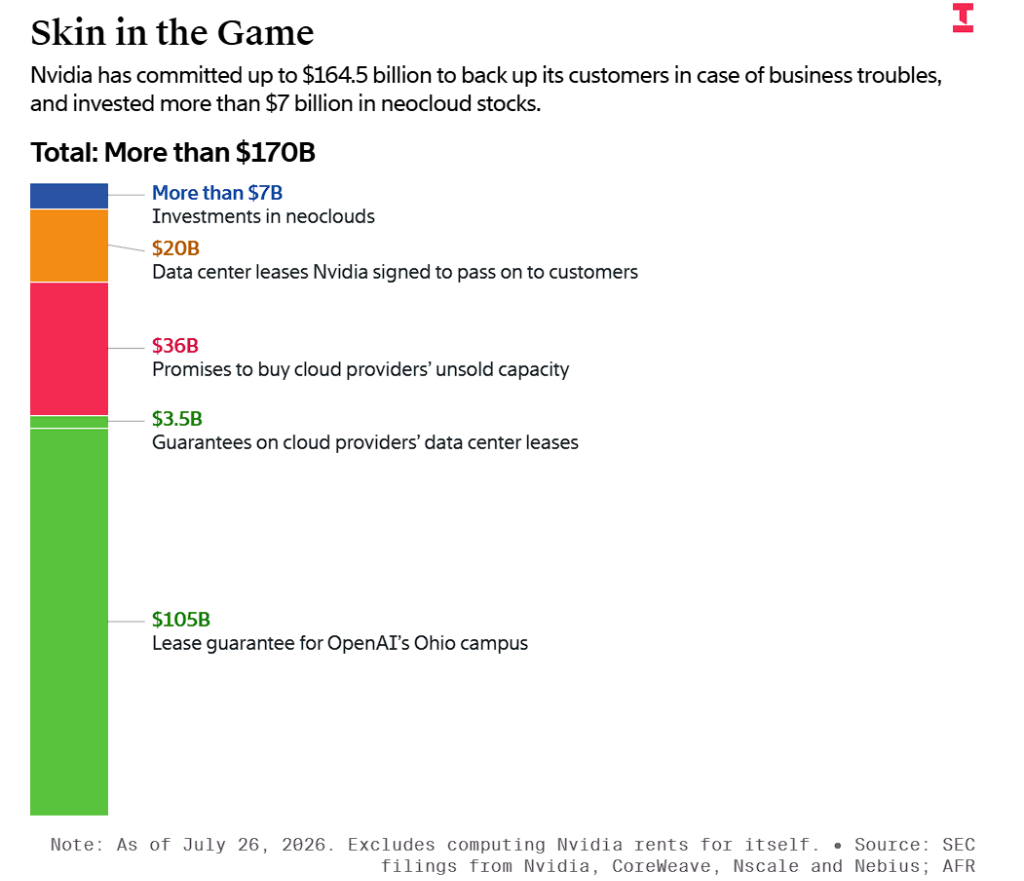
Nvidia's stock fell nearly 7% intraday on Thursday (November 12) after the news of Huang's resignation was announced, and has dropped more than 25% over the past two weeks. Meanwhile, shares of Nvidia-backed emerging cloud computing companies CoreWeave and Iren both fell about 7% that day. According to tech media outlet The Information, venture capitalists, startup founders, and semiconductor executives widely expect Nvidia to slow its aggressive investment pace—in the first two months of this year alone, that pace had already totaled $140 billion, including large-scale credit guarantees.

At the same time, a Wallstreetcn article noted that the $500 billion AI computing infrastructure financing platform jointly created by Nvidia and six asset management institutions was already riddled with problems before Huang's exit, and its prospects are now even more uncertain. Under his leadership, Nvidia was dubbed "the central bank of AI," building confidence in this still-early-stage industry by taking stakes across the AI ecosystem and providing backstop support. This role was most concentratedly demonstrated in the August announcement of the financing platform. However, with Huang forced out due to an extramarital affair scandal, the platform's advancement has lost its most core driving force.
A Wallstreetcn article mentioned that on Thursday, Nvidia announced that Huang resigned as the company's president, chief executive officer, and director, effective immediately. Chief Financial Officer Colette Kress took over as interim CEO. According to The Information, people familiar with Nvidia's investment decisions said that Kress had repeatedly raised objections to deals Huang strongly pushed, and her style is markedly more conservative, and she is not expected to advance deals at a pace close to Huang's.
Which Deals Are Signed and Which Remain Pending
According to The Information, investments that have signed legally binding contracts are expected to be unaffected. Safe Superintelligence (Nvidia plans to invest $5 billion) and Thinking Machines Lab, founded by former OpenAI CTO Mira Murati (Nvidia plans to invest about $2.5 billion, roughly half of the company's $4 billion to $5 billion funding round)—people close to both companies said the relevant contracts were signed months ago, and the investments are expected to close as planned.
However, deals still in negotiation face greater uncertainty:
Anthropic: Nvidia plans to invest $10 billion in Anthropic's upcoming IPO, but whether this plan can continue remains unclear. Previously, Nvidia provided Anthropic with a $105 billion credit guarantee for data center leases.
Figure AI: Nvidia has previously invested twice in this humanoid robotics company and recently was reported to be discussing an additional $1 billion investment, but the latest progress is unknown.
Nscale: Nvidia is negotiating to provide more than $5 billion in credit guarantees to this emerging cloud computing company for the construction of a 460-megawatt data center; as of the end of October, the agreement had not been signed.
Firmus: This Australian cloud computing provider is seeking at least $2 billion in private financing after withdrawing its IPO. Nvidia had previously participated in negotiations, but the outcome is undecided.
Lambda: Nvidia has committed to guaranteeing nearly $20 billion of its leases and has signed a $1.5 billion chip leaseback agreement. The company is in a new funding round, and it is unclear whether Nvidia will participate.
Reflection AI: Nvidia has cumulatively invested more than $1 billion in this startup, and the company was recently reported to be in talks with Nvidia for additional investment, but people close to the company said Reflection is not currently raising funds.
According to The Information, Huang intervened in Nvidia's investment decisions in a highly personal manner. He would meet with founders personally, and once he found that a favored startup had other potential investors, he would move quickly. Nvidia typically does not lead funding rounds or set valuations, but often writes the largest check.
The report said that an investor who has invested in multiple Nvidia-backed startups said:
"Jensen's support for the startup ecosystem is real, because he himself has a founder's mindset. If the next CEO doesn't have the same perspective, they are unlikely to be equally generous."
Huang also habitually pushed employees to prioritize speed over adequate due diligence, according to people familiar with Nvidia's investment operations. This style is expected to undergo a fundamental shift after Kress takes over.
The $500 Billion Financing Platform: Stalled After a High-Profile Launch
In addition, a Wallstreetcn article noted that in August this year, Huang, wearing his signature leather jacket, appeared on television alongside executives from Apollo Global Management, BlackRock, Blackstone, Brookfield Asset Management, Goldman Sachs, and KKR to jointly announce the establishment of an AI computing infrastructure financing platform with a target size of up to $500 billion. However, months after that high-profile appearance, the platform has yet to close a single deal.
According to Bloomberg, people familiar with the matter said that after failing to facilitate any deals over the past several months, Nvidia has faced pressure over the past month from some customers and Wall Street partners to increase its financing backstop ratio. Nvidia currently commits to a "residual value support agreement" cap of 25% of the deal size, lower than competitor Broadcom's level, and this gap is considered one of the key factors hindering deals. People familiar with the matter said Nvidia may not announce any deals until January next year at the earliest.
Broadcom has already pioneered such deals through its "AI XPV" platform jointly established with Apollo and Blackstone—in May this year, Broadcom provided a backstop for $30 billion of a $35 billion debt deal, supporting Anthropic's lease of TPU chips jointly produced by Broadcom and Google's Alphabet; according to Broadcom's 8-K filing, Broadcom will also provide about 72.5% (about $43 billion) backstop support for another $63 billion deal. By contrast, Nvidia has committed to only a 25% backstop ratio—a significant gap.
Kress Takes Over: A More Conservative Style, a More Complex Situation
According to The Information, Kress is 59 years old and joined Nvidia in 2013. She previously served as CFO of a Cisco division and as a Microsoft finance executive. She is the only executive besides Huang who regularly attends Nvidia's quarterly earnings calls, and she has some recognition in the investment community.
However, the challenges Kress faces go far beyond adjusting the investment pace. According to The Information, an executive at a cloud computing provider that buys Nvidia chips said the uncertainty brought by Huang's departure is prompting the company to consider switching to other chip suppliers such as Google or AMD—the company had previously considered diversifying procurement but shelved the idea out of concern about offending Huang.
At the Washington level, Huang had previously been close to the Trump administration and actively lobbied to relax chip export restrictions. After Kress takes over, whether Nvidia's policy influence can continue is also in doubt. According to The Information, bipartisan lawmakers in Congress have begun calling for stricter export controls on Nvidia chips, and related legislation could pass as part of the National Defense Authorization Act in the coming weeks.
According to The Information, competitors such as AMD and Broadcom do not have the capacity Nvidia had over the past year to provide large-scale credit guarantees to cloud computing providers and data center developers, but whether this advantage can continue in the post-Huang era remains unknown.
"Nvidia has been using its balance sheet to leverage a massive amount of investment," said Craig Coben, a managing director at financial advisory firm Seda Experts and a former Bank of America equity capital markets banker. "Without Huang at the helm, can the company sustain this frenetic pace of dealmaking?"





