






Looking back at the development history of Bitcoin: 15 years, 43 million times


Original author: Jack, rhythm worker, BlockBeats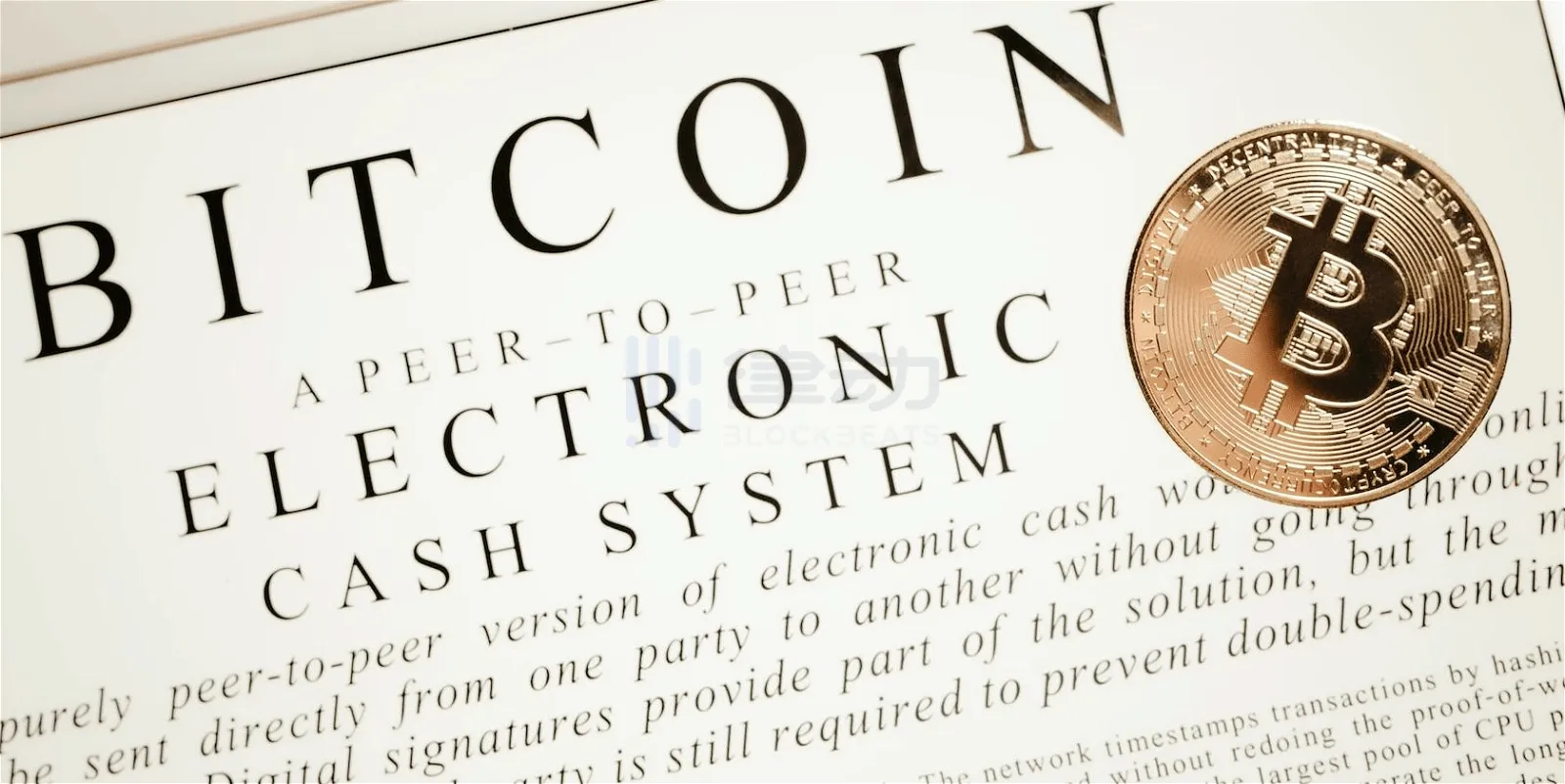
October 31st marks the 15th anniversary of the release of the Bitcoin white paper Bitcoin: A Peer-to-Peer Electronic Cash System by Satoshi Nakamoto on the P2P foundation website. The Bitcoin network was officially launched on January 3, 2009, with the initial transaction price of Bitcoin being $0.0008.
According to market data, the current price of Bitcoin is US$34,429.09, with a total market value of US$672.9 billion. Today, Bitcoin has gradually appreciated more than 43 million times since its launch. Let’s go back to the beginning of the birth of crypto and commemorate the release of the Bitcoin white paper.
The starting point of everything
In November 2008, a paper signed by Satoshi Nakamoto was published on the Internet, titled Bitcoin: A Peer-to-Peer Electronic Cash System. The paper details how to use peer-to-peer networks to create an electronic transaction system that does not rely on trust.
The background of Satoshi Nakamoto’s creation of Bitcoin is exactly the original intention of Bitcoin’s creation. Starting with the collapse of Lehman Brothers on September 15, 2008, the financial crisis broke out in the United States and spread rapidly around the world.
After Lehman went bankrupt, in response to the crisis, the U.S. Treasury Department launched an unprecedented large-scale bailout, spending an astonishing amount of public funds to save Fannie Mae and Freddie Mac, the two major home loan lenders. At the same time, the Federal Reserve adopted a quantitative easing policy and released a large amount of money in an attempt to stimulate the U.S. economy by issuing excessive amounts of money. Not only the United States, but the whole world is also suffering. The U.S. dollars in the hands of various countries shrank significantly, causing a series of butterfly effects such as intensified exchange rate fluctuations and stampede crashes of stock markets. In an instant, the global economy was stuck in the quagmire of recession and was unable to extricate itself.
Satoshi Nakamoto created Bitcoin out of frustration with the current monetary system and protection of privacy. In a traditional monetary system, all currencies are issued by the central bank and recorded and confirmed in transactions by banks. Bitcoin breaks this traditional model, allowing individuals to conduct peer-to-peer transactions without the intermediary of banks or other financial institutions. Since the number of Bitcoins is limited, the total amount is 21 million. This means that it does not expand over time like traditional currencies, thus protecting the value of the currency from being eroded by inflation.
Just as the traditional financial market is in chaos, Bitcoin has gained the attention of cryptography enthusiasts. After another two months of precipitation, Satoshi Nakamoto officially launched the Bitcoin system on January 3, 2009. After the Bitcoin network went online, the first open source Bitcoin client software was launched. Satoshi Nakamoto used this software to create the first Bitcoin block (block, also known as the genesis block). Carry out mining and obtain the first batch of 50 Bitcoins. The value of the initial Bitcoin transaction was negotiated among users on the bitcointalk forum, which included 10,000 Bitcoins for a whole pizza.
Whenever Bitcoin enters the mainstream medias attention, the mainstream media will always ask some mainstream economists to analyze Bitcoin. Early on, these analyzes always focused on whether Bitcoin was a scam. Todays analysis always focuses on whether Bitcoin can become the mainstream currency in the future. The focus of debate often focuses on the deflationary characteristics of Bitcoin.
The Bitcoin network generates new Bitcoins through mining. The so-called mining is essentially using computers to solve a complex mathematical problem to ensure the consistency of the distributed accounting system of the Bitcoin network. The Bitcoin network automatically adjusts the difficulty of math questions so that the entire network gets a qualified answer approximately every 10 minutes. The Bitcoin network will then generate a certain amount of Bitcoin as a block reward to reward those who get the answer.
Many Bitcoin players are attracted by the fact that Bitcoin cannot be issued at will. In contrast to the attitudes of Bitcoin players, economists have polarized attitudes towards the fixed total supply of 21 million Bitcoins.
Economists of the Keynesian school believe that the government should actively regulate the monetary aggregates and use the loosening and tightening of monetary policy to fuel or brake the economy in a timely manner. Therefore, they believe that Bitcoin’s fixed total currency sacrifices controllability, and what’s worse is that it will inevitably lead to deflation, thereby harming the overall economy. Austrian economists hold the opposite view. They believe that the less government intervention in currency, the better. Deflation caused by the fixed monetary aggregate is not a big deal and is even a sign of social progress.
silk road
Compared with the glory of Bitcoin today, its birth is simply insignificant.
On January 3, 2009, Satoshi Nakamoto personally created the first block, the genesis block of Bitcoin, on a small server in Helsinki, Finland, and obtained the first automatically generated by the system. With a reward of 50 Bitcoins, the first Bitcoin was born.
For a long time, the world ignored this new invention - what was it really for? Satoshi Nakamoto is a recognized genius and he did not answer. In December 2010, Satoshi Nakamoto left his last message online and never showed up again.
In the first year or two after its birth, Bitcoin has remained at US$0.1 per coin. The famous story of exchanging 10,000 Bitcoins for pizza happened at this time. Bitcoin has a genius design, but it is a useless design.
Satoshi Nakamoto is like Shakespeare, writing a perfect script but no one can perform it. Until Bitcoin met another genius.
Ross Ulbricht, born in 1984, has been involved in drug trafficking since college. The U.S. government has strict controls on drugs, and Ross has never been able to make his drug manufacturing and trafficking business bigger and stronger. It wasnt until 2010 that Ross heard about the existence of Bitcoin from customers, which became a turning point.
Ross Ulbricht
The core of the governments crackdown on illegal activities is the supervision of funds - the core behind this is the banking system, which is firmly in the hands of the government. Bitcoin is the payment tool that is separated from the banking system - until now, banks and Bitcoin still go their separate ways.
In January 2011, Ross, who was only 26 years old, founded a deep network, commonly known as the dark network. Ross named this website Silk Road, which means a place where goods are traded.
The Silk Road does not trade tea, silk, or porcelain. It is the most famous and notorious dark web in history. The main trading objects of this website are drugs, sex slaves, child pornography, private killers, arms trading, and identity fraud.
All illegal transactions are gathered on the Silk Road. In the end, even Ross himself was deeply involved. He once hired a killer with a high deposit to kill a Canadian user who invaded the sellers computer and blackmailed him.
With the rise of Silk Road, Bitcoin finally found its first application scenario - a payment tool for sinful transactions. Data shows that the Silk Road once circulated more than 9.5 million Bitcoins, accounting for 80% of the Bitcoin circulation at that time.
Silk Road website screenshot
In August 2013, Ross was arrested at a public library in San Francisco. In 2015, he was sentenced by the court to life imprisonment without the possibility of early parole.
Black needs are demands. Just like the consensus of fools, it is also a consensus. Driven by criminal transactions, Bitcoin experienced its first surge, reaching $31 in June 2011. Two months after Ross was arrested, Bitcoin rose to $1,100 per coin.
It can be said conclusively that Ross Ulbricht is an extremely important figure in the history of Bitcoin development. When Bitcoin is about to be ignored by the world, it ends the history of Bitcoin as a toy and gives it a real-world meaning - serving crime.
Criminals are the most able to embrace new technologies. Xu Zhihong, a partner at Biyou, concluded. But in the long battle, police departments mastered Bitcoins traceability technology. More black transactions turned to harder-to-trace digital currencies such as Monero. Bitcoin has embarked on a long bearish journey that has lasted for several years.
block size war
Fast forward to 2015.
On August 15 of this year, two early Bitcoin technology pioneers, Gavin Andresen and Mike Hearn, jointly announced on their blog that their new version of BitcoinXT would implement the BIP-101 proposal, which does not require a vote by miners. , it will be activated directly. This day later became known as The Day the Block Size War Erupted.
Since the birth of Bitcoin in 2009, the Bitcoin community has been divided on a number of key issues. Among them, the debate surrounding the size of Bitcoin blocks is the most intense. This controversy first originated from the original design intention of Bitcoin. The mysterious founder Satoshi Nakamoto set a limit of 1 megabyte per block size to prevent meaningless transactions and data inflation. But with the popularity of Bitcoin, this upper limit began to appear stretched, leading to network transaction congestion and increased confirmation times. In fact, as early as 2013, core developer Jeff Garzik proposed doubling the block size to 2 megabytes, triggering initial discussions on block size in the Bitcoin community.
In 2015, the controversy escalated further. Developers who support block expansion launched the Bitcoin XT project, which attempts to directly increase the block size to 8 megabytes.
On the one hand, Gavin Andresen and Mike Hearn, the two original developers who had in-depth communications with Satoshi Nakamoto, tended to increase the block size to 8 megabytes as a strategy to deal with the increase in transaction volume. On the other hand, core developers such as Greg Maxell, Luke-Jr, and Pieter Wuille warned that overexpansion may result in fewer nodes being able to run full nodes, reducing Bitcoins decentralization. It is even suggested that hard forks may lead to chaotic fragmentation of the network, and the infinite pursuit of expanding blocks is not the best solution for scalability.
At the same time, 2015 also witnessed the birth of Ethereum. Although its founder Vitalik Butarin is a staunch supporter of large blocks, his idea fell on the Ethereum chain. He believes that the scalability of the chain should have no boundaries, and all smart contracts and data should be included in the chain, while providing larger blocks and lower transaction fees.
The controversy subsequently turned into a serious schism in the Bitcoin community. The two parties had many rounds of heated discussions around the block size, but could never reach a consensus. The block size war began as a debate over how the network could scale to handle increased transaction volumes, but has since turned into a philosophical debate about Bitcoins ultimate purpose and political drama over how to manage the open source project.
In 2017, developers who supported large blocks initiated a hard fork of Bitcoin Cash, directly increasing the block size to 8 megabytes. This resulted in the Bitcoin community officially splitting into two camps. Those who support small blocks continue to maintain the original Bitcoin blockchain, while those who support large blocks create a new Bitcoin Cash blockchain. At this point, the Bitcoin block size controversy led to the first and largest fork in the history of the blockchain.
After the fork, the two chains developed independently, and the block size dispute continued. Bitcoin kept its block size unchanged at 1 megabyte, while Bitcoin Cash further expanded the block size to 32 megabytes in 2018. In the end, the block size war was won by the small block side. But in fact, winning a battle does not mean that the war will never end, because new BIPs are still being proposed, and there are still many debates between the small block camp and the big block camp.
Related Reading:Today in History|Eight years of block size war, revelation of blockchain’s checks and balances philosophy》
Members of the Bitcoin community have put forward hundreds of proposals to solve this problem. The debates on these competing proposals are extremely fierce. Often, as soon as one person puts forward his own idea, he will be mercilessly refuted by another opponent. Its like a war on the Internet. Sometimes it seems to have lost touch with the original intention of solving the problem. The debate has intensified, and even death threats and hacker attacks have appeared.
In the chaos, two solutions slowly emerged and gradually evolved into two camps. One is the group of miners led by Bitmain, which proposes a large block plan to directly expand the capacity of the Bitcoin network. The group led by Bitcoin Core developer Bitcoin Core does not support the idea of the Bitmain system. They advocate Keep the Bitcoin network at 1 MB, and instead launch SegWit and Lightning Network solutions for second-layer networks outside of the Bitcoin network.
fork in the road
In 2017, the highest price of Bitcoin was as high as $20,000 per coin, and just as it was rising wildly, a player who owned a large amount of Bitcoin made a call to his close friend. The 31-year-old said to his best friend on the other end of the phone in an almost pleading tone: So what if you just help me once?
The person who answered the phone is named Chang Chai. He is the founder of Chinas largest blockchain forum and media Babit. He plays a decisive role in the Chinese blockchain world. Babbitt also has huge influence in the Chinese encryption world.
The man who called for help was Wu Jihan.
Wu Jihan once fought side by side with Chang Chai and jointly founded Babbitt. Now he is one of the founders of Bitmain, the worlds largest cryptocurrency mining machine manufacturer. In Huruns post-80s wealth list, 32-year-old Wu Jihan is rated as a self-made post-80s with assets of 16.5 billion yuan. Top 50.
At that time, Wu Jihans Bitmain controlled more than 60% of the computing power of the Bitcoin network and was considered the only person with the opportunity to destroy and control Bitcoin at that time.
It may not be easy for Wu Jihan to make the decision to make this call. He is not a person willing to bow his head. But he now has to get more support for his hard fork of Bitcoin. On the phone, he waited for Chang Chais reply, hoping in his heart that this friend who had fought together could support him.
Forks are common upgrades and updates in the field of open source software. Usually in the blockchain, a soft fork can be compatible with both old and new versions, but a hard fork cannot be compatible with both old and new versions. A hard fork of Bitcoin means that Bitcoin will be divided into two mutually incompatible versions, the old and the new.
I can promise you anything else, but not this one. Chang Chai bluntly rejected his request. Perhaps Wu Jihan never thought that Chang Chai would reject his request like this. After all, he had helped Chang Chai when Babbitt was in the most difficult time. He might have hoped that Chang Chai would help him out of old friendship.
In the end, Chang Chai and his Babbitt remained neutral in this bifurcated war of the century.
The time goes back to February 20, one year before the fork, at the Hong Kong Cyberport. The atmosphere at the meeting was somewhat tense. Representatives of Bitcoin miners from China and representatives of the Bitcoin development community in the United States had a heated debate in a small conference room for 18 hours. Everyone is not relaxed, tired but excited. They don’t know what impact the conclusions drawn in this room today will have on the crypto world in the future, but they know that this is the first time that Bitcoin has faced a real “fork” since its birth.
At 3:30 in the morning on February 21, the debate in the conference room ended and was replaced by a moment of silence. The nervous representatives finally breathed a sigh of relief because they reached a consensus on expanding Bitcoin, which is also known as the Hong Kong Consensus.
No more divisions! those in attendance began to cheer.
If you were previously worried that Bitcoin would split into two coins, causing the currency price to collapse, you can now rest assured that the two parties in the dispute have downgraded the military struggle that may lead to the division of the country to a parliamentary struggle, and the risk is greatly reduced.
With the reaching of the Hong Kong consensus, many people in the Bitcoin industry finally breathed a sigh of relief and rushed to tell each other about this hard-won consensus.
Wu Jihan, who usually appears with a baby face, round glasses, jeans, and sneakers, has been looking gloomy these days. Finally, in a rare photo taken after signing the Hong Kong Consensus Agreement document, Wu Jihan showed his happiness. smiling face. The reason why the Hong Kong Consensus makes the entire Bitcoin industry so excited is because the Bitcoin community has been involved in three years of quarrels and divisions due to the expansion dispute. This time it is finally possible to put aside the disputes and develop together.
Since the participants of this consensus include Bitcoin core developers, the five major mining pools led by Bitmain (accounting for 80% of the computing power of the Bitcoin network), representatives of the four major exchanges (BTCC, Bitfinex, OKCoin and Huobi) and other individuals or industries Representative, therefore the Hong Kong Consensus is also regarded as the most important official document in the history of Bitcoin since the white paper.
In 2013, the Bitcoin network began to face a thorny problem. As the number of Bitcoin users grew larger, the block capacity designed by Satoshi Nakamoto was no longer sufficient. Bitcoin transfers are getting slower and slower, and the fees required for transfers are getting higher and higher. This has plunged the entire Bitcoin community into an unprecedented worry. If this continues, Bitcoin will become as mediocre as bank card transfer transactions. People began to argue over how to resolve this matter
Just a month before the Hong Kong Consensus Conference, Bitcoin developer Mike Hearn announced that he would withdraw from the Bitcoin industry and declared that it had failed. Affected by this negative impact, the price of Bitcoin fell from $440 to $360.
Through the mediation of many parties, a consensus was reached in Hong Kong. On the day after the Hong Kong consensus was reached, the price of Bitcoin also recovered to $440.
After the Hong Kong consensus meeting, Bitcoin Core claimed that the developers who promised various changes at the meeting were all programmers who did not have permission to modify the Core source code. None of the five people with the authority to change the Core source code attended, nor did they sign.
Adam Back also stated that his signature at the meeting only represented an individual and could not agree to the Hong Kong Consensus on behalf of Bitcoin Core. His attitude turned 180 degrees and he strongly opposed the Hong Kong Consensus that he personally signed not long ago.
The Hong Kong consensus was rejected by Bitcoin Core.
This reversal directly stimulated the miners who supported the Hong Kong consensus and accounted for 80% of the entire networks computing power. The Bitcoin community that had just reached a consensus once again fell into continued quarrels and divisions. The miners faction represented by Bitmain describes Bitcoin Core developers as conservative Bitcoin fundamentalists, while Bitcoin Core developers disrespect the miners and consider them businessmen full of copper odor.
One day in March 2017, Wu Jihan wrote on Twitter, I think the economic majority is not important. I ignored the so-called majority when I started investing in Bitcoin in 2011. He decided to start a new business and no longer play with Bitcoin Core. .
On May 23, 2017, Barry Silbert, founder of Digital Currency Group, the industrys top cryptocurrency investment company, convened 58 company representatives from 22 countries to hold a meeting in New York.
In order to convene this meeting, Barry Silbert established one-on-one contacts with major companies and developer representatives in the industry to act as a mediator. After putting in a lot of effort, Barry initially softened the positions of all parties. At that time, Adam Back also promised Barry to go to New York for face-to-face consultations in May.
An accident happened, Adam Back, representing the Bitcoin Core faction, bounced again.
Before he set off, he was severely stopped by another important partner within Blockstream. On the eve of the talks in New York, he temporarily announced his refusal to attend the meeting and instead sent the lower-ranking Miao Yongquan to attend the talks.
Miao Yongquan joined Blockstream in April 2017 as CSO. When he arrived representing Bitcoin Core and blockstream, he was refused entry by Barry Silbert at the door of the venue. Since Miao Yongquan usually had quarrels with many people on Twitter, Barry Silbert was worried that Miao Yongquans arrival would make everyone unhappy.
As the defensive side that controls the development of Bitcoin code, Bitcoin Core can take the initiative and continue to maintain its original path as long as it does not make mistakes. As the offensive party advocating a hard fork, Bitmain needs to use its interests to convince others to support the new route. After the Bitcoin Core faction was shut out in New York, before Segregated Witness was deployed, they also proposed their own soft fork plan. Although it was not implemented in the end due to various reasons, this behavior really stimulated the miners faction.
So Microbit, a mining farm invested by Bitmain, launched a hard fork plan to deal with the challenges of the Bitcoin Core soft fork plan. Finally, on August 1, 2017, the Weibit team dug out the first block. Since then, BCH, a fork coin that competes with BTC, was born. The capacity of BCH reached 8 M, which can accommodate more than eight times that of BTC. transactions and is not compatible with SegWit.
On January 13, 2018, Bitcoins market capitalization share of the entire cryptocurrency market fell to 32.45%, a record low. At that time, many people thought that it was only a matter of time before Bitcoin was replaced.
For Wu Jihan, computing power is the biggest advantage and weapon. He hopes that the fork currency BCH he leads can replace BTC. However, BTC occupies the legitimacy and naming rights of Bitcoin, and it still has 9 years of user accumulation and industry ecology. After the birth of BCH, it has been facing a severe challenge, that is, no one recognizes it.
Coupled with the opposition of the Bitcoin Core camp and the wait-and-see neutrality of most industry companies, after the BTC fork, most BCH was sold as candy by users, and the price of BCH was only over 200 US dollars when it first came out.
After the fork, Wu Jihan on the one hand attracted miners to mine BCH by raising the price of BCH, and on the other hand continued to sell BTC, causing the price of BTC to become unstable. In the end: Many miners will choose to continue to mine BCH, thus causing the Bitcoin calculation The power is reduced, the network is more congested, more people lose confidence and sell Bitcoin, and finally miners move to BCH, forming a vicious circle, leading to the collapse of Bitcoin.
So Wu Jihan chose to pull the ball in his first attack. The price of BCH has been rising all the way. Less than twenty days after the fork, the price soared to $898 on August 20, more than tripling. Miners see that BCH is profitable, and coupled with the shrinking computing power of BTC, transactions are more congested; more and more people begin to switch to BCH, which further causes the price of BCH to rise. This cycle continues, and the price of BCH keeps rising.
Then Wu Jihan made his second attack and began to snatch Bitcoin’s computing power. In extreme cases, BCH diverted nearly half of BTCs computing power, causing significant congestion in transactions on the Bitcoin chain. However, in November, BCHs computing power reached twice that of BTC, and the price was still only one-third of Bitcoins. In the end, BCHs computing power collapsed rapidly and never exceeded Bitcoin.
For a long time, the price of BCH has been artificially anchored at 7% ~ 10% of BTC.
In May 2018, the CoinGeek Hong Kong Conference was held. Major mining pools, exchanges, and developers came to Hong Kong to celebrate the first anniversary of BCH and to participate in BCHs exciting development in the past year. Bitcoin.com founder R0ger Ver, Lebit mining pool founder Jiang Zhuoer, and BCH core developer Jiang Jiazhi took a group photo at the event, representing public opinion, mining pools and development respectively to celebrate the first anniversary of the birth of Bitcoin Cash.
During the bear market throughout 2018, Bitmain heavily invested in the BCH track and exchanged the companys Bitcoin and cash for BCH, resulting in heavy losses. Since then, BCH has roughly maintained a ratio of 1:20 with Bitcoin in terms of price and computing power. Also because of its excessive BCH holdings, Bitmain was questioned about selling BCH in exchange for income when it was listed in Hong Kong in 2018.
Looking back two years after the Bitcoin fork, we can see that the BTC fork incident has long since settled, and BCH has also taken another parallel route. But this fork had a profound impact on the entire Bitcoin ecosystem.
Related Reading:Bitcoin forks past》
miners story
If I told you today that Bitcoin had a chance to be controlled by the Chinese ten years ago, would you believe it?
One night in May 2010, a hungry programmer exchanged 10,000 Bitcoins for two pizzas worth $30, and Bitcoin had its first denominator - $0.003. This invisible and intangible agreement has since gained real value, and what followed was a bull market filled with wealth creation myths and the rise of crypto mining.
Early Bitcoin had no value, there were very few people participating in the network, and mining only required a computer CPU. Hal Finney was one of the earliest miners at that time. Within a week or two, he mined thousands of Bitcoins using his computer. Later, he turned off the mining software because the CPU was too hot and the computer fan noise was annoying. .
But this $0.003 denominated transaction changed everything. Seeing that Bitcoin mining is profitable, more and more people are participating in the network. Soon, geeks from all walks of life began to write their own GPU graphics card mining programs and set up targeted mining machines. It is the mining machine we are familiar with now.
Soon, this technological craze spread to domestic geek forums, causing heated discussions among a small group of people. In 2011, Wu Jihan funded Changzhao to establish Babbitt, the earliest Bitcoin forum in China, and began to discuss how to mine on the forum. Zhang Nangeng, who studied integrated circuit design at Beihang University, became famous for manufacturing FPGA mining machines and was called Pumpkin Zhang by netizens. There is also Xigua Li, a software engineer from Guilin who developed the smash hit Xigua Mining Machine.
Just when GPUs were becoming popular, a small company in the United States called Butterfly Labs began to announce that it would develop a machine specifically for Bitcoin mining—ASIC. This kind of machine abandons all other computer functions and specifically targets the Bitcoin SHA-256 algorithm, with a speed far exceeding that of a GPU mining machine.
Butterfly mining machine, pictures from the Internet
After the concept of ASIC mining machines spread to China, some people quickly took action. In addition to the previously mentioned Pumpkin Zhang Zhang Nangeng, there is also another mining legend, the roasted cat Jiang Xinyu. Roasted Mao entered the University of Science and Technology of China at the age of 15, and later went to Yale to pursue a PhD in computer science. He was attracted by the concept of Bitcoin when he first heard about it. Before he finished reading the book, he ran back to China and became a miner. He became the second person in China to develop an ASIC mining machine after Zhang Nangeng.
In August 2012, Roast Cat established a company in Shenzhen and conducted an IPO on the Internet, issuing 160,000 shares at a price of 0.1 Bitcoin per share, with the code ASICMINER. After that, he used the funds raised from crowdfunding to open a mining farm in Shenzhen, using his own mining machine to mine Bitcoin. It is said that he earned 200 million yuan in three months.
One of the few public photos of Roast Cat (left), the picture comes from the Internet
Seventeen days after the announcement of Roast Cats ASIC prototype, Zhang Nangeng also formed his own Avalon team to complete the delivery of the first mining machine, Avalon 1. While Roasted Mao and Zhang Nangeng were developing rapidly, another competitor also entered the market. In the first half of 2013, Wu Jihan founded Bitmain and launched three computing power chips in just 13 months, forming a three-legged rivalry with Roast Cat and Zhang Nangeng. After the winter, Bitmain’s Antminer S 1 swept away a large number of competitors, allowing its mining machine agents to make a lot of money.
Roasted Mao and Zhang Nangeng are also hard to find machines and their business is booming. The era of Bitcoin ASIC mining machines is coming.
The huge wealth effect has attracted countless entrepreneurs to join the game and produce a variety of Bitcoin mining machines, including Chrysanthemum mining machines, Xiaoqiang mining machines, and Silverbait mining machines. Manufacturers are competing with each other, and the iteration of mining machines is getting faster and faster, and there is even a crazy situation where futures mining machines are ordered in early and become obsolete after they are obtained. Later, manufacturers discovered that while their mining machines were still on the production line, their rival customers had already obtained mining machines with better performance. Companies like Bitmain, which entered the game early, have begun to deploy larger-scale computing power in units of P. From then on, more than 70% of Bitcoins computing power is firmly rooted in China.
On the other side, led by geek miners, China’s Bitcoin market has seen a large influx of gold diggers. Driven by the Chinese Aunt, the price of Bitcoin skyrocketed. After breaking through the 4,000 yuan mark, it approached 7,000 yuan within a few days. At the beginning of the year, Bitcoin was only less than 80 yuan. In just a few months, about 10 billion yuan of capital has been invested in the market, making China the most enthusiastic market in the world for mining and trading Bitcoin.
In 2013, Bitcoin has created one wealth myth after another, and Li Xiaolai is the most typical one. This early New Oriental English teacher purchased 100,000 Bitcoins in 2011 and has now become Chinas Bitcoin richest man. He not only founded the Bitcoin Fund, but also established Yunbi.com. Lao Mao is another example. While on a business trip with his boss, Lao Mao saw a report on Bitcoin in a newspaper at a newsstand, which changed the trajectory of his life.
Related Reading:The 8-year mining era of Ethereum is over: Buterin, China Mining, and Nvidia》
great migration
The time soon comes to 2021, and the dark moment for miners has arrived.
At midnight on June 20, all Bitcoin mines in Sichuan were forced to cut off power under file instructions. Previously, driven by policy documents, domestic Bitcoin miners from Inner Mongolia and Qinghai to Xinjiang and Yunnan kept moving their machines to other locations, with Sichuan becoming the final gathering place. However, the issuance of the Sichuan shutdown document completely dashed the hopes of the miners, and also marked that theoretically there will no longer be mining farms in China. Chinas computing power, which once accounted for 75% of the entire Bitcoin network, will completely disappear from the map. .
After that unforgettable night, the most indispensable thing in Chengdu, the capital of domestic crypto mining, was depressed and confused miners.
On June 22, in a jazz bar on the top floor of a five-star hotel in Chengdu, young and middle-aged men with solemn faces sat together in twos and threes, smoking and talking. Their T-shirts were sporadically printed with Bitcoin and To Da Moon Waiting for slogans in the currency circle, the conversation is full of keywords such as mining machines, going overseas, overseas resource docking, etc. There are always a few people scattered in the corridor in front of the bar, making calls to sell mining machines and pacing back and forth. Step by step, one cigarette after another.
On the same day, in the venue of another five-star hotel in Chengdu, the Global Mining Resources Docking Conference was held in a low-key manner. Miners from all over Sichuan who had lost power came here to systematically understand the overseas process from the introductions of various overseas companies, in an attempt to The Noahs Ark headed for the other side of the ocean was salvaged from the collective warmth and collective wisdom.
It is not difficult to see from the status of the miners that China’s Bitcoin mining industry, which has been suspended, is in confusion and panic.
In Dujiangyan, 50 kilometers away from Chengdu, the majestic Min River surges down. Li Bing and his son during the Warring States Period saw the world-famous water conservancy project from the surging water. Contemporary Bitcoin miners saw the power resources that mining machines rely on for survival.
Miner Lao Wus mine is located in the mountains of Dujiangyan, covering an area of about 1,000 square meters. It relies on the impact of water flow to maintain the roar of tens of thousands of mining machines day and night.
Bitcoin mine in the mountains, pictures from miners
When the policy of shutting down mines in Inner Mongolia and Xinjiang was introduced in May, I was not panicked. Lao Wu told BlockBeats that after being in this industry for a long time, starting from 2013, mining policies have been implemented basically every one or two years. The crackdown is severe, especially in Inner Mongolia, which relies on thermal power generation. We are all used to it.
Therefore, when the mines in Inner Mongolia were shut down one after another, Lao Wu was still buying second-hand mining machines online and attracting more machines to be hosted in his mines. At that time, while chatting with his friends, he said calmly, Dont panic.
Time has entered June, and even Lao Wu cant sit still. The mine is on the local frontline and has received rumors from various channels, but Lao Wu still has hopes. Sichuan is different from Inner Mongolia and Xinjiang. There is a large amount of abandoned water and electricity here, which are all clean resources. If we dont use these resources, they can only be wasted.
The disturbing news first started in Yaan. On June 17, there was market news that Sichuan Yaan implemented a one size fits all policy for mines, and all mines must be shut down before the 25th, including consumption of electricity and abandonment of hydropower. On June 18, a Notice on Cleaning up and Shutting down Virtual Currency Mining Projects issued by the Sichuan Provincial Development and Reform Commission and the Sichuan Provincial Energy Bureau required 26 suspected virtual currency mining projects to be circulated in the community. The key objects of the project will be closed before June 20.
On the evening of the 19th, Lao Wu finally gave up his luck and sighed, I have to change my career again. He turned off the constantly roaring mining machine and began to transfer the mine.
Compared with miner Lao Long, Lao Wu is considered a lucky one. After all, Lao Wus mine has been in operation for several years, and the profits in the past few years were still considerable.
I started building a managed mine in Ganzi Prefecture in March this year and completed it in May. It has a load of 50,000 kilowatts and can accommodate more than 30,000 mining machines. However, it was blocked by the policy on the eve of the start of construction. Lao Long told BlockBeats , the total investment in this mine is close to more than 20 million yuan, and it can be said that all the money was lost. After all, the profits of managed mines come from the difference in electricity bills and managed management fees.
Bitcoin mines that have been emptied, pictures from miners
This time, the governments policies were swift and powerful, and the countrys attitude was firm, which made Lao Long a little desperate. I have been in this industry for five years. There will be a policy crackdown every one or two years, but this time it is too serious. Mines, miners, mining pools, and all mining groups are affected.
In the mining industry, Lao Longs experience was not the most painful. I have a friend who is also a managed mine, which has been put into use before. His mine investment was 160 million, and the total value of the mining machine reached 400 million. However, after the policy was introduced, not only was the mine out of power, the mining machine was shut down, and the roads in and out of the mine were blocked. It’s also blocked, and the machines can’t be shipped out. It’s really a mess.”
In the face of mining disasters, selling mining machines has become a forced choice for many miners.
Unlike the famous mining machine sales point SEG Building in Shenzhen, although Chengdu is an important city where miners gather, the computer city known as Chengdus Zhongguancun does not see a boom in the sale of mining machines.
BlockBeats’ on-site visit found that there were no mining machine-related stalls in the Chengdu Computer City. When further inquiries were made to the merchants, they found that the merchants were no strangers to mining machines. There are very few Bitcoin mining machines flowing out of offline channels now. We also need to ask the supplier. On the contrary, there are more graphics card mining machines. A salesperson from Computer City told BlockBeats.
Different from the deserted offline market, online Bitcoin mining machines are undergoing a 50% discount sale.
In a circle of miners who value credibility and privacy, messages from strangers can easily make them wary. They prefer to trade with miners and mining farms who are familiar with each other in the same circle. Therefore, the main trading market for this round of [mining disasters] is still large online intermediaries and communities.
Mr. Tu from Bixin Technology told BlockBeats, “Now the price of mining machines has more than doubled, and it has entered the buyer’s market. The buyer has the final say on the price.” Take the Antminer S 19 Pro 95 t mining machine that is currently common in the market. For example, at the peak of the bull market, the price could reach RMB 60,000-70,000, but the current domestic price is only RMB 30,000+.
Ant S 19 online quotation at press time, picture from Miner
BlockBeats also found that although foreign mining companies and mines were taking advantage of the domestic mining disaster to purchase mining machines at low prices, they were driving the prices of mining machines even lower. Some foreign demanders expressed that they hope to receive the S 19 j Pro at US$40/T, which is equivalent to RMB 252/T. The total price of a 100 T machine is only RMB 25,200, which can be said to be the floor price in recent months. ”.
Such a low price shows that the second-hand mining machine market has become saturated. Previously, Bitmain also announced that it would suspend the sale of spot mining machines. However, there are also miners who think the price is too low and choose to wait and see.
Perhaps because I have experienced multiple rounds of policy crackdowns, I always believe that the mining industry has a future. Lao Long told BlockBeats, The price of mining machines is too low now. I would rather shut down and wait and see than sell at a loss.
Ahao, a senior mining industry insider, also told BlockBeats that most mines are currently shut down and waiting, not selling, waiting for the policy to become clearer. Most of them are struggling like this now.
The domestic living space is constantly shrinking, and miners who are unwilling to sell mining machines and leave the industry want to go overseas to find a chance of survival.
At present, there are about 10 million mining machines in Sichuan going overseas. Ahao told BlockBeats that if they are stagnated in China, the owners and funds of these mining machines will bear very high capital costs. Just like using leverage to speculate in real estate, there are also miners in the mining industry who use borrowed funds to buy machines and build mines, burdened with millions of dollars of pressure. They have to replenish funds every day and are in a panic, Ahao said.
Faced with the demand for going overseas, mining machine companies that have long been deployed overseas have seen business opportunities and designed customized overseas module containers to address the plight of miners. It integrates hot and cold isolation, fans, networks, monitoring, power distribution cabinets and other equipment, which is quite In a mobile mine built from shipping containers.
Naturally, such a design is not cheap. Taking BitDeer as an example, the minimum unit price of each container is 142,000 yuan, which can accommodate 180 19 series mining machines. Given the current scale of domestic mines with thousands of mining machines, a small and medium-sized mine would need nearly one million for shipping containers alone, and a large mine would need tens of millions.
At present, mining exports mainly focus on North America and the Middle East. In North America, represented by the United States and Canada, local policies are relatively stable and the legal system is relatively sound. Many large mining companies are already stationed there. However, the overall cost of mining sites in North America is too high. The United States also imposes a 25% tax on Chinese electronic products. tariff.
Another relatively cheap option is Kazakhstan. The region has abundant energy resources, is closer to China, has lower labor and construction costs, and has far lower tariffs than the United States. However, the degree of legalization is not high, the business environment needs to be improved, and like China, policy is the biggest risk.
The road to sea is long. Not only will there be no Sun Dasheng to escort you on the way to get the true scriptures, but you may also encounter countless pitfalls.
Recently, some industry insiders said that at a mine in Kazakhstan, the mining machines were robbed as soon as they were delivered to the local area, leaving the miners in tears.
There are too many pitfalls in the sea, and it is not that easy. Ahao also thinks so. Initially, Kyrgyzstan talked about attracting investment and attracted mines. But in the end, the army directly snatched away Chinas mines and lost everything.
In legal countries such as the United States and Canada, building factories overseas faces extremely high costs. Ahao told BlockBeats that it would cost about 3.5 to 5 million yuan to build a 10,000-load mine in China. Under the same scale, foreign countries need 18-40 million. The current quotation from Bitmain is 18 million, and the quotation from BitDeer is 40 million.
It is worth noting that although there are various resource docking and one-stop services in the process of going overseas, the final loss is often all paid by the miners.
Related Reading:China’s Last Bitcoin Miner》
Western Development
Since the inland comprehensive ban on Bitcoin mining activities in June 2021, the Bitcoin computing power center has been transferred from China to North America.
By the end of 2021, the changes have become visible to the naked eye. According to the Bitcoin mining map developed by the Cambridge Bitcoin Power Consumption Index, if the average monthly hash rate share is used as the standard, the global Bitcoin mining center is still in China in January 2021, but by 2021 In December of this year, the center was moved to North America.
Left: January 2021; Right: December 2021. Image source:Cambridge Bitcoin Power Consumption Index
Behind this change is the continuous rise of mining companies in North America. Since 2020, North American mining companies, led by Core Scientific (NASDAQ: CORZ), Riot Platform (NASDAQ: RIOT), Bitfarms (NASDAQ: BITF), Iris Energy (NASDAQ: IREN), etc., have begun to purchase mining machines in large quantities, and have gradually Listed in North America and embarked on the path of compliant operations.
In February 2020, Bit Digital (NASDAQ: BTBT)) went public;
In June 2021, Bitfarms, Hut 8 (TSE: HUT), and HIVE Digital (CVE: HIVE) were listed;
In November 2021, Iris Energy went public;
In January 2022, Core Scientific went public;
Riot Platform was formerly a biopharmaceutical company that took off after jumping on the mining wave.
The main business of these mining companies is Bitcoin mining, so their development is also highly related to the price of Bitcoin. During the bull market from January 2021 to May 2022, the stock prices of these companies took off. According to Nasdaq data, compared with the initial stage of listing, the stock prices of Core Scientific, Bitfarms, Hut 8 and HIVE Digital rose by as much as 57%, 707%, 371% and 228% respectively during the bull market in the crypto market.
Bull market conditions from January 2021 to May 2022. Source: Coingecko
During this period, most mining companies achieved profitability through computing power mining + debt/equity financing. Take Marathon Digital (MARA) as an example. Its main business is self-operated Bitcoin mining. Its strategy is to purchase mining machines and deploy mines through financing. After paying the cash operating costs of production, it holds Bitcoin as a long-term investment. Data shows that in 2021, Marathon Digital spent US$120 million to purchase 30,000 Antmining machines from Bitmain, and also obtained a US$100 million revolving credit line from Silvergate Bank, and plans to issue senior convertible notes through In this way, it raised US$500 million in debt to continue to purchase mining machines, and once became the mining company with the largest Bitcoin holdings in North America.
Coincidentally, Core Scientific is even more exaggerated. It once operated more than 200,000 Bitcoin mining machines in 5 states in the United States, and in June 2022 alone, it produced more than 7,000 Bitcoins. In addition, Core Scientific has received an investment of US$54 million from Celsius and signed a US$100 million equity investment agreement with investment bank B. Riley.
However, due to their highly leveraged business attributes, these mining companies were caught off guard by the sudden bear market.
The first is Marathon Digital, which recorded a net loss of US$686.7 million throughout 2022; Riot Platforms net loss in 2022 was US$509.6 million; Bitfarms net loss in 2022 was US$239 million; and Core Scientifics net loss was only in the first nine months of 2022. It has lost more than US$1.7 billion, so much so that by the end of 2022, Core Scientific was on the verge of bankruptcy.
According to a report by Hashrate Index, the total collective debt of mainstream centralized mining companies will exceed US$4 billion by the end of 2022. Core Scientific has the largest debt, owing creditors US$1.3 billion as of September 30, 2022; Marathon Digital owes approximately US$4 billion. US$851 million, but most of it is convertible notes; the tertiary debtor is Greenidge Generation, which owes US$218 million.
Source: Hashrate Index
Many institutions believe that the development of centralized mining companies is highly related to the price of Bitcoin. Therefore, the business model of financing the purchase of Bitcoin mining machines for mining will test the companys cash flow management capabilities in a bear market. At the same time, it is also easy to face Risk of insolvency.
Related Reading:With a market size well exceeding US$9 billion, the Bitcoin RWA paradigm shift is underway》
regular army
In the great bull market of 2017, the encryption industry spread the seeds of Bitcoin to the world. On the other side of the ocean in China, a Bitcoin trading platform called OKcoin was quietly established. This exchange, known as the Huangpu Military Academy in the Chinese currency circle, was founded by Xu Mingxing. Xu Mingxing comes from the Internet industry. He was previously the CTO of Docin.com.
There are a large number of people who do the same thing as Xu Mingxing. They are working on solving another fundamental need—how to make Bitcoin more accessible to ordinary investors.
Miners have to pay electricity bills, mining companies have to develop more advanced machines, and development teams also need to maintain, all of which require money - Bitcoin needs more support from the fiat currency world, which is a matter of life and death.
After Bitcoin’s first big bull run, digital currency exchanges began to boom. OKcoin, Huobi, Binance, Coinbase, bitFlyer, BitMEX, Bitfinex and other exchanges began to rise.
Cryptocurrency exchanges provide a bridge where investors can buy Bitcoin as easily as opening a stock account. For quite some time, digital currency exchanges were the only place where the public could buy Bitcoin.
No matter how Bitcoin rises or falls later, wealth from the legal currency world continues to flow into the digital currency world, supporting the transaction price of Bitcoin, and various innovations in the digital currency field continue.
Since its birth, the exchange has been using various methods to develop customers in the fiat currency world. Most of the exchanges customers are investors who prefer new things and high-risk investments. But for Bitcoin to truly move into the real world and the general public, more financial innovation is needed.
Bitcoin ATMs make it easier for investors to buy Bitcoin, which is one of the main directions of innovation in the digital currency world.
In February 2021, when the price of Bitcoin exceeded US$50,000, Meituan founder Wang Xing spoke on Fanfou on February 16. Satoshi Nakamoto is recognized as the father of Bitcoin and owns 1.12 million Bitcoins. Just two months after Wang Xings speech, the price of Bitcoin rose by another 30%, exceeding $64,000.
The wealth creation myth of Bitcoin goes beyond that. On Wednesday, Coinbase, the largest digital currency exchange in the United States, went public and closed at US$65.4 billion on its first day, surpassing Chinas largest brokerage CITIC Securities.
Wang Xing is a supporter of Bitcoin. At the end of 2013, Wang Xing bought Bitcoin to pay tribute to this extraordinary imaginative creation with practical actions. This investment brought a return of about a hundred times, even surpassing Meituan, one of the most successful technology companies in China in the past decade.
Bitcoin is now seen as a currency that can be used as a store of wealth and payment, just like gold. Few of China’s Bitcoin supporters come from the financial industry. Most of the supporters, like Wang Xing, come from the Internet.
Xu Zhihong, a partner of Biyou, is one of the earliest investors in Chinese concept stocks in China. In 2013, Xu Zhihong received a wedding invitation from a friend. Different from sending a big red envelope before, this time he prepared a special gift - a Bitcoin, worth about US$300.
You should keep this Bitcoin. When your child gets married, it can buy a house in Beijing. After giving it away, Xu Zhihong was not at ease and told his friends to hold it for a long time.
Over the past decade, friendship prices have remained stable and Bitcoin prices have skyrocketed. Nowadays, no one gives their friends Bitcoin as a wedding gift anymore.
Bitcoin will quickly (within 1.5-2 years) approach 80% of the market value of gold, which is US$400,000 per coin. Kuai founder Chen Weixing predicted. After merging with Didi, Chen Weixing devoted himself to blockchain and founded a taxi-hailing chain. As Bitcoin rises, similar predictions are growing.
Supporters of Bitcoin often mention the word faith. Only those investors with faith can step on the thorns, hold Bitcoin through bulls and bears, and gain huge wealth. Those who set up exchanges to make it easier for investors to buy Bitcoin are more like human evangelists. Do they have any belief in digital currencies?
In front of Bitcoin, there are two bigger peaks - how to enter the investment portfolio of mainstream financial institutions, and how to enter the balance sheet of listed companies - which are very difficult.
In the past ten years, Bitcoin has been the most heavily invested category in the world - rising from US$0.1 to US$64,000. Unfortunately, such an investment product has been ignored for ten years, and almost all investment institutions in the world have missed it.
Currently, most financial institutions and banks cannot buy Bitcoin, and it will take a long time to further form a consensus. Jinshajiang Venture Capital Zhu Xiaohu said in an interview with Tencent Technology. He has invested in Didi, ofo, and Inke. and a series of cutting-edge technology companies. Wherever there is a vent, he is there.
Currently, the biggest restriction on institutional participation in Bitcoin investment is the financial regulations of various countries. said Yuan Yuming, CEO of Huolian Technology. In 2018, Yuan Yuming, who was still the chief analyst of Industrial Securities TMT, announced that he would change jobs and join Huobi China, which caused a sensation in the industry.
Microstrategy, Silicon Valley and Wall Street
When asked why there is this new round of market conditions, almost all practitioners in the currency circle gave the same answer - the United States.
The center of blockchain innovation has always been in the United States, but the innovation of blockchain and Ethereum in the past two years basically has nothing to do with China. Chen Yong, founder of Biyou, believes that when entering the currency circle to start a business, Previously, he was senior vice president of Cheetah Mobile. The situation that is based on American financial innovation still cannot be changed.
Also buying Bitcoin is Micro Strategy, a company from the United States.
In August this year, MicroStrategy CEO Michael Saylor tweeted, looking back on MicroStrategy’s experience of purchasing Bitcoin three years ago. MicroStrategy purchased Bitcoin at an average price of $11,653 on August 11, 2020. The company spent $250 million to purchase 21,454 Bitcoins at that time.
In the past three years, precious metal categories with safe-haven properties have experienced varying degrees of decline, while the mainstream U.S. stock indexes have risen by nearly 10% per year. Bitcoin took the lead with a 145% increase. MSTR, which heavily bet on Bitcoin, also made a lot of profits, and its stock price increased by more than 200%.
According to the beginning of the monthfinancial report display, the micro-strategy recorded holdings of 152,800 Bitcoins as of July 31, with a total cost of US$4.53 billion and a unit cost of US$29,672. The current Bitcoin price is also fluctuating in this range. CoinMarketCapData Display, Bitcoin was quoted at US$29,340 before the deadline, which is slightly lower than the average holding price of micro-strategy. However, even so, MSTR still relied on the title of Bitcoin Concept Stock to rise by nearly 200% during the sharp rebound of Bitcoin this year.
Related Reading:Micro-Strategy to Buy BTC 3rd Anniversary: CEO Shows Off Big Profits: The first batch of Bitcoins was bought for only $11,653!》
In addition to micro-strategy, there is also an American asset management company that breaks the boundaries between the digital currency world and traditional finance—the industry generally calls it Grayscale Fund.
In the world of Bitcoin, a person holding 1,000 Bitcoins is called a whale. There are approximately more than 2,000 whales in the world.
Among all the whales, Grayscale Fund is undoubtedly one of the largest - it manages more than 650,000 Bitcoins. At current prices, Grayscale has at least US$38.5 billion in assets, enough to rank among the worlds most successful asset management companies.
Grayscale Fund founder Barry Hilbert
Through the innovation of financial products, Grayscale Fund has reduced the difficulty of purchasing Bitcoin assets to the same level as buying U.S. stocks for the first time. As long as you have a U.S. stock account, you can trade GBTC just like buying and selling stocks. You don’t have to consider the complicated deposit process, and you don’t have to worry about platform thunder.
For a long time, Grayscale Fund has continued to grow at a scale of 2,000 Bitcoins per day, and its scale has expanded rapidly. Its innovation is very simple. A trust fund for encrypted assets is set up to hold Bitcoins, and investors hold shares in the trust, which can be traded in the secondary market.
There are currently two main ways for institutions to directly participate in Bitcoin investment in the United States. One is to purchase shares through trust fund products (ETP) operated by institutions such as Grayscale and 21 Shares, and the other is to purchase directly through compliance trading platforms such as Coinbase. Introduction by Yuan Yuming.
In the United States, the annual management fee for trust funds is generally 0.3-1.5%. The annual management fee for grayscale products ranges from 2% to 2.5%. Even if Grayscale Fund does nothing, it can withdraw tens of thousands of Bitcoins in management fees every year.
Grayscale Fund is typical of all Bitcoin startups. Make it easier for more investors to hold Bitcoin—and earn huge returns. The profit-seeking behavior of these financial institutions has brought a steady stream of investors to Bitcoin, driving Bitcoin to continue to rise.
“Bitcoin is an “extremely inefficient way” to conduct transactions, and processing these transactions consumes a staggering amount of energy. U.S. Treasury Secretary Yellen once denounced Bitcoin, Bitcoin is often used for illegal financing, and investors should be careful.
Although Yellen does not like Bitcoin, this does not affect the United States’ financial innovation in Bitcoin at all. In September 2017, the People’s Bank of China and seven ministries and commissions jointly banned ICOs. But three months later, the Chicago Mercantile Exchange launched Bitcoin futures.
Today, the worlds top asset management institutions such as Bridgewater and BlackRock are eager to try. Financial institutions can use your money to buy any asset as long as they receive management fees.
On the other side, there is the innovation hotspot of Silicon Valley amid the FOMO.
Jack Dorsey, the founder of Twitter, is a well-known American technology leader. He is also a stronger advocate of cryptocurrency than Musk. He believes that cryptocurrency will become the worlds single currency.
Twitter, while everyone knows it, is not the most successful business company Dorsey has founded. Dorseys Square is a pioneer in Bitcoin innovation, with a current market capitalization of $120 billion, twice that of Twitter. If Grayscale Fund is like a water pump, pumping water from the legal currency world to the Bitcoin world. Silicon Valley tech companies invent new tools that eat into Bitcoin stocks like ants moving.
In January 2018, Square’s Cash App launched a new feature that allows users to purchase Bitcoin. A total of 3 million people purchased Bitcoin through Cash App in 2020, and 1 million new people were purchased in January 2021. Data disclosed by Square CFO shows that Bitcoin is entering the wallets of the general public through various methods.
Due to pressure from competitors, in October 2020, Paypal, the worlds most important online payment tool, announced that it would support the purchase of digital currencies such as Bitcoin and Litecoin.
Research shows that the number of Bitcoins stored on exchanges has dropped by 800,000 over the past year from 3 million to 2.2 million. The number of Bitcoins stored on exchanges continues to decrease.
In February 2021, Tesla announced that it had purchased $1.5 billion worth of Bitcoin and announced that Tesla cars could be purchased with Bitcoin. The price of Bitcoin instantly rose by 10%.
Musk also announced that customers will be able to buy Tesla cars with Bitcoin, and Tesla will not sell the Bitcoins.
Tesla is not the first technology company in the world to take advantage. In 2020, Square invested approximately US$50 million to purchase 4,709 BTC. Square’s attempt made Bitcoin appear on the balance sheet of a U.S. listed company for the first time and was recognized by accounting standards.
The limited amount of Bitcoin and the increasing demand are creating an increasingly serious contradiction between supply and demand.
On June 16 this year, BlackRock, one of the worlds largest asset management groups, submitted a document application for a spot Bitcoin ETF to the US SEC through its subsidiary iShares. According to the application documents, the ETF is named iShares Bitcoin Trust and its assets are mainly composed of Bitcoins held on behalf of the trusts custodian, and the custodian is managed through the cryptocurrency trading platform Coinbase.
As an asset management company with assets under management exceeding US$10 trillion, BlackRocks assets under management even far exceed Japans GDP of US$4.97 trillion in 2018. BlackRock, Vanguard Group, and State Street were once known as the Big Three and controlled the entire index fund industry in the United States. Therefore, BlackRock submitted a spot Bitcoin ETF document application to the U.S. SEC.
BlackRock’s application for a spot Bitcoin ETF did not come without warning. As early as the beginning of 2021, BlackRock CEO Larry Fink publicly stated that he was optimistic that Bitcoin will become a global market asset. Its fixed income chief investment officer Rick Rieder later also said that BlackRock has begun to get involved in Bitcoin.
That same year, BlackRock said its Global Allocation Fund gained some Bitcoin exposure through CME’s Bitcoin futures issuance. Two of BlackRocks fund companies, BlackRock Global Allocation Fund and BlackRock Funds V, stated in their investment prospectuses (497 Prospectus) submitted to the U.S. Securities and Exchange Commission that one of their Some funds may participate in the trading of futures contracts based on Bitcoin. The investment prospectus also stated that not all Bitcoin futures contracts are available for investment, but are cash-settled Bitcoin futures registered with the U.S. Commodity and Exchange Commission (CFTC).
Source: BlackRock Funds V 497 Prospectus
Related Reading:BlackRock applied for a Bitcoin ETF under high-pressure supervision, but why is the crypto community generally negative?》
The ARK 21 Shares BTC ETF, a partnership between Ark Investment Management and 21 Shares, has been seeking approval since 2021. Since the beginning of this year, eight large financial institutions, including BlackRock, have submitted Bitcoin ETF applications to the US SEC.
In the case of Bitcoin spot ETF, Grayscale’s story is more representative.
Grayscale’s Bitcoin Trust (GBTC) is one of several financial instruments that allows investors to trade stocks in trust funds that hold large amounts of Bitcoin, with each stock priced close to the price of Bitcoin.
The way the Grayscale Bitcoin Trust works is that Grayscale invites wealthy private investors to pledge funds into the fund, which can be used to purchase large amounts of Bitcoin. Grayscale listed the fund on a public stock exchange, meaning anyone can trade shares in it. The funds share price tracks the price of Bitcoin, but not exactly. Shares of the fund can trade at a premium or discount to the actual price of Bitcoin. Historically, they have almost always traded at a premium. This is good news for Grayscale and its investors, who have made money from this premium.
In October 2021, Grayscale submitted a 19 b-4 document to the US SEC to apply for a Bitcoin spot ETF, hoping to convert GBTC into a Bitcoin spot ETF, but it was also rejected. SEC Commissioner Mark Uyeda said on the sidelines of the ICI Global Asset Management Asia Forum in Singapore: So far we have received a lot of applications, but none of them have been approved. Uyeda said that if there are applications submitted by trading platforms, the SEC will review them based on their actual circumstances. circumstances will be taken into consideration.
After Grayscales application was rejected, it even launched a court battle with the SEC in the District of Columbia Court of Appeals. The SEC believes that Bitcoin futures ETFs are more resistant to manipulation than the spot market, and used this as one of the reasons for rejecting Grayscale’s spot ETF application. Judge Rao expressed doubts about this: The SEC needs to explain how it understands the relationship between Bitcoin futures and spot prices. A futures is essentially just a derivative. They are together 99.9% of the time, so in the SECs view What is the difference between the two? The SEC also argued that 99% correlation is not equivalent to causation. Futures data only refers to daily prices, not intraday prices. In the SECs view, Bitcoin spot The market is undisputedly decentralized, in stark contrast to Bitcoin futures, which only trade on the Chicago Mercantile Exchange (CME).”
After years of litigation, on August 30 this year, Grayscale won the lawsuit, overturning the SECs decision to block the Grayscale ETF. Although this victory does not mean that GBTC can be freely converted into ETFs, it takes the conversion one step further.
A three-judge appeals panel in Washington overturned the SECs decision to block the Grayscale ETF, according to court documents. The court stated that the rejection of Grayscales proposal was arbitrary and capricious because the SEC failed to explain the different treatment of similar products.
Grayscale stated that this ruling is a milestone for U.S. investors and the Bitcoin ecosystem. The reason why it is a milestone is that if the Bitcoin spot ETF is launched, the cryptocurrency will usher in a historic moment. By then, GBTC is expected to be successfully converted into an ETF, and its negative premium will no longer exist.
Related Reading:Grayscale wins the SEC lawsuit, does the DCG empire behind GBTC have new hope?》
new ecology
The Bitcoin Taproot upgrade inadvertently opened up a new design space, allowing users to engrave arbitrary content on the blockchain.
This year’s Bitcoin ecosystem has gained some unexpected ways to play, such as brc 20, ordinarys, and Bitcoin NFT. Yuga Labs, Degods and even the real-life supercar brand Bugatti have made plans. Relevant infrastructure is developing rapidly, including trading markets (Magic Eden, Gamma, Ordswap, Ordinals Wallet, etc.), wallets adapted to Bitcoin NFTs (Hiro, UniSat, Xverse, etc.), aggregators (bestinslot.xyz), and more complete browsing Device (OrdinalHub, ordiscan).
As of October 8, according to Dune data, the total number of Ordinals inscriptions minted by the Bitcoin NFT protocol has exceeded 35 million, reaching 35,274,213 pieces. The current total transaction fee is 2,121.1597 BTC (approximately 59,385,414 Dollar).
The emergence of these gameplay methods has caused gas costs to skyrocket. From the perspective of miners, this is undoubtedly a good thing, because from the summer of 2021 to early 2023, the Bitcoin block space is almost a wasteland, and the income of miners is very negligible. But this is not a good thing for some people who cannot afford high gas fees. “I’m mostly in Africa. They don’t have the privilege like you to pay these high fees. They really need BTC and you guys are just playing around,” Bitcoin educator and Anita Posch wrote on Twitter .
However, BRC 20 and Bitcoin NFT have also challenged Bitcoin’s original 1M limit block size, and its value of existence has also been questioned.
This is Not What Ethereum is Built For! This is Vitaliks evaluation of BAYC in an interview with Time Magazine in March 2022. Even in the Ethereum ecosystem where a hundred flowers bloom, the development of NFT IP manufacturers like Yuga Las is not recognized by OG developers.
In the Bitcoin ecosystem, this resistance against industrial culture seems to be even stronger. Many Bitcoin OGs even completely deny the rationality of the existence of NFT on the Bitcoin network, throwing out This is Not What Bitcoin is Built For remarks.
Udi Wertheimer, the founder of Meme NFT Taproot Wizards, planned the largest block and transaction in the history of Bitcoin. The block size is nearly 4 MB, which is called the largest Bitcoin block in history and has also been cited by many People accused it of being an attack on Bitcoin.
Blockstream CEO Adam Back, Bitcoin Core developer Luke Dashjr and others believe that this will cause the size of the Bitcoin blockchain to rapidly expand, and the equipment requirements for running full nodes will increase significantly, resulting in fewer full nodes on the entire network and reduced censorship resistance. At the same time, unexpectedly huge transactions and huge blocks will impact ecological facilities such as wallets, mining pools, and browsers, causing abnormalities in some facilities, such as certain transactions failing to be parsed normally. In addition, in order to reduce the time to synchronize and verify huge transactions and blocks, mining pools or miners may choose not to download and generate blocks without verifying the transactions and blocks, posing security risks.
They even severely criticized Taproot Wizard for this behavior, saying: This is an attack on Bitcoin. Bitcoin blocks have a 1M limit. Taproot Wizards 4M data is put on the chain in witness, and blocks and transactions are bypassed. After the 1 M limit, 4 M is fine, and 400 M is fine! In this sense, this is not an innovation, but an attack on vulnerabilities!”
Udis response to this is that he himself


