


A glance at the current status of South Korean listed companies with crypto assets


Original author: Jay Jo Yoon Lee
Original title: Korean Enterprises: A Deep Dive into Their Cryptocurrency Holdings》
Original compilation: Felix, PANews
TL ; DR
Although the South Korean cryptocurrency market continues to decline, corporate holdings of cryptocurrencies have increased. In fact, 37 listed companies hold crypto assets worth 201 billion won (approximately $160 million).
The largest share of companies directly issues cryptocurrencies for cryptocurrency-related business operations. They also hold assets such as stablecoins as investment reserves, or purchase BTC and ETH for investment purposes.
In the future, information disclosure by companies holding crypto assets will become mandatory, and a more transparent and secure investment environment is expected.
introduce
While South Korea’s cryptocurrency market continues to decline, corporate-focused cryptocurrency holdings are on the rise. In fact, a total of 37 domestic listed companies acquired and held crypto assets as of June 2022, according to a survey by the Financial Services Commission. In addition, the market value of crypto-assets issued by third parties held by the above-mentioned companies is estimated to be approximately 201 billion won (approximately $160 million). These findings indicate that Korean companies are expanding their cryptocurrency-related businesses and actively investing in the market.
Virtual asset holdings of Korean listed companies (tokens issued by third parties), source: Financial Services Commission
Current status of Korean listed companies with crypto assets
The Financial Services Commission’s 2022 Domestic Listed Company Cryptocurrency Holdings Survey does not show detailed company names, making it difficult to determine which companies hold cryptocurrencies. Through own research, we found that as of December 2022, multiple listed companies held crypto assets. Most of them are gaming companies such as Neowiz, WeMade, and Netmarble, or companies operating payment and settlement businesses such as Danal and GalaxiaMoneyTree. The number of virtual assets held is also quite large. Their cryptocurrency acquisition paths are as follows (Note: The Financial Services Commission’s 2022 Domestic Listed Company Cryptocurrency Holdings Survey is the survey results as of June 2022, and the author’s research is confirmed as of December 2022 Financial statements of public companies, overall cryptocurrency holdings may vary):
Paid acquisition: Obtain cryptocurrencies through cryptocurrency exchanges, ICOs, private placements, etc.
Free access: Obtain crypto assets through self-developed cryptocurrencies, airdrops, etc.
Exchange acquisition: Acquire virtual assets by exchanging tokens issued by third parties with tokens issued and held by the company.
Providing services: Obtaining virtual assets by providing services such as consulting and development services (participating as a member of the governance committee of each foundation and a node validator)
Block mining rewards: Directly obtain virtual assets by operating virtual asset mining business, staking services, etc.
Therefore, listed companies acquire and hold crypto-assets through a variety of channels, mainly through overseas subsidiaries directly issuing crypto-assets to operate crypto-related businesses.

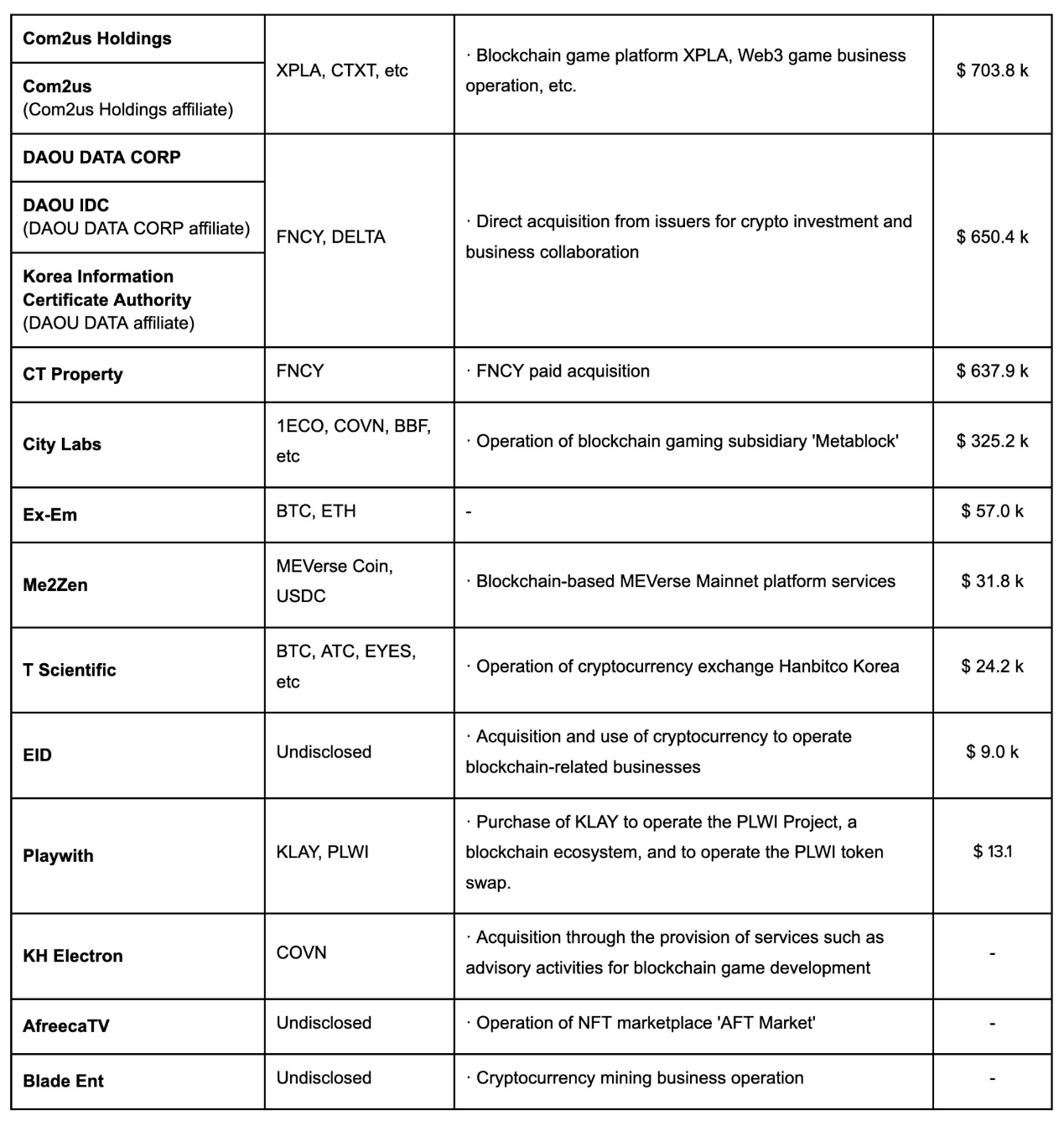 Cryptocurrency holdings of 29 listed companies in South Korea (excluding self-issuance), data source: each company
Types of cryptocurrencies held by South Korean listed companies
The top 10 cryptocurrencies held by South Korean listed companies are shown below. These companies mainly have the following three characteristics:
1. They directly issue or purchase cryptocurrencies to carry out their own blockchain business. Blockchain game-related cryptocurrencies such as WEMIX, BORA, and NEOPIN, mainly issued in South Korea, account for the largest holdings.
2. Approximately 51.7 billion won (approximately US$39.8 million) is invested in stablecoins such as USDC and USDT. These funds are either used as backup funds to fund blockchain projects through 1C0, or for marketing and commission purposes.
3. Cases of purchasing major cryptocurrencies such as Bitcoin and Ethereum for investment purposes have also been discovered.
Types of cryptocurrencies held by private companies
It has been confirmed that private companies also acquire and hold virtual assets and disclose them transparently through annual audit reports. Mainly Dunamu, Bithumb, Coinone, Cobit, Gopax (Streamy) and other companies operating virtual asset trading business. In addition, there are also companies that obtain a certain amount of cryptocurrency by logging into Web3 games on game platforms such as Gurobal Games and XL Games. Cryptocurrency investment companies like Uprise hold cryptocurrencies as investment assets, such as Bitcoin or Ethereum. Even among private companies, crypto assets are mainly held by companies that operate or plan to operate crypto-related businesses, such as gaming companies, investment companies, and IT-related companies. In addition, even if they do not directly operate cryptocurrency-related businesses, there are cases where they can obtain cryptocurrency by participating in Klaytn and XPLA mainnet validators.
in conclusion
Many Korean companies are acquiring and holding virtual assets and trying to disclose these assets through information disclosure. Despite these efforts, many companies continue to face difficulties due to the ambiguity of current accounting standards for virtual assets.
Furthermore, disclosure of virtual asset holdings is not yet mandatory. Many companies have not disclosed their virtual asset holdings or explained how they acquired virtual assets, which has further confused investors. However, starting next year, a new regulation will be in place requiring crypto asset holders to disclose the following information. From then on, public companies will be able to disclose their crypto asset holdings more transparently and create a safer investment environment. The information expected to be disclosed is as follows:
General information about virtual assets (name, characteristics, quantity, etc.)
Accounting policies applicable to virtual assets (account classification, cost and revaluation models, etc.)
Information on how to obtain virtual assets, acquisition costs, book value, market value, etc.
Virtual asset market value calculation information (exchange name, calculation time, etc.) and price fluctuation risks
Information about the nature of risks associated with holding virtual assets





