






Network Effects in Web3 Games: How Game Platforms Enhance Network Effects Through Token Incentives


Original Author: HIRAYAMA SHO
Translation: Lu Lu
Original Source: The SeeDAO
Summary: This article mainly discusses the application and impact of network effects in Web3 games, pointing out how emerging crypto game platforms create and leverage network effects through their own tokens and other interconnected projects; as well as the possibility of enhancing network effects through stage-specific token incentive strategies, and emphasizing the importance of community power and appropriate incentives in the strategic path from small-scale network effects to large-scale network effects.
Introduction
We collaborated with Animoca Brands' research team to study network effects in Web3 games. The aim is to propose more specific hypotheses about the network effects of Web3 products, building upon the close relationship we have previously discovered between products and token economics.
Overall, a structural challenge that Web3 products face is that it limits the utilization of network effects. Additionally, noteworthy is the fact that DeFi and Web3 games have different rules in terms of network effects and token economics to support their development.
The Evolution of Blockchain Games Away from Network Effects
Blockchain-based games, also known as GameFi, have only been around for about five years, but have already achieved various innovations, including the use of NFTs, creating speculative demand through reward redistribution mechanisms, and more sustainable mechanisms.
Due to their user-friendly interfaces, experiences, and financial incentives, Axie Infinity and STEPN have experienced explosive growth in their user bases. However, due to the sustainability issues of products relying solely on speculative demand, their subsequent products have attempted to minimize speculative dependence in order to achieve a healthier token economy.
We won't discuss the pros and cons of this change here, but completely eliminating its speculative nature has weakened one of GameFi's biggest advantages: its connection to the global network through the public chain. Speculation does not generate network effects, nor does it possess sustainability, but it has already become a global phenomenon. Furthermore, unlike DeFi, most existing games do not have composability, and interactions between people are primarily achieved through game content. Therefore, GameFi easily becomes a downgraded version of Web2 games.
How can we create a product that can distribute tokens without impacting user experience, achieve a customer acquisition cost (CAC) that is lower than the user's lifetime value (LTV), and grow autonomously beyond a certain threshold? The answer is network effects.
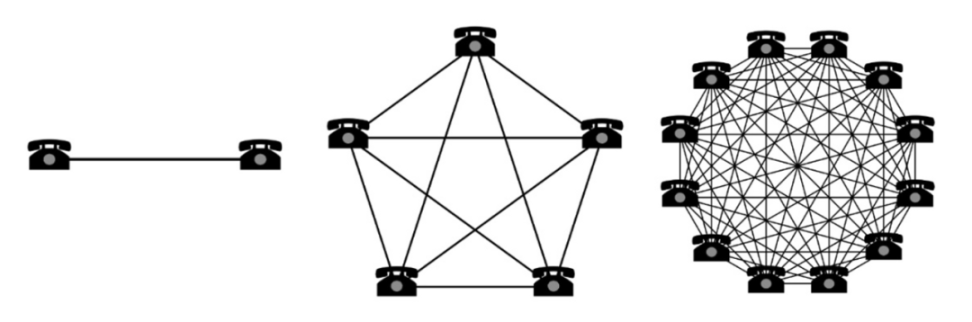
Network effects (Nfx) refer to the phenomenon where the value of a product or service increases as the number of its users increases. The more users a product has, the greater its value.
When discussing network effects, it is worth noting that there are multiple types of network effects, such as physical effects, protocol effects, platform effects, performance effects, etc. For more information, please refer to this article. Different network effects have different characteristics in terms of types, categories, and stages. For example, the old-fashioned telephone is an example that benefits from physical network effects, where users can only call others using the same network. If a person can reach everyone they want to contact through a single network, then having two telephone networks would be useless, as the value of a single telephone network increases with the increase in its usage. Due to its direct utility, people need physical terminals and lines to use it in their daily lives, resulting in high switching costs, and competitors must offer the same or better utility at 10 times or higher efficiency to replace it.
Take games as an example. As the number of users increases, the time required for matchmaking decreases, and the common topics of communication increase, creating a virtual society in the digital space, and the enjoyment of each user also increases.
What factors promote network effects (Nfx) in Web2 games?
In traditional gaming and technology fields, as well as in the Web2 era, the main factors that influence network effects (Nfx) include ease of use, quality, brand recognition, critical mass, complementary goods, and switching costs:
The ease of use and high quality of a product or service naturally attract and retain more users, as these advantages can be spread more quickly through word of mouth.
Brand recognition contributes to network effects as users are more inclined to use and talk about products or services from brands they are familiar with and trust. The strong brand of Coca-Cola has contributed to its success, as consumers naturally have better awareness and memory of its products, which helps spread them faster.
Critical mass - a network needs to reach a certain level of active users to be attractive to other potential users, thereby forming a positive feedback loop. After reaching critical mass, the network may grow rapidly and be widely adopted as more users join. For example, social media platforms like Facebook and Twitter are more valuable and interesting to users if enough friends and family are already using these platforms.
Complementary goods are products or services that are used together with a specific network or platform, making the network more attractive and encouraging user acquisition or retention, just like application software developed for a specific operating system adds more value to the system.
The conversion cost refers to the financial or non-financial costs incurred by users when switching from one network to another, which makes it unlikely for users to switch to competing networks, thereby helping to lock users into that network because they become less willing to give up tangible and intangible investments in a specific network.
How should Web3 games leverage network effects?
Web3 games often have limited budgets and imperfect interfaces and user experiences, so they must fully leverage the unique functions of public chains to attract users. Therefore, although they belong to the same category, the business models of Web2 games and Web3 games are different.
To delve deeper into this direction, let's consider a game-specific rollup that supports on-chain games with discrete mechanisms (all digital games are technically discrete, but here we focus on "actually discrete games such as card games and board games rather than shooter games and real-time strategy games).
The entire on-chain game stores all game logic on the blockchain. The reason for processing game logic on-chain is not only because it increases information transparency and platform fairness, but also because storing core components on-chain makes this logic composable and interoperable. We focus on games with discrete mechanisms here because the number of on-chain transactions required to represent game behavior is limited and controllable. In addition, thanks to zk technology, we can now support games like poker that require hiding certain information.
This roll-up solution has built-in features that can help game creators, including random number generation, information hiding, user performance-based ratings, and visibility of on-chain activities. Once the game has obtained a sufficient number of users in a region and formed network effects in that region, the user count can be increased by expanding to other regions. It should be noted that in synchronous games, network effects only affect users in the same time zone, but there is no geographical restriction for game creators who gain greater benefits by increasing the number of users.
Game developers, streamers, and tournament organizers receive native tokens of the roll-up based on their performance. They should be incentivized for their contribution to network effects, not just for playing games.
The importance of integrating multiple network effects into products
The main reason why Web3 projects, especially non-DeFi applications, cannot achieve scalability or self-sustainability (or both) lies in the product aspect. Many people focus on sustainable token economic models, but what really matters is the product itself. Although Web3 games can achieve most of the functions of Web2 games, they are largely "weakened" due to significant budget differences, limitations in user interfaces and experiences, and unreasonable designs for token integration.
nerf = weaken (usually used to balance a game)
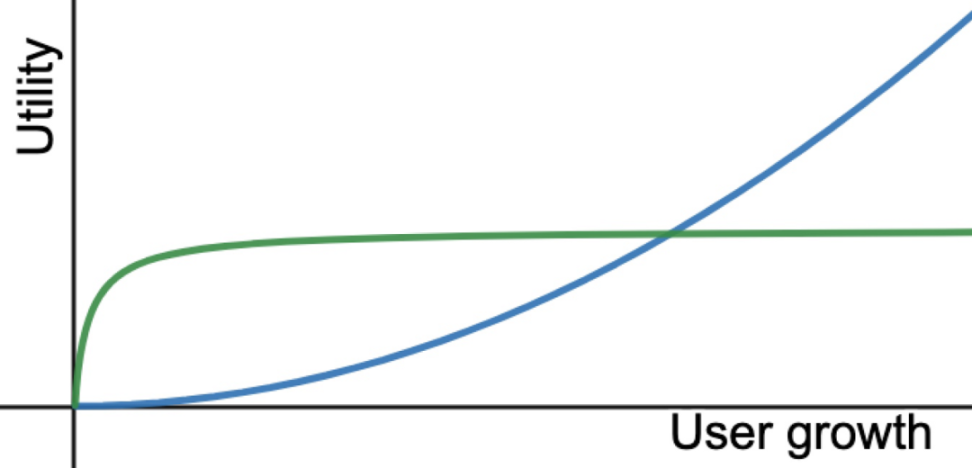
Many Web3 games lack network effects or only have the convergence network effect shown by the green line in the above picture. The green line represents a converging network effect. This effect initially results in significant utility growth but quickly diminishes to a certain value. For example, increasing the number of users in a region can reduce the time required for matchmaking. The utility growth from 10 seconds to 1 second is significant, but reducing it from 1 second to 0.1 second does not lead to a substantial increase in utility. The value of a product depends on the upper limit of its utility.
On the other hand, the blue line represents network effects formed by transaction formats required for geographically scalable products, token standards, and comprehensive ecosystems consisting of multiple games, as well as tools for building on-chain game logic and a new type of wallet that provides seamless user experience. These measures may not bring explosive growth in the short term but will have a compounded effect over time.
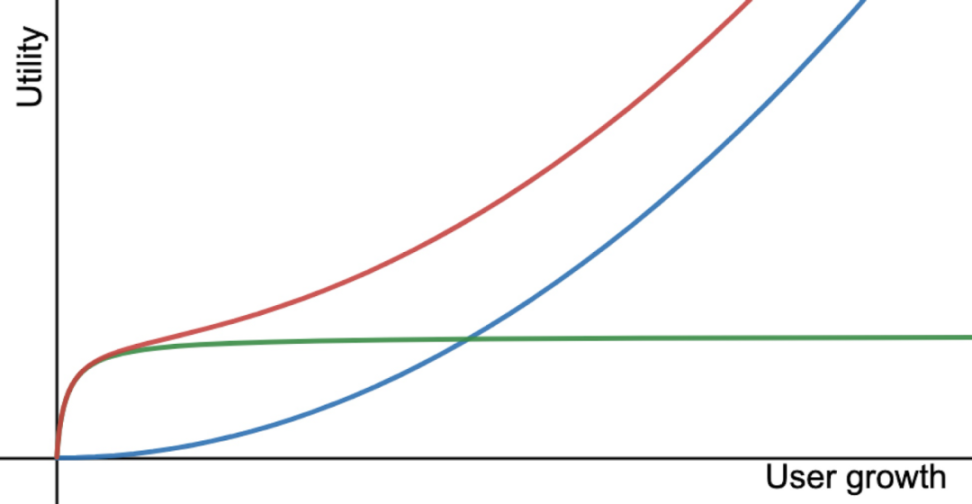
By integrating multiple network effects into a single product, both initial launch and long-term growth can be achieved. For example, industry-specific rollup operators of the aforementioned game initially must create their own games and organize competitions. However, as the number of users increases, a community will form where not only waiting time for games decreases but also more users are willing to substitute the operator to create games and organize competitions.
Case Study: Network Effects in Web3 Games
The Magical Power of $MAGIC in the TreasureDAO Ecosystem
Current Web3 games find it difficult to leverage network effects through their platforms, and popular games like Axie Infinity and STEPN have limited exposure in terms of network effects. However, the situation has begun to change as crypto game platforms shift towards creating multiple gateways and targeting multiple player groups with a single token.
TreasureDAO is a good example, where their $MAGIC token allows users to participate in some metaverse projects within the decentralized ecosystem on Arbitrum. As different projects on the platform utilize and are interconnected with the $MAGIC economy, each game acts as a complementary product, adding value to the TreasureDAO ecosystem, and network effects start to emerge.
TreasureDAO takes a bottom-up approach to create the metaverse, building a community by providing users with free game assets to attract more players, ultimately reaching the desired critical mass. Developers also put significant emphasis on cultural development while building games.
Artists and developers can fully utilize community resources, and players can enjoy enhanced gaming experiences. The design of $MAGIC also connects players from different games to the same community. Players can use $MAGIC to exchange assets between different games, which also has a powerful network effect of interoperability. In addition, an enhanced metaverse experience attracts more users, which in turn attracts more developers and provides better experiences. Over time, this cycle contributes to the development of the entire ecosystem.
The $MAGIC ecosystem protocol includes: Bridgeworld, Smolverse, Tales of Elleria, The Beacon, Battlefly, The lost donkey, Toadstool, Knights of the Ether, LifeVerse, Lost Samurise, and Realm.
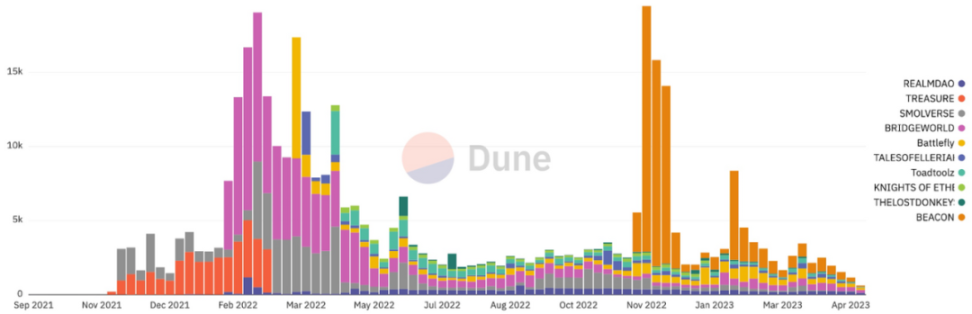
As shown in the above figure, the TreasureDAO ecosystem has shown great potential in the "one token, multiple game structure" aspect, but the influx of daily active users (DAU) brought by new games is only sufficient to compensate for the decrease in old game users. This means that the ecosystem has not fully achieved sustainable development.
Animoca Brands leverages its network effect by connecting multiple projects in its portfolio through shared liquidity pools and cross-project token rewards. Among them, the first NFT series supported by Animoca Brands, "Mocaverse," demonstrates this synergy by integrating multiple communities from other projects and subsidiaries within the Animoca ecosystem, enhancing its value.
In addition to the above examples, network effects can also be seen in the areas of EVM economic model region and tools, such as programming languages, development toolkits, node services, token standards, token issuance, and tools. Creating a new EVM chain will form a decentralized and interconnected ecosystem, which will generate a series of positive effects, such as multi-chain deployment of products, leveraging infrastructure on other chains, and increasing potential customers for developers on different chains.
Unlike EVM-compatible Layer 1 implementations for horizontal scalability, roll-up-based EVM-compatible Layer 2 solutions provide vertical scalability. Although there are differences in the economic models at the protocol layer, both are equally effective for applications like games. Furthermore, due to the strong influence of each chain and roll-up in specific regions and different user perceptions, the same strategy of extending atomic networks to other areas, which Uber uses to expand its services, can enhance network effects.
Imagining the Future Token Economic Model
Token incentives for specific stages or goals
As DeFi and GameFi products flood the market, management teams need to find opportunities to build user communities in order to benefit from the growing network effects. One common approach is to use phased token incentive measures to attract the participation of an initial user base.
In these incentive schemes, maintaining a proper balance is crucial to fully motivate early users until the product is mature enough to attract a wider audience. During this period, token incentives should be managed cautiously to avoid issues related to unsustainable economic models.
While there may be different opinions, certain product categories do not require excessive decentralization, and token design should not be immutable. For example, a fixed token issuance plan means that the management team cannot change their strategy based on the evolving environment. In contrast to some emerging DeFi products, these products attract users by allocating a fixed budget as token incentives in the initial stage, requiring payment or purchase of items as conditions to acquire tokens, and then transferring the proceeds to the treasury.
For gaming platforms, compared to DeFi, they offer a greater variety of utility tools, so the token incentive mechanism needs to be adjusted based on the platform's development. Initially, gameplays and cooperation within the community can be incentivized through liquidity token rewards. As the platform grows, it becomes crucial to regulate these rewards to maintain a stable ecosystem.
By seeking alternative strategies in the later stages of a game's lifecycle, managers can encourage participation in competitions, innovative game development, and intense leaderboard competitions through different scales of token rewards (or even without relying completely on token-based rewards).
The evolution of network effects from small scale to large scale
As the title suggests, utilizing more small-scale network effects requires developing a strategy. For example, when Uber has a certain number of drivers in a city, the benefits gained from adding more drivers become minimal. Therefore, it is necessary to understand how to first expand the network to achieve small-scale network effects, and then use several small-scale network effects to facilitate larger-scale network effects, ensuring the project's sustainable development.
We have seen this trend in horizontal expansion models of multiple small networks (such as Uber, Tinder) and vertical expansion models of individual large networks (such as telephone, identity recognition).
These trends are also evident in the GameFi field, as seen in approaches attempted by Axie Infinity and STEPN, which first drive progressive network effects through token incentives tailored to each game. In contrast, TreasureDAO leverages small-scale networks within the platform to facilitate the expansion of the ecosystem of tokens ($MAGIC) at the platform level.
For the cryptocurrency industry, there is another alternative method to stimulate early network effects within its community. When companies expand the primary player base of a game through token incentives, a blueprint emerges whereby GameFi enterprises can utilize existing communities to gradually expand from small to large scale. This provides GameFi companies with a new pathway to quickly accumulate network effect advantages and ultimately expand their products.
In the upcoming game Legends of Mara developed by Yuga Labs, this point is well demonstrated. They are using the Otherside series NFTs in the game. Previously, Yuga Labs has received strong support from the community through Bored Ape Yacht Club and its subsequent series. They leverage this to establish a user base in the early stages of Legends of Mara and ultimately expand its influence through network effects.
Therefore, to create a successful product, we must consider the scale of network effects we want to achieve. For sustainable development of the product, governance and token issuance must be flexible and distinct from the outdated models of immutable token design.
Summary
There is no doubt that Web3 games have enormous potential. However, managers must fully leverage network effects to achieve efficient growth, while not overlooking the importance of sustainable token economics for long-term success. The success of existing Web2 projects and how they cleverly utilize network effects to scale operations provide valuable experiences and lessons. With the continuous development of GameFi, if executed correctly, it will provide substantial benefits for users.
Therefore, for product owners, designing games based on a strong community and proper incentives is crucial to achieving exceptional expansion through network effects.





