






Is forced replacement of NFT digital collections legal?


Original author: Liu Honglin, lawyer and founder of Shanghai Mankun Law Firm

Decomposition, synthesis, substitution... Users of digital collectibles may have been "confused" by the activities launched by the platform. It's interesting to note that any digital collectibles platform that has opened a consignment market will always find ways to "mess around" with the issued collectibles. Platform users also need to constantly pay attention to the changes in collectibles. If they are not careful, either the collectibles have been forcibly automatically replaced, or the collectibles have already entered the "collection area".
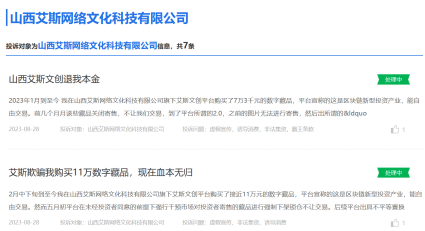
Many popular digital collectibles platforms in the market have caused waves due to collectibles replacement activities; and some smaller platforms have directly ignited user emotions, leading to destructive turbulence. By checking the complaint platforms of "Hei Mao" and "ZhuoMuNiao", you can see a lot of complaint information about collectibles replacement.
Today, let's talk about the matter of digital collectibles replacement.



01 Reasons for the replacement of digital collectibles
Since the replacement of collectibles easily triggers collective user events, why do digital collectibles platforms, which depend on user stickiness and value consensus for their survival, still "knowing that there are tigers in the mountains, but still heading towards the mountains of tigers," insist on carrying out collectibles replacement activities? Preliminary analysis suggests that there may be several reasons for this.
Specific collectibles repurchase
The empowerment of collectibles designed by the Numerical Collection platform may not be reasonable initially to gain attention or fulfill other activity requirements. As the platform develops, it becomes increasingly concerned about the realization of empowerment for historical collectibles. Not fulfilling them directly would lead to user complaints, while persistently fulfilling them would be quite difficult or may result in a loss-making business.
In the dilemma between advancing and retreating, one solution is to exchange and recycle these types of collectibles.
Platform Positioning Adjustment
Due to various types of collectibles, mixed classification, and lack of prominent value points, the Numerical Collection platform will reorganize the value system of collectibles and enhance their value, aiming at users and collectibles to ensure a healthy cycle between series. For example, in the announcement of Ten Eight Numerical Collection in March this year, it was mentioned that "almost all collectibles will be split and gradually released for trading to achieve a certain supply-demand relationship."
Consignment and Circulation Needs
In terms of profitability, aside from the income generated from introducing new collectibles, the Numerical Collection platform mainly relies on transaction fees from the market (although some platforms have directly relinquished income from introducing new collectibles). The revenue from transaction fees depends on the value and circulation of the collectibles. Supply and demand naturally create a market. Although the value of collectibles lies in the consensus among users, establishing this consensus also requires certain incentives and opportunities. Relying solely on IP linkage and artistic empowerment, and waiting for the market to develop freely, is clearly insufficient.
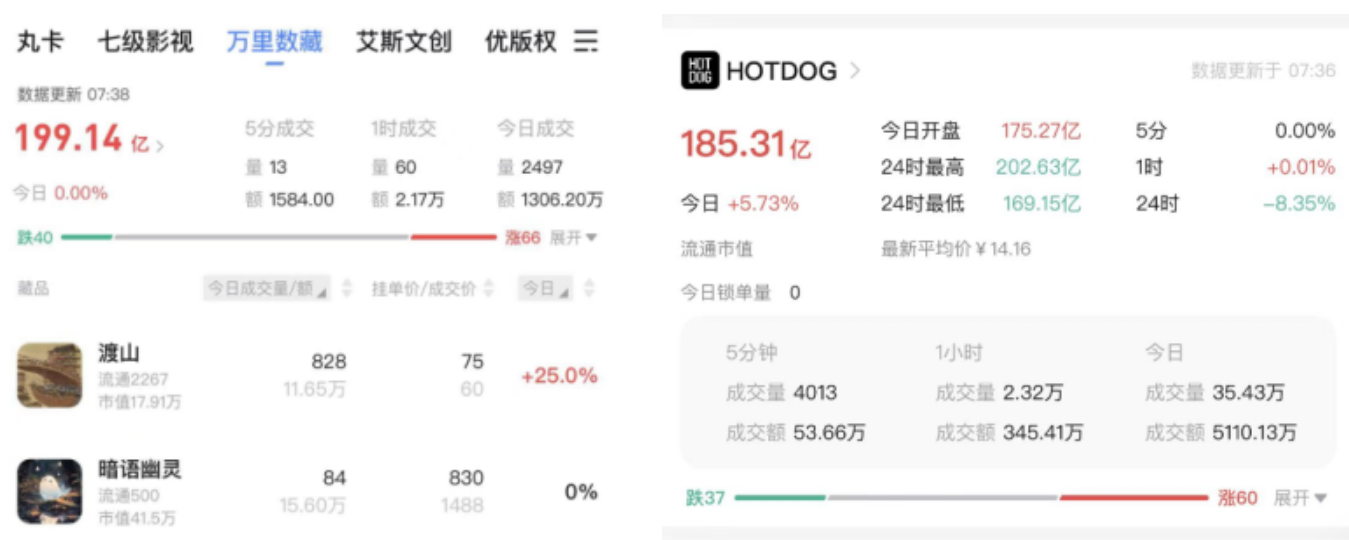
Therefore, the platform continuously creates new popular collectibles and consistently "influences" users to participate. Users not only need to exchange their existing A collectibles for B collectibles but also purchase newly released C collectibles in order to form the popular D series. By doing so, the platform successfully activates the transaction volume in the consignment market.
02 Types of Digital Collectible Exchanges
The way in which the number hidden platform implements the collection exchange activities in the market can be divided into the following two types from the perspective of users' subjective intentions:
Forced Type
After the number hiding platform issues an announcement, it directly replaces all the collections in the user's hands in the background after a certain period of time, and the user has no choice; moreover, the number hiding platform does not even leave a reasonable notice period, and does not inform the user in advance that the exchange activity is about to start.
Voluntary Type
The number hiding platform informs users in advance that they have the right to choose whether to exchange, and conveys through explicit and implicit means that the old images that are not exchanged will go to jail, so the majority of users choose to agree to the exchange.
Some number hiding platforms have even more comprehensive practices, which is to organize a user vote before launching the exchange activity to decide whether to start the exchange activity based on the voting results.
03 Collection Exchange Legal Analysis
After discussing the reasons for the collection exchange and the types of exchange activities, the following two questions are worth discussing: Does the platform have the right to forcibly exchange user's collections? In the user agreement, does the authorized agreement to exchange allow for 100% exemption from liability?
Digitized collections have property value
There is still no clear definition for the specific legal attributes of digital collections. The viewpoints within the academic community, such as the debt rights theory, property rights theory, rights certificate theory, and intellectual property theory, all have their merits.
Although the legal attributes are not clear, in a case involving a dispute over an information network purchase and sale contract triggered by a digital collection transaction that was heard by the Hangzhou Internet Court, the property value of digital collections was affirmed.
The court believes that "digital collectibles have the characteristics of value, scarcity, disposability, and tradability as property rights objects, and also have the specific attributes of virtual property in the network, such as virtuality and technicality, and belong to virtual property in the network" as stipulated in Article 127 of the Civil Code. This also lays the foundation for the protection of virtual property. "The law has regulations for the protection of data and virtual property in the network, and shall be implemented according to these regulations."
Does the platform have the right to force the replacement of collectibles?
The aforementioned judgment states that "the transaction in question is conducted through internet information, and digital collectibles belong to virtual property in the network, falling within the category of digital goods. Therefore, the transaction in question is the operational activity of selling digital goods through internet information, falling within the scope of e-commerce and subject to regulation under the Electronic Commerce Law."
According to Article 34 of the Electronic Commerce Law, the operator of an e-commerce platform, when modifying the platform service agreement and transaction rules, should publicly solicit opinions in a conspicuous position on the homepage and take reasonable measures to ensure that relevant parties can express their opinions in a timely and sufficient manner. The modified content should be publicized at least seven days before implementation. If an operator within the platform refuses to accept the modified content and requests to exit the platform, the operator of the e-commerce platform shall not obstruct and shall assume relevant responsibilities in accordance with the service agreement and transaction rules prior to the modification.
Therefore, digital collectibles as a new type of virtual property in the network, as the object of the transaction between the two parties, should be protected by Chinese law.
According to the provisions of the Civil Code, once a contract is concluded, it has binding force on both parties. Neither party may unilaterally change the content of the contract. Moreover, once the user obtains the digital collectibles, it should be considered as completed delivery, and the actual performance of the buy-sell contract between the two parties has already taken place. If the platform replaces the collectibles under the user's name without the user's permission, it may involve infringement of the user's property rights and interests.
Furthermore, as digital collectibles rely on blockchain technology, their transaction information can be traced and cannot be tampered with, making the calculation of losses due to breach of contract more accurate and convenient compared to general buy-sell contract disputes.
In the user agreement, does authorization and consent for replacement provide 100% indemnity?
In voluntary collectible replacement activities, the digital collectibles platform gives users a certain degree of autonomy in their choices, and the user's second manual confirmation and consent to the replacement substantially reduces the risk of the platform infringing upon their property rights and interests.
In the agreements confirmed by the user, the digital collectibles platform often uses the "Replacement Agreement" and "Disclaimer Clause" in combination. The terms of the agreement also attempt to exclude or reduce the platform's liability by using wording such as "at one's own risk" and "not related to the platform."
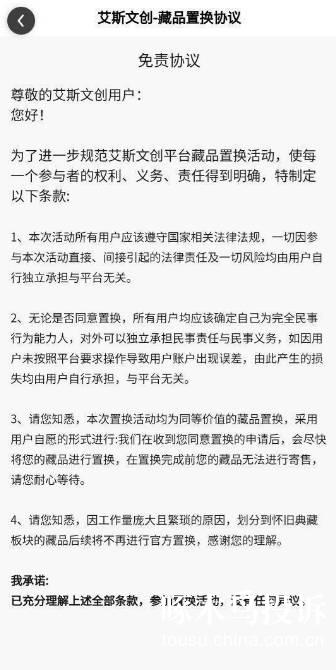
However, the user's authorization to agree to the exchange of collections does not necessarily mean that the "Exchange Agreement" and "Disclaimer" are fully lawful and effective.
According to Article 496 of the Civil Code, when a contract is entered into using standard terms, the party providing the standard terms should adhere to the principle of fairness in determining the rights and obligations between the parties, and should reasonably bring to the attention of the other party any provisions that exempt or reduce liability or any other provisions that have a significant impact on the other party's interests, and explain such provisions upon request. If the party providing the standard terms fails to fulfill the obligation to bring to attention or explain, causing the other party to fail to notice or understand provisions that have a significant impact on its interests, the other party may assert that such provisions are not part of the contract.
According to Article 497 of the Civil Code, if one party providing standard terms unreasonably exempts or reduces its liability, increases the other party's liability, restricts the other party's main rights, or excludes the other party's main rights, the standard terms shall be invalid.
Therefore, in this context, even if the user agrees to participate in the platform's exchange activities, the platform needs to pay attention to the following:
① In the design of exchange activities, user rights should still be safeguarded. First, it is recommended that the platform adhere to the core value of digital collectibles and maintain their non-fungible characteristics, avoiding weakening the non-fungible characteristics of collectibles through division of ownership or mass creation, and avoiding situations where the issuance of individual exchanged collectibles reaches tens of millions or even hundreds of millions. Second, it is recommended that the platform ensure the equivalent value of collectibles before and after the exchange, to avoid damaging the user's property rights.
② In the content of the exchange agreement, the platform should adhere to the principle of fairness and reasonably determine the rights and obligations provisions in the exchange agreement based on legitimacy and reasonableness. For important provisions, users should be reminded by means such as bolding, highlighting, and underlining.
04 Conclusion
In conclusion, the exchange activities have emerged in the domestic digital collectibles industry demand and are becoming increasingly popular. However, some platforms, while using it to boost market value, have further intensified the contradictions between the platform and users.
In order to prevent running along with problems, we hope that platforms can comprehensively consider the realistic needs of digital collectibles platform operation, management, and protection of user rights, pay attention to compliance, and develop steadily, contributing to the vigorous development of the digital collectibles industry.
Special statement:
This article is an original article from Shanghai Mankun Law Firm, representing the personal views of the author and does not constitute legal advice or legal opinions on specific matters. For reprinting of the article, please contact Mankun Law Firm staff: MankunLawFirm





