


Renowned Financial Analyst: Four Misconceptions for Traditional Investors Transitioning to Cryptocurrency Investment


Original title: "A Little Bit About..."
Source: SAM ANDREW, substack
Translation: Kate, Marsbit
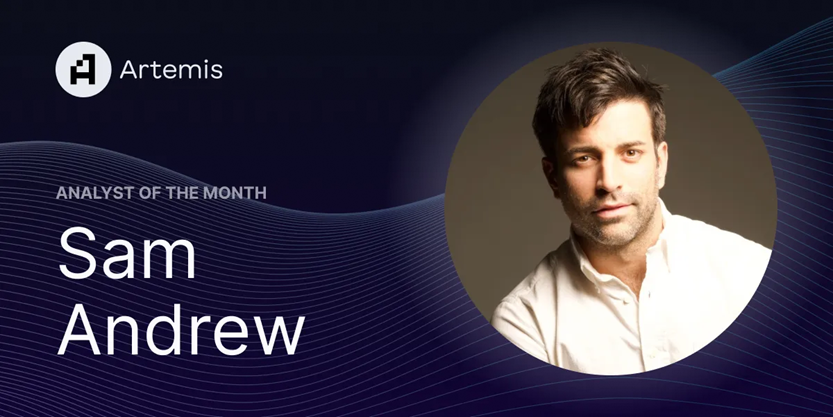
Former hedge fund analyst Sam Andrew made it onto the Artemis Monthly Analyst List. Sam has over 8 years of experience in financial analysis, having worked at Credit Suisse and hedge fund Blue Mountain Capital. In this article, Sam shares four misconceptions about traditional investors transitioning into crypto investments, three key aspects of crypto fundamentals, and his perspectives on crypto investment themes. He also provides his advice to newcomers interested in entering the crypto investment space. This experience-packed conversation is worth a read. Below is the translated full text:
I made it onto this month's analyst list at Artemis. My conversation with Artemis founder Jon Ma covers personal, investment, and cryptocurrency topics. Our discussion provides more insight into my background, which some Crypto Clarity readers have inquired about.
I'll explain my crypto journey and share how I apply frameworks from my hedge fund experience to cryptocurrencies. I outline misconceptions that most tradefi investors have about cryptocurrencies. I also share more thoughts on the importance of crypto fundamentals. We wrap it up with interesting topics and general advice.
Below is my interview with Jon Ma, from "Artemis Monthly Analyst List".
What is your story? How did you get into the investment and crypto field?
I grew up in Toronto, Canada. When I was in my teens, my grandfather introduced me to the financial markets and investing. He was a World War II veteran who spent most of his life working in a factory, and later taught himself about investing. I was fascinated! The idea that I could make bets and earn money based on my own experiences was exciting. At the same time, I realized I wouldn't become a professional hockey player, so I thought it would be best to pursue something else!
I entered the investment banking industry due to my interest in investments and financial markets. I work at Credit Suisse Bank in London, UK. The banking industry serves as a stepping stone for the buy-side. After completing a two-year banking analyst program, I joined the hedge fund BlueMountain Capital. I spent over 8 years at BlueMountain. I worked in London for three years, primarily focusing on credit investments. I was then transferred to the company's headquarters in New York, where I spent over 5 years involved in the firm's long-short equity strategies. I was fortunate to join a great company in its early stages. The firm's managed capital grew from $3 billion to $22 billion.
I first ventured into cryptocurrencies in 2017. The potential of Bitcoin as a seamless peer-to-peer currency exchange and the programmability of Ethereum resonated with me. From my perspective, there are numerous potential use cases in the financial markets. I bought my first BTC and ETH. I experienced the bull market and subsequent crash. Over the years, I've maintained an interest in cryptocurrencies to satisfy my curiosity. But it took a few more years for me to fully immerse myself in the crypto space.
The belief to dedicate all my time to cryptocurrencies is driven by personal and professional motivations. On a personal level, being part of a rapidly evolving disruptive industry, where I can take a leadership role and help develop a potentially revolutionary technology, is too compelling to ignore. From a professional standpoint, cryptocurrencies present the most fertile investment landscape. It is the only market that is both inefficient and illiquid. It reminds me of the stock market decades ago when investment legends were just starting to emerge.
You spent over 8 years as a hedge fund analyst at BlueMountain. What frameworks and experiences did you learn from the buy-side that are applicable when evaluating crypto assets?
I have summarized four key experiences applicable to cryptocurrency investments from my hedge fund experience:
1. Time Management: The most important skill as an investor is effective time management. There is an endless amount of research to be done. Timely returns and capital returns are equally important. The ability to quickly judge what is interesting and why it is interesting is crucial. Focus research on the factors driving asset prices. Prioritize the research.
2. Source of Returns: Excess returns, often referred to as alpha, are the result of you diverging from market expectations. Most investors get it wrong. Investors need to believe in one outcome while the market believes in another. If the market starts to believe in your outcome, it will drive asset prices and generate excess returns.
3. Paper-Driven Investing: Investment papers are rooted in in-depth independent research that includes 3 to 5 principles unknown to the market, which will change the market's perception of an asset. The result of paper-driven investing is a differentiated view.
4. Risk Management: The correct probability of an excellent investor is only slightly higher than their incorrect probability. The true driving factor behind portfolio returns is position sizing. Those that you get right, you have a larger position. Manage position size accordingly. Investors need to find a balance between the courage of strong beliefs and the humility of making mistakes.
Where do you think traditional financial investors researching cryptocurrencies often go wrong?
When researching cryptocurrencies, traditional investors typically fail to understand four things:
1. Business Models: Cryptographic protocols and applications sell products in a fee-based manner and generate revenue from it. This fundamental principle is no different from any other business. Non-crypto investors are interested in i) the term "cryptocurrency," ii) non-legal tender units, and iii) value appreciation. Most tokens are not currencies. It is unnecessary confusion to mix up tokens and currencies. Introducing a new accounting unit is a paradigm shift. People find it difficult to understand this, weakening their existing perspective that fiat currency is the only gauge of value. The appreciation of cryptocurrencies is not as straightforward as owning stocks. This difference is primarily due to regulation. I expect cryptocurrency appreciation to become standardized.
2. Operational Leverage: Cryptographic protocols have already become and have the potential to be highly profitable. They have what traditional investors call operational leverage. Their costs do not increase proportionally with revenue. Traditional investors misunderstand the profit potential when revenues grow.
3. Durability: Durability of a company, also known as competitive advantage or moat, comes from its intellectual property, brand, network effects, or regulatory capture. However, in cryptocurrencies, ownership of intellectual property does not exist. Cryptocurrencies are open-source. Code is copied and used to create new versions of existing protocols. Therefore, the durability enjoyed by enterprises does not apply to cryptocurrencies. Traditional investors avoid them due to the lack of a moat. They misunderstand that moats can still exist without owning intellectual property. The moat lies in the network effects of the protocol.
4. Valuation: Valuing cryptocurrencies is difficult. There is no universally accepted way to assess the value of tokens. As a result, traditional finance investors mistakenly view cryptocurrencies primarily as speculative assets. There are many methods that can be used for valuation triangulation. I believe most protocols will be regarded as productive assets with token-equivalent cash flows. A small portion of tokens will also have properties of value storage assets.
We really like your research on Crypto Clarity. We enjoyed hosting "Crypto Fundamental Investment" on Twitter and your article "Crypto Fundamentals Don't Matter… Or Do They?" So, are fundamentals important for cryptocurrencies? When do you think fundamentals will become more important?
The importance of fundamentals reflects an adoption curve. Fundamentals were not important in the early days of cryptocurrencies. They are more important now. They will become even more important in the future.
Fundamentals are becoming increasingly important because:
1. Metrics Exist: DeFi summer saw the birth of many applications and the emergence of metrics to track, including developer activity, network usage, fees, and costs. These metrics did not exist before. There is no fundamental analysis without metrics.
2. Capital Formation: Cryptocurrencies are becoming increasingly important globally. The growth and adoption of the industry require funding. When investors are able to assess the projects they invest in effectively and predict their value, they are more willing to allocate capital.
3. Historical Analogy: The crypto market is similar to the stock market decades ago. Fundamental analysis of stocks has become increasingly popular over the past few decades. As the market matures and becomes more complex, understanding and monitoring the fundamentals becomes more important. The same pattern applies to stocks, credit, and commodity markets. Cryptocurrencies will be no different.
I believe regulation could be a turning point for the fundamentals of cryptocurrencies. Increasing confidence and integrity in the crypto market will pave the way for more investors to enter. They will apply what they are best at, fundamental analysis.
What are the crypto topics you are currently researching or interested in?
In a low-volume market post-FTX, catalysts are crucial. Fundamental whitepaper underwriting investments and catalyst-driven position sizing are essential. I believe the two biggest catalysts next year, outside of macroeconomics, are EIP-4844 and Bitcoin halving. I've spent a lot of time on both.
What advice do you have to share for new investors looking to enter the crypto fundamentals investment field in 2023?
It's useful. This goes far beyond the scope of fundamental investment in 2023. Cryptocurrency is not an industry for experts. In fact, it doesn't matter that you haven't been involved in the crypto industry in the past decade because no one has. Things change so quickly that insights from two years ago are no longer as applicable today. So you're not much behind those already in this industry.
When I started writing Crypto Clarity, I had three goals: I) to improve my knowledge, II) to share that knowledge with others, and III) to leverage my knowledge and value to provide cryptocurrency investments for others. If you provide value to others, you'll also receive returns.
How do you use Artemis in your fundamental research?
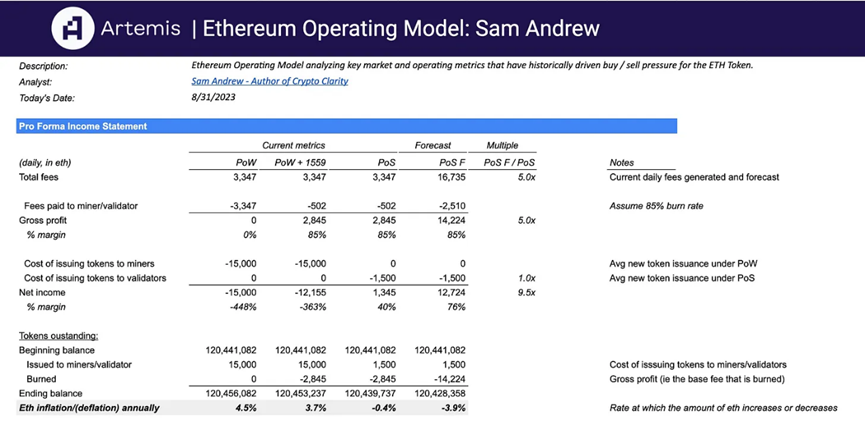
Artemis is the tool I use most often. Browse through the 50+ articles I published last year. Artemis has the widest range of sources. Artemis is the tool I use to extract chain data and easily compare protocol metrics. I also use it to create dashboards and models in Excel and Google Sheets, with the ability to update with just one click. Check out the Ethereum template I built on the Artemis sample template.
Stay curious.





