


PSE Trading: The battle for the cross-chain throne


Original Author: PSE Trading Analyst @Daniel Flower
In the blockchain world, each network can be seen as an independent ecosystem with its own native assets, communication rules, and so on. However, this feature also makes it impossible for different blockchains to communicate with each other, preventing the free flow of assets and information. Therefore, the concept of cross-chain interoperability has emerged.
1. The Significance and Use Cases of Cross-Chain Interoperability
Defi is the core and foundation of the blockchain today, but it faces many challenges such as fragmented liquidity, insufficient depth of asset pools, and low capital utilization. The emergence of cross-chain interoperability protocols can integrate assets from different chains into a unified smart contract, maximizing user experience and capital utilization. In ideal circumstances, cross-chain interoperability protocols can reduce friction to zero.
For example:
Put assets from the OP chain into GMX on the ARB chain to increase liquidity depth
Put assets from the OP chain into Compound on ARB for collateralized borrowing and lending
Enable cross-chain transfer of NFT assets
In addition to the financial aspect, information transfer is also crucial. For example, cross-chain voting to support important proposals, data transfer between social dapps, etc. If Defi opened the door to the world of cryptocurrency, cross-chain interoperability protocols are the essential path to success!
2. There are Four Types of Cross-Chain Interoperability Protocols
2.1 Validation Based on Nodes or Third-Party Networks (First Type)
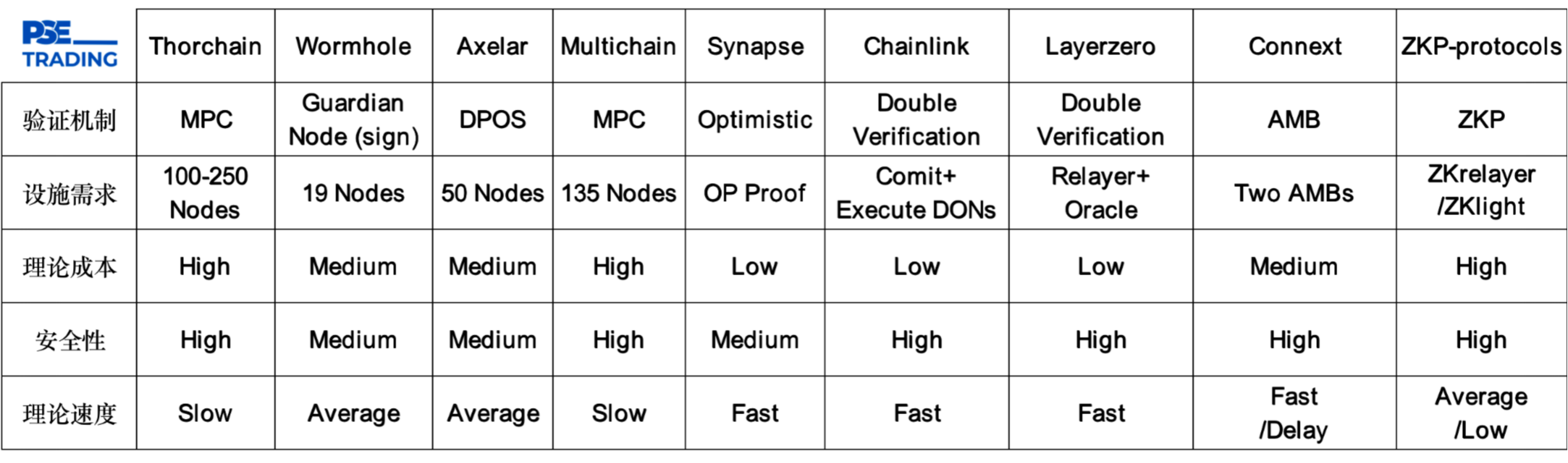
The most primitive cross-chain protocols use MPC (Multi-Party Computation) for transaction validation. Thorchain is a typical representative that deploys nodes on the chain to verify transactions and establish security standards. Typically, this protocol attracts 100-250 node validators on the network. However, the disadvantage of this approach is that each node needs to validate the transactions, resulting in longer wait times for users. In addition, the operational costs of the nodes cannot be overlooked, and eventually, they are passed on to the users. Furthermore, Thorchain sets up a Liquidity Pool for each trading pair, using the project's native token RUNE. Every cross-asset transaction requires converting the assets into RUNE and then into the target chain's assets. This model requires significant funding support and incurs friction. In the long term, this is not the optimal solution for cross-chain protocols. Tips: Thorchain was attacked due to code vulnerabilities (fake ETH symbols being treated as real ETH symbols), which is unrelated to the security of the validation method.
2.1.2 Improvement
Based on this change: Wormhole selects 19 Validators to verify the authenticity of transactions, including well-known Validators such as Jump crypto. These Validators also run verification businesses on other networks such as ETH and OP. However, this method bears the risk of excessive centralization. The author believes that complete decentralization may not always be the best choice, as some degree of centralized management can reduce costs. Ultimately, the project must achieve large-scale adoption and maximize economic benefits. Tips: Wormhole was attacked due to contract vulnerabilities, where attackers used external contracts to validate transactions and steal assets, unrelated to the security of its own validation.
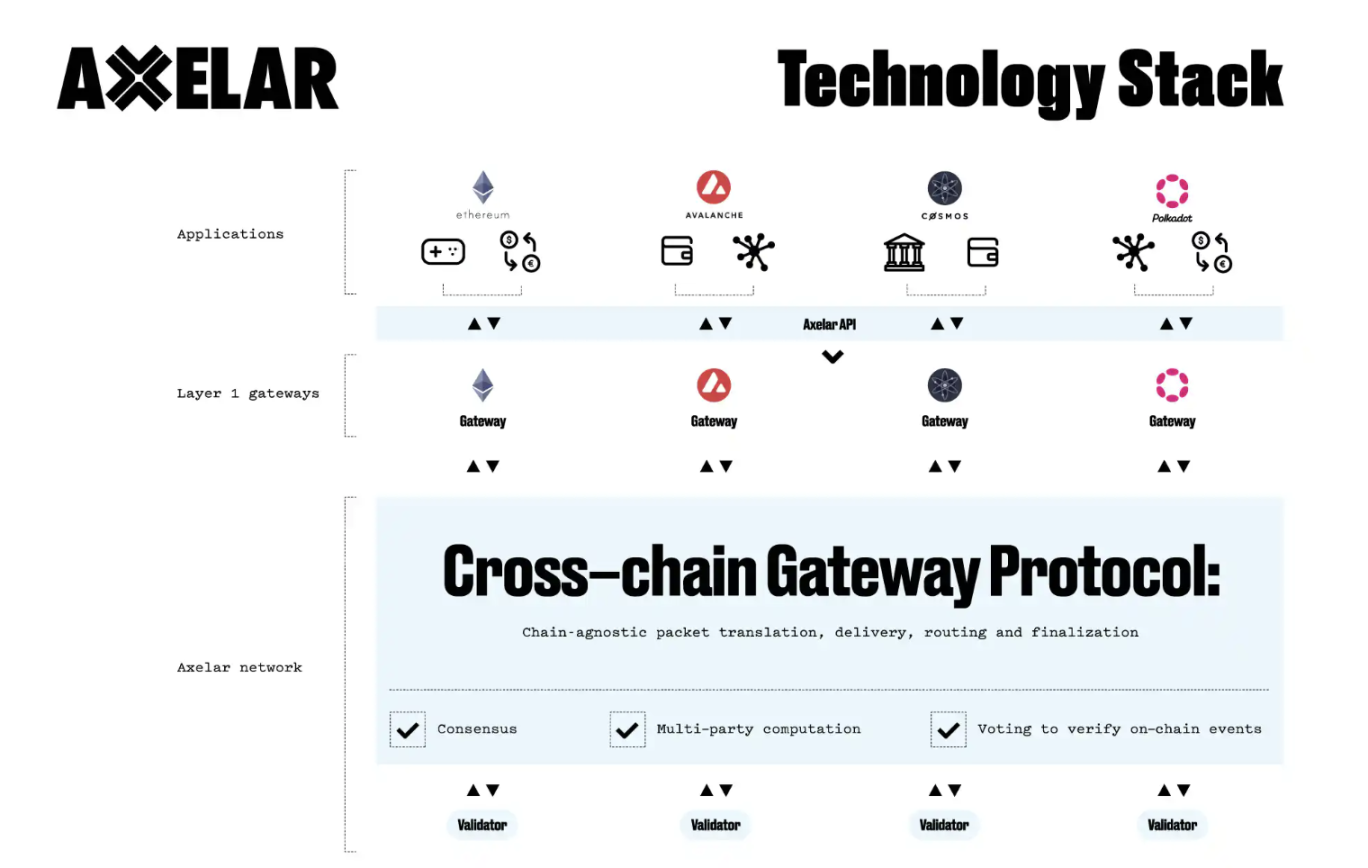
Compared to other cross-chain protocols, Axelar is a POS-based public chain. Axelar packages verification information from other networks and sends them to its own mainnet for validation before sending them to the target chain. It is worth noting that verification costs and security are inversely proportional. As the number of verification information increases, more nodes are needed to participate in verification and maintain network security. Theoretically, there is no upper limit on the number of nodes. However, an increase in the number of nodes will cause a surge in transaction costs, posing a challenge for Axelar in the future.
2.2 Optimistic Verification (Second Type)
The success of OP represents the current security, low cost, and speed advantages of optimistic verification. Therefore, cross-chain protocols like Synapse also adopt this verification mode. However, Synapse uses the Lock/Mint method to exchange assets, which carries the risk of being attacked by hackers. The author will explain the reasons in 2.3.1. In addition, optimistic verification can only meet current needs, and in the future, a more secure and reliable verification method will be required while maintaining speed and cost advantages. The author will now introduce dual verification to replace optimistic verification.
2.3 Dual Verification (Third Type)
The most prominent dual verification protocols in the market are Layerzero and Chainlink. In conclusion, the author believes that dual verification has the most promising development prospects in the current cross-chain protocol field, surpassing other protocols in terms of security, speed, and response time.
(1) Layerzero
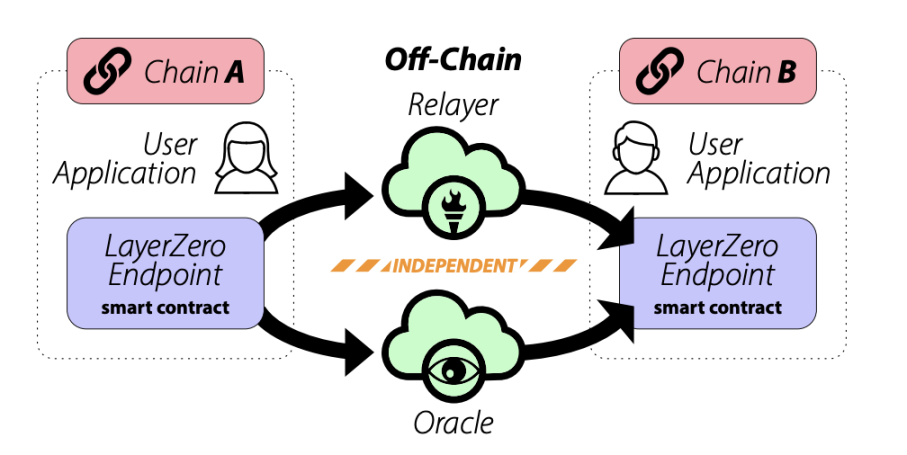
One of Layerzero's innovations is deploying ultra-light nodes on various chains to transmit data to Off-chain Relayers and Oracles (provided by Chainlink) for verification. Compared to the first type of protocol, it avoids heavy computational tasks. Oracles generate block headers and other information, while Relayers verify the authenticity of transactions. Transactions are only allowed to proceed when both elements are error-free. It is important to emphasize that both operate independently, and hackers can only steal assets if they control both the Relayer and Oracle simultaneously. Compared to optimistic verification, dual verification offers higher security because it verifies each transaction.
Cost and Security Advantages: The author conducted experiments with Stargate (using Layerzero technology)
1) From OP to ARB takes 1 minute to complete the transaction - $1.46
2) From OP to BSC takes 1 minute to complete the transaction - $0.77
3) From OP to ETH takes 1 minute and 30 seconds to complete the transaction - $11.42
In summary, the dual-validation mode is in an absolute leading position.
(2) Chainlink
Committing DON collects transaction information, and the target chain ARM collects information from the source chain ARM to reshape the Merkle tree and compare it with the Merkle tree of Committing DON. After a certain number of nodes successfully 'verify', the transaction will be submitted to Executing DON for execution, and vice versa. Note: ARM is an independent system. The technology used by Chainlink is similar to Layerzero, with a similarity rate of 90%, both using the "collect information + verify information (verify each transaction)" mode.
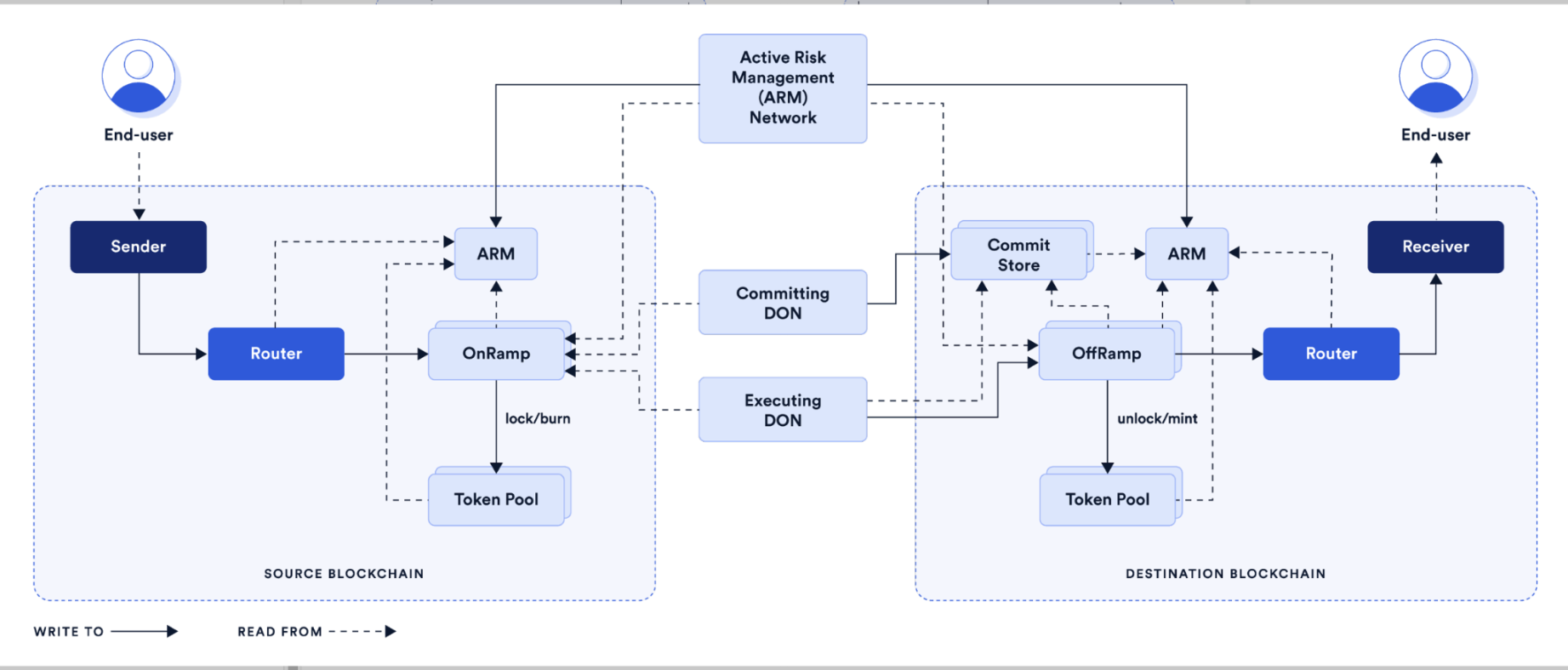
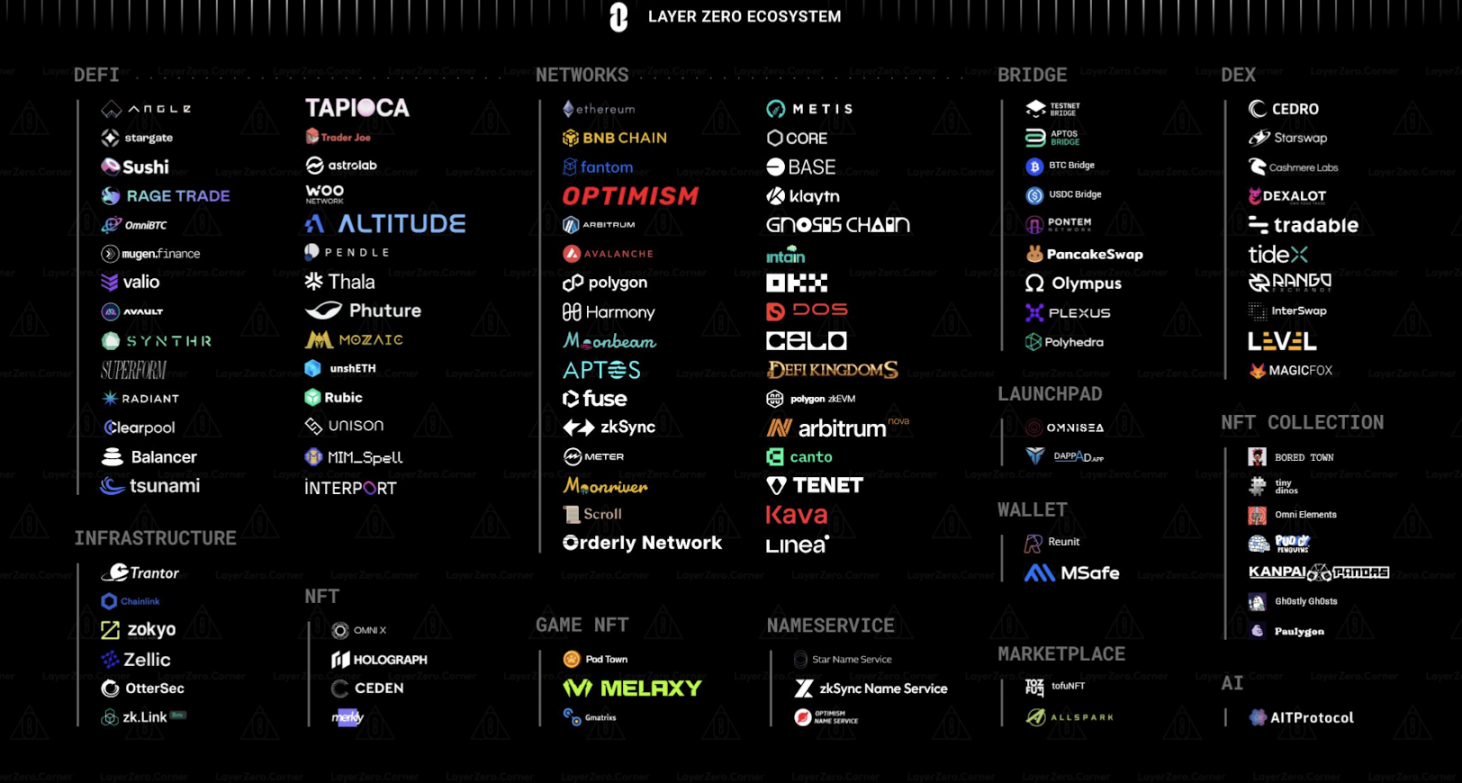
Currently, Chainlink supports projects such as Synthetix (cross-chain transfer of sUSD) and Aave (cross-chain governance voting). From a security perspective, although ARM and Executing DON belong to two different systems, they are both controlled by Chainlink itself, which may involve self-plundering. In addition, under the same technology, Chainlink is more likely to attract old projects with deep collaboration to use this service and achieve bundling. Layerzero, on the other hand, is more likely to attract new projects for deployment, but from the perspective of supported networks and ecosystems, Layerzero has the upper hand. In addition, project owners generally hope to deploy their products on popular ecosystems.
2.3.1 The Impossible Triangle of Layerzero
Safety: There are four ways to transfer assets across chains
1) Lock/Mint: The cross-chain protocol will deploy a fund pool in each network. When users want to transfer ETH from Chain A to Chain B, they need to lock the ETH on Chain A and mint an equal amount of wETH on Chain B. When returning from Chain B to Chain A, the wETH will be destroyed, and the ETH on Chain A will be unlocked. The risk of this approach is that the security depends entirely on the cross-chain bridge. If the amount locked is large enough, hackers will choose to attack the fund pool.
2) Burn/Mint: Tokens are minted in the form of OFT (Omnichain Fungible Token), which allows a certain amount of tokens to be burned on the source chain and minted on Chain B. This approach can avoid the risk of attacks due to excessive funds in the fund pool and is theoretically safer. OFT mode is usually chosen during token issuance and facilitates circulation between dapps. Old projects can also convert their tokens to OFT, but it is difficult to implement due to the interests of multiple parties. For example, how to handle native tokens in other dapps after the change. Therefore, only new projects can adopt this mode. In summary, old projects do not need to take risks and can follow the existing path for development, so they choose safety, which cannot be applied to old projects.
3) Atomic Swap: The protocol establishes fund pools on both chains to store a certain amount of tokens. When users want to cross-chain, they deposit assets into the fund pool on Chain A, and Chain B will extract the corresponding amount from the fund pool on Chain B and send it to the user. Essentially, it is a plus and minus process, with funds stored and withdrawn at will, providing a high level of security.
4) Intermediate Token: For example, 2.1 Thorchain causes wear and has a long waiting time.
Currently, the most widely used is Atomic Swap, but in the future, it will definitely move towards the Burn/Mint model to achieve zero-wear cross-chain and maintain security. Old projects are also concerned about using Layerzero for reasons such as price manipulation of oracles. There have been many cases of oracle attacks, and the technology is not yet fully mature. Therefore, most protocols will also choose a cautious attitude.
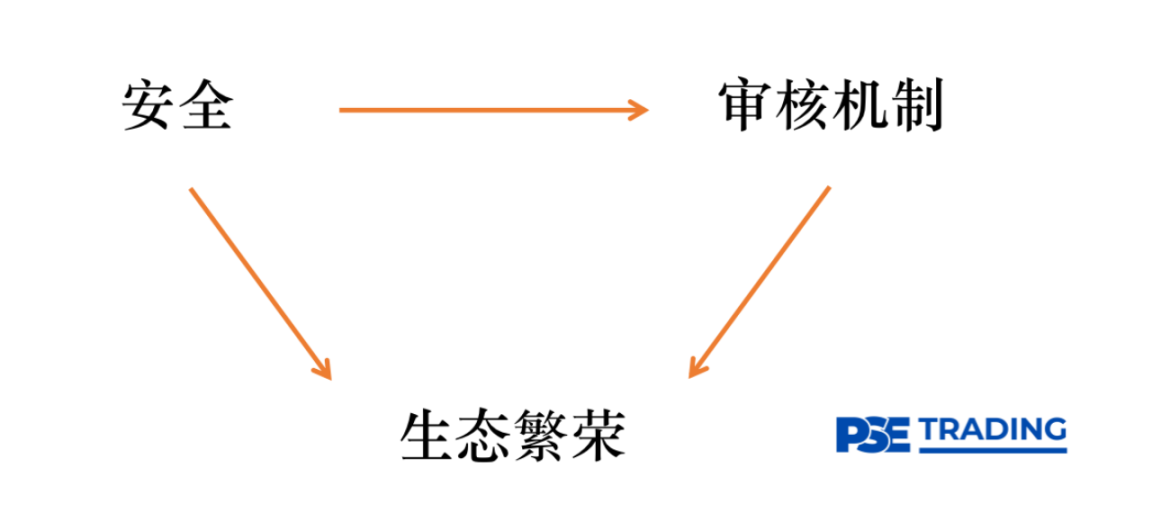
Review: The verification parameters in Layerzero's Relayer and Endpoint are set by the project team, which poses a risk of malicious operation by the project team. Therefore, the review process is particularly strict, resulting in Layerzero not having many outstanding projects. If the review is abandoned and old projects use Layerzero, the security cannot be guaranteed, and if safety is chosen, it will be difficult for new projects to pass the review. Therefore, Layerzero is in a dilemma and still needs some time to develop.
2.4 Modular Cross-Chain Protocol (AMB Verification, fourth method)
Connext is a modular cross-chain protocol with a hub-and-spoke structure. The verification of Chain A and Chain B is delegated to their respective Arbitrary-Message-Bridge (AMB) spokes. The Merkle tree proofs generated by the spokes are stored on the Ethereum (ETH) mainnet, which serves as the hub.
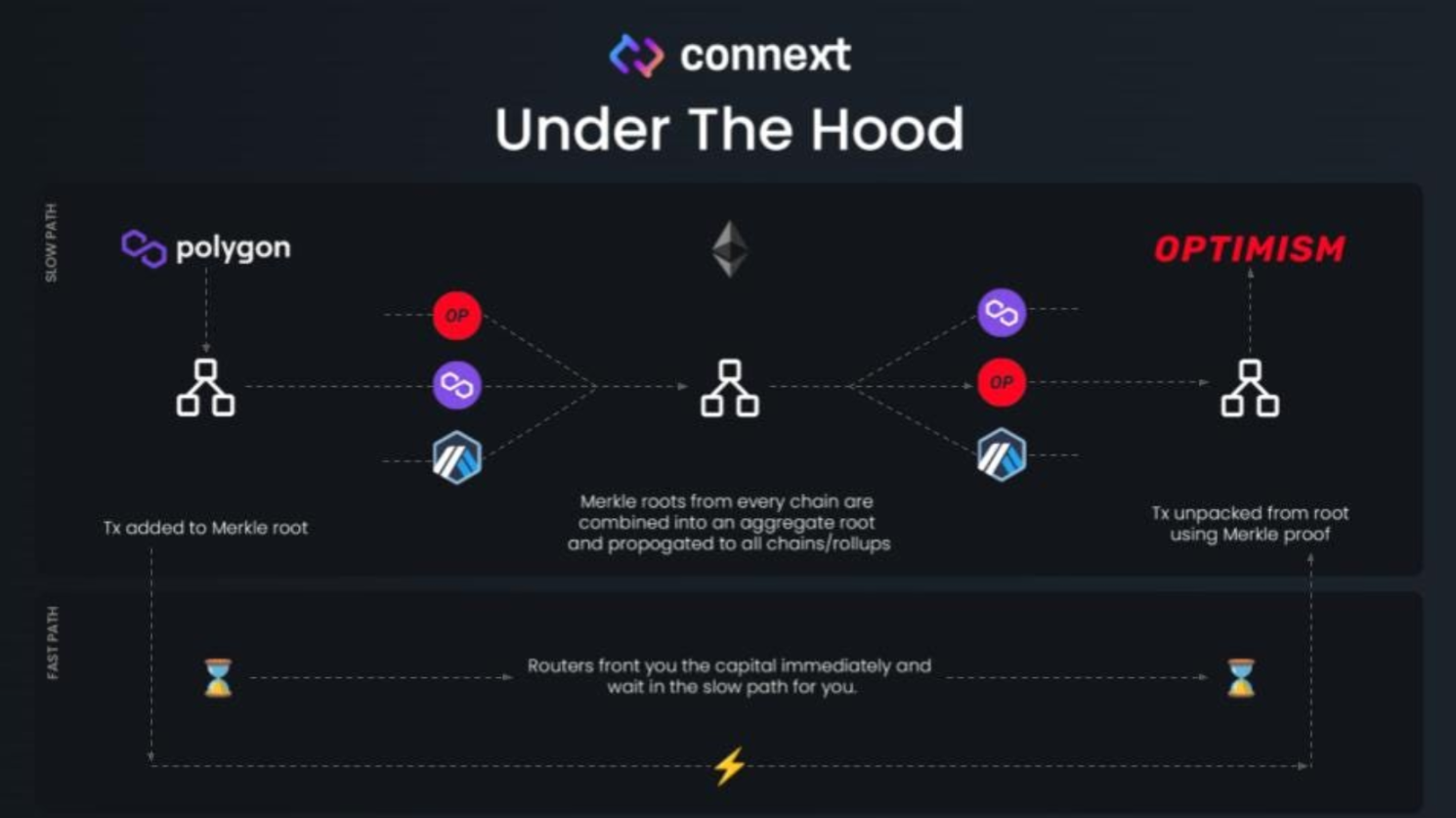
This protocol has the highest security level because it relies on the security of the ETH network. It utilizes the principle of shared security. By using Layerzero's technology, we place our trust in the project itself, which theoretically is more secure than traditional double verification. Looking ahead, some OP cross-chain protocols may have security issues, and the future trend may shift towards Zero-Knowledge Proofs (ZKP) or double verification models. Additionally, for the secure validation of cross-native tokens, each chain uses its own AMB module for verification. However, the transmission time for these validations may not be consistent. Official AMBs usually require longer validation times, and users may need to wait for up to 4 hours or even longer to complete the validation. This may impose limitations on the scalability of the Connext protocol and its widespread adoption.
3. ZKP Cross-Chain Protocol
The competition among existing cross-chain protocols is already quite intense. Many projects are turning their attention to Zero-Knowledge Proofs (ZKP) to keep up with the concept of ZK roll-up. They employ technologies such as ZKrelayer and ZKlight-endpoint, emphasizing the highest level of security. However, the author believes that the application of ZKP in the cross-chain field is still premature and difficult to compete with existing cross-chain protocols for the following reasons:
(1) The time and cost of proof generation are excessively high. Zero-Knowledge Proofs can be categorized as ZK STARK and ZK SNARK, where the former generates larger but quicker proofs, and the latter generates smaller but more time-consuming proofs (larger proofs incur higher costs). Most ZKP cross-chain protocols choose ZK SNARK because if the cost of cross-chain operations is too high, no users would choose the solution. So, how can the challenge of long proof generation time be addressed? Some protocols choose to add a "fast channel," similar to the OP mode, to perform the verification after a particular transaction. However, this is not strictly considered ZKP but rather an OP Plus version.
(2) High infrastructure requirements. ZKP demands higher infrastructure requirements, involving significant data computation and performance support. Once ZKP is widely adopted on a large scale, it may lead to insufficient computational power, requiring hefty investments in infrastructure. Currently, it lacks economic viability.
(3) Uncertainty of technological iteration. Among the existing cross-chain protocols, the security of the double verification method is already high enough to meet current security needs. Although ZKP may not be necessary now, future technological iterations may change this situation. Just like whether third-tier cities needed to build overpasses twenty years ago, the need may not arise in the short term, but ZKP may become the cornerstone of cross-chain development in the long term. Therefore, although it is not the time for ZKP currently, there is a need for teams to continue researching and exploring, and to stay attentive, as the pace of technological development cannot be predicted.
4. Summary and Reflection
The cross-chain interoperability protocol is crucial for the development of blockchain. Among various cross-chain protocols, the double verification model performs well in terms of security, cost, and speed, especially Layerzero and Chainlink, the two industry leaders. Although their technical implementations are basically the same, Layerzero has a richer ecological construction, therefore currently has a competitive advantage. However, due to its security and auditing mechanisms, Layerzero's ecological development is progressing slowly, but it is believed that there will be more development opportunities in the future. As for ZKP cross-chain, although its practical applications are still somewhat distant, there are prospects for future development in this direction, and we should continue to pay attention to it.
The author maintains an optimistic attitude towards Layerzero and the cross-chain field, but also raises some potential issues. Most existing cross-chain protocols belong to L0 (transport layer) and are mainly used for asset transfer and information transmission (social, governance, etc.). In terms of asset transfer, the existing cross-chain bridges are pseudo-cross-chains. The author believes that true cross-chain refers to an asset truly crossing to another chain (Burn/Mint), rather than Lock/Mint or Atomic Swap. But if we want to achieve this, we need to completely replace the existing old projects and let new projects take their place, and the token issuance would be in the OFT mode, but the implementation difficulty is too great and requires a long transition period.
In fact, we are still living in a world that relies on "third parties," and the communication between chains is still closed. In terms of information transmission, chains can rely on the transport layer for message transmission, but the current demand is not significant. For example, cross-chain message transmission between Lens and Cyber is required, but first, when will the social field develop on a large scale is still a question, and second, if most dapps are deployed in the Lens ecosystem and freely communicate with each other, there would be no demand for cross-chain. Cross-chain only has significant demand in a highly competitive environment.
From this, the topic of Layer 2 superchain's new threat is extended, such as the success of OP superchain will make more Layer 2 adopt similar technologies to build, and they can seamlessly connect (assets) with each other. In the future, the success of blockchain, OP and other rollups will not be able to handle too many users and transactions, and it will also give rise to more Layer 2. The essence of seamless connection here is to share a settlement layer. In this way, the transfer of assets does not need to go through a third party, but obtains transaction data from the same settlement layer and verifies it on their respective chains. Similarly, the ideal scenario for cross-chain protocols is to see competition among OP, ARB, ZKsync, and Starnet, with no clear distinction between high and low. This way, cross-chain can meet the transfer between these several chain ecosystems. Otherwise, if one Layer 2 occupies 80% market share, there will be no need for cross-chain. However, there are still a lot of uncertainties in the future, and these are just the author's concerns, which will be determined in due course.





