






a16z Founder: Why is the emergence of blockchain so important when looking back at the history of the Internet?


Original title of the video: web3 and how we got here.
Video author: Chris Dixon, Founder and General Partner of a16z crypto
Translation: Qianwen, ChainCatcher
In this video, Chris Dixon, Founder and General Partner of a16z crypto, shares the history of the Internet, protocol networks, enterprise networks, the similarities and differences with blockchain, and the potential of truly open-source and decentralized networks.

The three stages of Internet development
There are various theories on the development of the Internet. Personally, I believe it can be divided into three core stages, and we are entering the third stage. Each stage of development has a key network architecture. In my opinion, networks are the killer application of the Internet, and these networks will have various downstream impacts on the economy, user experience, and other aspects. Each stage of development has its dominant network type and typical computing primitives. In this context, one idea is to have everyone in the world put their information into a large repository for sharing, so that different information does not get mixed up. To achieve this, some simplified principles need to be followed, which gave rise to the three stages of the Internet.
In the first stage, "read", the network was like a large multiplayer social game, and websites were a fundamental invention. The underlying idea behind this design was that you could put any information, such as code data, into something called a website, which could be linked to other websites. This was a very important encapsulation mechanism and a simplification mechanism, allowing all of humanity to have information that could be linked to and traversed, making these contents a digestible unit. We achieved democratization of information retrieval in the "year of the Internet", and the killer applications of that time were Google and Wikipedia. Through the network, you could find the content you were looking for, which was a magical new experience. Some say that ordinary users now have access to more information than the President of the United States had 30 years ago. However, at that time, it was still a relatively primitive (imitation) version. The feeling the network gave people was like putting magazines on websites, and you could submit forms and do some one-way interactions, but it was not a true two-way interactive experience.
Phase 2, Writing. The key is how to truly interact with users on the internet and democratize publishing. That's where blogs come in. People can use a simple way to publish information. Many ideas from figures like Mark Zuckerberg come from early blog communities. Blogs have various content, such as photos, links, and more, which extend into a range of interesting products.
Phase 3, Protocols. This was a great design decision in the early days. People wanted to build a global multiplayer social networking game. How should it be designed? Without tools like Google or AWS data centers, it had to be built peer to peer. That's where protocols come in. They are a series of standards, such as HTTP for the web and SMTP for email. Protocols are like a language, like English, that tell you the standards to follow for various operations. If someone builds, opens, sends emails, or uses any other tools, the protocol is built into the software. When you download that software, you join email and the internet.
What's important is that there's no central intermediary controlling everything. It's community-driven, and people can freely discuss things. Most importantly, it doesn't cost you anything. Of course, you need to buy a domain name, but after that, the website is yours. Anyone with good ideas can legally build and own a website and the value it brings.
An important invention in this is DNS. DNS is the naming system for the domain name system. For example, I own Cdixon.org, and it maps to an IP address. The important thing is that I control this mapping - the power of the network is transferred to the user. This means I can build my website, change hosting providers if I don't like their high fees or slow speed, and still retain my network, search results, and emails (someone might say that later Gmail monopolized email, but that happened later). In short, if you don't like it, you can leave. This forces providers to align with our thinking. However, when we enter the era of corporate networks, even if you leave, you're not really leaving. For example, on Facebook, you can download a CSV file and take it with you, but you can't take your fans and audience. The current situation is that the internet is monopolized. If you ask a blogger on the street, most people are not interested in building their own websites, which was the original purpose of the internet.
The Internet Stagnates
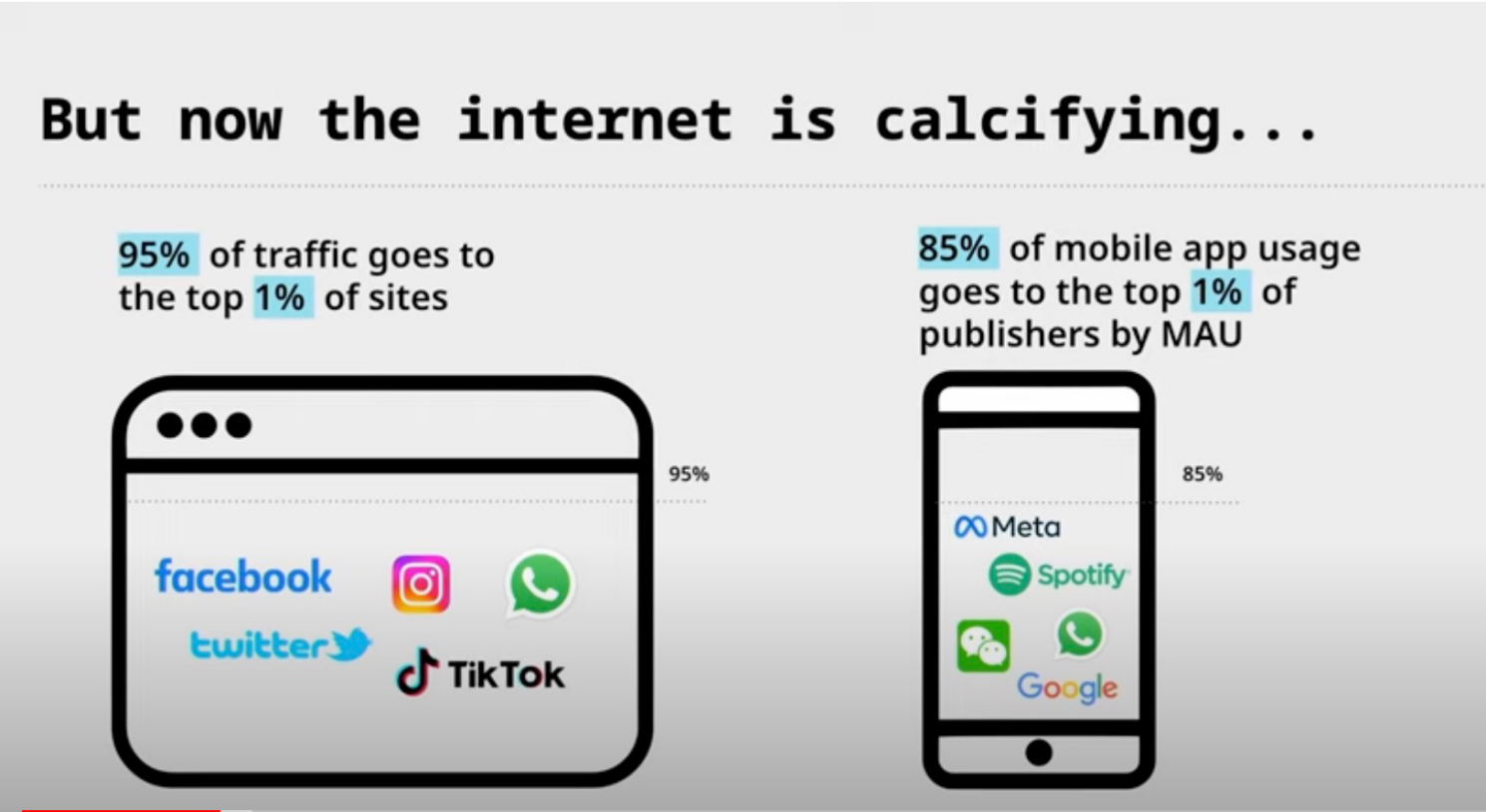
The internet is stuck in a rut. Ninety-five percent of the traffic goes to the top one percent of websites, and according to MAU (Monthly Active Users), eighty-five percent of mobile device usage goes to the top one percent of publishers. Economics is similar. The Nasdaq 100 index is mostly dominated by the index of five major tech companies. We are moving towards a monopolistic world, which is far from the initial vision.
For me, the internet is a tool to build networks, such as the TikTok network, Instagram network, Uber network, and so on. As I mentioned before, concepts like DNS and the way networks are built ultimately have significant downstream effects on the economy, governance, and who can build networks. For example, many of my friends were developing Twitter and Facebook applications around 2010, but all these companies were wiped out on the platforms because the big companies changed the APIs, changed the rules, and unilaterally controlled everything. So the network architecture determines everything.
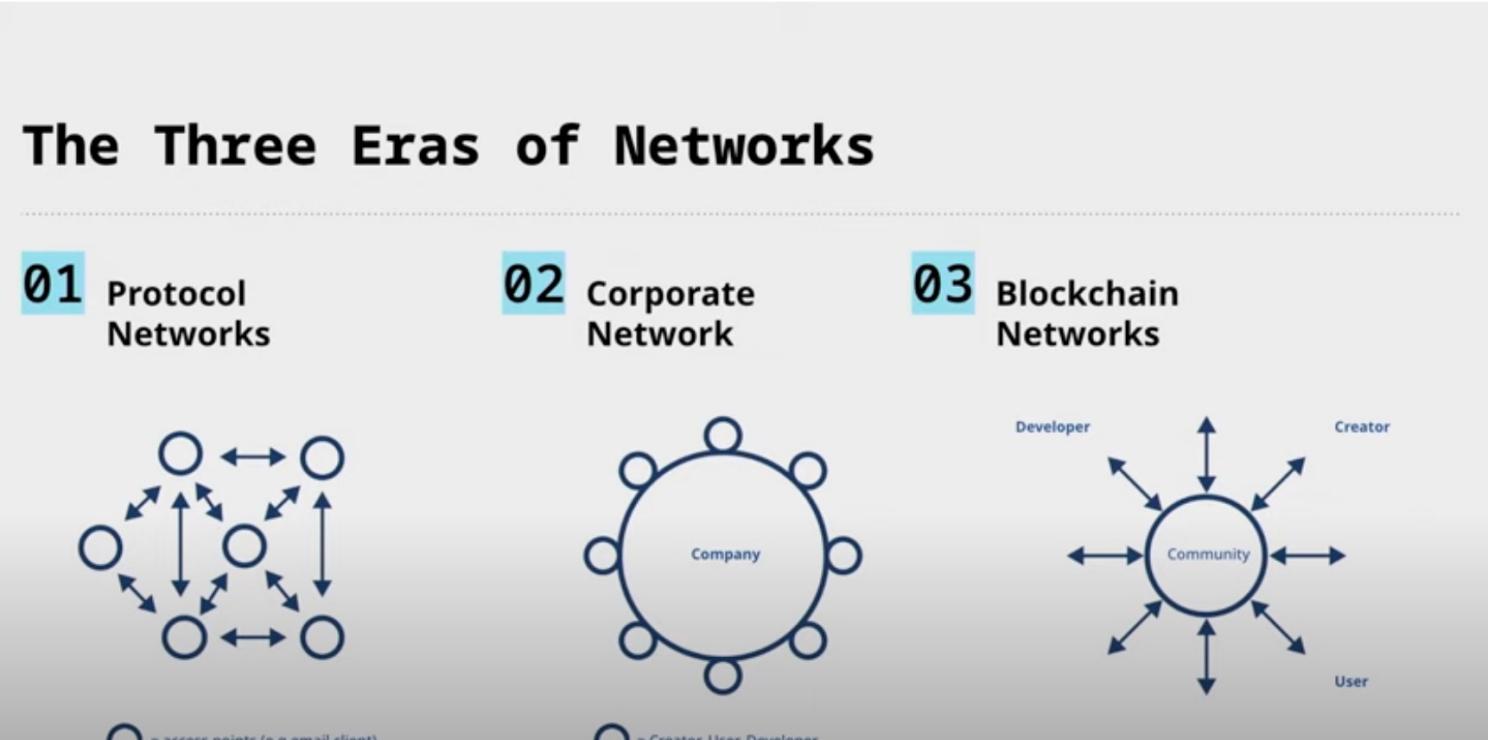
Here I want to talk about take rates. For example, on Youtube, they take a cut of the fees. But if we replace social networks with different protocol architectures like RSS, a large portion of these fees would flow to creators, users, and software developers, rather than intermediaries. Maybe this is a good thing, or perhaps it's a bad thing, but what I want to convey is that architecture determines everything. If you build an enterprise network, you will eventually face economic and social problems, which are the current economic and management models.
Blockchain is a new virtual computer built on a computer network, and its main feature is that it disrupts traditional computing architectures.If Google's servers were put on the network, they would eventually control the network because they control the hardware and can modify the software, which they have been doing. Imagine if Google announced the launch of Google Coin and promised to issue a limited number of tokens. No one would believe it because they would change their minds at some point. There would be changes in management team personnel, such as the departure of the founder. In short, things would change.
What blockchain does is say: we give power to the software. For example, by writing a smart contract on Ethereum, you can have control over everything. The most important thing is: you can build networks on top of the blockchain that can benefit from the social incentives of protocol networks and the competitive advantages of enterprise networks.

The advantage of a protocol network is that there are no middlemen, and all funds flow to the edge, enabling various interesting innovations. However, they have a major weakness in that raising funds is not easy and mainly relies on government funding and other means.
In fact, the RSS protocol was once popular before but later lost to YouTube, partly due to their different strategies. YouTube started with no traffic, so they adopted a strategy of free hosting to attract traffic. For example, if I have traffic on my own website, YouTube can host my videos for free, and then embed a widget on my website. That's how YouTube started. But RSS had a different strategy - you could buy a domain name, but you had to pay hosting fees. Hosting videos and other costs were very expensive, so YouTube subsidized this, which is an architectural advantage of corporate networks and why RSS lost to Facebook, Twitter, and other software. Initially, companies like YouTube and Twitter supported RSS functionality and the use of APIs, but later they discontinued these services.
So, I think this is a cycle. At the beginning, when there is little traffic, companies try every means to attract creators and offer various subsidies. However, as the company grows in size, network effects become significant, and the incentive mechanism changes, with profitability becoming more important. So, this is just a core logic. For these corporate networks, the larger the scale, the less motivation there is to interoperate and support other networks, allow creators to enter - I call this the "extract circle". Initially, you try to attract all different people to join your network, but at a certain stage, you start to extract from them. Of course, efforts are made to mitigate this situation, such as Google's promise not to do this, but in reality, once the founder leaves, the company's strategy will shift to prioritize profits, because if you don't, other competitors will. This puts us in an almost monopolistic world where innovation is suppressed.
Blockchain should be an organically growing city
The blockchain still has a core, which is the blockchain network. Taking Uniswap as an example, the smart contract code is the core running, and the core concept includes immutable code. Uniswap is a good example, where even the community cannot change the code. If they release a new version, it's a new set of code that cannot be altered. That's "don't be evil." They can't change the rules because they are defined in the code, so as a developer or user, you can decide for yourself because there is competition and choice here.
The core of blockchain is much smaller than that of enterprise networks. It is more like building a city rather than building a theme park. Enterprise networks are like theme parks because every function of Facebook and Twitter is built by themselves. Regardless of what kind of network you choose, it is created by the company's employees, fundamentally stifling all innovation.
In the late 90s, spam messages were rampant, so how was this problem eventually solved? Although the problem is not completely solved now, the situation has improved. The market intervened, and there were about 50 venture capital-backed companies solving spam email at that time, and Gmail eventually acquired the startup company Postini. Similarly, you can use the power of the market to create blockchain. If you want to establish a blockchain network here, you would want to establish the core of the network. Just like building a city, you need a mayor, a city hall, a fire brigade, and the police, all of which involve basic rules and management.
You can build such a network to establish incentives for people, and the mechanism design leaves room for rich design space, while also accumulating funds to provide funding for developers, and achieve everything that RSS cannot do. This is what I mean by "having the best of both worlds". You will have this open ecosystem, these cities, these digital cities. On this basis, you can build future applications and networks, and all the wonderful things around the protocol network. And from a technical perspective, some new naming systems like ENS can also solve the domain name problem I mentioned earlier, making the user experience more modern.
Ideally, in the current era, if you cannot achieve the same level of functionality as an enterprise network, you are unlikely to succeed. User demands are high, they want a good user experience. So fundamentally, this architecture is centralized in logic but decentralized in organization. For example, ENS has a central database, but it is not controlled by individuals, but by the community.
Federated Network
The federated network is still a protocol network, and its logic acknowledges the problems that individual control brings, so the solution is to divide this huge dictatorship into many small dictatorships. Each server is a small mini-dictatorship, as long as the federated subnet is small enough, people will have autonomy, they constrain each other, this is the method to maintain decentralization of power.
In the 2000s, services like Twitter and Tumblr promoted themselves as RSS servers, but the reality was that one or a few servers either didn't work or were centralized around a single server, especially in a federated architecture without a typical nation-based center to store namespaces and everything else. So these servers crossed over each other and couldn't operate "gracefully," ultimately necessitating a sharding system. If the entire system eventually works, then certain servers will inevitably become powerful, and we will once again experience the history of monopolies. I believe that you need a typical central core to have a system that matches the future and modern corporate networks.
What I want to express is that cities are better than theme parks. The interaction between private ownership and public ownership in cities is very important. For example, if I open a small restaurant, I rely on the flow of people on the street and public facilities; this is a form of interaction. If only a central institution makes decisions, they find it difficult to be aware of people's specific needs. Therefore, in a well-designed city, there will be diversity between public facilities, parks, and infrastructure, giving people a sense of an open, shared city while also promoting entrepreneurship. But at the same time, you can leverage the creativity of the free market, as exemplified by the internet and its ability to achieve genuinely interesting things like Google and Wikipedia. There are various elements here, and in a great city, various organic and wonderful things interact with each other, which is far superior to a meticulously planned and managed place.
Why is Blockchain Important?
So let's discuss why people would like to see a world where blockchain networks are widespread. Because this new network architecture combines the essence of previous architectures. First is community ownership, similar to protocol networks. Here, you have community ownership, and the concept of ownership includes both read and write access; you can truly own a part of the network.
Tokens are a key concept of this era; they encapsulate ownership. I think tokens can be anything: physical or digital objects, code, games, art, anything. Tokens give the public many impressions that resemble currency, which is a very narrow view. To me, tokens are like a website, where you can put anything inside. In a well-designed blockchain network, you can include voting power, the ability to own parts of the network, and other factors to share economic benefits.
Lower fees. Money will ultimately flow somewhere. Do you want it to flow to network operators or network participants? This is not only an altruistic principle but also a competitive advantage. You can go to creators, musicians, and all these people and offer them lower fees, which is one of the powerful factors that will drive this movement to success. In fact, it's a better economic proposition for all participants.
Inspire innovation. Everything you build belongs to you. The rules have been written into the code and cannot be changed by others, while also having the advantages of crowdfunding in the corporate network. I like to use an example to illustrate this: a few years ago, there was a vulnerability called "heartbleed" in SSL (SSL can be understood as a standard technology for protecting internet connections). This was a very dangerous vulnerability that could threaten all encryption technologies on the internet. Half of the developers were researching SSL, but there was almost no funding, so the problem was only partially solved at the time.
Some may argue that Linux has sufficient funding; however, if you take a closer look, you'll see that the biggest contributor to Linux is Intel, and Intel has strategic reasons to support Linux because their main competitor is Windows, so they have to analyze all political alliances. But the internet does not naturally have its own allies, so the internet needs its own native form of funding in order to have a chance at success, and that is exactly what blockchain can provide.
Token
Tokens are a product of the traditional electronic gaming industry, which pioneered virtual economies. For example, League of Legends and Fortnite are popular video games. In the past, people used to buy physical games, but now most modern gaming companies do not charge based on the game itself; instead, they make money through virtual economies.
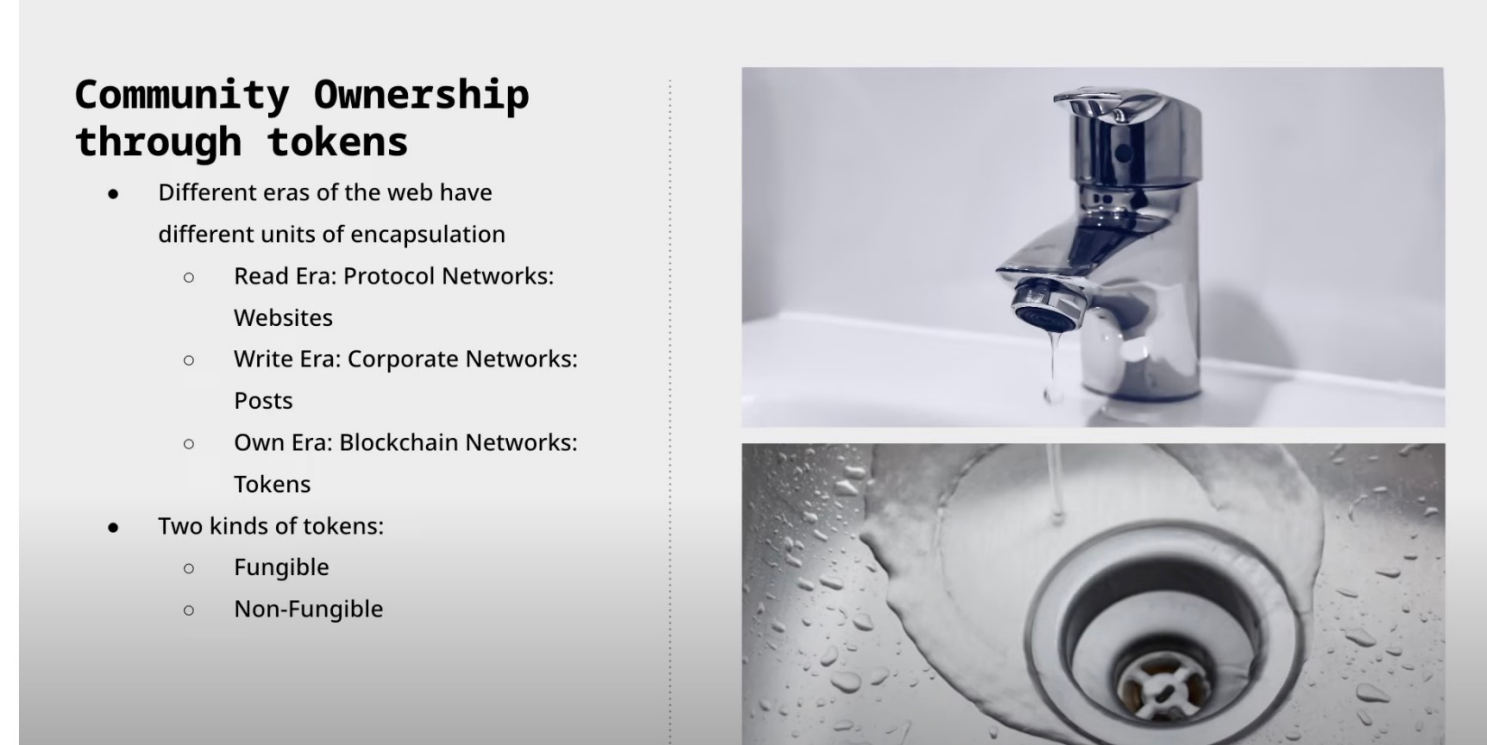
In the design of blockchain networks, if you want to create a virtual economy, you can think of tokens as flowing water, with places where tokens flow out (faucets) and places where tokens flow in (taps). For example, staking and airdrops are forms of faucets, while access fees and transaction fees are faucets. You want to achieve a balance between the two, and balance between supply and demand is also necessary, but you also want to incentivize good behavior through the faucets. You hope that blockchain can make up for the shortcomings of mechanisms like RSS.
Incentive mechanisms are very important here, as you can use them to provide funding for developers. For example, the example I mentioned earlier about YouTube hosting can be understood as a faucet. Ideally, the faucet should be consistent with the utility of the underlying application. For example, Ethereum's faucet is good; Ethereum is a globally shared supercomputer in the cloud, no one owns it, and anyone can access it. It's like an old-style mainframe computer with limited resources, charging you for using the computer in the form of Ether. The convenience of this is that as people build more applications for Ether, the demand for Ether should increase, and Ethereum will become a more popular network.
So, it is closely related to the practicality of the economy. If someone creates a popular game based on Ethereum, it will increase the demand for Ethereum, which is economics. This is the same as what economists have been talking about for centuries in the field of Internet economics. This is also the relationship between economics and supply and demand. If you create a popular network and link the network tokens to the utility of the network, it will generate basic sustainable demand instead of speculative demand.
There is speculative behavior in token prices today, just like in every tech market. But speculation is not sustainable because the focus is on creating intrinsic value, creating new networks that have the advantages of protocol networks and can better harness the advantages of enterprise networks, and creating new virtual economies. By using tokens and incentive mechanisms to achieve adoption, promote behavioral adjustments, and achieve all the wonderful results I mentioned, such as the rate of return.

The above figure shows the commission rate. I guess with the emergence of market competition, there will be downward pressure, that is, over time, many of these commission rates will decrease. For example, OpenSea does not own NFTs, so they cannot force you to stay there. The network must have the right to competition, and competition lowers prices, adoption rates, or network prices. So I think it is possible that this rate will decrease in the future.
Composability
Composability is the truly interesting part of software. The core is created by network designers, and then everything is built around the core by the ecosystem. It's very exciting. If you trace the history of technology, you will find that the history of composability goes way back, specifically focusing on networks and open source software. I remember in the 1990s, when Linux was very niche, open source was a particularly radical idea. It came from Richard Stallman in the 1980s, who believed that no one should own software and was against intellectual property.
In the 1990s, there was a famous article called "The Cathedral and the Bazaar", which introduced two concepts. One is the cathedral, like Microsoft, which was the Google of that era and dominated the market. And the bazaar was the bustling crowd, everyone was developing open source software. Now, the majority of operating systems in the world are Linux. Your Android phone is Linux. All data centers and all IoT devices are Linux. So this system has completely won. In fact, it has been proven that packaging a group of people on the internet is a better way to do software than in the "cathedral". It can be said that the bazaar is a better way, and networks and Wikipedia are examples of this.
Because of the composability of the network, a global knowledge base is being established, giving everyone more power. Personally, the most frustrating part of the enterprise network architecture is that all the innovation is confined to "specialized personnel" (such as product managers), and innovation is largely stifled.
Our Current Stage of Development

As shown in the above figure, our team has made a rough classification of applications and infrastructure. Our theory is that when a situation occurs, such as price increases, people around us will also get excited. For example, I want to read the Ethereum whitepaper and learn more about it, and then they become really interested in it. Some people are speculators, but some people are genuinely interested in it, so they start companies, contribute to open-source projects, and so on. Usually, it takes some time for the seeds to fully blossom, and then you will see another cycle of exciting things. So we created the data analysis project shown in the diagram below.

As shown in the diagram, its development is not as stable as that of internet software; there is some chaos. This reminds me of artificial intelligence. Artificial intelligence has also gone through a period of chaotic development. Since Turing published his paper, artificial intelligence has experienced "summers," "winters," and so on. Therefore, larger technologies are more likely to experience multiple cycles of chaos because it involves market sentiment, funding, and other factors. If you are familiar with the S-curve, we are currently at the bottom.
The Golden Age

I am a loyal fan of history. I have read every book about computational history, technology, and history, and I try to read these contents, because I am a loyal fan of stories. I used to be an entrepreneur, and I love the stories that happen in a room. Just the thought of three people sitting together, drinking beer, and discussing an idea is truly amazing. I have been an early investor in many companies. In this world, being able to create software and be part of these early movements is truly incredible.
When you read history, you might think that doing something like personal computers in the 80s was obvious, like "History does not repeat, but it rhymes." There will always be something different that emerges, such as encryption technology, which of course also faces a lot of criticism. Bill Gates' vision at the time was revolutionary, to have a computer in every home, and to have everyone be a part of the internet, which was a great vision. In fact, the entire history of computing in the 1930s is very interesting, such as the stories of logicians. Such as the story of Fairchild Semiconductor Company, and the story of Robert Noyce and others. I encourage you to read about it.
The story of building personal computers at the time is actually somewhat similar to our hackathons today. Someone said, let's make PCs, that would be cool, the price of an Apple phone is $5000, but you can't do much with it, so why not build personal computers? At the time, no one realized it would change the world.
I am excited at this moment, why? Actually, you should be excited too, because these are very special moments, when you can witness new computing movements, AI, VR, and a series of technological transformations.
This time of change really affects the future of the internet, and we must make a decision, what kind of internet do we want? An internet monopolized by a few companies? Or do we want an open, decentralized, innovative internet? Currently, I haven't seen good regulations emerge that can achieve an open internet. Perhaps the form of protocol networks will make a comeback after 30 years, which to me seems to be the most reliable way to return the internet to its origins.
Of course, that's also why you're here. I think this is a great entrepreneurial opportunity, where you can really make a difference.





