






Ideals and Reality: Bitcoins Wild West and Legal Challenges


Original author: Will Ah Wang (Twitter: @Will_7th)
Original source:Three views of crooked neck
From the beginning, Bitcoin has not only meant electronic cash, but the trust machine it carries, and the more changes it can bring to society. However, although Bitcoin and blockchain technology can liberate personal data sovereignty from the digital cage of centralized institutions, the governments supervision of encrypted assets is still the Sword of Damocles hanging above its head.
In 2008, a person who called himself Satoshi Nakamoto published a paper called Bitcoin: A Peer-to-Peer Electronic Cash System, proposing a decentralized peer-to-peer electronic cash payment. The idea of the system has thus opened the door to the Web3 blockchain industry.
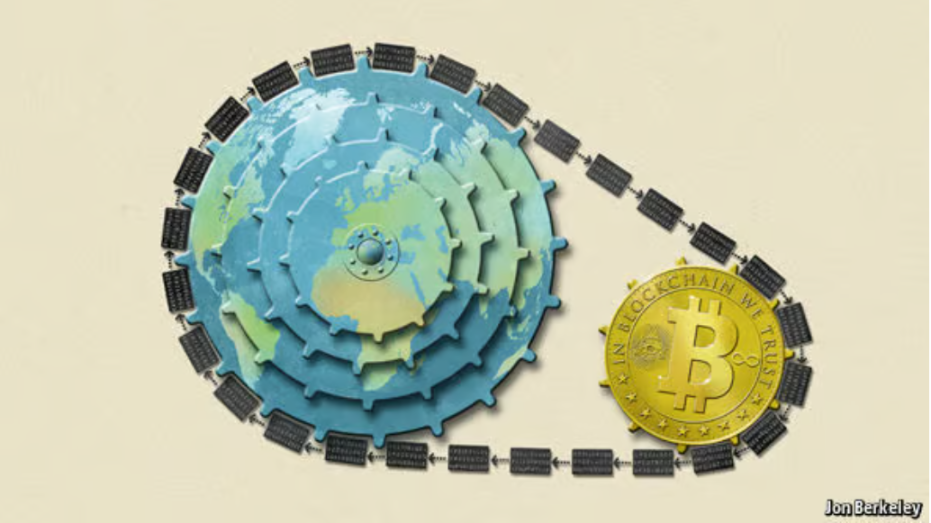
The Economist published an article about Bitcoin in 2015 - The Trust Machine, telling us that the technology behind Bitcoin will change the way the economy operates.It is true that early Bitcoin has been notorious for its illegal uses, but we cannot ignore the extraordinary potential of the blockchain technology behind Bitcoin. The significance of this technological innovation goes far beyond the cryptocurrency itself.
This article will start from the Bitcoin white paper to explore the social impacts and legal challenges brought to the real world by the innovations behind Bitcoin and blockchain technology—decentralization, anonymity, and privacy protection. Later, let’s discuss how this innovative mechanism has brought us great wealth—the decentralized trust mechanism—how it will be interpreted in the future.
(Image source: https://www.economist.com/leaders/2015/10/31/the-trust-machine)
Bitcoin White Paper
Bitcoin: A Peer-to-Peer Electronic Cash System proposes the idea of a decentralized point-to-point electronic cash payment system, that is, electronic cash can be based on blockchain technology, using distributed ledgers, and digitalized through asymmetric encryption technology. signature, and combined with the consensus mechanism to achieve decentralized peer-to-peer (P2P) transactions. The Bitcoin white paper, by combining a variety of innovative technologies and the revolutionary design of social production relations, hopes to change the centralized financial system with traditional banks as the core and achieve decentralization of the entire financial network system.
In 2009, Bitcoin was officially born, which opened the door to the Web3 blockchain industry, which is of symbolic significance. Understanding the Bitcoin white paper is of great value for us to understand the original intention of the entire industry, the nature of the blockchain, and the future development.
(Image source: https://bitcoin.org/files/bitcoin-paper/bitcoin_zh_cn.pdf)
A decentralized peer-to-peer electronic cash payment network
Transactions in the real world rely on financial intermediaries as trusted third parties (Trusted Third Party) to endorse. This kind of trust endorsement by a trusted third party often has many flaws, such as unnecessary transaction costs, reversible transactions, centralized evil, etc. problem, the most realistic and tragic lesson is the 2008 financial crisis. So is it possible to invent a new medium of exchange that allows any two parties to transact directly without the need for a trusted third party, just like cash transactions?
This is exactly what the Bitcoin network wants to achieve - a decentralized peer-to-peer electronic cash payment system that aims to solve the centralized trust problem existing in the current financial system and provide users with a more secure, convenient, and low-cost payment method. (a peer-to-peer version of electronic cash (system) would allow online payments to be sent directly from one party to another without going through a financial institution).
Achieved using blockchain, cryptography, distributed ledger and other technologies
Blockchain technology ensures the realization of decentralization. It stamps transaction information within a certain period of time (Timestamp) and combines them together to form an information block (block), and then links the information blocks to each other. Forming a chain and verifying each other forms a blockchain.
Since the code under the blockchain is distributed and stored on each node of the network, there is no central server, and the network will verify and maintain transaction information jointly by each node through the consensus mechanism (PoW) according to the principle of the longest chain. At the same time, the network adopts asymmetric encryption technology (public key and private key) to realize the audit and verification of transaction information in the whole network, so that repeated transactions (double spending) are no longer possible.
The public accounting model based on mutual verification of blockchain technology can, on the one hand, enable transactions to be recognized without intermediaries, and on the other hand, it also records all transactions completely and publicly. Blockchain ensures the non-tamperability of data to a certain extent through cryptographic hash functions and digital signature technology, thereby establishing a trust mechanism for the networks ledger without the need for a trusted third party.
Brand New Governance Incentive Mechanism
In the Bitcoin white paper, a business model based on mining and transaction fees is designed, that is, Bitcoin miners calculate the hash value of the block to obtain Bitcoin rewards and transaction fees at the same time. In the case of decentralization, this model provides economic incentives for the participants of the Bitcoin network, while also ensuring the stable operation of the Bitcoin network.

(Image source: https://money.com/is-bitcoin-mining-profitable/)
Thus, we have a kind of electronic cash (Electronic Cash) that can be used in the network, and the online payment goes directly to the other partys account without going through a trusted third party. In this network, participants use computing power to compete to solve a complex mathematical problem, thereby verifying and recording transaction information in blocks, and obtaining a certain amount of newly generated bitcoins as rewards. Satoshi Nakamoto called this network Bitcoin.
Although Bitcoin was designed out of distrust of centralized institutions (the 2008 financial crisis), the innovation it brings through blockchain technology lays the foundation for a new currency system, a new financial system, and a new Web3 economy. foundation. At the same time, the Bitcoin network has achieved large-scale global collaboration among participants, decentralized governance, and a positive cycle of effective incentives.
Bitcoin and blockchain technology have brought freedom, autonomy and privacy to the digital world due to their decentralization, anonymity, globalization and other characteristics, but it is this innovation that also poses many social and legal challenges. .
The Conflict Between Beauty and Reality of Technological Innovation
The vision proposed by the Bitcoin white paper is very beautiful, but all innovative technologies are often accompanied by mixed reviews and voices during the development process. Just like the purpose of Twitters birth, it wants to socialize users through SMS, and the core is to update users real-time status (where am I, what am I going to do, etc.). But soon, it became a tool for ISIS recruitment and Trumps online political arena. The same is true of Tinder, which started out as a teenage matchmaker and ended up being a tool for lust.
Ross Ulbrich’s Silk Road is no exception. Silk Road Business is actually a logical extension of Craigslist and eBay, which is to create a platform to match buyers and sellers and collect fees from it. It’s just that criminals took advantage of the anonymity of the platform’s trading currency—Bitcoin, to match illegal drug dealers and addicts around the world, making 70% of the transactions on the platform are drugs, and other targets of transactions include guns and ammunition, buying Fierce and so on.

(Image source: https://portswigger.net/daily-swig/the-long-road-to-freedom-whats-next-for-silk-road-founder-ross-ulbricht)
Silk Road once became the most complex and extensive darknet criminal market on the Internet. As part of the dark web, it uses bitcoin as a means of payment and operates as a hidden service, allowing online users to browse anonymously without fear of potential surveillance. Launched in February 2011, the site has served over 100,000 buyers with goods and services during its lifetime.
In November 2020, the U.S. Department of Justice confiscated revenue from drug sales on Silk Road — 70,000 bitcoins, worth more than $1 billion at the time — from hackers known as “Individual X.” In October 2013, the FBI seized Silk Road and arrested the sites founder, Ross Ulbrich, who was eventually sentenced to life in prison without the possibility of parole.
Ross said in an interview that the Silk Road is a way to circumvent government supervision. The Silk Road is far from being as simple as buying and selling drugs. It is to regain our freedom, dignity and justice. As Carla Gericke, a candidate for the US Senate from New Hampshire, said, this case is not about Silk Road, but about freedom, autonomy and privacy in the digital world. In addition to the sensational plot, this story also has the contradiction between the original law and the digital world, the choice of human nature at the edge of the law, and the complexity and inefficiency of the huge government system. This is the first trial of a digital financial crime, but it is still in progress.
Bitcoin has played a fundamental role in the rise of the Silk Road, a dark web empire. However, whether it is a decentralized payment network or a trading platform for the public, it is necessary to abide by laws and regulations and social ethics, otherwise the final result will be It can only be destroyed.
Privacy protection and security conflicts in Web3
What Privacy in Web3 Means
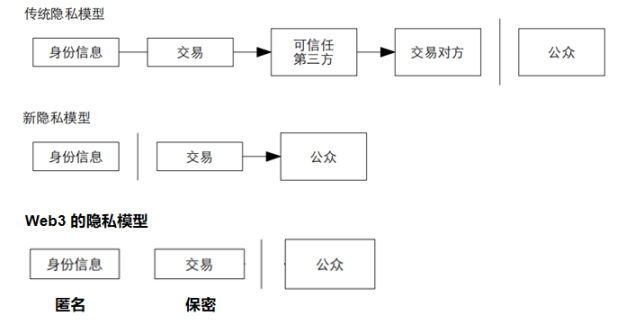
The above Silk Road case is just one of the privacy protection use cases of Bitcoin and blockchain technology - anonymity (although it is illegal). The Bitcoin white paper has a chapter dedicated to explaining privacy issues, which actually contains two What layers mean about privacy:
(1) After decentralization is achieved, personal data will be taken back from the centralized organization and owned by the individual (data sovereignty), thereby protecting personal data from the monopoly and infringement of the centralized organization, which means that our personal data Liberation from the digital prison of centralized institutions;
(2) Due to the need of decentralized nodes to verify the public ledger, asymmetric encryption technology is used to ensure the anonymity of the public key holder, thereby protecting the privacy of the public key holder to a certain extent (the identity is anonymous, but the behavior is open) , similar to the anonymity of Silk Road business information.
But in actual situations, the privacy protection of identity anonymity mentioned in the Bitcoin white paper is far from enough. Imagine that after the on-chain transaction information of personal financial, medical and other sensitive information is disclosed, organizations like Chainalysis can analyze transactions and use open source intelligence to label addresses with real-world entities. Regardless of whether it is used for legal purposes or not, this is absolutely terrifying!
(Image source: https://bitcoin.org/files/bitcoin-paper/bitcoin_zh_cn.pdf)
An important challenge is how to protect personal privacy while ensuring open ledgers and data transparency.Therefore, in order to enhance the privacy of on-chain transactions, some privacy protection tools have been developed. For example, privacy coins like Zcash and coin mixers like Tornado Cash use additional technical means to make interactions and transactions on the chain invisible, thereby providing a higher level of privacy protection.
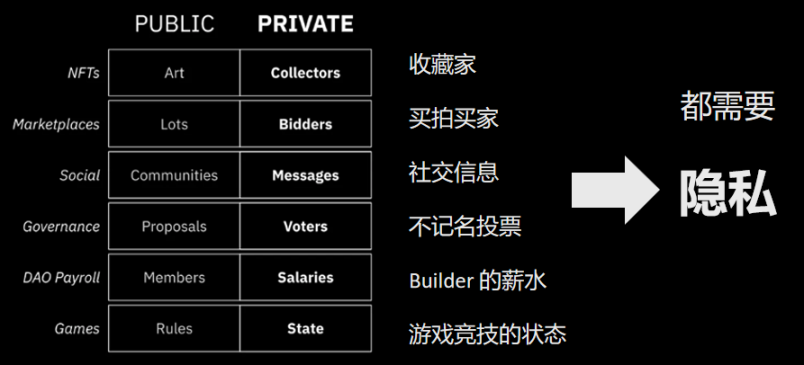
Therefore, the privacy of Web3 should include the above-mentioned identity anonymity and behavioral confidentiality, that is, the invisibility of all user data such as identity, behavior, and activity.
Privacy in Web3 = anonymity (identity data) + confidentiality (behavioral data).
Anonymity means that the identity information of the user is not visible, which means that the transfer party and the payee of the transaction are non-public. However, due to the emergence of on-chain analysis tools, the anonymity of user identity information has become unsustainable. It can be seen that the off-chain identity information of the founder of BAYC was exposed.
Confidentiality refers to the invisibility of behavioral information such as user interaction and activities, which means that the content of on-chain interactions such as transaction amounts is non-public. This step can be realized through technologies such as zero-knowledge proof and coin mixer, so that the information such as input, output and amount in the transaction can be protected in privacy.
(Picture from Manta Lianchuang’s Polkadot Decoded Talk 2022)
Although the privacy of users Web3 can be protected through technical means, so users are happy (no one can see that I lost money because of being a bully), but supervision is urgent (criminals are laundering 7 billion to finance terrorist countries and buy bombs). ).
Most jurisdictions require crypto trading platforms to comply with regulations such as Know Your Customer (KYC), Anti-Money Laundering (AML), and Counter-Terrorism Financing (CTF) to ensure transaction compliance and prevent illegal activities.These regulations may require trading platforms to collect and verify users identity information, reducing the privacy of transactions. The sanctions imposed by US regulators on the currency mixer Tornado Cash just illustrates the conflict between Web3 privacy protection and security.
Tornado Cash is used for illegal online activities
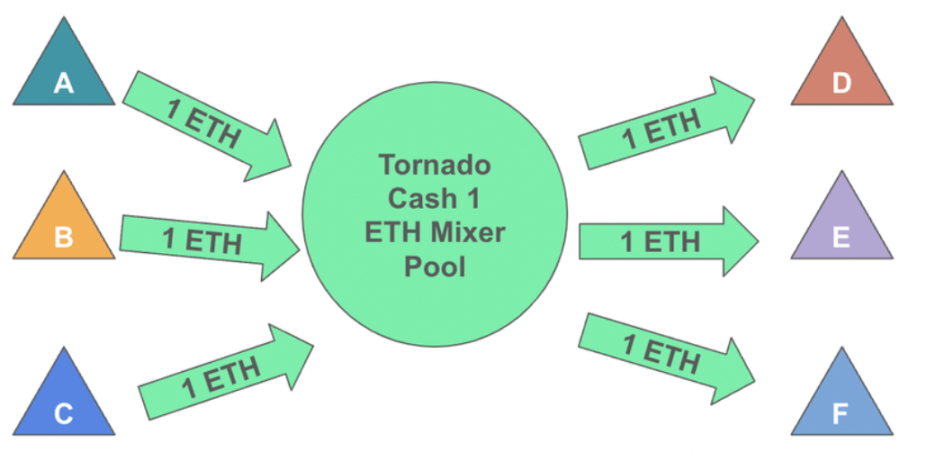
Tornado Cash is a well-known currency mixing application on Ethereum. It aims to provide users with privacy protection for transaction behavior. It achieves private and anonymous transactions by confusing the source, destination and counterparty of cryptocurrency transactions. Tornado Cash accepts transactions (user deposits) of different types of tokens, mixing various transactions together through smart contracts and innovative applications of zero-knowledge proof technology, thereby severing the public link between deposit addresses and withdrawal addresses, and then Transmitted to the counterparty (user withdrawal) to achieve privacy of transaction behavior, users no longer have to worry about their transactions being monitored on the chain.
(Image source: https://www.researchgate.net/figure/Example-of-the-Tornado-Cash-1-ETH-pool-addresses-A-through-F-deposit-to-and-withdraw_fig 1_357925591 )
Although the identity address on the chain is anonymous, the transactions between addresses are traceable and permanently recorded on the blockchain. Careful people can use some technical means to match the transaction records of the addresses with individuals in the real world. This is very scary. Tornado Cash can precisely solve this pain point and cut off the transaction traces between addresses, thereby protecting the privacy of the users behind the addresses. This is a technological innovation, but in reality it is used in money laundering crimes.
On August 8, 2022, Tornado Cash was sanctioned by the U.S. Office of Foreign Assets (OFAC), and some on-chain addresses related to Tornado Cash were included in the SDN list. That is to say, any entity or individual with an on-chain address in the SDN list Any interaction with the address is illegal. In the press release, OFAC stated that since 2019, the amount of money laundered using Tornado Cash has exceeded US$7 billion. Tornado Cash has provided substantial assistance, sponsorship, or financial and technical support for illegal network activities in the United States and abroad. The behavior may pose a significant threat to the national security, foreign policy, economic health, and financial stability of the United States, and is therefore subject to sanctions by OFAC.
The conflict between Web3 privacy protection and anti-money laundering security
The law enforcement actions of U.S. regulatory agencies from a national security perspective require agencies within their jurisdiction to maintain regular and continuous information disclosure to support law enforcement supervision, prevent online financial money laundering to support terrorist activities, and advance national security policies and other matters. However, while adopting strict compliance supervision, this directly conflicts with the privacy protection required by Web3 users.
For the U.S. Financial Crimes Enforcement Network (FinCen), because it regards cryptocurrencies as currencies, it requires entities that provide cryptocurrency trading services to comply with the U.S. Bank Secrecy Act and related financial regulatory requirements and fulfill compliance obligations. Obviously, KYC, AML, and compliance requirements for collecting customer information and reporting suspicious financial activities under regulations are the biggest enemies of Web3 privacy protection. Once KYC is performed on the user, the identity information of the user will be exposed. Coupled with the subsequent continuous investigation and information disclosure, the confidentiality of the users identity and behavior information will no longer exist.
For the U.S. Office of Foreign Assets Control (OFAC), from the perspective of protecting the national security and foreign policy interests of the United States, it directly cuts off users’ privacy protection tools (coin mixers) with a single blow to prevent online financial money laundering and Support terrorist activities. OFAC mentioned in the press release: The crypto industry should adopt relevant risk prevention and control measures to assess the risks associated with cryptocurrency services, take measures to reduce risks, and address the challenges of anonymity to compliance with anti-money laundering obligations.
Decentralization does not mean deregulation, and embracing supervision does not mean depriving privacy. Privacy and supervision should not be antagonistic. It is expected that a balance between the two can be achieved with the support of technology.
The conflict between decentralization and financial regulation
Bitcoin and blockchain technology, starting from the Declaration of Independence of the Bitcoin White Paper, aims to challenge the existing financial system and protect individual freedom in a decentralized way. This innovation is a new monetary system and a new financial system. and laid the foundation for the Web3 new economy.
But at the same time, because the Web3 project is based on the characteristics of anonymity and decentralization of the blockchain, coupled with the current relatively single financial application scenario, it is very easy to cause information unequal between the project party and investors, which leads to Fraud, market manipulation and other behaviors. Whats more serious is that some projects can easily bypass KYC and AML regulations and provide financing channels for criminals and terrorism.
These issues pose unprecedented challenges to the existing financial regulations of governments in various jurisdictions. It is necessary for governments of all countries to carry out financial supervision on the industry based on (1) anti-money laundering and anti-terrorism financing; (2) protecting the interests of investors and consumers; (3) regulating the long-term and healthy development of the Web3 market.

(Image source: https://news.bitcoin.com/bitcoin-core-developer-appeals-to-sec-regarding-bit/)
Supervision for anti-money laundering and counter-terrorism financing purposes
The latest report Regulations on Virtual Assets issued by the Financial Action Task Force (FATF) shows that FATF is actively monitoring the related risks in the field of virtual assets and needs to take measures to effectively deal with the risks of money laundering and terrorist financing related to virtual assets; there is an urgent need Take legal and effective measures to prevent the misuse of virtual assets; currently most virtual asset service providers are not supervised by regulatory authorities; FATF has created a sound anti-money laundering and anti-terrorist financing regulatory environment.
Although we can see the conflict between Bitcoin and blockchain technology in terms of privacy protection and national security from the Tornado Cash case,But the lower-level conflict is to supervise the KYC/AML/CTF prevention of virtual assets such as Bitcoin for illegal purposes.This is one of the reasons why various countries have begun or have already implemented regulatory legislation on virtual assets. This is also the bottom line for supervision of virtual assets.
Regulation to protect investors
The United States Securities and Exchange Commission (SEC) is responsible for the supervision and management of securities in the United States, with the aim of protecting the interests of investors, promoting the formation of capital, and maintaining the fair and orderly operation of the securities market. The current chairman of the China Securities Regulatory Commission, Gary Gensler, has repeatedly stated in public that, except for absolutely decentralized cryptocurrencies such as Bitcoin, cryptocurrencies issued by most other projects should be regarded as securities and thus need to apply to the SEC. Register or apply for an exemption.
The purpose of such strict supervision is not to maintain the authority of the institution, but to protect investors and enable the industry to develop soundly in the long run. SEC requires issuers to disclose complete project information to investors that is not materially misleading in order to reduce the information gap between issuers and investors and protect investors for making investment decisions. The information disclosure system is one of the cores of the Securities Law.
Although Bitcoin is excluded from the scope of strict securities regulation, other types of cryptocurrencies are still strictly regulated by the SEC. This can be seen in the recent SEC listing more than a dozen tokens on Binance and Coinbase as securities. .
Exploring Decentralized Supervision
On April 6, 2023, the U.S. Department of the Treasury released the 2023 DeFi Illegal Financial Activities Assessment Report, which is the world’s first DeFi-based illegal financial activities assessment report. The report recommends strengthening the control of AML/CFT in the United States and, where possible, strengthening enforcement of virtual asset activities (including DeFi services) to improve the compliance of virtual asset service providers with BSA obligations. It can be seen that US supervision also follows this idea, supervising the deposit and withdrawal business of virtual assets from the perspective of AML/CTF, achieving source control, and then supervising the compliance of specific project businesses from the perspective of investor protection.
In the Tonardo Cash case, U.S. regulators put it on the SDN list on the grounds of terrorist money laundering, whereby all U.S. individuals or entities are prohibited from trading with Tonardo Cash or the wallet address bound to the agreement, which means that the U.S. Regulation directly sanctioned DeFi protocols. The Ooki DAO case went a step further. The U.S. regulator directly judged the DAO organization on the chain through the judiciary on the grounds that the DAO business violated laws and regulations.
In the CFTC v. Ooki DAO case, the U.S. judge ruled that Ooki DAO should bear civil liability for operating an illegal trading platform and illegally acting as a futures commission merchant, and imposed a fine of $643,542, and ordered the permanent closure of Ooki DAO’s website and from remove its content from the Internet. This decision should serve as a resounding blow to those who believe they can circumvent the law by adopting a DAO structure, intending to avoid regulatory enforcement and ultimately put the public at risk, said CFTC officials. Ring the bell.
Since the United States is a country of case law, this judgment is bound to have a huge impact on the encryption world: DAO is defined as an actionable subject, and the chain is no longer an extrajudicial place. Regulatory law enforcement agencies can use this case as a breakthrough to punish DAO, DeFi and DEX projects are supervised; at the same time, members participating in DAO governance may assume joint and several legal liabilities of DAO.
We see from the above cases thatVarious conflicts between on-chain and off-chain are leading to deepening supervision. In the future, with the continuous intertwining of on-chain and off-chain businesses, the former legal place on the chain will inevitably need to embrace supervision. So the important question is, where will the hand of supervision go?
distrust and trust
We have seen that although the innovations brought about by Bitcoin and blockchain technology will cause social and legal conflicts, it has also brought us a huge wealth - a decentralized trust mechanism (Trust Machine). ), worthy of our deep thinking and practical exploration.
Trustless
In todays society, our way of life is undergoing an irreversible digitalization process, and various data are unknowingly intertwined in many networks. Consumption decisions, behavior patterns, use objects, payment methods, etc., are becoming more and more predictable in front of computers. Centralized institutions hold our data in their hands, predict our predictions, judge our judgments, and capture our trust through centralized mainstream monopoly narratives for private gain (for example, FTX’s centralized narrative and endorsement before the thunderstorm was How convincing).
Fortunately, Bitcoin and blockchain technology can take data back from the digital cage of centralized institutions, allowing us to regain personal data sovereignty. Satoshi Nakamoto’s vision of decentralization (Trustless) in the Bitcoin white paper was realized through a series of technical means and governance mechanism design, and because of the collective consensus of us data sovereign individuals, a new set of decentralized systems was established. Centralized trust mechanism (Trust).
This new trust mechanism is like the title of The Economists 2015 article-Bitcoin: The Trust Machine. It is precisely because of this that we have built a mechanism that can naturally realize trust in a decentralized world, so we say: In Trustless We Trust!
(Image source: https://www2.deloitte.com/us/en/insights/focus/tech-trends/2023/trustless-blockchain-decentralized-internet.html)
Trust
Faced with the solidification of class and power and the harmonious unity of mainstream monopoly narratives, we need to reshape free will and promote the birth of a new order. After getting rid of the single narrative monopolized by centralized giants, it also gives each independent individual the right to narrative. The narratives of diverse individuals can promote the collision of different viewpoints, trigger innovative thinking, form a new trust system, and thereby promote social progress.
Compared with traditional data matching that relies on trust and monopoly of centralized institutions, the decentralized trust mechanism based on Bitcoin and blockchain technology is a trust method based on free will data interaction. Individuals have the right to choose how to use their own data. , with whom you resonate, and with whom you build a trusting relationship. As Outlier Ventures mentioned in its article, Cryptocurrency is an inherently social technology. To refine it further, cryptocurrency is hyper-social, it is a form of tribalism.
Rachel Botsman, a scholar who specializes in social trust, believes that the collapse of trust we see is actually just a restructuring of trust. The essence of distributed trust based on Bitcoin and blockchain technology is no different from the Stone Age when we only trusted our own tribe.
Whether it’s the music we listen to, the items we buy, or the school we attend, we can make these experiences immutable on-chain and share them with the community. As cryptocurrency participants, we are all tribes, and each tribe stems from a common ground among its members, which is a mechanism of trust based on the sovereignty of personal data.
(Image source: https://outlierventures.io/article/the-future-of-customer-acquisition-and-community-monetization/)
Therefore, when talking about personal data sovereignty, we are not only talking about the possibility of a technological realization, but also talking about expectations and challenges for the construction of a future social trust system. Looking forward to the future, in these worlds driven by personal data sovereignty, independent individuals can maintain their own free will and form a new trust system to challenge the narratives of capital religion and the mechanical universe, and can also criticize and break the existing solidified trust system .
The decentralized trust mechanism is such a powerful tool and concept that can promote people to form new consensus communities, thereby forming a future world of peace, fairness, connection and mutual understanding.
write at the end
Cryptopunks initially believed that the Internet was the greatest liberating tool, until they realized that the Internet has transformed into an unprecedented propeller of totalitarianism. The former digital utopia has become a digital prison, so the cypherpunks have to create a path to utopia-Bitcoin and blockchain technology. Therefore, Assange wrote in Cryptopunk, The universe believes in encryption! Cryptozoology is the ultimate form of non-violent direct action.
Although Bitcoin and blockchain technology can liberate personal data sovereignty from the digital cage of centralized institutions, the governments supervision of encrypted assets is still a Sword of Damocles hanging overhead. Gary Gensler once said that this is the Wild West period of the encryption world, but we dont need to ignore the pioneering spirit brought to that era by the Westward Movement and the cowboys just because there are many outlaws in the west. Embark on this land of autonomy, adventure and innovation. Just like Bitcoin, which appeared in 2008, it is bringing various changes to the world.
The concepts of blockchain and distributed ledgers may not sound as revolutionary or attractive, but so do dual accounting and joint-stock companies. However, like these great innovations, blockchain, a seemingly mundane technology, may improve processes and has the potential to change the trust relationship and cooperation between people.
Bitcoin believers are fascinated by the libertarian ideal of pure electronic cash that transcends any central bank. But the real innovation is not electronic cash itself, but the trust machines that create them, and the further transformations it can bring to society.





