


You cant be friends with my competitors, two-stage reversal after friend.tech releases statement


A few weeks ago, friend.tech was born out of nowhere, and quickly swiped the screens of various encrypted kols and media.
A few weeks later, when we were happy to analyze friend.tech’s fission model and how it became popular, we couldn’t help but want to draw inferences from one example—what kind of core technology should we master if we want to play social in web3?
Today, friend.tech taught us a lesson himself. The core technology (tech) of making friends is you cant be friends with my competitors.
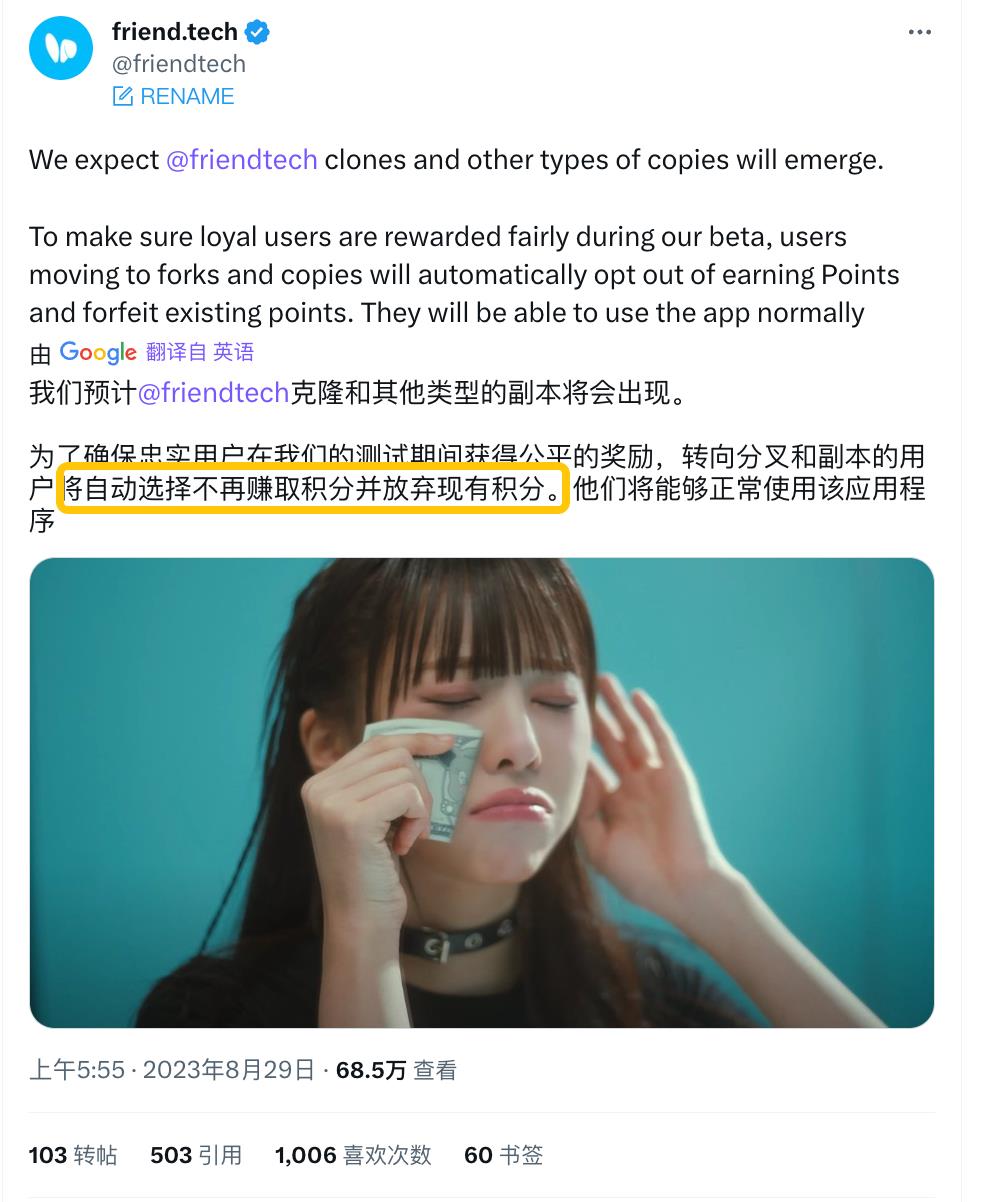
A few hours ago, friend.tech keenly sensed an old routine in the encryption world: when a project becomes a phenomenon-level hit, countless imitation disks will bloom everywhere. Whether it’s fear or prevention, its official Twitter released this statement:
To ensure loyal users are fairly rewarded during our testing period, users who turn to forks and imitations will automatically opt out of earning points and forgo existing points. They will be able to use the app normally.
Moreover, the pictures on the tweets are too heart-wrenching, and the meaning of money and crying is self-evident.
The meaning of this statement is very clear, that is, you can use various imitation disks, but after you use them, you will not be able to get points rewards from me.
Since friend.tech is built based on Twitters original account and social network, as long as the same Twitter account is bound to other imitation disks, friend.tech can certainly identify these disloyal users relatively easily and cancel the Qualifications for awarding points rewards.
In contrast to the whitelist of airdrops for various projects, this statement is actually a blacklist of no airdrops.
Disloyalty = not rewarded. A straightforward but slightly arbitrary logic.
two-stage inversion
There are no eternal friends, only eternal interests.
After friend.tech released this statement, cobie, the boss, made a humorous and precise last-ditch attack in the comment area, explaining the term:
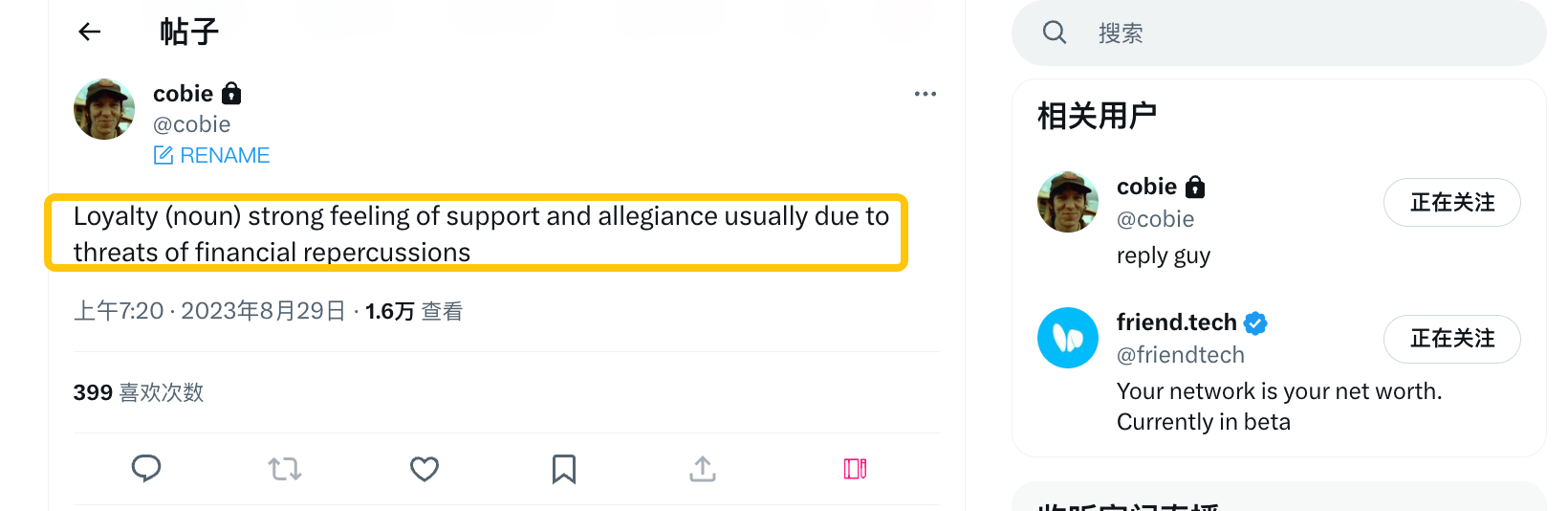 Loyalty (noun) generally refers to a strong sense of support and allegiance, usually due to the threat of financial consequences.
In other words, cobie is threatening users with financial interests in Inner Friend.tech, so that they are forced not to use other imitation disks and not to participate in other projects under the negative expectation that their airdrop points may be cancelled.
In crypto projects, the first place often has extremely high profit expectations.
Since friend.tech is the first socialfi project recently, users have to make a trade-off: Is it more profitable to participate in other imitation disk projects, or is it more profitable to just play friend.tech?
But forcing users to make a 1/2 choice doesn’t seem right in itself.
The spirit of encryption emphasizes openness and decentralization (of course there are also cases under the guise of decentralization), and assets, users and protocols can often flow freely. Such a clear-cut opposition to the use of competing products and cancellation of rewards is not common in the entire industry.
At the same time, the encryption community also pays attention to consensus. A kind of benefit that everyone can flock to, but if it annoys everyone, they can also rush away.
Friend.tech’s previous statement will obviously inevitably be criticized verbally and verbally by users. In addition, if there are various big influencers taking the lead, the negative influence caused by social media cannot be ignored.
So, 5 hours after friend.tech issued its first statement, an apology letter from its founder Racer followed:
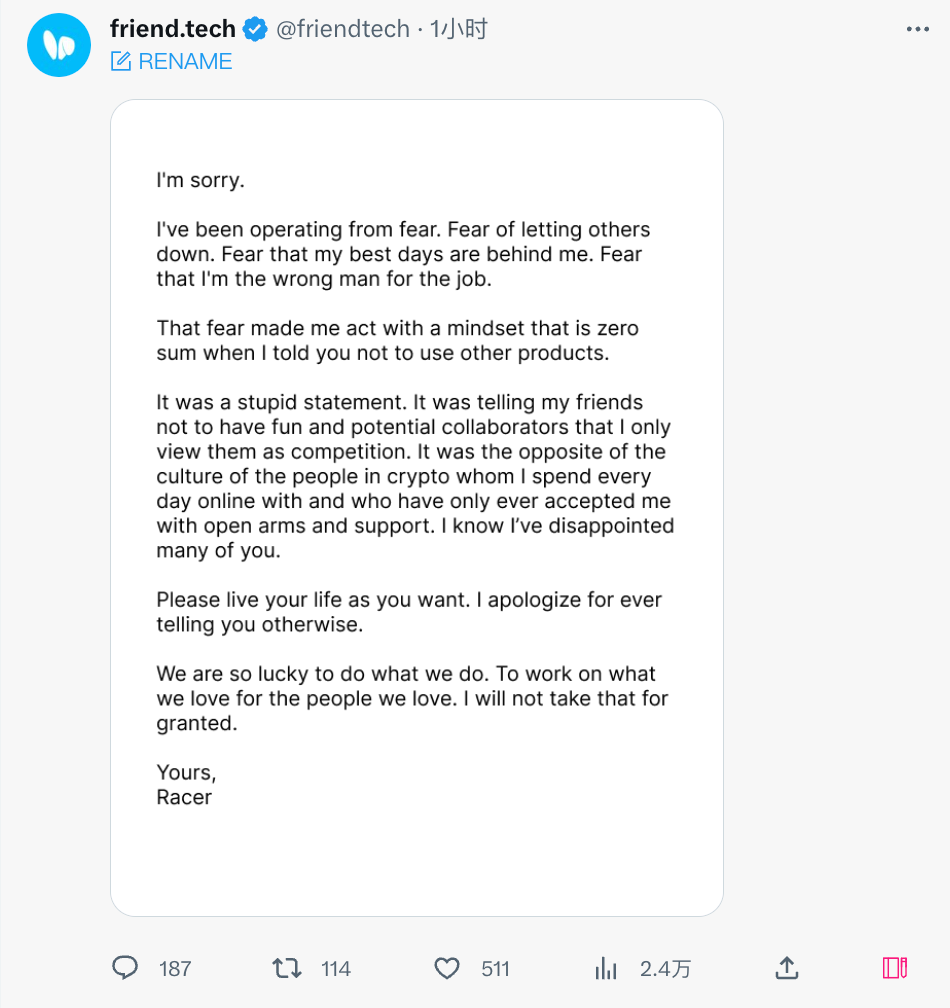
He admitted that his previous remarks about restricting users from using cloned and copycat versions of apps were motivated by fear and zero-sum thinking.
He said he was afraid of disappointing others, that his prime was behind him, and that he was not qualified for the position. This fear has led him to display zero-sum thinking in previous statements, advising everyone not to use other products.
He called it a silly statement, a way to tell friends not to have fun, and to make potential partners think he only saw them as competitors. He said that this runs counter to the open culture in the encryption field, and he is deeply sorry for this.
This public apology letter expresses the teams previous poor consideration and fear trumping reason, which is why they made this decision.
However, the author thinks that this open letter was able to be sent out because reason actually prevailed over fear, because there is actually no subtext clearly written in the letter:
If we continue like this, our project will be finished amidst the condemnation, and our interests will be damaged.
Whether it is out of consideration for appeasement or sincerity, this two-level reversal at least illustrates the following issues:
This kind of mistake will only happen if the team or founder is not very crypto-native;
The team lacks judgment in PR and marketing;
The problems of governance and business thinking cannot be solved by product web3.
The prosperity of the world is all for profit, and the world is for profit. If you want to show sincerity and retain the already cracked consensus, you might as well do another round of airdrops to bring this two-level reversal to a wonderful end.
Nothing new in Web3?
The monopolistic thinking of friend.tech is actually nothing new, and there are traces in the long history of the Internet.
More than 20 years ago, a 3Q war maxed out all kinds of media. The competition between 360 and QQ may have lost the impression on younger readers.
In 2010, Chinas two largest software companies, Qihoo and Tencent, accused each other of unfair competition. In September 2010, Qihoo released 360 Privacy Protector and 360 KouKou Bodyguard for Tencent QQ, saying it could protect the privacy and network security of QQ users. On November 3, Tencent announced that QQ software would no longer be able to run on computers with 360 software installed.
“Use me or it.” On the Internet 20 years ago, companies forced users to choose between QQ and 360 based on user habits and social needs;
In web3 20 years later, projects are competing with each other with airdrop expectations and rewards, forcing users to make choices.
In the more greedy and disorderly web3, only children make choices, and of course the wooly people want them all. As long as the wool is publicly accessible, there is no reason to collect A instead of B.
Therefore, friend.tech reined in the precipice, presumably also quickly realized the magic of web3 after the impulse:
Monopoly in web3 cannot be created by mandatory terms, but needs to be forged by value consensus.
BTC and ETH are all like this. After all, we still need to be open and allow everyone to choose to be friends with the same interests and time.





