A Guide to Preventing Criminal Risks for Cryptocurrency Executives


Original author: Attorney Zhou Fengxuan—senior lawyer at Shanghai Mankiw Law Firm

On August 6, Hong Kong media reported that Huobi executives had been arrested by the Chinese police. At that time, Wu Shuo Blockchain also quoted news and revealed that many domestic CTOs, CHOs and other senior executives of an exchange were recently investigated by the Chinese police. The crime is to open a casino. In addition, some other exchanges have also been investigated, and the founder of a third-tier exchange has also been investigated in a very wide range. Although Huobi promptly came forward to clarify and refute the rumors, saying that they were taken away by the police and were only invited to drink tea. We will not delve into the truth or falsehood for the time being. The situation of executives being taken away by the police for investigation, whether it is news reports from official channels or illegal Revelations from official channels have long been common in the currency circle. In short, the cryptocurrency field involves higher risks, and cryptocurrency industry executives need to understand and comply with relevant laws, regulations and regulatory requirements to ensure that the companys business is legal and compliant. For now, business activities related to cryptocurrency are in a gray area in China, which is ultimately related to the countrys regulatory policies.
01 Key Points of my country’s Virtual Currency Regulatory Policies
Deny the currency and value attributes of virtual currency, but recognize its commodity attributes.
It is prohibited to carry out exchanges between virtual currencies and legal tender in mainland China, prohibit centralized trading of virtual currencies through platform methods, and supervise various infrastructure and intermediary agency platforms involved in virtual currency transactions.
Complete de-financialization prohibits any virtual currency projects involving fund-raising and financing, so as to isolate the transaction risks related to virtual currencies from the financial system.
02 Who are the executives in the currency circle?
Executives are also called senior managers. According to Article 216 of my country’s Company Law, “the meanings of the following terms in this law: senior managers refer to the manager, deputy manager, and financial director of the company. Secretary to the board of directors of a listed company and other personnel specified in the companys articles of association.
Managers and deputy managers generally refer to the companys general manager and deputy general manager, not department managers.
The secretary of the board of directors of a listed company is a required institution for listed companies and is responsible for the preparation of shareholders meetings and board meetings of listed companies, the storage of documents, the management of company shareholder information, and the handling of information disclosure matters;
Senior managers specified in the companys articles of association. In addition to the personnel listed above, Chinese law also allows companies to choose their own management methods, hire other senior managers based on the companys operating conditions, and stipulate them in the companys articles of association.
When we talk about executives in the field of virtual currency, we usually refer to people who hold senior management positions in digital assets or blockchain-related enterprises, such as chief executive officer (CEO), chief financial officer (CFO), chief operating officer (COO), chief technology officer (CTO), partners, directors, etc.
03 Common criminal offenses and prison terms involving virtual currencies
1. What are the most common crimes involving virtual currencies?
The 3,084 criminal cases involving virtual currencies disclosed on the China Judgment Document Network (as of August 23, 2023) were classified and sorted. There were 11 types of cases involved, among which the number of casino-opening cases was the largest, reaching 680, accounting for the total number of cases. 22.05% of the total number, followed by 634 cases of organizing and leading pyramid schemes, accounting for 20.56% of the total number, and crimes involving many types of cases accounted for more than 95% of the total number. The specific statistics are as follows:
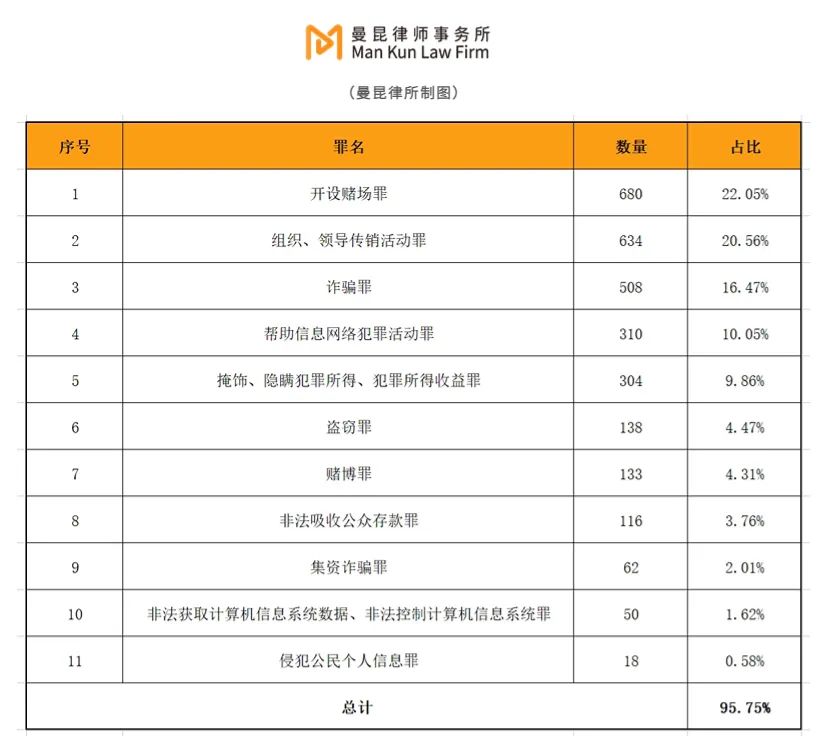
In view of the decentralization, anonymity, global convertibility, transaction convenience and irrevocability of virtual currency, combined with the above figure, it can be seen that companies (or organizations) engaged in virtual currency are most likely to be identified as online gambling and pyramid schemes. In addition to the three major categories of cases: fraud and fraud, the crimes involved are complex and dazzling. In other words, virtual currency is like a double-edged sword. On the one hand, as an innovative Internet financial product, it is in a period of rapid development. On the other hand, it also brings huge challenges to traditional financial supervision and criminal risk control. .
2. Sentences for common crimes related to virtual currency
Through analysis of related crimes, the maximum penalty for criminal cases involving virtual currency can be life imprisonment. The main crimes and legal provisions are as follows:


04 Take precautions against criminal risks
As a cryptocurrency industry executive, you must know that the cryptocurrency industry is a market full of opportunities and risks. In this market, various currencies and investment strategies emerge in endlessly, and there are also many risks and challenges. Among them, criminal risk prevention is an important aspect that executives in the currency circle need to pay attention to.
1. Prevent mining criminal risks
(1) Using the gimmick of investing in mining, purchasing mining machines, and paying principal and interest to attract users to invest funds is suspected of illegally absorbing public deposits or fund-raising fraud.
In the currency circle, the most typical illegal fund-raising is the fund-raising model, such as various ICOs, IFOs, IEOs, IMOs, etc. conducted using virtual currencies as carriers. Relevant financing entities raise funds from investors or virtual currencies such as Bitcoin and Ethereum through illegal sales and circulation of tokens, which is essentially an illegal public financing without approval. It should be noted that even if the project party raises virtual currencies such as Bitcoin and Ethereum instead of legal currencies during the fundraising process, Bitcoin, Ethereum, etc. (different from other data that may be considered Air Coin), as an online virtual property, will be more likely to be recognized as funds for illegal fund-raising.
However, on the other hand, in order to maintain the normal expenses of the domestic technical operation team, general project parties often liquidate the raised Bitcoin or Ethereum through exchanges or OTC, convert the transaction into legal currency and use it for team operations or other purposes ( such as squandering). The above situation will also be more likely to be identified as raising and trading Bitcoin or Ethereum to achieve the purpose of illegal fund-raising.
After the 9.4 incident, some project parties returned coins to domestic users in order to avoid risks. However, some project parties only make coin refund announcements instead of actively refunding coins to all original addresses. The proportion of users who actively refund coins is very small. Therefore, the above-mentioned projects still have the risk of illegal fund-raising.
(2) Using the concepts of virtual currency mining, virtual currency and blockchain to attract participants to join the organization, and through training and publicity, to induce participants to continue to develop and others to participate, it is actually a Ponzi of borrowing the new to pay back the old A scam, which constitutes the crime of organizing and leading pyramid schemes.
In reality, under the guise of “virtual currency” and “blockchain”, some people believe that virtual currencies can rapidly appreciate and join them. At the same time, through the remuneration system, reducing entry fees, issuing high rebates, shortening the settlement time of member bonuses, etc., the temptation and deception are enhanced, inducing users to actively recruit people to join to form a hierarchical structure, and stimulate the rapid expansion of the MLM network. For example, some project parties have gone to third- and fourth-tier cities to do hotel conference marketing, inducing some uncles, aunts, and inappropriate investors to invest or develop downline investments in order to achieve the purpose of illegal profits. Projects suspected of carrying out pyramid schemes usually spend hundreds of thousands to buy a set of codes to build a digital token exchange, and then issue digital tokens in the name of blockchain and list them on the exchange, and use market value management Do things in the name of price manipulation. After the digital tokens are listed on the exchange, the project team will hire a large number of people to go to third- and fourth-tier cities to promote them, and use the guise of multiple returns and stable dividends to attract investment and develop offline investments. Currently, MLM coins like this have been criminally regulated, such as Guangdong’s Pu’er coins.
(3) By fabricating mining, mining machines, and mine projects to conceal the truth and deceive others into purchasing them, this is suspected of fraud.
Some project parties, investment agents or market makers, etc., fabricate facts, forge a luxury founding team, use various official government information at home and abroad to promote guaranteed capital and guaranteed returns, induce ultra-high multiple returns, and think they have harvested IQ tax, or through trading mentors, group learning, etc., to induce investors to invest in digital tokens, and then illegally make profits through price manipulation, currency value management or reverse operations, similar routines are followed in futures Spot transactions, postal currency cards, cultural exchanges, etc. are all suspected of constituting fraud.
2. Prevent criminal risks associated with opening casinos and online gambling
The online gambling platform server is built overseas, which is a complex of traditional online gambling, dark web technology, blockchain virtual currency transaction + chat tool promotion and operation, and has become a new form of cybercrime. From the model point of view, most of the online gambling platforms adopt a pyramid organizational structure model, which recruits agents layer by layer, develops members layer by layer, and pumps from members wagering amounts layer by layer to make profits. Behind the scenes, the bookmaker analyzes the gamblers bets and controls the odds based on the betting ratio. A small number of people win money, and most people lose money.
Gambling projects have been popular for a while during the World Cup, and gangs or organizations that opened online casinos made a lot of money by combining blockchain gimmicks. Even some listed companies, especially those in the gaming industry, are jumping into projects such as games + blockchain and plan to use the concept of blockchain to transform some projects such as slot machines, black pool transactions and black pool trading. Games such as Horse Racing have induced a large number of domestic users to participate.
What’s more, some domestic public chains, in order to increase the activity of users and transactions, develop so-called spinach DAPPs in the name of “gamification”. Of course, there are also some overseas projects that, in order to solve the problems of foreign exchange control and overseas payment, sell or issue digital tokens through domestic agents, and use digital tokens as gambling chips, hoping to achieve the purpose of opening and operating online casinos in the country.
3. Prevent and help information cybercrime criminal risks
Some technical service providers, project packagers, traffic media, underwriting agents, etc., knowingly know that these project parties wantonly amass money and make illegal profits through ICO or currency issuance, etc., knowingly that others use information networks to commit crimes and provide Internet access for their crimes Provide technical support such as access, server hosting, network storage, communication transmission, etc., or provide advertising promotion, payment and settlement, etc., which is suspected of constituting the crime of assisting information network criminal activities. Therefore, if some WeChat public accounts in the currency circle are blocked, it is considered lucky. If the judicial authorities investigate deeply, they may one day be suspected of committing a criminal offense.
4. Prevent criminal risks of infringement of citizens personal information
When some blockchain projects are cold-started, in order to acquire a large number of early users in a short period of time, they attempt to drag out the databases of other project parties through credential stuffing, or buy and sell accurate users personal information through gray and black industries. That is, through so-called candy airdrops and other methods, a large amount of user personal information is obtained, resold, or used for other illegal purposes. There are also some blockchain projects in the name of data equality and data ownership, crawling a large amount of data without the full authorization of users or seriously exceeding the principle of necessity to illegally obtain citizens personal information.
5. Prevention of money laundering criminal risks
(1) Money laundering through buying and selling virtual currencies, or using virtual currencies as a means of payment, and money laundering through money mules (specifically referring to criminals who transfer money overseas through Internet fraud) have become the current methods of using virtual currencies to launder money. Main way.
(2) Purchasing virtual currency on the trading platform, after multiple transfers of wallet addresses and frequent transactions of multiple platform accounts, the virtual currency is finally withdrawn or converted into legal currency; or using trading platforms, over-the-counter brokers, etc. A third person facilitates money laundering. As far as most exchanges or large-value OTC transactions on the market are concerned, their KYC (KYC rules refer to the fact that when providing services to customers, the actual holder of the account must be reviewed to confirm that the account holder or the actual Whether the client of the beneficiary is subject to risks such as anti-money laundering laws and anti-terrorism financing) can only be done to a very rudimentary level. For example, the rules of some exchanges will require users to register with their real names. If the user registers with a real name, he or she will be allowed to make large transfers and withdrawals. If the user does not register with a real name, the daily transfer and withdrawal amount will be limited. In the process of real-name registration, facing users from all over the world, most exchanges can only require registered users to take photos and upload with their ID cards or passports in hand to achieve primary real-name authentication. That is to say, the exchange cannot do face-to-face signing by users, and there is no way to use the four elements: name, citizenship number, mobile phone number, and bank card for binding verification that are commonly used in the financial industry. The legality of the source of the traded Bitcoin, Ethereum or other digital tokens cannot be traced and reviewed. Therefore, if a transaction similar to the above occurs, it will often happen that our domestic bank cards are frozen by the police, and the police will go deeper into it. In practice, it is often accompanied by the occurrence of predicate crimes such as telecom fraud and illegal fund-raising.
05 Lawyer Mankiw suggested that executives in the cryptocurrency industry should fully realize the seriousness of criminal risks, strengthen their own compliance awareness, and guard against potential risks:
Executives in the currency circle should fully understand and abide by national laws and regulations and my countrys digital currency regulatory policies deny the currency and value attributes of digital currency, prohibit the exchange between digital currency and legal currency, and prohibit centralized transactions of digital currency through platforms. ” and “de-financialization” characteristics, in order to establish a complete internal management system, standardize business behavior, and avoid violating the law.
Companies (or organizations) that engage in virtual currencies are most likely to be identified in the three major categories of online gambling, pyramid schemes, and fraud, and criminal cases involving virtual currencies carry maximum sentences of up to life imprisonment.
The criminal risk prevention of currency circle executives should focus on: mining, opening casinos (online gambling), helping information network crimes, infringing on citizens’ personal information, and money laundering.
06 Conclusion
At present, we are on the cusp of digital development. The development and construction of the web3.0 industry are also in full swing. The number of criminal cases related to virtual currency is increasing. The image of scourge is becoming more and more profound in society. What exactly is virtual currency? Whether it is the value output of blockchain, a new technology, or another problematic financial method in the context of digitalization and informationization, there is no conclusion yet. But for every enterprise, only by clearly understanding the legal risks behind the virtual currency, especially being alert to the related criminal risks, abiding by relevant laws and regulations, and having a clear insight into the wind vane of regulatory policies, can you minimize your own risks in investment operations , thereby allowing enterprises or assets to maintain steady growth.
Special statement:
This article is an original article of Shanghai Mankiw Law Firm, which only represents the authors personal opinion and does not constitute legal consultation or legal opinion on specific matters. If you need to reprint the article, please contact Mankun Law Firm staff: MankunLawFirm