






What should be the crime for hackers to steal NFT digital collections?



Recently, domestic digital collection platforms have been attacked by hackers one after another, resulting in the theft of a large number of digital collections, which were quickly put up for sale, withdrawn and left, causing huge losses to users or platforms. It is reported that the platform has reported to the police, and the police have frozen most of the funds involved in the case, and the suspects have also been brought under control.
It is not uncommon for NFT to be stolen. As early as April 1 last year, Jay Chou announced that the boring ape given to him by his friend had been stolen. This is not an April Fools Day joke. Since then, whether it is Opensea abroad or domestic digital storage platforms, hackers and thefts have occurred one after another. The reason is that the cake of NFT is too attractive, the field is too hot, and the money comes in too fast. Hackers can quickly cash out and leave the market, focusing on efficiency and convenience.
However, the legal network is back and forth, and the suspects have arrived. As a legal practitioner, the author is often concerned with professional issues-what is the crime of stealing digital collections?
01 Theft or the crime of illegally obtaining computer information system data?
Before discussing the theft of NFT, we can briefly talk about digital currencies that are also blockchain technology. Around the theft of digital currency, there has always been a dispute over the crime of theft or the crime of illegally obtaining computer information system data. The Mankiw team has also talked about it (see: Is illegally stealing other people’s Bitcoins considered stealing?). However, we have found in judicial practice that the legal characterization of digital currency theft by different courts is still inconsistent, which directly leads to a huge gap in the prison terms of the parties involved.
For example, in the case of Xu XX illegally obtaining computer information system data and illegally controlling computer information system [(2020) Min 0305 Xingchu No. 82], the defendant Xu XX took advantage of the platform system delay loopholes to repeatedly withdraw USDT, and then called five other He used the same operation to extract 110,000 TEDA coins, and was finally convicted and punished by the court for illegally obtaining computer system data.
In the case of Fang’s theft [(2021) Shanghai 0118 Xingchu No. 670], Fang invaded the company’s system through technology and secretly transferred “King Kong Coin” to make a profit of 20,000 yuan. He was finally sentenced to one year in prison for theft by the court. Six months a year and a fine of five thousand yuan.
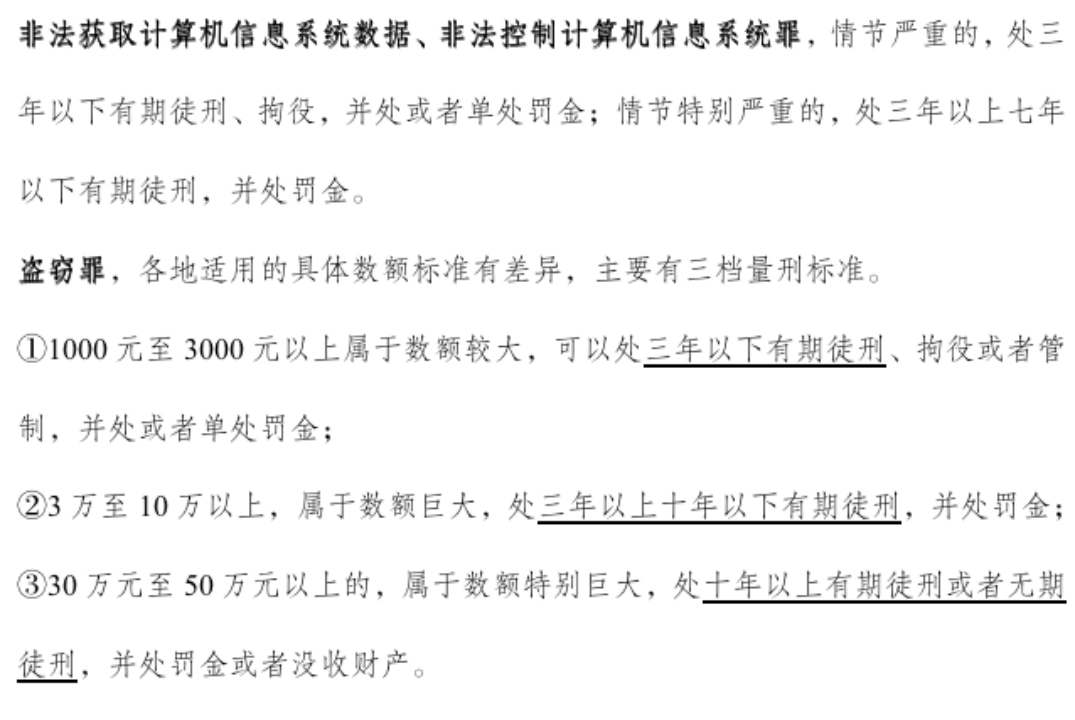
We can see that the same method is used to steal coins, but the amounts are very different, but the results are very different, which is puzzling. The reason is that, in terms of legal regulations, the two crimes are very different. Theft, as an ancient crime of property infringement, is punishable by life imprisonment (the death penalty has been abolished); while illegally obtaining computer information system data, illegally controlling The essence of the crime of computer information systems is to stabilize public order. The maximum penalty is fixed-term imprisonment of not more than seven years and a fine.
02 What is the crime of stealing digital collections?
I have said a lot before, just to explain that there are different opinions on theft of digital currency in practice. However, for the theft of digital collections, the author believes that it is more appropriate to be convicted and punished for the crime of theft.
First of all, there are many significant differences between digital collections and Bitcoin. Bitcoin is a homogenous token, while digital collections are non-homogeneous tokens, which are unique. The essence is the ownership certificate corresponding to specific works and artworks, in order to realize authentic and credible digital distribution, purchase, Collection and use, which not only condense blockchain technology, but also comprehensive things such as copyright and appreciation value of works, cannot deny its own value just because some users/platforms hype it, it should be Protect it as property in the context of theft.
Secondly, the domestic policy does not prohibit the transaction of digital collections, especially the vast majority of Tibetan platforms use RMB for settlement. From the nature of transactions, digital collections are commodities and should also be protected by law. Taking a step back, even if the country prohibits the transaction of digital collections, making them completely lose their circulation properties from the legal level, they should be protected by law, otherwise, is it innocent to steal drugs? On the contrary, in practice most people are still convicted and punished for the crime of theft.
Thirdly, from the perspective of victim protection, stealing digital collections should also be classified as theft. Digital collections may be purchased by users with a lot of money. From the perspective of their losses, the conviction and sentencing of theft can better protect their rights and interests (the legal interests behind them). Otherwise, they may fall into a moral trap, that is, criminals steal digital collections. After the collection is resold, the stolen goods are resolutely not returned, and after several years of imprisonment, they finally come out to eat and drink. In this case, the crime, responsibility, and punishment do not match, and it is easy to encourage the arrogance of criminals.
03 Summary of Lawyer Mankiw
As a legal practitioner in the NFT field, I still hope to increase the crackdown on cybercrimes such as hackers. This circle not only needs its own compliance, but also needs a good legal environment to protect its healthy and orderly development.
Author of this article: Gao Mengyang
Senior lawyer at Shanghai Mankiw Law Firm
Attorney Gao Mengyang is a full-time lawyer of Shanghai Mankiw Law Firm. He once worked for a leading e-commerce platform in China. He has rich practical experience in contract compliance and risk management. He has handled more than 100 criminal and civil litigation cases since his practice.
Lawyer Gao Mengyang has been deeply involved in the fields of new economic crimes, tax-related crimes, criminal compliance and criminal defense for many years, and has handled many major and difficult cases. In the field of civil and commercial dispute resolution, we have also handled many cases including disputes over liability for harming the interests of companies, futures trading disputes, entrusted wealth management contract disputes, and private equity fund contract disputes.
Special statement:
This article is an original article of Shanghai Mankiw Law Firm, which only represents the authors personal opinion and does not constitute legal consultation or legal opinion on specific matters. If you need to reprint the article, please contact Mankun Law Firm staff: MankunLawFirm





