






In-depth discussion on the ecological status and future development trend of Intents


Original author:BRIDGET HARRIS
Original compilation: MarsBit, MK
Intents and their impact on account abstraction, proof of storage, rollups, etc. are creating interesting new dynamics for cryptocurrencies. As these key components emerge, they are uniquely reshaping user experience (UX), transaction efficiency and design, and the balance between centralization and decentralization.

Interpret intent
A transaction is a highly specific action a user wishes to perform, whereas an intent specifies what the user wishes to achieve within certain parameters. Often, the intent is to outsource the task at hand to the user and have access to multiple environments so that the user does not have to manually manipulate fragmented protocols. By not coding every aspect of each transaction, more transaction expressiveness and efficiency can be achieved, and UX can be improved.
As Paradigm puts it: “By signing and sharing intents, users actually authorize the recipient to choose computational paths on their behalf.”
Users just want to trade at the best price, often, they dont care which platforms need to be involved (the success of 1inch and the launch of 1inch Fusion as an early example of intent is one reason for that success). Furthermore, intents can often be fulfilled in many different ways, while transactions have a highly specific execution path. This is graphically depicted below:
Source: Paradigm
In some intent infrastructure designs, once a user specifies an intent, it is broadcast to gossip nodes in the p2p network layer. We then delegate computational responsibility to entities called solvers (also known as searchers/matchmakers), which in a fully intent-centric protocol are also builders (required for PBS). The solver operates to execute the users intent specification and generate valid transactions. They compete with each other to satisfy intents in the most efficient way, then relayers do validation, and finally validators on the intent network commit to fulfilling. The process here is: the user sends the intent to the intent pool → the gossip node broadcasts in the intent pool → the solver competes to execute the transaction in the mempool.
The intent is an open problem space, and were not entirely sure yet what the UX will look like, but the general goal is to make cryptographic applications easier, more flexible, and efficient for users. A recent episode of Bankless in conversation with Dan Robinson highlighted how the new design will be structured from a high-level user flow perspective. Users will see a similar interface as usual on the web app, but instead of signing an eth transaction, they are signing an offline message, which is then routed to the MEV black box, which ultimately turns the intent into a complete transaction, and then included on the chain. Intent is a more versatile format for users than eth trading, as it only specifies the start and end points, rather than by gas, slippage, using only one DEX/AMM, etc. as we have now, thus Leading to a better user experience. Once the intent is expressed, it is offloaded to the system that finds the best price; the user just broadcasts a message without creating the transaction themselves. From there, any solver is free to satisfy the intent, so long as they can prove that they solved it in the most competitive way (e.g., highest satisfaction gradient), users can get the most out of whatever theyre trying to do. Good price. In this sense, intents are more attractive and flexible for end users than traditional on-chain transactions, as they can be resolved in various ways, often resulting in faster and cheaper processes with fewer manual steps.
An example application of intents can be seen in UniswapX. In UniswapX, Dutch auctions are used for intent, where the price is set high and gradually decreases, with orders being filled as soon as someone finds it profitable. As Dan pointed out, the benefit of this in a competitive market is reduced slippage, providing a better basis for order flow auctions.
Uma Roy of Succinct gives a great concrete example of transactions vs. intents in her presentation on intents, SUAVE, AA, and cross-chain bridging:
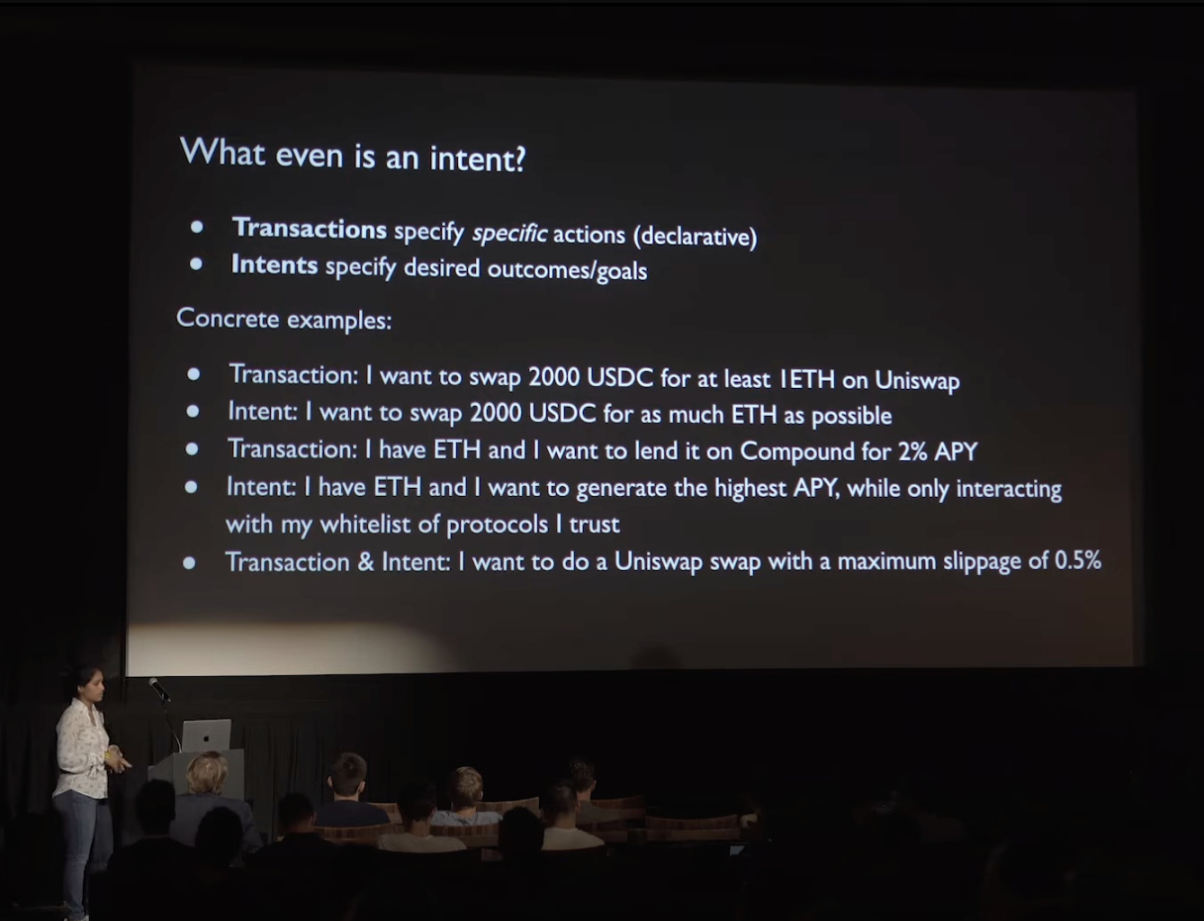
Source: Uma Roy
Intentions in practice, and what they mean for cross-category
Intent can have a broad impact on the following categories:
Bridges and rollups: Dan covered this in more detail on a recent episode of Bankless, but here’s how UniswapX might handle intentions that require bridging: Users could just indicate an intention to, for example, own USDC on Arbitrum instead of Ethereum ETH on. Proof of fulfillment of intent can then be passed to the destination chain via the messaging bridge.
Another element that Dan mentioned is that in the future market makers may be more profitable in terms of satisfying intent (e.g. people trying to exit because the market makers are rebalancing)
In many classic cross-chain bridge designs, funds reside in the bridge contract (for example, the bridge keeps funds on rollup), which is often highly vulnerable to hacker attacks. However, with the emergence of UniswapX, as Dan explained, the only funds at risk are exchanges in transit or active exchanges. For example, an exchanger expresses intention to transfer funds across chains → a filler on the chain commits to fulfilling the order [bridge risk] → the filler completes the order on the destination chain. This is a huge advance for the entire cross-chain space, as exposure is limited to the moment the exchange is being transferred, significantly reducing the amount of funds at risk in the event of an attack.
The intent mechanism reduces cross-chain complexity because users do not need to manually bridge assets (a lengthy and expensive process). Instead, they simply specify the type of token they want to own and which rollup/chain they want to own. Everything else is abstracted away, constituting a huge UX improvement for swappers. Ultimately, if we are leveraging intent to alleviate cryptocurrencys massive user experience problem, users need to be able to more efficiently satisfy their intent by leveraging more liquidity and different technology stacks to access cross-domain environments.
Zero-knowledge (storage) proof: Zero-knowledge storage proof is a new mechanism for transferring blockchain state between L1s/L2s/L3s in a trustless manner. With the emergence of L2 and L3 ecosystems, the problem of latency in transmitting state information has become more and more urgent. The work of storage proof is to solve this problem in a fast and lightweight way.
Proofs of storage might work with intent in interesting ways. As mentioned above, bridging occurs when a user specifies an intent to acquire an asset on a rollup, and the state of the destination chain is sent back via a storage proof to verify that the intent was fulfilled correctly/that the chain is in the expected state. Thus, Proofs of Storage can be generated for trustlessly bridging assets across supporting infrastructure.
Perhaps in the future we will see fulfilled intentions aggregated into verifiable storage proofs, or vice versa - aggregated storage proofs of different states as part of a computational flow to fulfill intentions.
At the EthCC Modular Summit, Vitalik talked about Proof Aggregation in an L2 environment. In the design below, the proof at the end is just the signature/privacy protocol, the proof in the middle is the aggregate proof, then the second layer of proof aggregates the aggregate proof, and finally there is an overall master proof that is transmitted to L1. Through proof aggregation, we can greatly reduce the cost and optimize the proof process.
Source: Builders and Higher Forms of Aggregation - Vitalik Buterin
Recursive proofs have also been explored with zkTree, originally introduced by the Polymer Labs team, and may help enable zkEVMs, zkRollups, zkBridges and zk storage proofs in the future.
Account Abstraction: Essentially, Account Abstraction acts to upgrade EOAs (Externally Owned Accounts, the current standard for transaction generation) so that they can be managed by smart contract wallets, or alternatively, enable smart contracts to initiate transactions directly. For intents, this new paradigm means that the intent layer may move from dapps directly to the user’s smart contract wallet, as intents become more mature and sophisticated. Stanley He makes this argument here, stating that in order for AA to work with intents, there might be an intent → userOp → packager flow (intents flow through the wallet frontend first):
Source: Stanley He
While AA greatly improves the user experience, the user still has to actually manually discover the best/most efficient platform for switching/bridging/LPing etc. The goal of intents is to further remove this layer of discovery so that the user is only responsible for specifying the starting state and desired ending state.
ERC-4337 proposes some designs to maintain decentralization, such as a unified ERC-4337 mempool. This section highlights that fragmented/smaller pools (packagers with different policies) are inherently more vulnerable to scrutiny and attacks. Reducing this surface area can be achieved by enforcing an implementation standard on each packager, thereby ensuring their compatibility.
Great projects like Zerodev, Fun, Stackup, and Rhinestone are building in this space.
Some have expressed concerns about concentration on intent. David Ma from the Alliance: “The key is that intent is difficult to decentralize and therefore is increasingly siled in centralized servers with permissioned reads and writes.”
Efficiency and decentralization are classic issues in this field. Given that cryptocurrency adoption is severely hampered by poor user experience, it may seem tempting to favor centralized solutions. Additionally, since certain elements of the intent rely on off-chain participants/infrastructure, the computational cost is extremely low, especially lower than regular transactions. The computational cost from the liquidation order does not have to be run on-chain (this will be reflected as a gas fee), only on the market makers server. Naturally, moving some parts of the transaction flow off-chain increases centralization, and there are also concerns around resolver centralization (which we use to coordinate the intent volume).
Intent is also explored in the context of compliance, where users can choose the most compliant path to satisfy the intent. The trade-off here will be cost and speed/efficiency, but ultimately it will shift the regulatory burden more to the users/liquidity providers rather than the protocol.
project
Many interesting projects are leveraging components with AA, bridging, and multi-chain infrastructure in unique ways in an effort to enable access to various deployments and ecosystems, delve into greater liquidity, and provide end-users with A more efficient and convenient experience.
Here are some interesting projects:
Essential
Essential is building a comprehensive intent architecture. They have three main projects: a constraint-based programming language for intent expression (more on the DSL), an EIP for intent-based account abstractions on Ethereum, and an intent-based intent-based programming language that reimagines the transaction lifecycle from the beginning protocol. The differences between Essential and SUAVE are as follows:
Essential uses a purpose-built DSL in Rust for expressing intent. SUAVE uses mEVM (Solidity), which has a built-in syntax for preference expression, block construction, and more. Also, the intent was never implemented in Essentials architecture. Instead, they are resolved, and then an execution trace of the resolved intent is generated, which is executed on-chain. This is in contrast to SUAVE, which generates EVM opcodes as part of the intent.
SUAVE is dealing with a cryptographic execution space, while Essentials protocol does not use cryptographic execution for intent privacy. The underlying intent is included on-chain before being decrypted and executed.
Essentials consensus mechanism forces solvers to compete on objective intent satisfaction (0-1 satisfaction gradient), thus competitively encouraging high end-user satisfaction. First, Essential is researching intents in the Ethereum ecosystem, as well as building its own intent-based protocols.
Anoma
Anoma is creating an intent-centric architecture where anyone can implement fractal instances of protocols that together form the Anoma ecosystem. For the intent itself, Anoma creates a partial transaction for the user to sign a signature that expresses the desired end state. As Jon Charbonneau points out, Anomas market makers can even update their intentions periodically: For example, Im willing to buy X for Y, but this order only applies to block height Z.
Source: Anoma
Like the base, Anoma differs from SUAVE. SUAVE is chain agnostic and serves as a separate middle layer in the stack to help serve intent, while Anoma identifies itself as an architecture that can be deployed as L1, L1.5 or L2 rather than a function in the stack/ layer.

Source: Anoma
SUAVE
Flashbots’ SUAVE is itself a blockchain that can “act as a plug-and-play mempool and decentralized block builder for any blockchain.” It is customized to facilitate expression and enforcement of preferences (same as intent at a high level). SUAVEs stack is as follows: a memory pool where users can specify preferences, an execution network where solvers compete to execute the users preferences, and a block building environment where solvers actually create the blocks - which can then be accepted by other networks.
SUAVE tries to be a mempool and block builder for all blockchains. Source: Flashbots
PropellerHeads
PropellerHeads is refining a specific element of the intent architecture - the solver. By using PropellerSDK, specifically their Solver API and Private RPC, users are more protected by MEV and get better prices on their transactions. The Solver API returns the best route by plugging in many liquidity sources and running an optimization algorithm to find the best route for the best price. Example of a routing combination with 4 orders completed by a resolver going into 1 route:
Source: PropellerHeads
OKcontract
OKcontract focuses on the concept of low-level intent by creating a standard to specify smart contract interactions, generating transaction interfaces from the specification, and then allowing developers to embed automated interfaces into any web page. This architecture is similar to Uniswap widgets that can be embedded on other sites - OKcontract hopes to do the same thing for every contract, but in an automated way.
CoW Swap
CoW Swap built an early example of intent to enable p2p settlement orders on a CoW protocol-based trading interface. Currently, CoW Swap can settle orders on Uniswap, Sushiswap, 1inch, and Paraswap, and enable user transactions through signed messages (a process that eliminates the need to pay gas fees). Instead of owning LPs on the platform, CoW Swap can plug into existing on-chain liquidity and leverage liquidity from other AMMs when there are not enough CoWs on the platform (coincidence of will).
User batch auctions, matching orders from multiple users to settle transactions. Source: EtherscanEtherscan
Skip
Within the IBC ecosystem, the Skip protocol is not generally seen as satisfying intent, but can be understood as satisfying intent in this context. Skip operates in Cosmos and holds block space futures to help stakeholders earn more and protect users from harmful MEV. Skips API routing solution finds the most efficient path for end users to experience across chains, ultimately creating an intent-based user flow.
future direction
In crypto, the future is coming fast. Intent is still at the beginning of the discovery and implementation phase, but it will be exciting to watch new companies emerge and what the category evolves into. Technology iterates rapidly in this space, so well no doubt see interesting new designs and implementations of these types of architectures in the near future. Abstracting as much as possible from the user while remaining decentralized and driving transactional efficiency and expressiveness is the primary consideration in the intent space. Hopefully it will eventually drive cryptocurrency adoption and increase efficiency. The dynamics between intent, AA, proof of storage, and bridging are still being explored, and how these parts work together will be key to the maturation of the crypto ecosystem.





