






Weekly Editors' Picks (0729-0804)


"Editor's Picks of the Week" is a "feature" program of Odaily. Based on weekly coverage of a large amount of real-time information, it also publishes many high-quality in-depth analysis content, which may be hidden in the information flow and hot news, passing you by.
Therefore, our editorial department will select some high-quality articles worth reading and collecting from the content published in the past 7 days every Saturday, bringing you new inspiration from the perspectives of data analysis, industry judgments, and opinion output in the encrypted world.
Now, let's read them together:

Investment and Entrepreneurship
The basic requirement for settling in Cyberport is to register a company in Hong Kong, and the registration process is not complex. However, currently only companies registered in Hong Kong can apply to settle in Cyberport.
Eligible companies can apply to Cyberport for initial startup capital (HKD 100,000), incubation and nurturing programs (HKD 500,000), acceleration funds (HKD 300,000), and Series A or later-stage funds (a total of HKD 400 million).
An Analysis of Vyper: A Smart Contract Programming Language Popular Among Developers
Vyper, like Solidity, is a programming language for smart contracts that can be compiled into bytecode for the Ethereum Virtual Machine (EVM) and run on the EVM.
However, Vyper's compiler is written in Python. It is a programming language based on Python and compatible with EVM. It has the characteristics of strong typing, small compiler code size, and efficient bytecode generation.
In the current DeFi development landscape (in terms of TVL share), Solidity dominates the market with a share of 94.71%, while Vyper ranks second with a 3.04% market share.
Vyper is designed to create transparent and simplified processes for smart contract participants, emphasizing readability and auditability to ensure security.
Because the Curve contract is more complex, Vyper makes it easier to manage these complexities and further saves Gas. The latest version of Vyper has fixed this vulnerability, but since the affected Curve stable pool contract cannot be upgraded, it can only be abandoned and the funds withdrawn.
DeFi
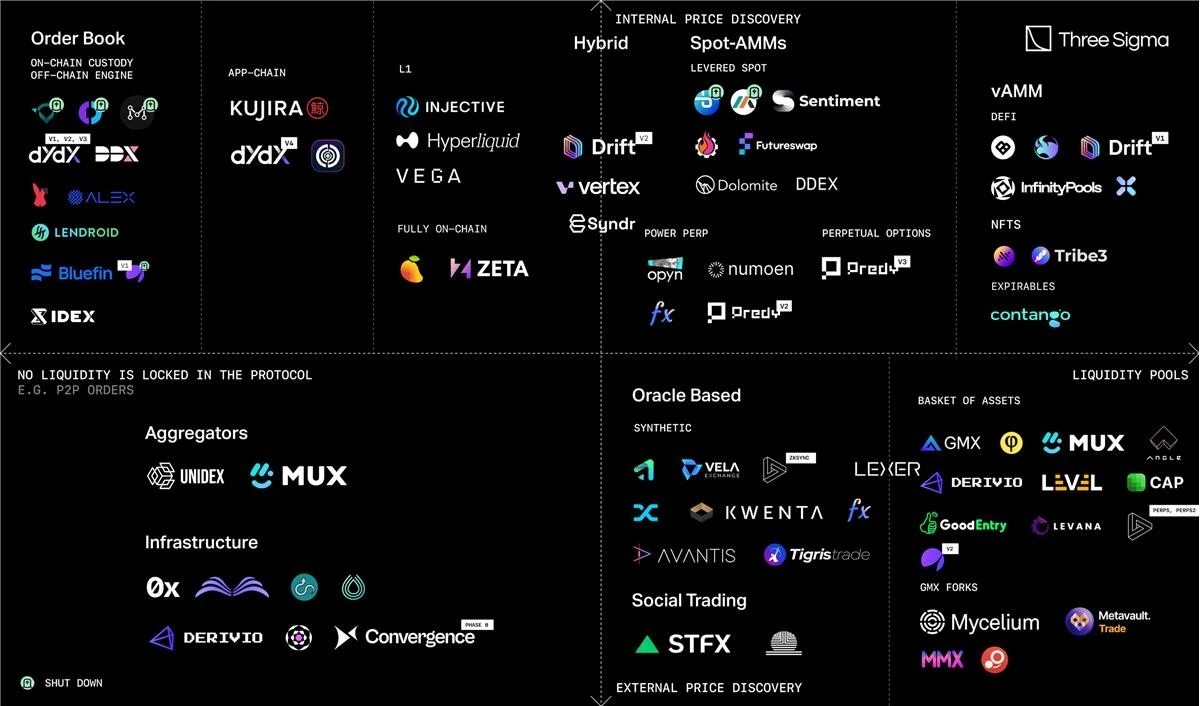
Overview: 60 Perpetual Contract Protocols - Order Book Still Dominant, Oracle Dependency Intensified
The basic classification of perpetual contract protocols is that the perpetual contract market has achieved substantial market adaptability, which may lead to market saturation to some extent.
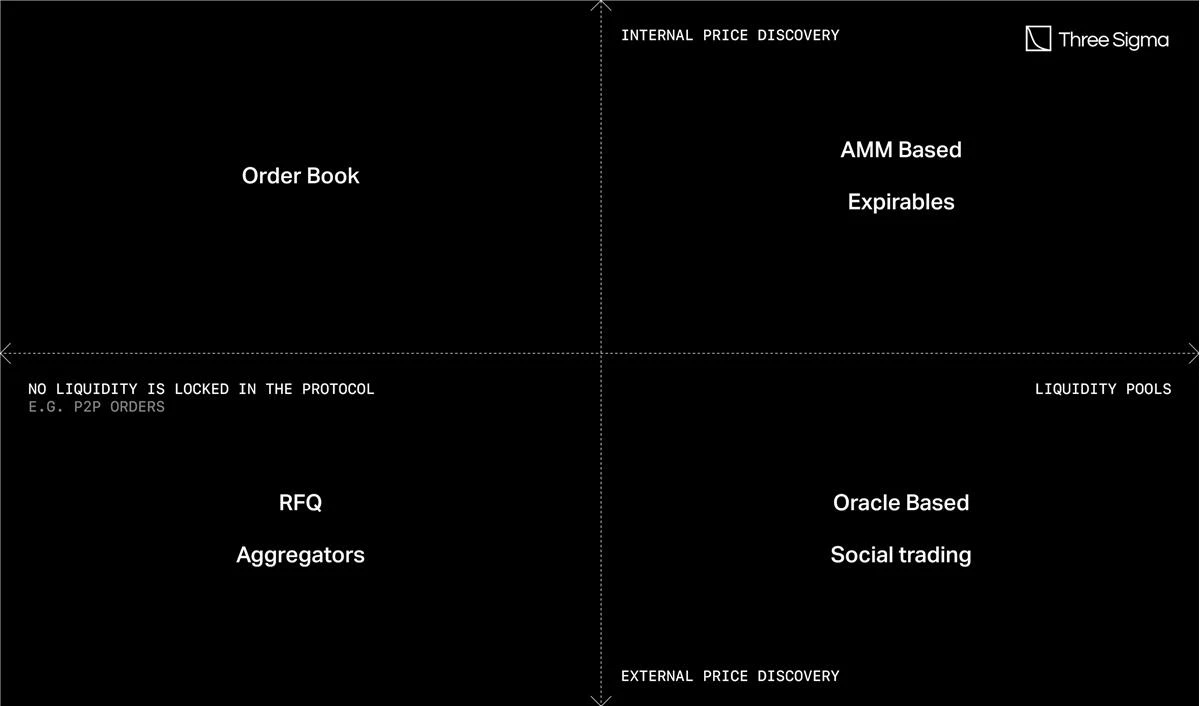
The order book is likely the most suitable type for trading, which is why dYdX currently has the largest trading volume among decentralized perpetual contract exchanges (perp-DEXs). AMM and vAMM were very popular in the early stages of DeFi cycles. Most of them eventually adopted the route of Uniswap v3 (centralized liquidity). AMM ensures that participants continue to obtain liquidity in the presence of liquidity but may absorb toxic order flow as a cost. Between the order book and AMM, two protocols - Drift and Vertex - have adopted a hybrid approach to provide liquidity and pricing.
 Lybra: The Growth Path and Real Challenges of LSDFi's Newcomer
Lybra's TVL has occupied a considerable position in the so-called LSDFi summer. Lybra Finance was officially launched on April 24.
In the current V1 version, eUSD can only be generated by over-collateralizing stETH. Lybra requires a minimum collateral ratio of 150% for eUSD. eUSD adopts a Rigid Redemption mechanism to stabilize the price. In terms of liquidation, Lybra introduces two roles, Liquidator and Keeper. Liquidator provides liquidation funds (eUSD), and Keeper triggers liquidation operations. They can receive rewards of 9% and 1% respectively.
Lybra Finance refers to the stablecoin protocol Liquity for core mechanisms such as minting/redeeming, liquidation, and price stability. It retains Liquity's redemption and recovery modes, removes the stability pool (thus eliminating some token incentives), and opts for liquidators to provide liquidation funds.
Lybra provides a strong use case for their stablecoin eUSD - interest-bearing stablecoin. By using mechanisms rather than incentives to stimulate the demand side of stablecoins, it combines early-stage incentives to encourage stETH holders to mint and close the loop.
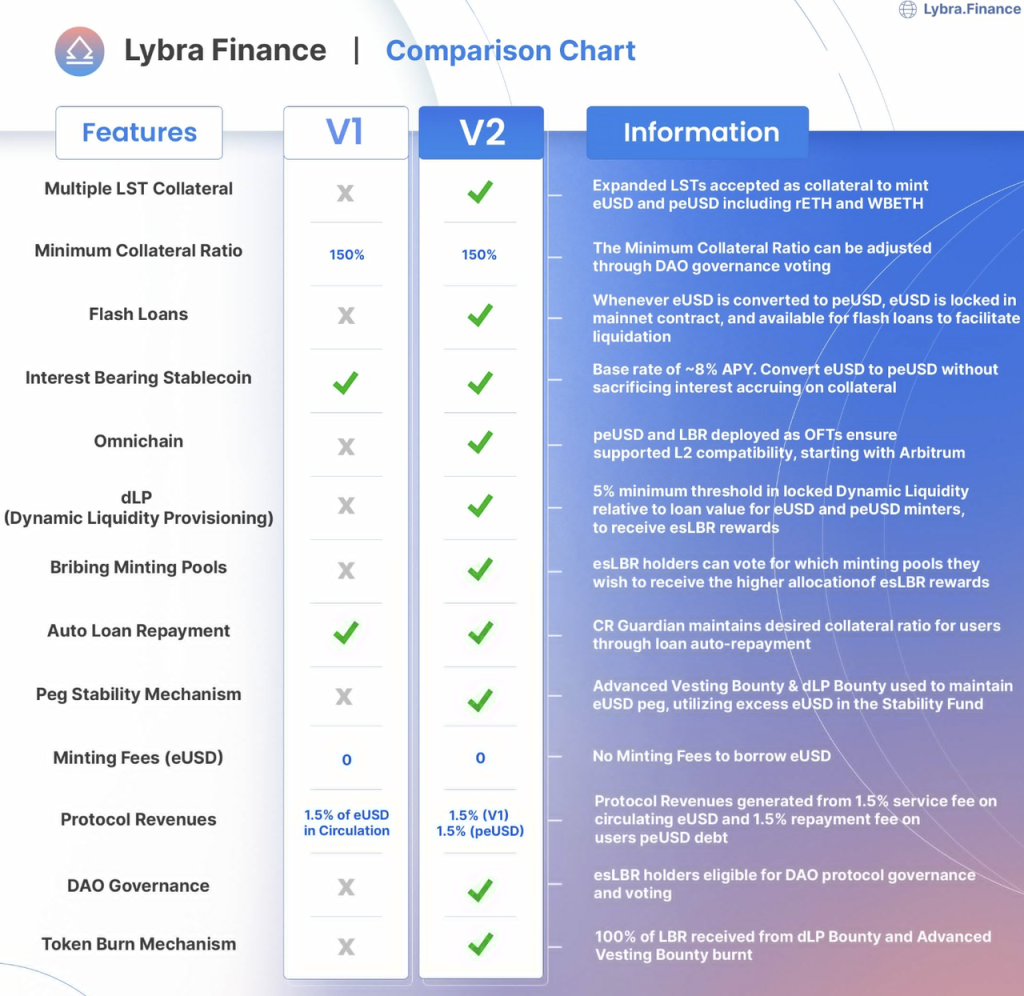
Lybra V2 addresses the issues exposed in V1, such as poor composability of eUSD, the inability to extend the product model to value-accumulating LST, and difficulty in recovering eUSD price premiums. It provides targeted solutions and aims to establish a stronger connection between the protocol's incentive token LBR and its long-term development.
The release of Uniswap V3 significantly improves capital efficiency in the DeFi market but also introduces liquidity-related issues. Existing methods to hedge impermanent loss are unable to fully unleash the potential of Uniswap V3, and this is the problem that Logarithm Finance is actively addressing.
Logarithm Finance is a decentralized liquidity management and market-making protocol designed for market makers and DeFi users. Users can profit from market-making activities without constantly managing their positions to find high APY. It focuses on earning automatic compounding fees on Uniswap-like AMMs and minimizes the risk of volatile assets by creating short positions on composable DEXes through delta-neutral strategies.
The advantages of LPDfi (Liquidity Providing Derivatives - liquidity-providing derivatives) include: cross-chain liquidity aggregation, improved capital utilization efficiency, decentralized risk, increased stability, reduced slippage, and improved trade execution efficiency.
Other LPDfi projects include Panoptic, Limitless, Smilee Finance, and Infinity Pools.
Synthetix V3 Outlook and Data Analysis
Synthetix V3 has introduced many new features and improvements. These enhancements improve the protocol's capital efficiency and security, remove the liquidity cap, enhance user experience, and attract more users to participate in the Synthetix protocol. After the full launch of V3, it is expected to bring new business increment and valuation. It is expected to be integrated into more products and become an important DeFi component.
However, new user growth is currently slow, and the development cycle required for the full launch of V3 is uncertain. The revenue from SNX staking under the new token model and the retention rate after the third quarter will be important valuation indicators for SNX holders in the short term.
NFT, GameFi, and Metaverse
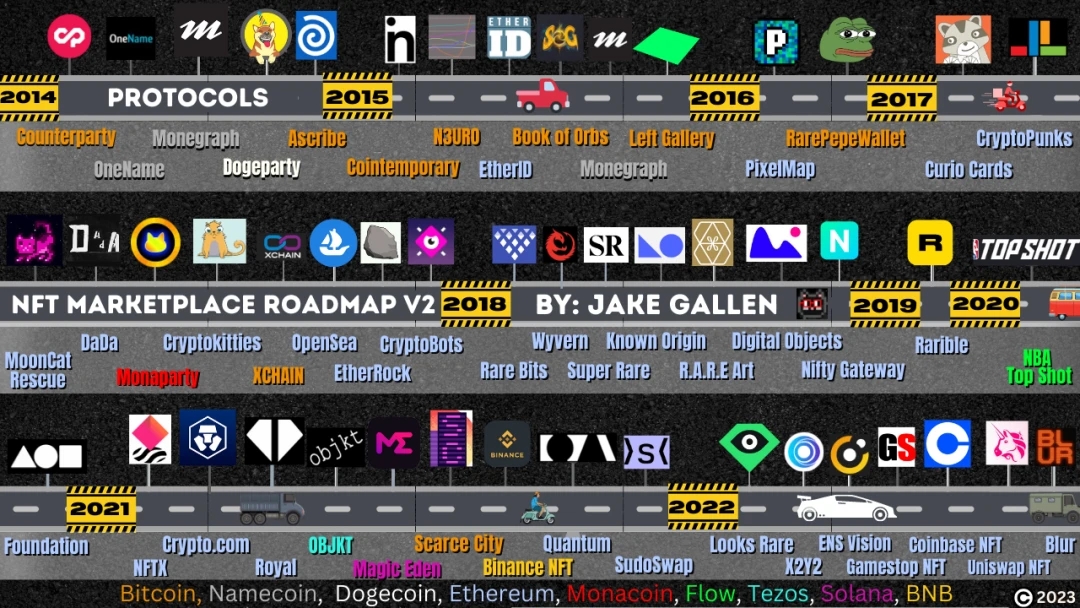
A Comprehensive Review of the History of NFT Market
Web 3.0
An Overview of Practical Decentralized Storage Products: Making Information Storage Easy
The article introduces ArConnect, Archive the Web, Planet, xLog, Web3.Storage, Filebase, Ardrive, and Weweave, websites that combine IPFS or Arweave, as well as storage integrated into protocols (Glass, Lens Protocol).
Ethereum and Scalability
Understanding EIP-7377: The Pioneer of Transitioning from EOA to Smart Contract Wallet
EIP-7377 proposal was put forward by Go Ethereum developer Matt Garnett with the aim of adding a new transaction type that allows EOA accounts to permanently migrate to smart contract wallets through a one-time transaction. This provides a feasible path for advancing Ethereum account abstraction. The motivation behind EIP-7377 is to address the real-world need for migration from EOA to smart contract wallets by providing a mechanism at the protocol level, enabling a smooth transition. This may significantly increase the willingness of existing users to migrate and provide a more practical EOA transition solution for new users before widespread adoption of account abstraction.
However, the risks of this new feature being used for malicious attacks include, but are not limited to: phishing attacks, malicious code injection, and repeated migration theft.
IOSG Ventures: Exploring the Monetization Design of Rollup
When the concept of Rollup was in its infancy, we referred to the role of operating Rollup as Relayer or Operator. As infrastructure development becomes more refined, this role has been divided into multiple entities: Sequencer responsible for sequencing transactions and writing to DA, Challenger responsible for presenting challenges, and Prover responsible for generating proofs.
Sequencer collects transaction fees from users and pays DA fees to Ethereum. MEV is an important way for Rollup to establish a business model.
Mainstream Rollups will gradually move towards DS within two to three years. Both decentralized Sequencers and Provers have two main options: internal development by the team or outsourcing. The former has a wider design space and is mainly based on Staking-slashing cryptographic economic primitives, with some mature mechanism designs available for reference. The latter may rely on a fee model similar to DA.
For early Rollups, including some App-specific Rollups, outsourcing this decentralized work and quickly conducting bootstrap may be the best solution (through DS & SS or EigenLayer). As for more mature Rollups, they have more abundant developer resources and funding, and they will consider capturing token value and resource connections to build moats and flywheel effects.
Currently, the only value proposition for Arbitrum and Optimism is governance; this is the sole function of ARB and OP. However, the value proposition of ARB and OP may come from two other sources: transaction fees and MEV.
L2 token is the first step to achieve value accumulation through decentralization sorter. The decentralization of the sorter is likely to be achieved through the PoS mechanism, where users stake native L2 tokens. Stakers can earn a portion of transaction fees, MEV (in the later FIFO world), or staking rewards in the form of native tokens.
New Ecologies and Cross-Chain
ConsenSys Leader Linea Makes Its Debut: Breaking ZK Rollup Limits, Achieving Full EVM Compatibility
Highlights of Linea include: seamless integration with ConsenSys products such as Infura, MetaMask, and Truffle, unique internal proof system and compression methods. These technologies enable Linea to improve transaction speed and reduce user gas fees while ensuring high compatibility with EVM.
The promotion of Multi-Prover Linea still lags behind the leading zkSync in the zk-rollup competition. Moreover, in terms of ecosystem development, Linea is relatively behind compared to several other zkEVM projects that have already gone live on the mainnet.
Deconstructing the Current Situation of Optimism: Ecosystem Development and the Future of OP Stack
From a data perspective, Arbitrum is still the leader in Layer 2, while OP remains at a disadvantage in terms of ecosystem. However, with the widespread adoption of OP Stack, OP has gained more market attention recently (Basechain, Worldcoin). Despite the continuous unlocking, the overall market value of OP has been growing.
Another point worth noting is whether chains using OP Stack can contribute back to OP. Basechain previously stated that it would funnel some of its revenue back to Optimism Collective. This is a positive development for OP, as the treasury having a source of revenue means "capability," and "capability" will be reflected more in token price. If more chains follow Basechain's approach, it will provide Optimism Collective with more "capability."
10 Reasons Why Cosmos Ecosystem is Worth Attention
Perpetual contracts are rising, native liquidity, native liquidity staking module, security, tokenomics upgrade, enhanced interoperability, enhanced composability, modularity.
Weekly Highlights Recap
Within the past week, Curve stablecoin pools alETH/msETH/pETH suffered attacks due to vulnerabilities in certain versions of Vyper (related topic), BALD deployer repeatedly added and withdrew liquidity, token price plummeted, LeetSwap: some liquidity pools may have been attacked, trading temporarily suspended, token LEET price instantly dropped to zero, Polygon accuses Matter Labs of code plagiarism;
Furthermore, in terms of policies and macro markets, Japan Blockchain Association seeks government amendment to cryptocurrency tax system to promote web3 development;
Regarding opinions and voices, Wu Jiezhuang: Hopes to explore the interconnection of digital asset trading between Shanghai and Hong Kong, Vice President of Circle Strategy and Policy: The latest turning point for cryptocurrencies is an opportunity for Asia to lead, Bitcoin OG AurtrianAjian: Please stop participating in outdated BRC-20 IPOs;
Regarding institutions, large companies, and leading projects, FTX has submitted a restructuring plan to restart the offshore exchange to address customer gaps, EuYi OKX launches the AA smart contract wallet, Litecoin network completes its third halving, block rewards reduced to 6.25 LTC, Sui supports native liquidity staking through network upgrade, CoinList introduces new rules for community sales, user accounts must hold a minimum purchase amount before the sale, Worldcoin releases security audit report, relevant issues have been mostly resolved, Web3 creator platform Nifty's announces failed transition and will gradually shut down starting today;
NFT and GameFi fields, based on NFT card chain game Parallel launches Beta version, and OpenSea announces support for Base network... Well, it's been an eventful week.
Attached is the "Editor's Picks of the Week" series link.
Until next time~





