Robinhood Chain的成功證明以太坊尚未消亡


- 核心觀點:加密行業正從以代幣銷售為中心轉向以實體現金業務為中心,新興鏈上企業基於商業理性選擇以太坊L1+L2模型,而非放棄該模型;Robinhood和Coinbase的案例證明,實體企業在構建真正的鏈上業務時,會優先依賴以太坊作為結算、安全與流動性底層。
- 關鍵要素:
- Robinhood並非否定以太坊模型:它選擇以太坊L1,並基於Arbitrum技術構建專有L2,使用以太坊blob保障數據可用性、ETH作為原生Gas,安全性由以太坊提供。
- 舊加密經濟以代幣貨幣化為目標:多數項目透過出售代幣獲取價值(依賴實用性、貨幣溢價或遠期現金承諾),而非服務真實用戶,導致基礎設施選擇圍繞代幣推銷展開。
- 新興現金業務驅動技術選擇:實體企業追求降低風險、改進產品和觸達客戶,傾向於選擇以太坊L1進行去中心化與流動性保障,或構建以太坊L2執行客製化與高效能需求。
- 實體企業預算有限,不會從零到一構建獨立L1:獨立L1需額外維護共識、驗證者、跨鏈橋和流動性,形成安全與流動性孤島,而以太坊L2在提供控制權的同時,保留與以太坊主網的緊密整合。
- Coinbase和Robinhood均做出理性商業決策:Coinbase推出Base作為以太坊L2,Robinhood選擇以太坊L1+L2,均非意識形態驅動,而是為了優化現金業務的基礎設施效率。
- 以太坊的「槓鈴」結構正在吸引更多實體企業:L1負責最小化風險與最大化流動性;L2提供擴展、客製化與營運商控制,企業無需為每個新想法獨立構建主權生態系統。
- ETH的網路效應將進一步強化:隨著更多實體企業在以太坊上構建應用,ETH的流動性、分發和用途擴展,增強其貨幣溢價和終值資產屬性。
原文来自Ryan Berckmans
编译 / Odaily 星球日报 Golem(@web 3_golem)
The previous era of the crypto industry dumped tokens through infrastructure, while its next era will choose Ethereum L1+L2 to build real businesses.
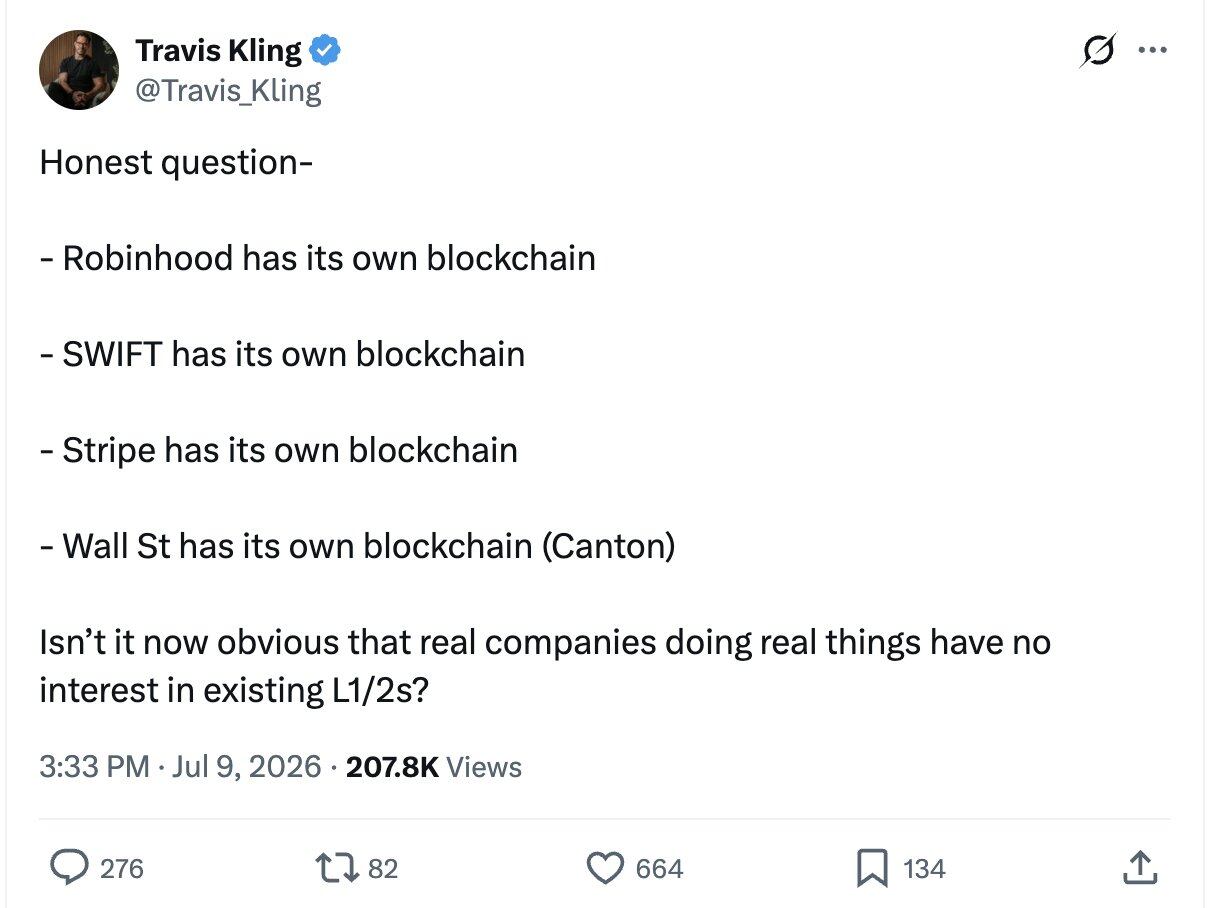
Travis Kling posed a question this week: "Is it now obvious that companies doing real work are not interested in L1/L2?" Robinhood was the first example he gave. But on the contrary, Robinhood is almost a perfect counterexample: when real companies make business decisions, they almost universally choose the Ethereum L1+L2 model.
Robinhood chose an existing L1—Ethereum—and then built its own Ethereum L2 using Arbitrum technology. Robinhood Chain uses Ethereum blobs for data availability, uses ETH as its native gas token, and its security is also provided by Ethereum.
Therefore, Robinhood did not reject the Ethereum L1+L2 model; on the contrary, that model is operating as intended at Robinhood.
The "buyers" choosing Ethereum have changed. In the past, crypto industry projects chose a public chain and technology to sell their own tokens. The emerging real-world on-chain economy is now using the Ethereum L1+L2 model as the foundation for cash-flow businesses.
As the composition of buyers changes, I believe Ethereum's advantages will become even more apparent.
The Old Crypto Economy Was Token-Centric
By "real businesses serving real users," I refer to a traditional company model: building products customers need, earning profits by serving those customers, and building equity value on those profits.
"Real users" here means consumer demand arising from ordinary economic needs, not speculative demand primarily generated by new token issuances. Crypto-native users are obviously real users. This is not a moral judgment on whether a protocol is useful or its developers are sincere; it is simply a distinction of operational goals within the real economy.
A token's value can only come from three sources:
- Cash: A reliable claim on future cash flows, similar to on-chain equities or bonds;
- Utility: Access, control, governance, or other privileged participation rights in a valuable system. Even without cash flows, a token that controls something important clearly has value;
- Monetary Premium: People hold the asset because they expect others to accept and recognize its value in the future. This asset is no longer just a claim that must eventually be redeemed for something else; it becomes a store of wealth—a terminal value asset.
The monetary premium is real, but extremely difficult to maintain. It requires deep network effects built on trust, liquidity, distribution, integration, and utility. Gold, the US Dollar, Bitcoin, and Ethereum have all built different versions of these effects, while few other assets have managed to do so.
Looking back, since the rise of programmable cryptocurrencies, the vast majority of industry participants have not been ordinary cash-flow businesses. Their economic goal was typically to sell a token, whose value was based primarily on utility, expected monetary premium, or promises of distant, unattainable future cash.
Sometimes, their plan was straightforward—launch a protocol and sell its token; other times, it was more indirect—receive funding from a token-funded ecosystem and liquidate the tokens received. Sometimes, a project genuinely anticipated future profitability, but because the token's valuation was disconnected from any possible future cash flow, the actual business model remained faith in the token itself.
This became the norm because almost every project was doing something similar, though there were some exceptions.
Centralized exchanges are inherently cash-flow businesses and are naturally multi-chain; adding another chain is like adding another deposit and withdrawal channel. Some stablecoin issuers are also cash-flow businesses, initially serving clients in the crypto space and now rapidly expanding into the broader economy.
But these exceptions prove the point: businesses aiming for ordinary cash flows choose infrastructure that maximizes the business, not the token's value.
Different Business Goals Lead to Different Projects
A company's ultimate goal dictates its technological choices.
If the goal is a cash-flow business, then blockchain is infrastructure, and the selection criteria are to reduce risk, improve the product, reach customers, and protect profits. If the goal is token monetization, there is more freedom in choosing a blockchain. After receiving funding from a public chain, a project can choose to develop on that chain.
For example, if a protocol succeeds on Chain A, you can launch a similar protocol on Chain B so that investors can price your token by comparison. Want to generate hype for a new token? A new L1, L2, app chain, gas token, governance system, or some special tech stack could all become selling points.
The problem isn't technological diversity itself. The crypto industry will continue to see an explosion of applications, protocols, L2 architectures, and specialized execution environments. The problem is the tendency to turn every new idea into a sovereign, independent ecosystem (with its own L1 architecture, security validation, liquidity base, and monetary asset), regardless of whether the underlying product is independent.
As the crypto industry now transitions towards cash-flow businesses, various attempts will continue, but they will increasingly be built on shared infrastructure. Companies will specialize at the application or L2 layer, while relying on the Ethereum L1 layer for settlement, security validation, liquidity maintenance, and monetary asset management. The result isn't less innovation, but a balance: more diversification at the edges, and more concentration at the base layer.
The old crypto economy typically chose its architecture around the token it wanted to sell. The emerging on-chain economy will choose its architecture around the product it wants its customers to buy.
The Buyer is Changing
The future of the crypto industry will be vastly different from its past because the "buyer" has changed.
The previous U.S. administration strongly suppressed on-chain transaction development; this trend has now reversed. The GENIUS Act is now in effect, providing a legal framework for payment stablecoins, and Europe's MiCA regulatory framework is fully applicable. Brokerages, payment companies, banks, asset managers, and governments worldwide are developing stablecoin, tokenization, and on-chain transaction strategies.
This doesn't mean all regulatory issues are resolved, but it does prove that large institutions can engage in more blockchain business experimentation.
We are approaching the beginning of the S-curve for genuine crypto adoption.
As we emerge from this phase, crypto and traditional finance will no longer be distinctly separate categories. Property, currency, transactions, finance, identity, and trust will all be coordinated through networks of on-chain and off-chain systems. Ultimately, "Web3" will fade away like "Web2," and everything will just return to the internet itself.
As this progresses, a larger proportion of crypto market participants will be real-world enterprises serving ordinary consumers in the broader economy. This proportion will be evident not just in the number of companies, but also in terms of capital scale, user count, asset size, and institutional influence.
These companies are no longer crypto projects seeking a business model for their tokens; they are enterprises using crypto technology to optimize existing or emerging cash-flow businesses. This dictates their technological choices. Infrastructure choices suitable for a token economy do not serve as a good guide for infrastructure choices suitable for a cash economy.
Real-World Enterprises Won't Build Infrastructure from Scratch
Typically, real-world enterprises have limited budgets for venturing into infrastructure building. They don't want consensus mechanisms, cross-chain bridges, validator economics, gas tokens, governance tokens, and liquidity bootstrapping to be six unrelated side businesses. Every additional component must create customer value, or it becomes a burden.
The chain should serve the business, not the other way around.
Some businesses are inherently multi-chain. Exchanges, wallets, stablecoin issuers, and certain asset issuers may require broad distribution. Even so, "multi-chain" rarely means every chain is equally important. Different chains often have their own specialized domains regarding liquidity, issuance, settlement, product status, or deeper integration.
Most on-chain businesses require a special commitment to one or a few chains. Their choices typically take three forms:
- When an on-chain business needs maximum decentralization, credible neutrality, risk minimization, or liquidity, they use the Ethereum L1 layer. L1 execution costs more because it bears the strongest shared environment;
- When an enterprise needs control, customization, compliance, predictable unit economics, low latency, or high throughput, they build their own Ethereum L2 layer. This allows them to have a dedicated chain tailored to their needs while maintaining a direct link to Ethereum;
- When an enterprise needs neither the L1 layer nor the necessity of building its own L2, they typically use one or more mature shared L2s. Base, Arbitrum One, Robinhood Chain, and other established Ethereum L2s have become common deployment platforms.
These on-chain enterprises will still bridge assets, "export products," and connect to other networks. Having a home chain doesn't mean isolation; imports, exports, and interoperability are core components of on-chain business. But the home chain remains crucial; it defines the system's security, canonical state, liquidity relationships, operational model, and long-term dependencies.
Why Does the Ethereum L1+L2 Model Still Work?
Ethereum separates the two essential elements needed by large enterprises.
The L1 layer provides a highly decentralized, credibly neutral, and extremely liquid global hub. The L2 provides a market for fast, low-cost, specialized, controllable, and customizable execution environments.
The L1 remains neutral, while the L2s on the edges can adapt to different operators, jurisdictions, products, and users. L2s extend Ethereum not just technically but also politically: organizations can operate on their own terms without needing the global hub (L1) to become their private chain.
A separate L1 can offer control and performance advantages. In some cases, full sovereignty over consensus and data availability is worth it for a project, but it doesn't come cheap.
A new L1 must create and maintain its own security system, validator or operator set, cross-chain bridges, liquidity, tools, integrations, and reputation. It creates a new security and liquidity silo, increasing the cost and friction of interoperability with the Ethereum L1 and the broader L2 economy (i.e., the dominant on-chain economic network).
For the vast majority of enterprises, the value created by a separate L1 is insufficient to offset these costs.
A custom Ethereum L2 can capture most of the business advantages an enterprise would seek from a separate L1: high TPS, control over execution, upgrades, fees, ordering, latency, access rules, product-specific functionalities, etc.
Furthermore, L2s offer advantages that separate L1s do not inherently possess: Ethereum for settlement and data availability, a standard L1 bridge, proximity to Ethereum's assets and capital, and a path towards trust-minimized interoperability.
L2 design is still critical. Admin keys, upgrade permissions, proving systems, and withdrawal guarantees determine the level of security a user can expect at any given moment. But even L2s with control held by a small group of operators can provide users with a solid settlement foundation on Ethereum L1. Companies don't need to operate and maintain their own L1 to run their business.
An Ethereum L2 is both an independent blockchain and a part of the Ethereum economic system. It can own and customize its execution environment while leveraging Ethereum for settlement, data availability, and interoperability management.
L2s typically integrate ETH deeply into their application economy, for example, as the native gas token. Standardized cross-chain models provide a trust-minimized path for capital and assets on L1 to enter the L2's "local economy." Each new L2 has a unique product interface, and Ethereum's network effects continue to strengthen.
Robinhood Made This Business Decision
Robinhood's development path is highly instructive.
It first issued stock tokens on a mature L2, Arbitrum One. After validating the product and understanding its own needs, Robinhood launched a proprietary chain built on the Arbitrum platform.
This could very well become a standard strategy for real-world enterprises: first build a business on an existing blockchain, then upgrade to a dedicated L2 once scale, product requirements, and unit economics reach a certain level.
Robinhood Chain is tailored for the financial services industry. It uses Arbitrum technology, offering 100ms latency, predictable transaction pricing, high throughput, and infrastructure customized for Robinhood's performance, security, and regulatory requirements.
At the same time, Robinhood Chain remains an Ethereum L2. It uses Ethereum blobs for data availability, uses ETH as native gas, and its official bridge to Ethereum requires no third-party validator set. This is what it looks like when a real-world enterprise builds a genuine on-chain product.
Robinhood didn't need to launch a Robinhood gas token, nor did it need to convince the public that it deserved a lasting monetary premium. Robinhood itself has equity; its economic returns come from customers, products, assets, transactions, and cash flows. Blockchain is merely its infrastructure.
Using ETH as gas was a simple business decision. L2 services already pay L1 services in ETH. ETH is highly liquid, widely used, and is the system's native token. If Robinhood used a proprietary gas token, it would introduce issues related to distribution, liquidity, pricing, and legality, and launching a token wouldn't improve Robinhood's core product.
Robinhood's success will depend on its application layer and the off-chain business it supports, not on its efficiency in creating new monetary assets. Therefore, it is inaccurate to say Robinhood built its own blockchain and rejected existing L1 and L2 services.
Robinhood only rejected sharing its dedicated execution environment with other projects. It did not reject Ethereum; rather, it chose Ethereum as the parent chain for its proprietary blockchain.
Previously, Coinbase made a similar decision, launching Base. Coinbase is not a pro-Ethereum advocate, and it's well-known that Brian Armstrong has publicly stated his passion for Bitcoin exceeds that for Ethereum. Yet, when choosing infrastructure for its on-chain business, Coinbase chose to become an Ethereum L2.
Base serves as the strongest evidence that the Ethereum L1+L2 model is not just theoretical. Coinbase's decision was driven by business logic, not ideology.
When companies build cash-flow businesses instead of token sales, they make business decisions, and this dictates that the infrastructure they choose is the Ethereum L1+L2 model.
What Does This Mean for Ethereum and ETH?
This change in participant composition is extremely bullish for Ethereum.
Historically, the competitive landscape of blockchains was dominated by teams whose incentives were geared towards token creation, ecosystem funding, and token valuation. Looking ahead, the competitive landscape will increasingly be dominated by companies optimizing for security, customers, control, distribution, liquidity, and interoperability—all in service of their cash-flow businesses.
This shifts demand towards Ethereum's "barbell" structure: L1 for maximum risk minimization and liquidity; L2 for scaling, customization, and operator control.
Ethereum evolved into a globally shared platform not by forcing all companies into a single shared execution environment, but by becoming the common settlement, security, liquidity, and asset layer underlying a multitude of environments.
This is also bullish for ETH. ETH's success is built on creating a monetary network and global trust. ETH is an excellent stake proof and the native asset of Ethereum's global settlement layer. Across the ecosystem, it serves as collateral, a liquid asset, a treasury asset, a productive asset, and is increasingly becoming a terminal asset.
As more real-world enterprises build applications on Ethereum, they distribute ETH to more users, integrate it into more products, and put it to work in more areas. This enhances ETH's liquidity and investor confidence, which in turn strengthens the monetary premium, ultimately evolving into an even greater network effect.
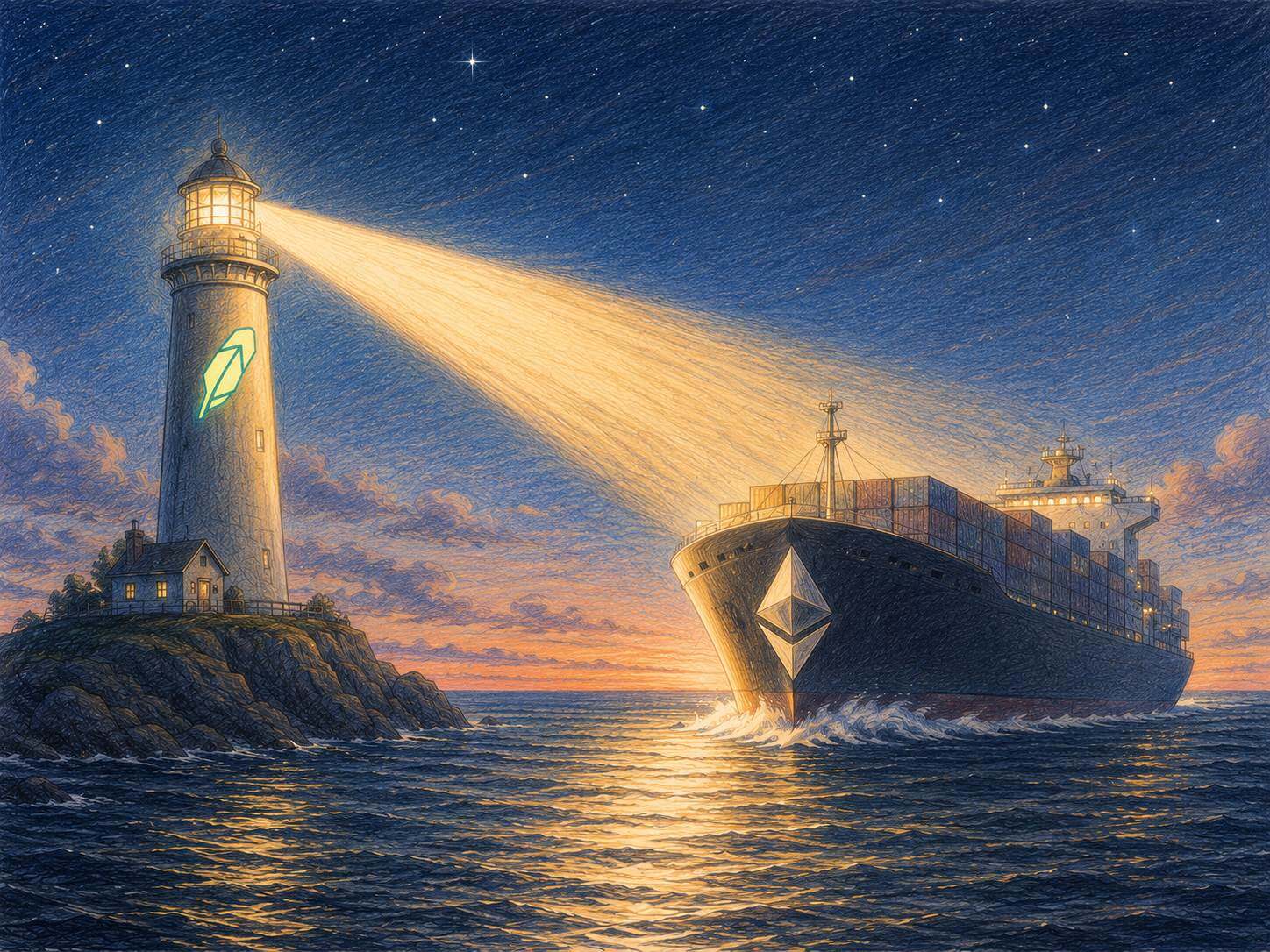
Robinhood is not an exception; it is a beacon.
Real enterprises use Ethereum L1 when they need a globally most neutral, lowest-risk, and most liquid shared environment. They build their own Ethereum L2 when they need control, customization, and high performance. And when their business doesn't yet justify building a standalone blockchain, they deploy to mature ones, typically Ethereum L2s.
This is not because they are Ethereum fans. It's because they make rational business decisions.