30 minutes flash crash 45%, SpaceX hasn't even gone public yet, and retail investors have taken a hit


- Core Viewpoint: On May 28th, the SPACEX perpetual contract on Hyperliquid experienced a flash crash due to an oracle data error, plummeting 45%. This reveals the liquidity fragility and pricing distortion risks of pre-IPO synthetic products in the absence of a spot market and arbitrage mechanisms. Furthermore, as the SpaceX IPO approaches, this risk could intensify.
- Key Elements:
- On May 28th, the price of the SPACEX-USDH contract dropped from $2,277 to a low of $1,254 within 30 minutes, a crash of 45%; it liquidated 405 users and 1,393 positions, with a liquidation value of $1.51 million.
- The immediate cause was an error in data returned by one of the oracle components (off-chain data provider Notice), leading to significant fluctuations in the mark price and triggering forced liquidations. The platform, Ventuals, has promised to compensate affected users.
- The pricing mechanism for this contract assigns 1/3 weight to off-chain private market data (Notice) and 2/3 weight to the on-chain average mark price over the past 2 hours; daily trading volume is only $4.87 million, indicating extremely low market depth.
- Pre-IPO synthetic products have structural flaws: there is no unified spot market, cross-platform arbitrage mechanisms are structurally infeasible, liquidity is fragmented across multiple closed small pools, and each platform is exposed to low liquidity risk.
- SpaceX has submitted a confidential S-1 filing, targeting an IPO on the Nasdaq around June 11-12, with a valuation range of $1.75 trillion to $2 trillion; settlement will be forced at the real stock price on IPO day, and the gap between the current on-chain price and the expected Nasdaq pricing is estimated to be around 60%.
Original Author: ChandlerZ, Foresight News
On the evening of May 28, the SPACEX-USDH perpetual contract on Hyperliquid experienced a severe flash crash, with the price plummeting from $2,277 to a low of $1,254 within 30 minutes—a drop of nearly 45%—before rebounding to approximately $2,169.
This crash triggered the liquidation of 1,393 positions belonging to 405 users, with total liquidations amounting to $1.51 million.
Data shows that the total trading volume for this contract over the past 24 hours was only about $4.87 million, with open interest below $2.9 million, indicating extremely thin market depth. A single large sell order nearly broke through the available liquidity, triggering a cascading sell-off. The liquidated users were primarily retail investors, with a median margin of only about $31, typically using around 3x leverage.
Ventuals, the perpetual contract platform within the Hyperliquid ecosystem, later responded on social media, acknowledging the flash crash event in the SPACEX market. The cause was identified as erroneous data returned by an off-chain data provider, which served as one of the components for the oracle price. This led to severe fluctuations in the oracle and mark prices for that market, consequently triggering forced liquidations for some users' positions.
The team has since implemented measures to prevent similar incidents. Additionally, the team is evaluating the impact of this event on affected users to formulate an appropriate compensation plan. Affected users will receive compensation within the next 48 hours.
A Fragile Pricing Chain
SPACEX-USDH is a crypto perpetual contract launched by Hyperliquid that allows users to bet on changes in SpaceX's market valuation before its IPO. It does not represent actual stock nor confer any shareholder rights.
On Ventuals, 1 SPACEX represents $1 billion of SpaceX's valuation. If the SPACEX price is $420.69, it implies the market values SpaceX at $420.69 billion.
The core challenge for this type of contract is: how do you price a company that isn't publicly traded?
Ventuals' solution splits the pricing into two parts. One-third of the weight comes from Notice, an off-chain private market data provider whose pricing model incorporates funding rounds, 409A valuations, mutual fund marks, secondary market trades and quotes, and comparable public companies.
Two-thirds of the weight comes from the contract's own exponentially weighted moving average of its mark price over the past 2 hours. Notice data is polled at least once per minute, and the oracle price is updated every 3 seconds.
In an ideal state, this design balances external information with on-chain price discovery, but it has a critical single point of failure. If the data returned by Notice is itself wrong, that one-third external anchor becomes a force pulling the price in the wrong direction. The other two-thirds on-chain average could hedge against this error under sufficient liquidity, but on the SPACEX contract, which has a daily trading volume of only $4.87 million, the on-chain price itself is fragile. Combining two fragile components results in a price flash crash.
Low Liquidity Under Zero Arbitrage and Fragmentation
The SPACEX flash crash exposes problems beyond just Ventuals. The entire category of pre-IPO synthetic products faces the same dilemma regarding pricing mechanisms: there is no unified spot market and no cross-platform arbitrage channel.
In traditional finance, price differences for the same stock between the NYSE and Nasdaq are nearly non-existent because high-frequency market makers execute arbitrage in milliseconds. However, in the market for pre-IPO synthetic products, this type of arbitrage is structurally impossible. This is because contracts on each platform are assets or derivatives issued according to their own rules and cannot be hedged across platforms.
SPACEX on Hyperliquid and SPCX on Binance track the same company, but there is no mechanism ensuring their prices are consistent. Consequently, each platform forms its own isolated pricing pool. Liquidity is scattered across multiple disconnected venues, making each pool shallower than the aggregate.
Ventuals' SPACEX has a daily trading volume of $4.87 million. If the liquidity of existing platforms were concentrated in one place, depth would be completely different, but fragmentation leaves each platform exposed to the risk of low liquidity.
The essence of pre-IPO synthetic products is a group of people betting on a number without a public price benchmark. The price discovery on each platform only reflects the consensus of the small group of traders on that particular platform and has no rigid connection to the company's actual valuation.
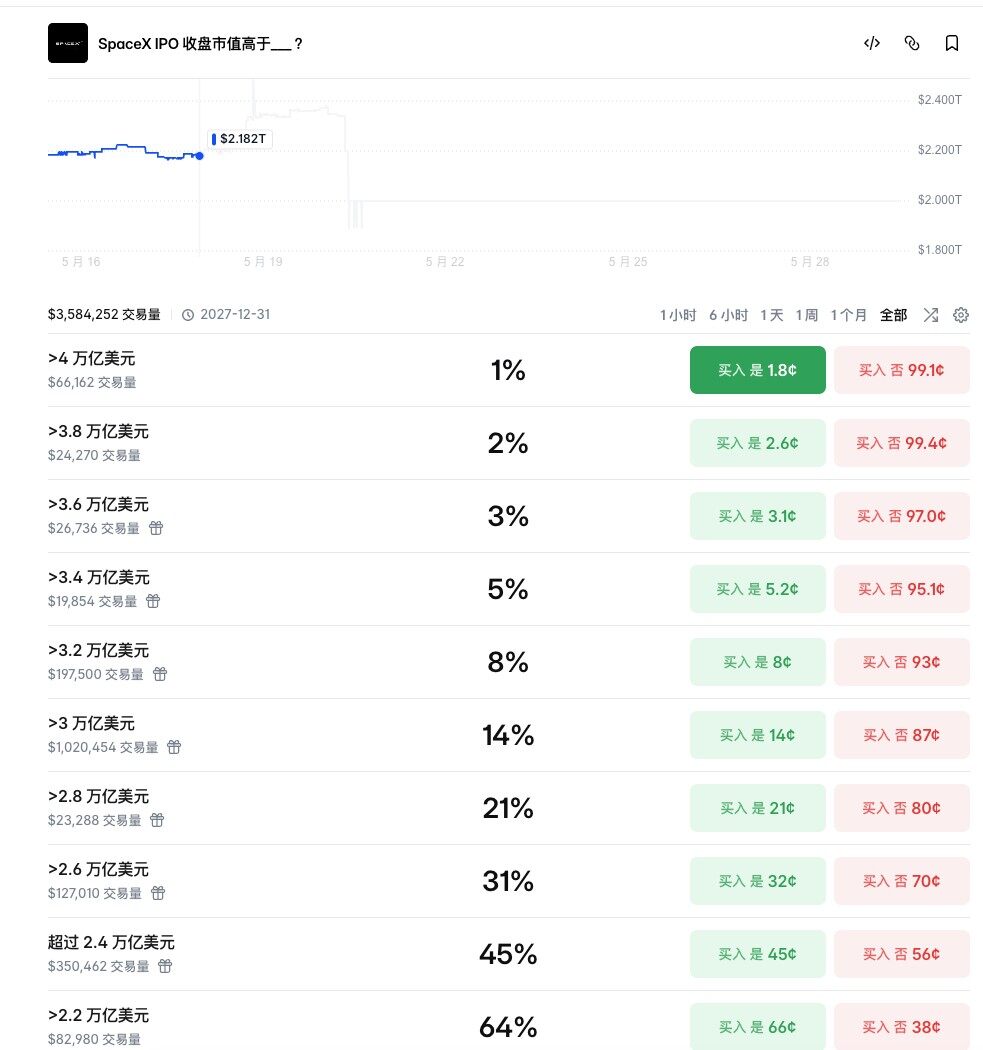
Data sources like Notice provide private market information with low update frequencies, narrow coverage, and opacity. No one truly knows how much SpaceX is worth. On Polymarket, the distribution of valuation probabilities for SpaceX's IPO is also fragmented, with a 45% probability for the >$2.4 trillion range and a 31% probability for the >$2.6 trillion range.
The Answer is Imminent
SpaceX filed a confidential S-1 with the SEC on April 1, targeting a pricing date of June 11 on Nasdaq, with trading set to begin on June 12, within a valuation range of $1.75 trillion to $2 trillion.
Ventuals' documentation outlines the contract's settlement mechanism. On the IPO's first day, following the opening bell, the funding rate resets to zero, the oracle price is locked to the mark price, and a valuation based on the real-time stock price is introduced as an external price constraint. After the market close, the mark price is overwritten with the valuation based on the closing price, and all open positions are forcibly settled at this price.
This means that on IPO day, all holders of SPACEX contracts will be settled according to the actual stock price. If there is a significant gap between the on-chain price and the Nasdaq pricing, the settlement will result in a massive one-way liquidation event.
Analysts estimate the current gap is around 60%, and convergence will likely not occur smoothly. Before the IPO, there is no way to hedge on-chain positions using actual SpaceX stock; the arbitrage mechanism is structurally broken. Convergence will likely occur violently within the final 72 hours.
This flash crash originated from an oracle data error. The convergence expected on the IPO day in June will result from calibration to the real price. The extent of the impact will depend on the total open interest across multiple platforms at that time. The closer SpaceX gets to its IPO, the more speculative capital will flow in, causing fragmented liquidity and distorted pricing to expand in tandem.
The user base with a median margin of $31 will not disappear. They will return, bringing more $31 margins.