






Blood earned 2.4 million - these 9 insider addresses have the best grip on the US-Iran war


- Core Insight: Blockchain analysis firm Bubblemaps has disclosed that 9 highly correlated anonymous accounts on Polymarket, by precisely betting on prediction markets related to US-Iran military actions, netted over $2.4 million with a winning rate of 98%, sparking serious suspicions of insider trading in the market.
- Key Elements:
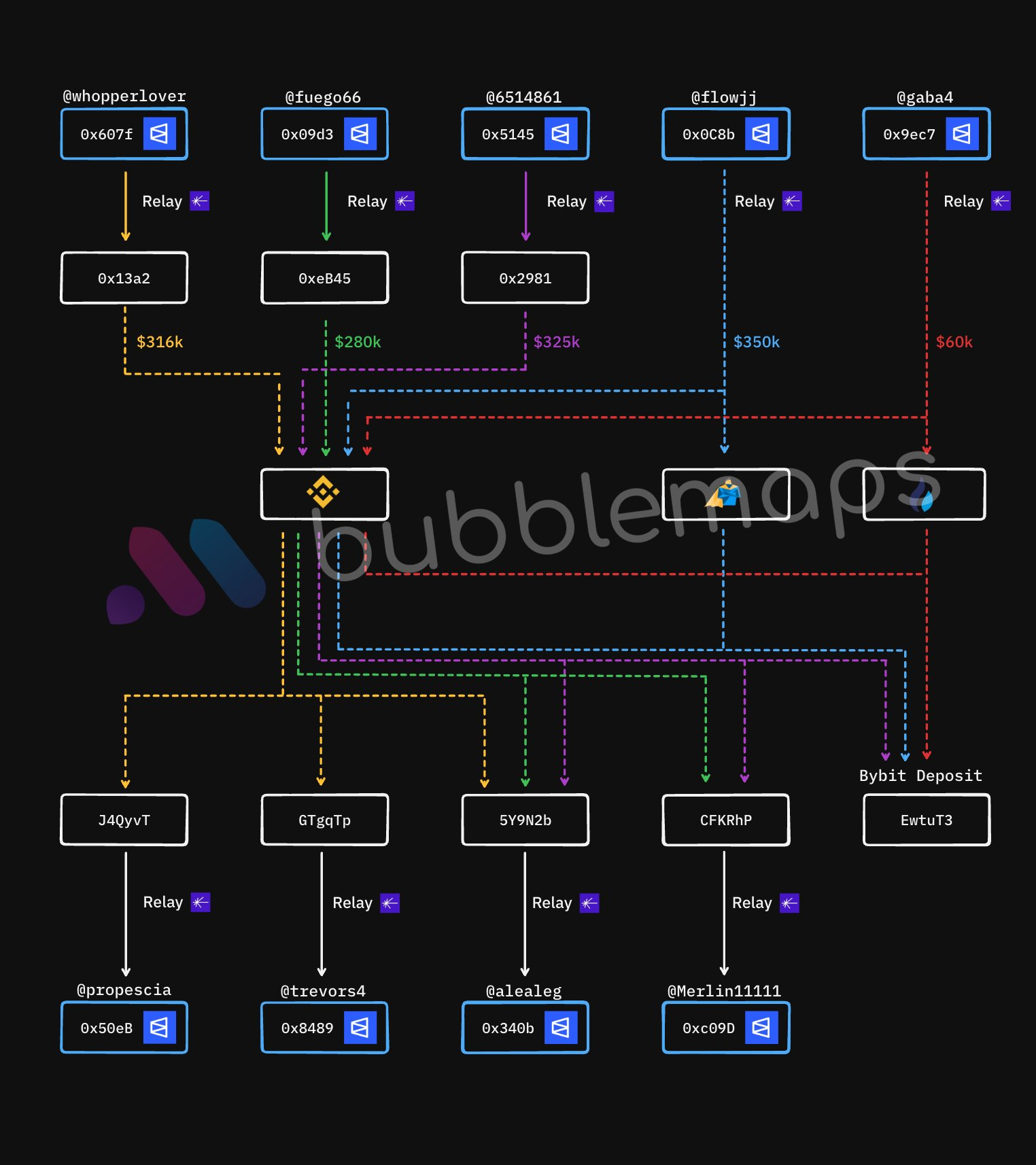
- The fund flow paths of the 9 accounts are highly consistent, quickly transferring funds from centralized exchanges into a shared wallet network, suspected of using professional trail-hiding services.
- Precise betting timing: The accounts were mostly created and placed bets within 24 hours to several days before the military actions, heavily concentrating on low-odds events like "US strikes Iran before February 28".
- Profit structure: 4 core accounts each made about $400,000, with 5 subsequent accounts linked through overlapping fund flows and trades, placing over 80 bets in total with near-perfect winning rates.
- Previous similar case: US Army Staff Sergeant Van Dyke was prosecuted for using classified intelligence to bet on the Venezuela operation on Polymarket, making $400,000, which became a landmark case for insider trading in prediction markets.
- Platform response: Polymarket has updated its market integrity rules, explicitly prohibiting trading based on confidential information, illegal insider tips, and the ability to influence outcomes, and has deployed AI monitoring systems.
- Industry controversy: The emergence of "copy-trading insider" projects like Kreo and Polycool, which allow users to replicate the trades of accounts with abnormally high winning rates, has sparked debates on whether this constitutes a violation. Some of these platforms have suffered hacker attacks.
Original Author: Mahe, Foresight News
On May 18, Bubblemaps founder Nicolas Vaiman and Head of Investigations Deebs (a former U.S. military officer, real name withheld for security reasons) disclosed to the public that they had discovered nine highly correlated anonymous accounts on Polymarket. These accounts collectively netted over $2.4 million from prediction markets related to U.S. military operations, with a win rate of 98%.
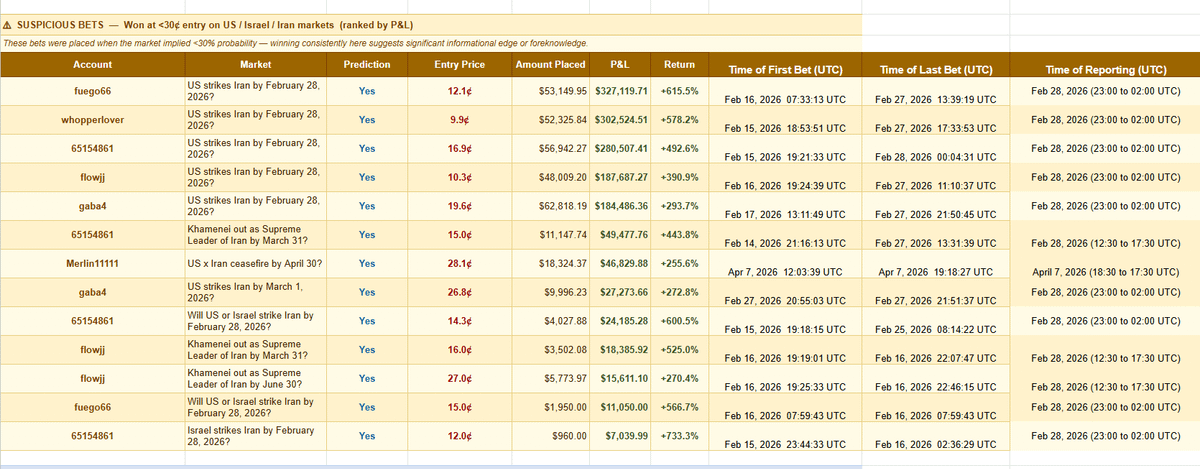
Bubblemaps detailed these accounts on Twitter. They almost exclusively bet on military events related to a 2026 US-Iran conflict, with timing so precise it was chilling—often placing bets days before key operations occurred, and favoring long-shot options with low odds.
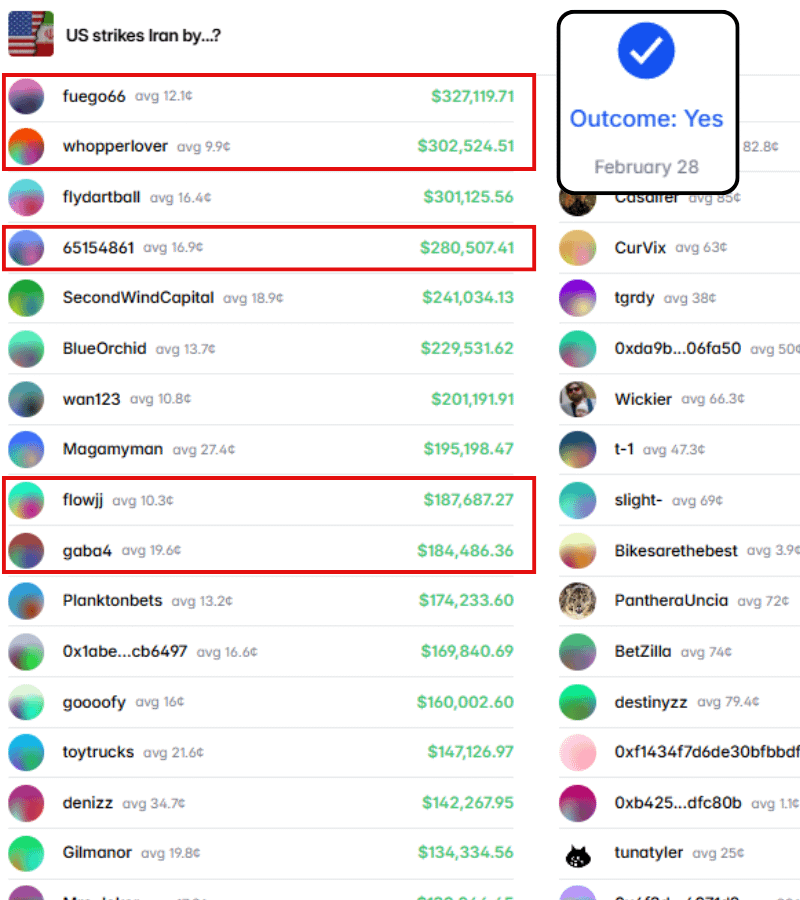
This is not simple "good luck." Bubblemaps used technology to visualize transactions in the Polymarket market "Will the US strike Iran for the first time before February 28," revealing a massive pink cluster previously unmentioned on platform X.
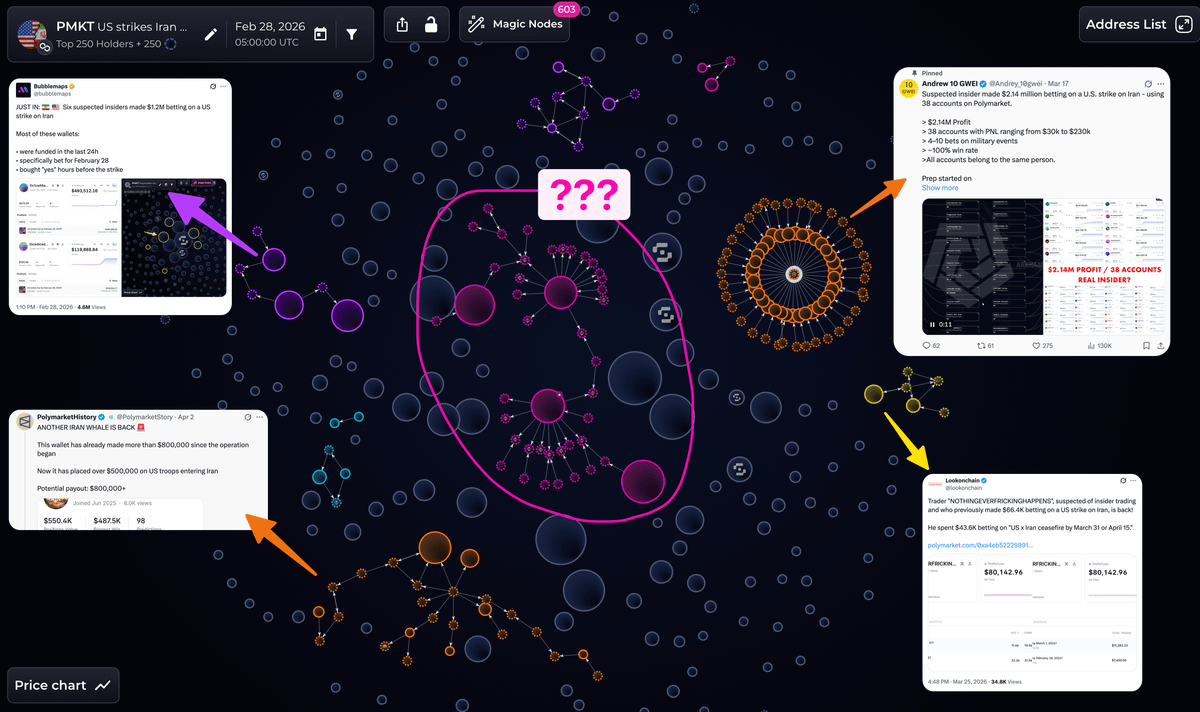
After further tracing, they linked the initial 4 accounts to 5 others through time windows, trade sizes, and fund flow paths. The funding paths of the nine accounts were highly consistent: funds were transferred from centralized exchanges into shared wallet networks within extremely short timeframes, likely using professional services to hide traces.
4 Core Accounts Each Earned $400,000
In the early morning of February 28, 2026, the United States and Israel launched a large-scale joint strike codenamed "Operation Epic Fury" and "Operation Lion's Roar." US and Israeli forces conducted nearly 900 strikes against Iran within 12 hours, targeting nuclear facilities, missile bases, military command centers, and hideouts of senior leaders. Iran's Supreme Leader Ali Khamenei, along with several family members and senior IRGC commanders, were killed in the initial wave of strikes.
As early as the day of the strike on February 28, Bubblemaps publicly flagged six "fresh" accounts. Most of these accounts were created and funded within 24 hours before the strike, precisely betting on "US will strike Iran before February 28," collectively netting about $1 million (some reports say $1.2 million). Market odds were extremely low at the time, yet these accounts took heavy positions. Bubblemaps called it "suspected insider trading."
Five months later, the nine-account cluster they discovered was larger in scale and had a higher win rate.
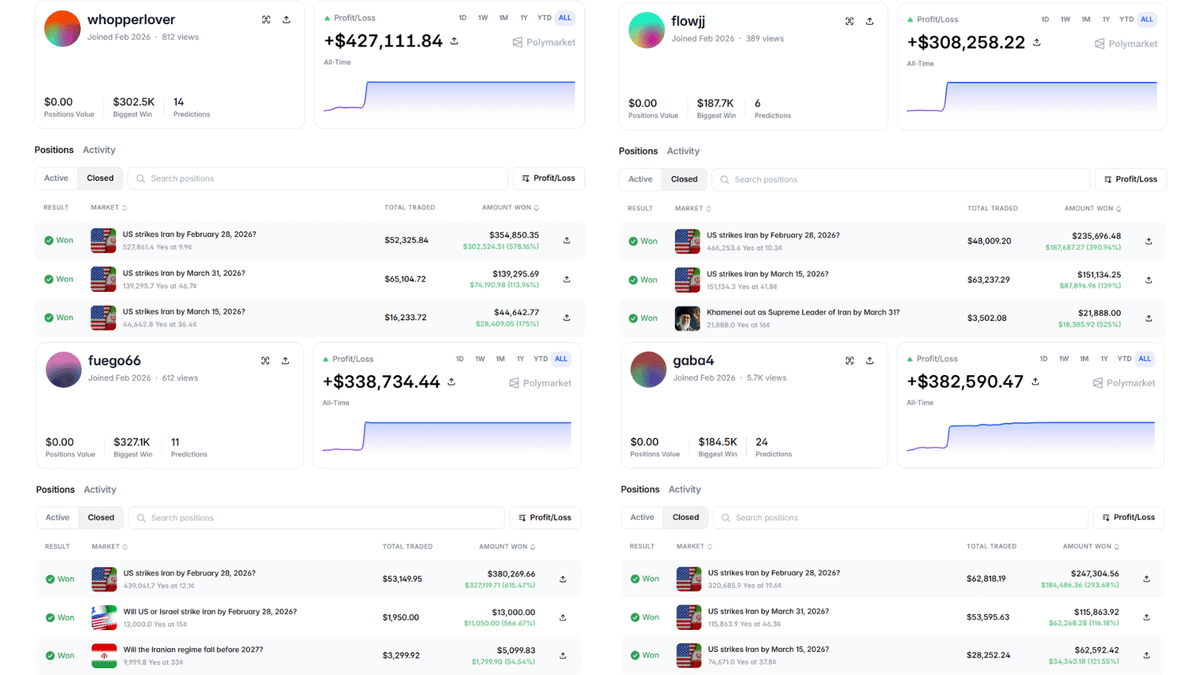
The four core accounts were created a few days before February 28, each earning about $400,000; the subsequent five accounts were linked through fund flows and overlapping trades. The nine accounts placed over 80 bets, almost all on US military actions: the initial strike on February 28, the specific timing of Khamenei's elimination, the announcement of a ceasefire, etc. They even spread bets across multiple dates to maximize profits, while occasionally placing one or two small losing bets (e.g., on February 20), seemingly as a cover.
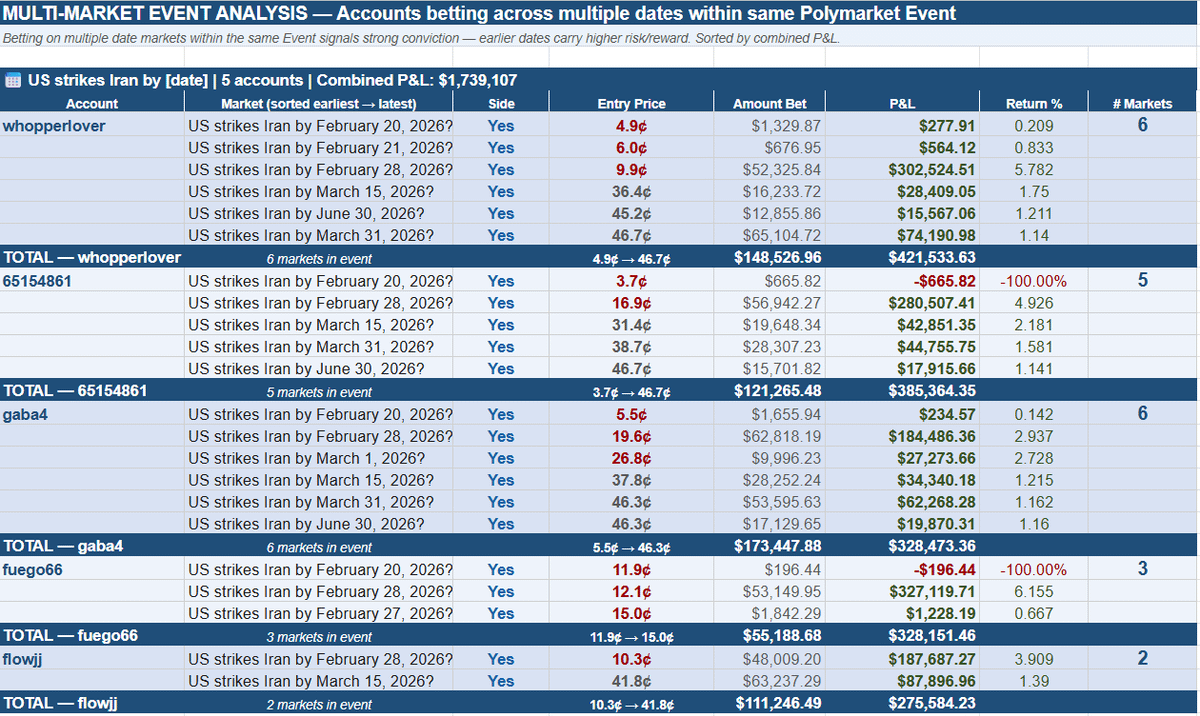
Bubblemaps listed nine Polymarket wallet addresses (e.g., 0x09d3273fa76282ce09f4f35a87d6f087c05f4e84) and emphasized that these accounts consistently dominated profit/loss rankings. Funds ultimately flowed into shared wallet networks, showing traces of professional money laundering or services.
Vaiman stated bluntly: "Luck cannot explain these numbers." Deebs added that potential sources of inside information are numerous—government officials, military planners, intelligence analysts, and even military family members.
Earlier this year, U.S. Army Staff Sergeant Gannon Ken Van Dyke was accused of using classified intelligence to bet on the Venezuela special operation on Polymarket. He invested $34,000, profited $400,000, quickly withdrew the funds, and attempted to delete his account. Polymarket actively cooperated with law enforcement, ultimately leading to the indictment. The Van Dyke case is seen as a landmark instance of insider trading in prediction markets.
This nine-account cluster's profit is six times that, with a higher win rate, and is entirely concentrated on US-Iran military events.
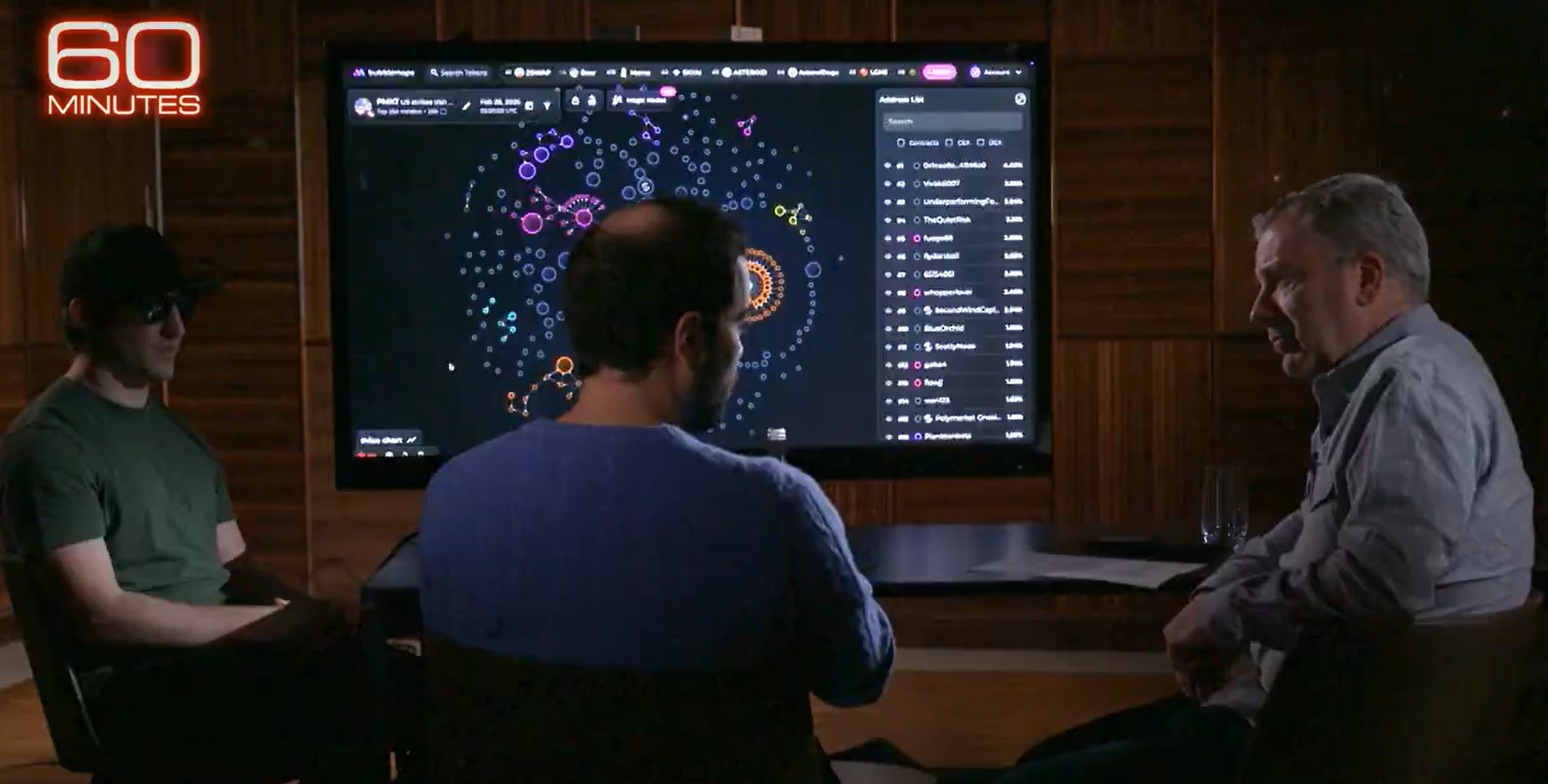
Bubblemaps shared its investigation exclusively with "60 Minutes." The program aired on the evening of May 17, generating considerable attention. CBS reported that Polymarket has established AI monitoring and blockchain forensic systems, reporting suspicious activity to law enforcement and emphasizing that "insider trading is not welcome on the platform."
As of press time, Bubblemaps has not directly linked the nine accounts to any specific entity or government department, merely stating that "the correlation and near-perfect win rate raise serious suspicions."
Anti-Insider Trading and Copy-Trading Insiders
Insider trading makes many market participants feel unfair. Prediction market platforms like Kalshi and Polymarket are taking more measures to combat insider trading.
At the end of March this year, Polymarket updated its market integrity rules for its DeFi platform and its U.S. exchange regulated by the Commodity Futures Trading Commission (CFTC). The updated rules clarify three core prohibited insider trading behaviors:
- Trading using stolen confidential information—if a participant possesses confidential information regarding the outcome or possible outcome of an underlying event, and using that information would breach a pre-existing duty of trust or confidentiality owed to another person or entity, the participant shall not trade in any contract.
- Prohibition of trading using illegally obtained inside information—a participant shall not trade using confidential information provided to them by another person, if that information was provided by someone who owes a pre-existing duty of trust or confidentiality to another, and the participant knows or has reason to know that the provider of the information would themselves be prohibited from trading on that information.
- Trading by persons capable of influencing the outcome—if a participant has the authority or influence sufficient to affect the outcome of the underlying event, they shall not trade in any contract.
However, rules always have loopholes. Since insider trading cannot be completely eliminated, some so-called "insider copy-trading projects" with ulterior motives have also become controversial. These applications compile trading accounts with abnormally high win rates for users, or flag trades with suspicious timing or abnormal amounts, allowing users to copy these trades with one click.
Kreo's selling point is helping users "find insider traders earlier than others." Polycool, meanwhile, directly posts a "Polymarket Insider Trading Guide" on its official website, stating, "This isn't the stock market; betting with non-public information won't land you in jail. The rules of decentralized prediction markets are entirely different."
The question then arises: Is copying the trades of an insider trading address a violation?
Currently, there is no official response.
However, so-called "insider copy-trading platforms" like PolyGUN and Polycule suffered hacker attacks earlier this year, losing tens of thousands to hundreds of thousands of dollars.


