






一声「尊貴的VIP」背後,Binance、OKX、Bitget在卷什麼服務?


- 核心觀點:在加密貨幣市場進入存量競爭階段,頭部交易所(幣安、OKX、Bitget)透過降低VIP門檻、提升資產供給能力和服務體驗來爭奪「成長型用戶」,用戶應主動利用這一「VIP下沉紅利」最佳化交易成本和管理效率。
- 關鍵要素:
- 費率差異對高頻交易者影響顯著,每月交易量超過100萬美元的用戶,0.01%的費率差可能導致每年數千至上萬美元的手續費支出差異。
- 交易所競爭重心從拉新、補貼轉向「卷服務」,2026年上半年幣安、OKX、Bitget相繼下調VIP1-3級門檻,重點關注資產規模約3萬美元的「成長型用戶」。
- Bitget的VIP門檻最低,例如5萬美元持倉即可升級至VIP-2,1000萬美元持倉解鎖最高等級VIP-7(現貨和合約掛單零費率),遠低於幣安和OKX的要求。
- 資產供給能力成為競爭關鍵,Bitget透過UEX策略率先上線美股合約、Pre-IPO產品(如RKLB、CBRS),提供多元化資產佈局機會。
- 交易所透過公開服務團隊、降低客服門檻(如OKX優先服務通道門檻降至3萬美元)和品牌活躍度(如何一、謝家印等)提升用戶心理距離和問題處理效率。

Have you ever done the math?
Suppose you are a relatively high-frequency trader, with an average monthly trading volume exceeding $1 million. Even a fee difference of 0.01% could accumulate to a difference of thousands or even tens of thousands of dollars in trading costs over the course of a year.
In the past bull market, this gap was easily masked by market fluctuations. Catching a single upward move or a hot trend, with daily gains of several tens of percent, was enough to cover most of the trading fees. However, as the market gradually enters a phase of existing competition, more and more traders are realizing: What truly determines long-term returns is no longer just how much you earn per trade. To achieve results in today's market environment, you need to manage the risk-reward ratio of each trade more meticulously.
This has also brought a term that was once distant from ordinary users back into the spotlight – VIP. In the past, ordinary users always had a certain defensive mindset towards the word VIP, subconsciously thinking it was a privilege reserved for "whales" with tens of millions of dollars in their accounts, far out of reach. Looking at market trends from the first half of 2026, this habitual perception is actually being broken. Major exchanges are successively lowering the entry threshold for VIP. Compared to the past, which relied solely on user acquisition, subsidies, and listing speed to compete for users, the current exchange competition is clearly entering a phase of "competing on services."
Since exchanges are proactively lowering the bar, for ordinary users – especially the "growth-type" users who still have limited assets but have developed relatively mature trading strategies – VIP is no longer just a vanity title, but a tangible channel for improving efficiency.
Therefore, this article won't discuss market trends or trading strategies. Instead, it will take the perspective of an ordinary user, dissecting the VIP systems of several mainstream exchanges like Binance, OKX, and Bitget. Against the backdrop of continuously lowering VIP thresholds and comprehensive service competition among exchanges, whose solution is more suitable for today's traders?
Comparison of VIP Systems Across Three Major Exchanges
Before the formal comparison, we need to address one issue first. The VIP system structures of major exchanges all differ. Trading, holdings, borrowing, options, OTC, invitations, migration... Each exchange supports multiple different VIP upgrade paths.
For ordinary users, there is no need to study all the rules in detail. To help you navigate the complex terms before comparing the numbers, we can first establish a user classification framework based on capital size and trading habits. You can first see which category you belong to, and then identify the most suitable upgrade path for yourself.
- In terms of trading style, users can be broadly divided into two categories: "low-frequency holders" and "high-frequency traders." The former typically have fewer daily trades but maintain a certain amount of assets in their accounts for a long time, making the "holding amount" VIP upgrade path more suitable. The latter trade more frequently; even with lower capital, their accumulated total trading volume often grows quickly (especially contract traders), so they pay more attention to the "trading volume" upgrade path and actual fee discounts.
- In terms of asset size, users can be broadly divided into three categories: "retail investors," "growth-type users," and "whales." "Retail investors" and "whales" need no further explanation. The former find it difficult to reach the VIP thresholds of major exchanges, while the latter can easily unlock top-tier VIP benefits (at this level, benefits are generally good across all exchanges). The key emphasis here is on the increasingly prevalent "growth-type users."
So-called "growth-type users" are potential groups whose asset size hasn't yet reached the traditional standard of "whales," but who have begun to form stable trading habits and actively optimize details like fees, slippage, and capital utilization. This user group is actually the most fiercely contested target demographic for major exchanges currently, as they have the potential to become core users in the future.
I. Entry Thresholds
Between March and April this year, major exchanges successively lowered their entry thresholds.
On March 18, Binanceannounced a reduction in the BNB holding threshold and contract trading volume threshold for VIP levels 1-3: VIP 1's BNB holding requirement dropped from 25 BNB to 5 BNB, and the contract trading volume requirement decreased from $15 million to $5 million. At the same time, Binance launched the VIP "Rising Star Program," targeting users with an average daily or 30-day average net asset balance of $30,000 (including 5 BNB or more). Eligible users receive dedicated VIP support, access to curated events, and exclusive opportunities for faster progression to Binance VIP.
On March 24, OKXannounced a reduction in the 30-day contract trading volume threshold for VIP levels 1-3 (VIP 1 lowered from $10 million to $5 million). On April 8, it also announced lowering the threshold for priority customer service channels to "current asset balance or 30-day average asset balance not less than $30,000." Although not a direct reduction in the VIP threshold, it allows qualifying users to enjoy the same service response priority as VIP users.
Compared to Binance and OKX, from the very beginning of building its VIP system, Bitget's focus wasn't "how high to set the threshold," but "how to cover more people."A holding amount exceeding $30,000, a spot trading volume of $500,000, or a contract trading volume of $5 million can upgrade a user to VIP 1. Furthermore, on April 2, Bitget launched the "VIP Fast Track"event, precisely incentivizing users currently at V0 level or holding only temporary trial access. It provides additional rewards to reduce friction and help them accelerate their upgrade to formal VIP levels 1-3.
The VIP upgrade requirements for the three major exchanges can be seen in the image below.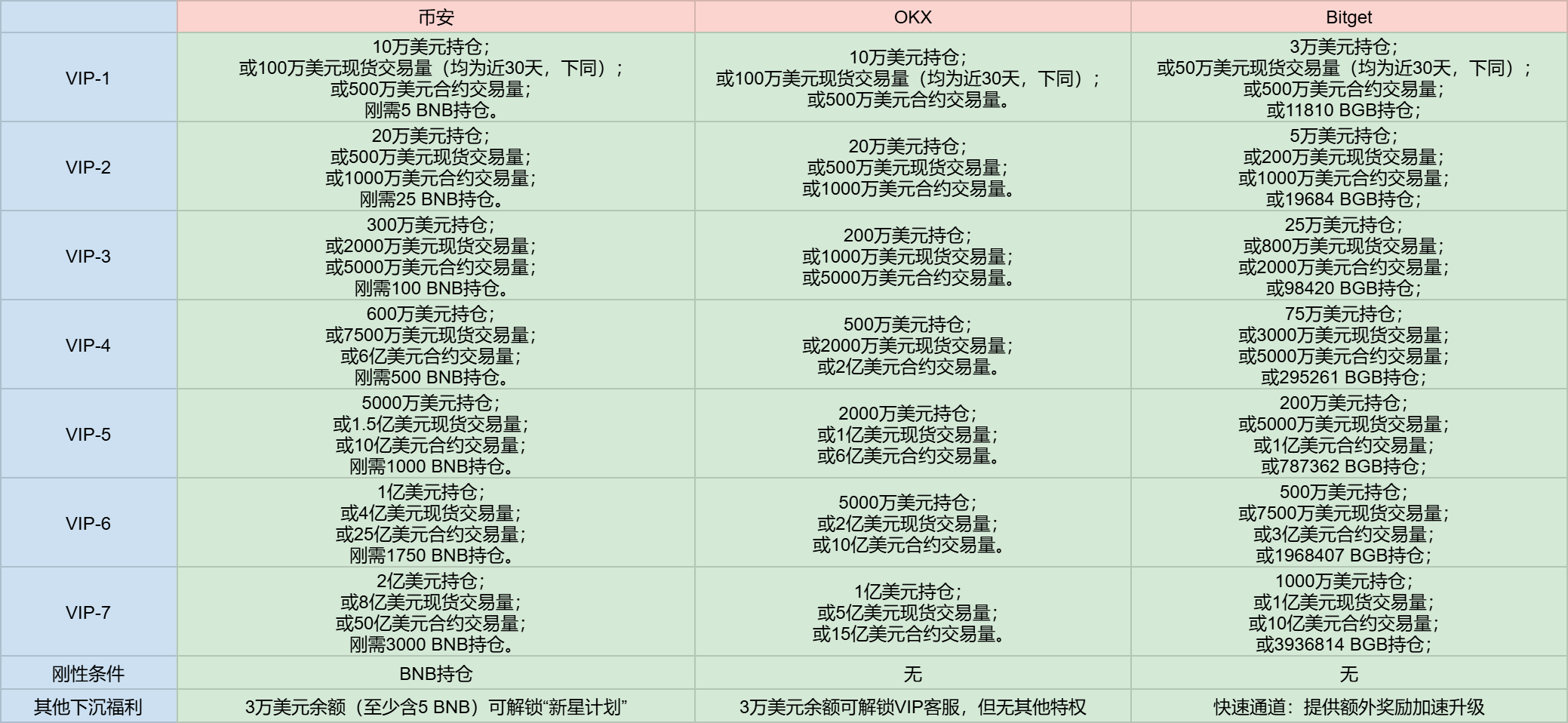
In summary, a holding balance of $30,000 is a user profile range that all major exchanges are intensely competing for. This holding size basically covers the mainstream user groups within the crypto space, especially those "growth-type users" with the potential to become future core users. Both Binance and OKX have extended some VIP benefits to this user group, while Bitget has directly set this as the entry threshold for formal VIP.
Beyond this, it is clear that Bitget's VIP upgrade is significantly easier than Binance and OKX. Compared to the other two exchanges' requirements, which often involve hundreds of millions or even billions of dollars in holdings and trading volume, Bitget requires only $10 million in holdings to unlock the highest VIP-7 level.
As shown above, if your total holding value is $50,000, you haven't reached the VIP threshold on Binance or OKX, but on Bitget you can already upgrade to VIP-2. If your total holding value is $1 million, you can only reach VIP 2 on Binance and OKX, but on Bitget you can reach VIP-4. If your total holding value is $10 million, you can directly unlock Bitget's highest level discount, achieving zero fees for spot and contract maker orders.
Faster upgrade progress means users can more efficiently unlock the exclusive benefits of higher VIP tiers.
II. Asset Supply
Besides VIP thresholds, another factor increasingly impacting user trading experience is the platform's asset supply capability.
With the continuous heating up of the RWA and asset tokenization narrative, traditional financial assets like stocks, precious metals, commodities, and Pre-IPO equity are being moved onto the blockchain at an accelerating pace. Compared to the past, where competition primarily revolved around cryptocurrencies, more and more trading platforms are evolving towards a "one-stop multi-asset trading entry point."
Looking at the current market landscape, CEXs like Binance, OKX, and Bitget, as well as emerging DEXs like Hyperliquid and Trade.xyz, are all moving in this direction.
For example, Binance maintains its mainstream trading advantage through its strongest liquidity and broadest asset coverage. Recently, it has also provided users with windows to invest in assets like US stocks through the listing of contract products and derivative tokens. OKX has also launched a TradFi version tracking traditional assets and continues to strengthen its integration capabilities between on-chain ecosystems and Web3 trading scenarios, allowing users to complete diversified asset allocation directly on-chain via its wallet. Bitget, on the other hand, was the first to propose the UEX (Universal Exchange) panoramic trading strategy in September last year, seamlessly bridging the gap between cryptocurrency and traditional finance. It was not only the first exchange to list US stock contracts but also a major source of traffic for Ondo US stock tokens. Based on recent months' actions, Bitget's asset coverage is continuously expanding, with noticeable acceleration in areas like US stocks, CFDs, and Pre-IPO.
Personally, I used to use OKX's wallet to buy spot US stock tokens and then open equivalent short contracts on Binance to arbitrage funding rates. Recently, I've been using Bitget for several active trades. Firstly, last week, I wanted to invest in Rocket Lab (RKLB), which was gaining heat due to SpaceX's upcoming IPO. I searched across several exchanges in the space and found that only Bitget had listed the RKLB stock token. Secondly, before the opening of Cerebras Systems (CBRS), the hottest IPO project on US stocks last week, Bitget was the first among the three major exchanges to list a Pre-IPO contract for CBRS, so I opened a small position. Additionally, I participated in a small amount in two of Bitget's Pre-IPO subscription events (preSPAX and preOPAI), both of which have been rising steadily since their opening. As of writing, the former is quoted at $894, up 37.5% from the subscription price of $650; the latter is quoted at $928, up 28% from the subscription price of $725.
III. Other Benefits
Furthermore, a VIP status brings other small perks, such as token airdrops, physical gifts, event tickets, private meeting eligibility, global travel, etc. While these are not core factors for users choosing a trading platform, they can further influence the long-term user experience for highly active users.
Exchanges are Growing Their "Service Wars"
Fee discounts and asset supply compete based on a platform's "hardware" capabilities. However, ordinary users need much more. When encountering unexpected situations, the efficiency of communication with the platform and the "software" experience, like the perceived distance, often determine whether users stay long-term.
With the peak of industry dividends seemingly behind us, the VIP systems of major exchanges are evolving from static numerical rules into a comprehensive, behind-the-scenes "service war." For Binance, even as the industry's top exchange, He Yi still personally takes time to actively answer user questions on social media. OKX has significantly lowered the threshold for dedicated VIP customer service, granting more comprehensive service capabilities to a larger user group. Bitget has recently been emphasizing the service philosophy of "VIP the moment you arrive" and has pushed its entire VIP account management team into the spotlight—publicly appearing and staying active on X. Its Greater China Regional Director, Xie Jiayin, also remains consistently visible to users. This approach of placing the real service team in front of users lowers the psychological barrier for users seeking help.
These are all microcosms of the exchanges' collective focus on "competing on services." In an era of increasingly diverse asset types and complex trading products, the trading experience is no longer determined solely by fee discounts. It encompasses a whole suite of service capabilities, including risk control response, product rule synchronization, and problem resolution efficiency. For trading users, the ability "to find someone quickly," "to get a timely response when issues arise," and "to have problems solved promptly" have become even more critical parts of the platform experience.
The underlying logic here is that as the industry moves into a phase of competition for existing users, exchanges find it increasingly difficult to achieve high growth through simple traffic expansion.Whoever can serve their active users better over the long term and accompany them in their growth will have a greater advantage in the next phase of competition.
How Should Ordinary Users Choose?
Arguably, in this "hardware and software service war" initiated by exchanges, the biggest beneficiaries are the trading users on the front lines. Whether it's lower entry barriers, more transparent growth paths, or a more complete service system, it's essentially exchanges re-contesting for core users and potential core users during the competition for existing market share.
Conversely, for ordinary users seeking better long-term trading management, they should proactively seize this precious "VIP dividend opportunity."
So, how should ordinary users choose? In summary, Binance still boasts the strongest liquidity and global depth. OKX has a clear advantage in its expertise in on-chain ecosystem integration. Bitget is more inclined to cover rapidly growing trading users through lower thresholds and more accessible services, while also offering opportunities for diversified asset allocation through its UEX panoramic strategy.
If you prioritize trading depth and global liquidity, Binance remains the safest choice. If you are more focused on on-chain ecosystems and Web3 trading experience, OKX might be more suitable. If you are currently in a phase of rapid growth in trading scale, hoping to unlock complete VIP benefits earlier, and have a demand for diversified assets like US stocks and Pre-IPO, then Bitget's system design will likely align better with your actual situation.
To some extent, this might be the most noteworthy aspect of this round of industry changes. In the past, VIP seemed like a privilege only accessible to a handful of big players. Now, more and more platforms are attempting to turn VIP into a capability to serve users earlier and accompany them in their growth.
For ordinary users, perhaps this is the truly valuable change.





