When Stocks Meet Crypto: How Does Gate Build a One-Stop Global Stock Investment Platform?


- Key Points: Cryptocurrency exchange Gate is building a stock product matrix covering Pre-IPO, IPO, and secondary markets by launching subscriptions for OpenAI Pre-IPO stock tokens. This aims to bridge the Crypto and traditional financial markets, meeting users' cross-asset allocation needs.
- Key Elements:
- Gate has launched subscriptions for OpenAI stock tokens (OPENAI), with an implied market capitalization of $895 billion and a token price of $722. As of press time, the total subscription amount has exceeded $226 million.
- OPENAI is a mirrored note reflecting the token's value before and after the listing. Users can exit through pre-market trading or by exchanging tokens for stock tokens/USDT after the listing.
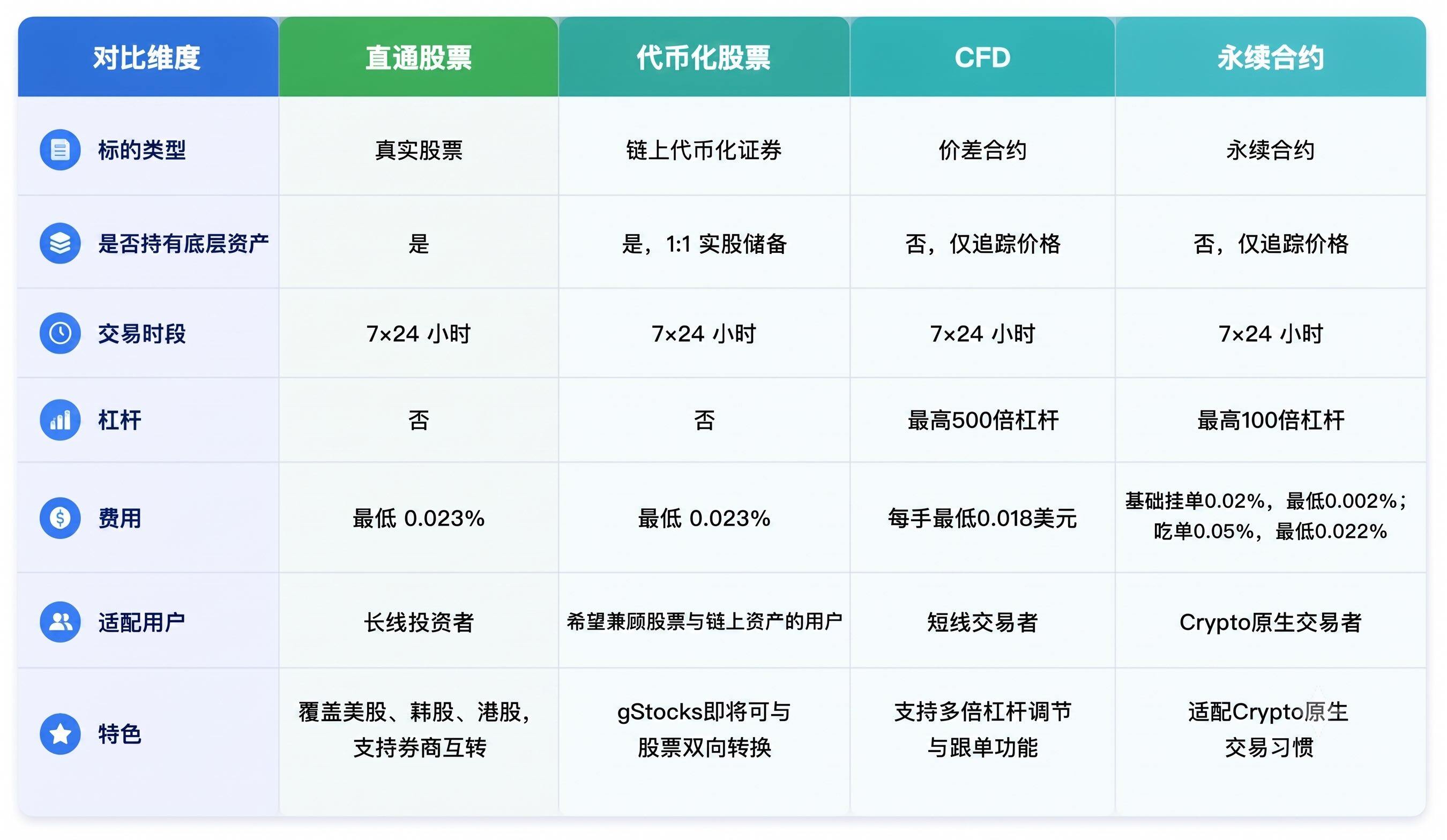
- Gate's stock product matrix includes Direct Stocks (covering over 12,500 stocks from the US, Hong Kong, and South Korea markets), Tokenized Stocks (gStocks, supporting 1:1 physical stock reserves and 24/7 trading), CFDs, and Perpetual Contracts.
- Direct Stocks support fractional trading starting from 0.01 shares, with fees as low as 0.023%, and allow stock transfers between brokerages. Tokenized stocks can be used as margin, for wealth management, and in quantitative trading.
- CFDs offer up to 500x leverage, industry-first adjustable leverage, and copy trading functionality. Perpetual Contracts follow a trading framework familiar to Crypto users, covering 223 trading pairs.

On June 27, OpenAI officially released its next-generation flagship model, GPT-5.6, in a move that appears aimed at reclaiming its throne from Anthropic.
Although this leading AI powerhouse is not yet publicly listed, Crypto users already have an opportunity for early positioning: On July 15, Gate launched the second phase of its Pre-IPO project, facilitating the subscription of tokenized OpenAI (OPENAI) shares.
According to the official announcement, the implied market capitalization for this OpenAI subscription is $895 billion, with a target total subscription amount of $20 million. The total supply of tokenized shares is 27,700 OPENAI, corresponding to a single token price of $722 USD. Users can subscribe using both USDT and GUSD, with a minimum subscription of $100 USD per order and a maximum allocation of 277 OPENAI per individual. The allocation mechanism is based on the "average hourly locked amount" as a proof-of-assets criterion. The earlier a user participates and the longer the lock-up period, the higher the allocation weight. As of this writing, the total subscription amount has exceeded $226 million USD.
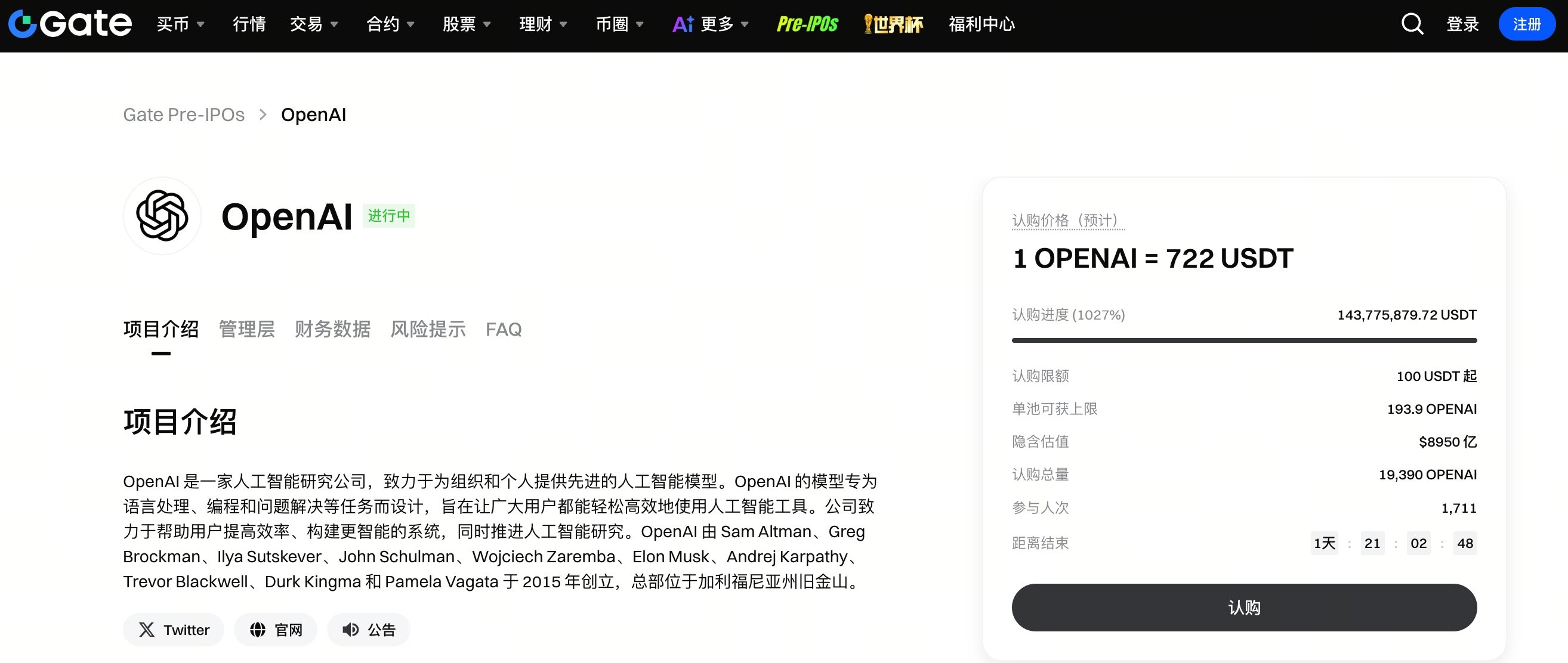
According to Gate's official description, unlike traditional stocks, the tokenized shares (OPENAI) obtained through this subscription are Mirror Notes issued before OpenAI's IPO. They are designed to mirror the market value of OpenAI both before and after its public listing.
After the subscription period concludes, OPENAI tokens will be unlocked and distributed in three phases. Additionally, OPENAI holders will have two exit options: before the listing and lock-up period, Gate will provide 7x24 pre-market trading for free buying and selling, with the Pre-IPOs zone opening on July 20. After the lock-up period (6 months post-listing), Gate will offer a dedicated exit page where holders can exchange their tokens for stock tokens or convert them to USDT based on the real-time market price of the actual listed shares.
From SpaceX to OpenAI: How Gate Builds a Stock "Subscription" Service
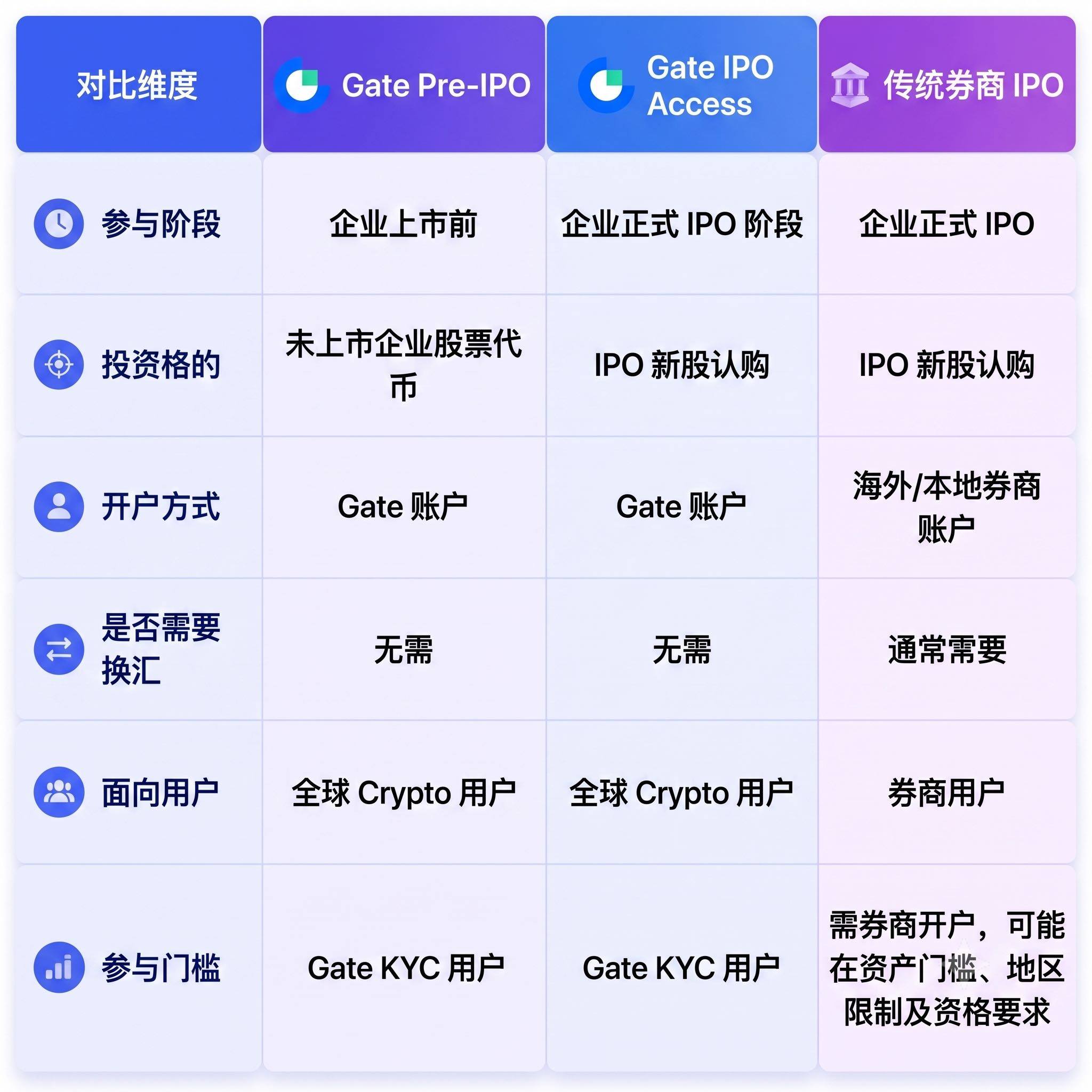
OpenAI is not Gate's first foray into the IPO space. Previously, Gate had built a comprehensive product system around SpaceX, covering Pre-IPO, IPO Access, and secondary market stock trading, creating an investment pathway spanning different stages before and after a company's listing. For users, this means they can position themselves early before a company goes public, participate in new share subscriptions during the formal IPO, and continue trading through the Gate stock account after the listing.
Specifically, Pre-IPO leans more towards pre-listing investment, allowing users to participate in unlisted companies early via tokenized shares; IPO Access focuses on the formal IPO stage, providing users with IPO allocation opportunities, which is closer to the "subscription" model in traditional capital markets.
Taking SpaceX as an example, in April of this year, Gate launched its first Pre-IPO project with a fundraising scale of nearly $395 million USD. In June, it rolled out the IPO Access service, with a minimum subscription threshold as low as 100 USDT. Users who successfully subscribed received actual new share allocations, with a single account receiving a maximum of 154 shares. During the SpaceX IPO subscription period, market demand far exceeded expectations. Gate successfully completed the quota allocation for the first phase of IPO Access, ensuring user participation rights and further validating its ability to execute IPO product designs.
Stocks: The New Battleground for CEXs
Over the past year, global capital markets have continued to diverge. The cryptocurrency market has remained bearish, while the U.S. stock market has strengthened driven by the AI wave. Structural opportunities have also emerged in markets like Hong Kong and South Korea, leading an increasing number of investors originally focused on Crypto to begin diversifying into stock assets across markets.
However, for Crypto users accustomed to on-chain transactions and CEX operational experiences, traditional brokerages often present hurdles such as cumbersome account opening procedures, needing multiple accounts for different markets, high currency conversion costs, and limited trading hours, making unified management of digital and stock assets difficult. It is against this backdrop that several major CEXs have successively launched stock-related trading services, aiming to further bridge the gap between Crypto and traditional financial markets.
Although their entry paths differ, the goals are highly consistent: on one hand, by introducing traditional financial assets like stocks, they aim to meet users' cross-market, cross-asset-class investment needs; on the other hand, leveraging native Crypto account systems, efficient capital flow, and 24/7 trading experiences, they seek to supplement and innovate upon traditional brokerage models, making global asset investment more convenient.
Comparing the solutions offered by various CEXs horizontally, Gate's offering stands out significantly, thanks to its asset coverage spanning US, Hong Kong, and South Korean stocks, a complete product matrix addressing different needs, and the capital efficiency of unlocking all scenarios through a single account.
Deconstructing Gate's Product Matrix: How Does It Meet Diverse Trading Needs?
Addressing different investment scenarios, Gate has gradually built a comprehensive product matrix covering CFDs, Direct Stocks, Stock Perpetual Contracts, and Tokenized Stocks.
1. Real Stocks: One Account, Access to Global Core Markets
For investors seeking long-term allocation to global core enterprises, prioritizing asset security, and wishing to enjoy the benefits of real stocks, Direct Stocks are undoubtedly the optimal choice.
Currently, Gate Direct Stocks cover three major core securities markets: US stocks, Hong Kong stocks, and South Korean stocks, supporting over 12,500 stock assets, with the total stock account asset size surpassing $200 million USD. This includes coverage of over 10,000 US stocks and ETFs; over 1,500 highly liquid Hong Kong stock instruments; and the top 1,000 listed companies by market cap on the Korea Exchange, including Samsung Electronics, SK Hynix, and others.
Compared to traditional cross-border investment processes, Gate Direct Stocks significantly simplify the trading flow. After completing KYC, users only need to transfer USDT to their stock account to directly trade US, Hong Kong, and South Korean stocks via a unified account, without needing to open separate overseas brokerage accounts or manually perform cross-border currency exchange. For trading, Gate offers fractional share trading starting from as low as 0.01 shares, a 7×24 hour trading experience, and integrates stock trading into the platform's existing VIP fee structure, with trading fees potentially as low as 0.023%.
Beyond the trading experience, Gate also preserves the entitlements of real stocks, such as dividends, as much as possible. Gate is also the first platform in the industry to support stock transfers both into and out of the platform, allowing users to transfer in stocks held at external brokerages or transfer out stocks held in their Gate stock account to other brokerages.
2. Tokenized Stocks: Unlocking 7*24 Hour Stock Trading
If Direct Stocks solve the problem of "real ownership," then tokenized stocks serve to further expand the use cases of stock assets. By representing traditional stock assets on-chain via blockchain technology, tokenized stocks, while anchoring the value of the underlying asset, grant stocks liquidity and composability closer to that of Crypto assets.
Currently, Gate has listed various tokenized stock products, including xStocks, Ondo, and gStocks. Among these, gStocks employs a 1:1 fully reserved real share mechanism, where each token corresponds to an actual stock asset. This ensures value anchoring while also providing the liquidity of on-chain assets.
Compared to traditional stocks, gStocks supports investments starting from as low as 1 USDT, fractional share purchases, and 7×24 hour trading, aligning better with the trading habits of Crypto users. More importantly, leveraging a single account system, gStocks can not only be bought and sold but also used as margin for leveraged lending, compatible with financial products like Gate Wealth Management, and supporting tools like Grid Trading, Trading Bots, and API interfaces, catering to the needs of both individual and institutional users in automated trading, liquidity management, and quantitative strategies.
In the future, Gate also plans to launch features such as bi-directional conversion between stocks and gStocks, and automatic dividend settlement.
3. CFDs: Providing More Strategic Options for Short-Term Trading
Unlike long-term holders, some investors focus more on short-term market fluctuations, seeking to amplify their ability to capture opportunities in both rising and falling markets. Some professional traders and institutional users also have hedging needs to manage portfolio risk more flexibly. For such needs, CFDs (Contracts for Difference) might be a more suitable product, as users can participate in price fluctuation trading without actually holding the underlying stock asset.
Currently, Gate has listed 653 stock CFD trading pairs, covering numerous popular stock instruments, supporting up to 500x leverage, with fees per contract potentially as low as $0.018 USD. Unlike traditional stock trading which requires holding the physical asset, CFDs allow users to trade based on their assessment of price movements and support both long and short positions. This provides more flexible tools for strategies such as trend trading, event-driven trading, and risk hedging.
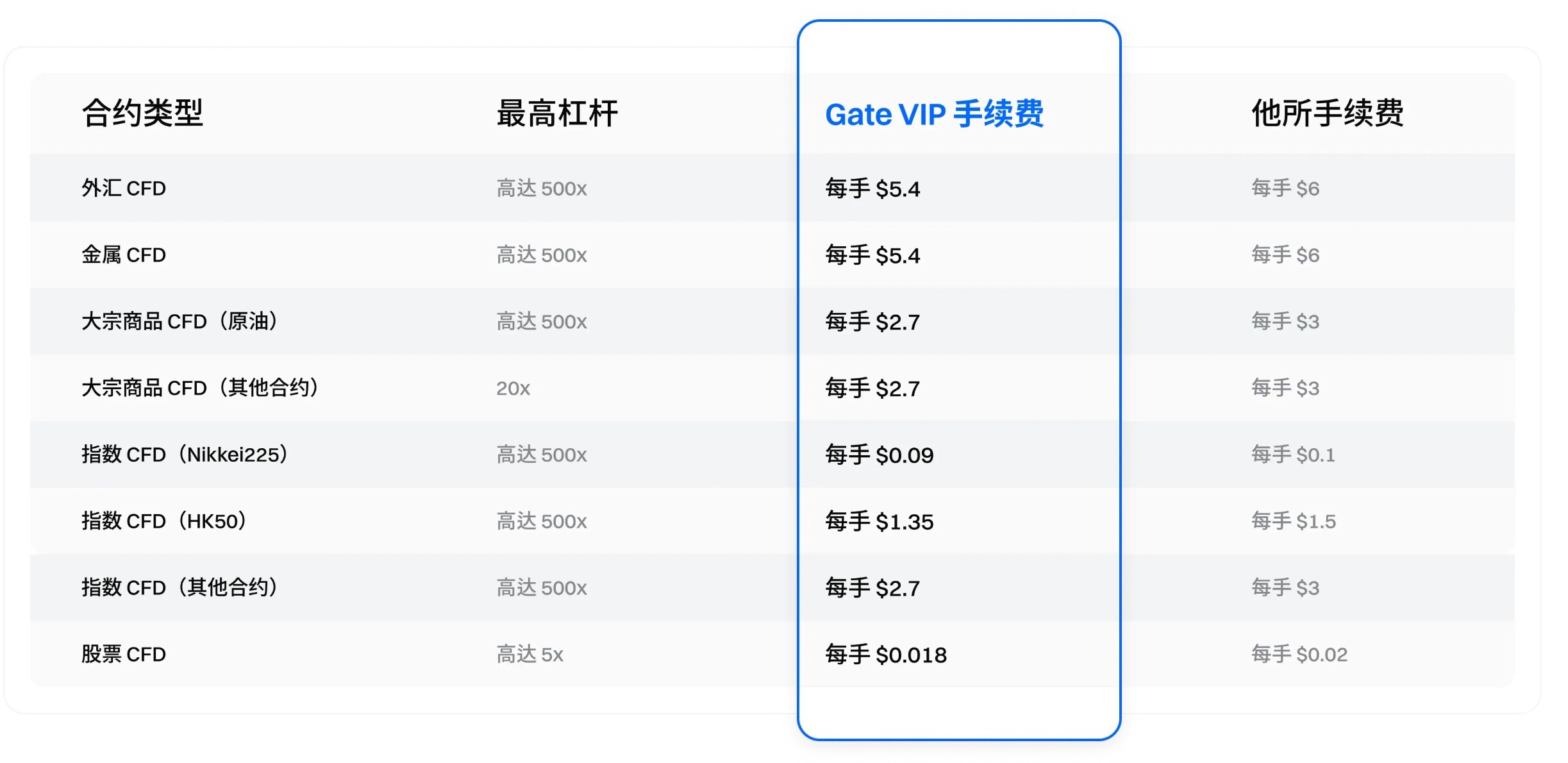
In terms of product experience, Gate's CFDs have also been optimized for trader needs. Notably, Gate pioneered an adjustable multi-leverage feature, allowing users to independently adjust the leverage multiple based on their own risk tolerance and trading strategy, rather than being limited by a fixed leverage mode. Currently, this feature is supported for several CFD assets, including Gold, Silver, and Crude Oil, enabling users to manage their risk exposure more granularly.
Furthermore, Gate has introduced the industry's first CFD Copy Trading feature, allowing users to reference professional trading strategies and lowering the learning curve for strategy development.
4. Perpetual Contracts: Extending the Trading Experience Crypto Users Know
Finally, for users who are long-active in the cryptocurrency market, perpetual contracts represent the most familiar and intuitive product form.
Currently, Gate offers 223 stock perpetual contract trading pairs, combining stock assets with the perpetual contract mechanism. This allows users to participate in global stock markets within a familiar trading framework and flexibly employ strategies like leverage and risk hedging.
Looking at Gate's stock product matrix, it is evident that its strategy is not simply porting stock products onto a Crypto platform. Instead, it builds a complete solution catering to different investment scenarios: long-term investors can allocate to global quality assets via Direct Stocks; short-term traders can capture market volatility through CFDs and Perpetual Contracts; and Tokenized Stocks further unlock the liquidity and capital efficiency of stock assets on-chain. These four product categories complement each other, collectively covering the entire investment cycle from asset allocation and trading strategies to capital management within a single account system.
Financial Markets: Heading Towards a New Normal
Looking back at the development history of the cryptocurrency market, the product boundaries of CEXs have been continuously expanding.
In the early days, crypto trading platforms primarily focused on spot and derivatives trading for digital assets like BTC and ETH. Subsequently, services like wealth management, lending, on-chain assets, and RWAs emerged, gradually transforming platforms from simple digital asset exchanges into comprehensive financial service platforms. Now, more traditional financial assets like stocks, funds, and bonds are entering the investment purview of Crypto users, and global asset allocation is becoming a significant direction for the next wave of industry development.
As infrastructure like RWAs and tokenized securities continues to mature, the lines between traditional financial assets and on-chain assets are becoming increasingly blurred. In the future, investors may no longer need to manage separate brokerage accounts, exchange accounts, and on-chain wallets. Instead, they could trade, hold, and manage stocks, Crypto, and more real-world assets within a single account system.
This is not a distant vision but an anticipated new normal for financial markets. And Gate is already a pioneer on this path.