Three Ways Stocks Go On-Chain: Which Model Gets Closer to the Ultimate Form?


- Core Viewpoint: In 2026, the tokenized stock track achieved a breakthrough, enabling stock trading to operate 24/7 for the first time. Mainstream tokenized stock products show significant differences in liquidity sources, trading mechanisms, and capital efficiency, catering to the needs of different investors.
- Key Elements:
- Industry Background: The implementation of the MiCA regulation in Europe in 2026 and the advancement of the CLARITY Act draft in the US have provided a clearer compliance framework for tokenized stocks, leading major exchanges like Ondo, Bitget, and Binance to increase their focus on this track.
- Liquidity Models: Ondo adopts an "inherited liquidity" model (minting/redeeming + arbitrage); rToken directly connects to the order books of Nasdaq and the NYSE; bStocks anchors prices via oracles. These three represent different technological paths.
- Trading Hours: All three claim to support 24/7 trading, but Ondo only covers 24 hours a day for 5 days; rToken covers pre-market, regular trading, and after-hours sessions; bStocks relies on exchange traffic to realize round-the-clock liquidity, with varying effectiveness.
- Capital Efficiency: rToken focuses on a unified margin account within the exchange, suitable for institutional clients; Ondo and bStocks lean towards on-chain DeFi composability, depending on the ecosystem of third-party protocols.
- Compliance and Custody: All three utilize regulated custody and third-party independent verification. However, there are subtle differences in audit frequency and disclosure granularity, which have a limited impact on user perception.
In 2026, the opening bell of Wall Street lost its power for the first time. For the past century, the trading floor of the New York Stock Exchange dictated when global capital would wake and rest, with weekends and holidays as strict off-hours. This year, that boundary began to loosen: the on-chain world, for the first time, gained the ability to absorb real order flow from the Nasdaq and NYSE, giving stocks—one of the oldest forms of financial assets—a new playbook that operates 24/7.
This significant change is inseparable from the intensive breakthroughs in the tokenized stock sector since 2026. The gradual implementation of Europe's MiCA compliance framework, the draft of the U.S. CLARITY Act providing clearer legislative references for digital asset classification, and multiple leading exchanges and fintech platforms have successively ramped up their stock tokenization product lines.
Ondo Global Markets, the veteran in the European and American tokenized stock space, pushed its asset scale to the billion-dollar level within months while simultaneously advancing its registration process with the U.S. Securities and Exchange Commission (SEC). Bitget's rToken can directly connect to the Nasdaq and NYSE, transforming U.S. stocks into tradable, collateralizable, and reusable crypto-native assets through unified trading accounts, margin applications, and high-frequency reserve audits. Binance also launched bStocks in June, rapidly expanding by leveraging the native user traffic of the largest exchange.
Although most exchange-traded tokenized stock products use similar descriptions like "24/7 trading" and "1:1 backing," there are significant differences in their liquidity sources, trading mechanisms, use of funds, and underlying risk structures.
For a deeper understanding, reporters from Odaily will conduct a horizontal comparison across four dimensions: liquidity sources, trading session availability, capital efficiency and composability, and compliance licenses with custodial transparency. Combined with market size and order book data, we will analyze the real differences among the three product models.
Evaluation Dimension Settings
The horizontal comparison dimensions used in this article include:
- Liquidity source and price anchoring mechanism
- Trading session and availability
- Capital efficiency and composability
- Compliance license and asset custodial transparency
These four dimensions correspond to what investors care about most: whether prices reflect actual U.S. stock prices, whether trading is possible at any time, whether funds can be used efficiently, and whether the underlying stock assets are real and verifiable. Finally, we will introduce the existing product trading volume rankings as a reference.
Dimension One: Comparison of Liquidity Sources
The price anchoring mechanism is the most critical structural difference among tokenized stock products and is key to determining the risk of "de-pegging." It directly affects whether traders can enter or exit at real prices during critical moments.
Ondo Global Markets uses an "Inherited Liquidity" model, maintaining token prices close to the underlying stocks through a real-time minting and redemption mechanism combined with arbitrageur behavior. This design allows tokens to circulate flexibly on-chain while staying as close to the underlying stock price as possible. rToken directly routes spot orders to the NASDAQ and NYSE order books during U.S. stock trading hours via a licensed broker. The transaction results are written back to the exchange's spot order records in real-time, making the price and liquidity fully synchronized with the underlying stock market. It is the only product among the three that achieves exchange-level order book direct connection. Binance's bStocks prices tokens by anchoring to the target stock price via data pushed by oracles. Leveraging Binance's own user base and update mechanisms, it can quickly cover a large number of assets at a low threshold, providing users with a real-time price tracking experience.
The three products each have their own focus on liquidity anchoring, respectively representing the three mainstream technical paths currently prevalent in the industry: direct exchange matching, minting-redemption arbitrage, and oracle tracking.
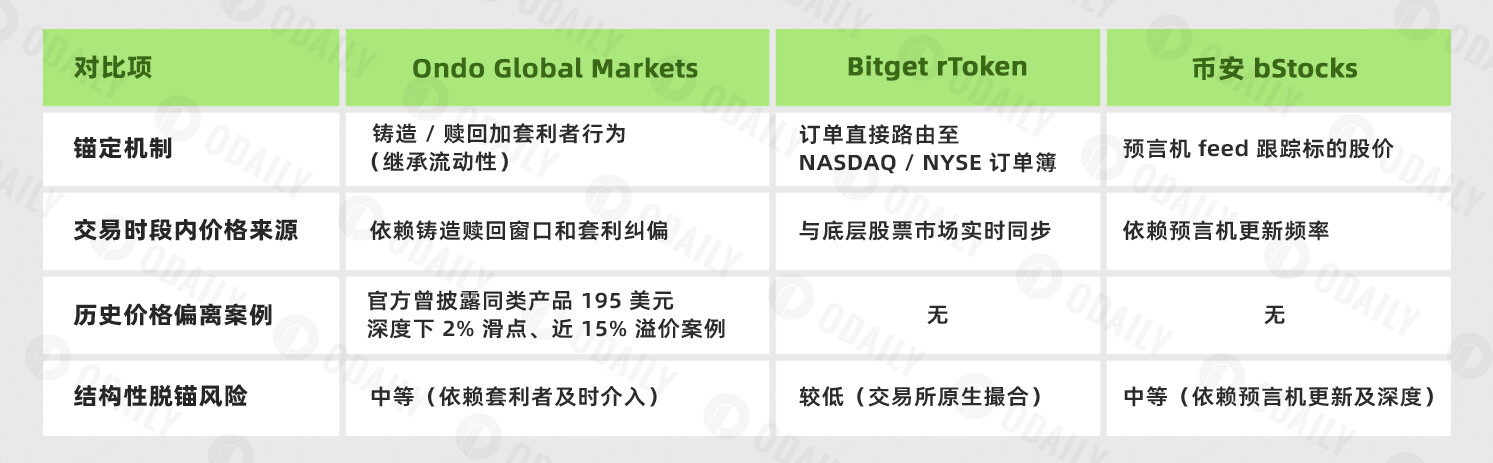
The liquidity anchoring mechanisms of the three are structurally different and suit different use cases. Ondo's minting-redemption model is more suitable for users accustomed to native on-chain operations who are willing to bear some time lag in arbitrage correction, and it is also more suitable for arbitrageurs. bStocks' oracle tracking has a lower threshold, suitable for ordinary users seeking convenience and broad asset coverage. rToken's direct trading order book model is closer to the real price in terms of design logic, especially during regular U.S. stock trading hours, making it suitable for traders with high price requirements and a preference for low slippage.
At the same time, we also conducted a practical test on the order book data. Taking Circle (CRCL) tokenized stock as an example, the quotes and depths from the three platforms at the same time show different advantages and disadvantages:

In this set of data, all three maintained relatively narrow spreads. However, in terms of order book depth and 24-hour trading volume, rToken performed more prominently. Its model of accessing the native order book of the stock exchange holds a significant advantage in order-taking capacity and market activity.
Dimension Two: Trading Session and Availability
Regarding 24/7 trading capabilities, all three products claim to support 24/7 user trading, but the specific mechanisms differ significantly.
Ondo Global Markets' minting and redemption window is 24 hours, five days a week, while on-chain transfers themselves are not subject to time constraints, providing users with flexible asset transfer capabilities. Price discovery, however, depends on the open status of the minting and redemption window. rToken covers regular U.S. stock trading hours, pre-market, intraday, after-hours, and overnight sessions. Some popular assets further support truly 24/7 trading, with Bitget providing liquidity during off-hours to maintain price discovery, achieving a seamless transition from regular to closed sessions. Binance's bStocks also emphasizes 24/7 liquidity, near-instant settlement, and zero conversion fees, leveraging the exchange's native user base to make more assets conveniently tradable at any time.
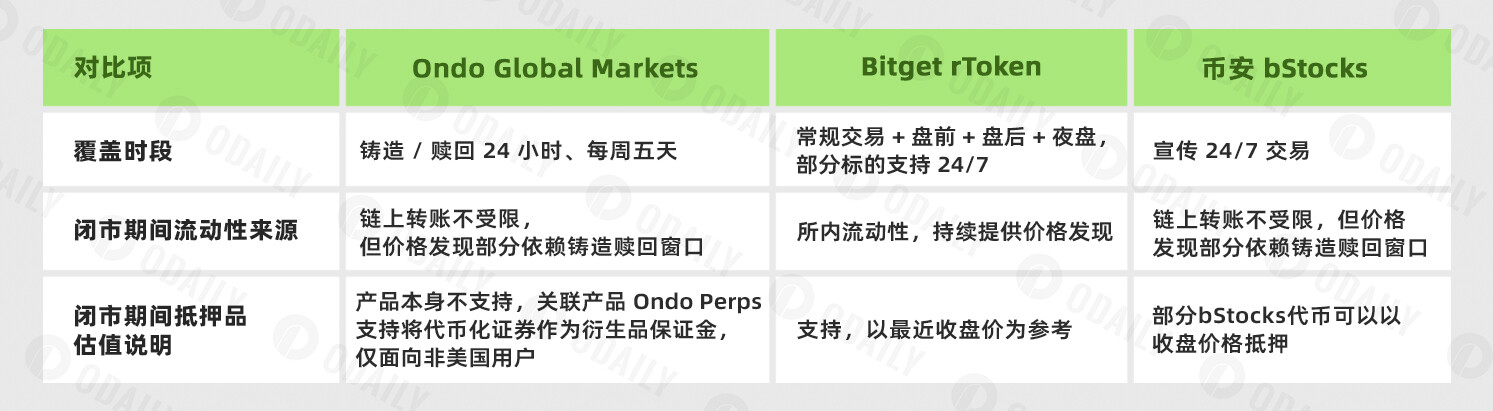
All three regard 24/7 availability as a core capability and have established corresponding mechanisms to address trading and price fluctuation risks during U.S. stock market off-hours. The overall product experience and risk management frameworks are relatively well-developed. In terms of pure 24/7 availability, Ondo falls slightly behind in coverage time. Therefore, Bitget rToken and bStocks might be more suitable for everyday users.
Dimension Three: Capital Efficiency and Composability
Capital efficiency is a core consideration for institutions and professional traders when choosing tokenized stock products. It is specifically reflected in whether these assets can be used as margin or collateral and whether they can be flexibly allocated across different accounts and strategies. This is where the actual use-value gap between products widens. Although this part is far from small retail investors with traditional funds, it is a core consideration for professional traders and institutions choosing to allocate crypto asset exposure to U.S. stocks.
Odaily's evaluation results are as follows:
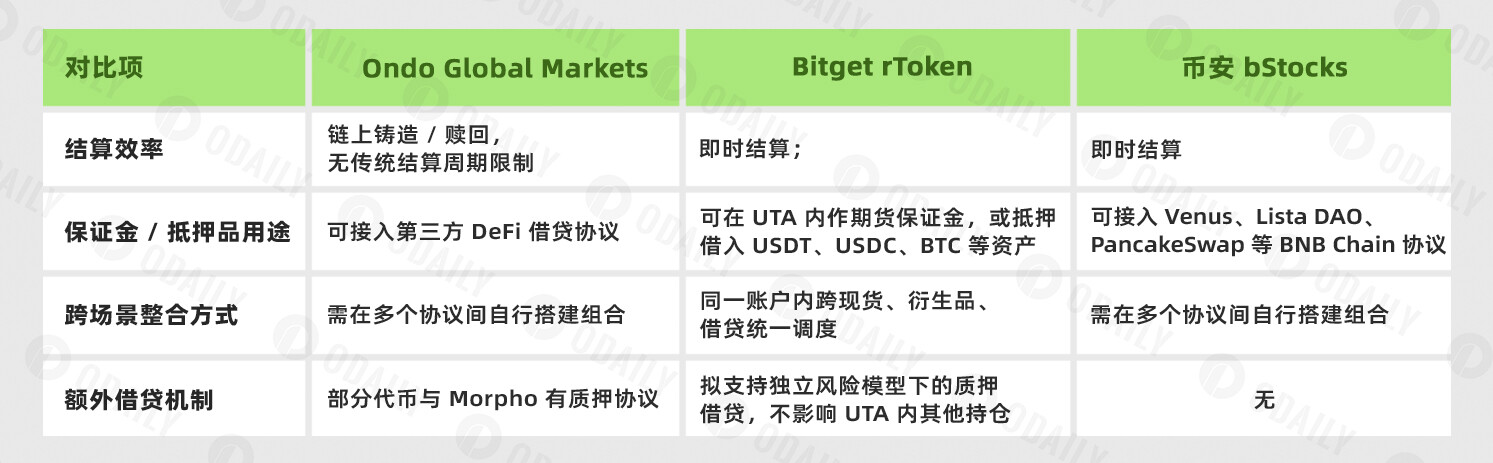
From a design perspective, the capital efficiency functions of the three are significantly different: Ondo and bStocks lean more towards "on-chain DeFi composability," relying on third-party protocol ecosystems, requiring users to bear the friction of cross-protocol operations and additional smart contract risk exposure. rToken, on the other hand, takes the "in-exchange institutional-grade unified margin account" route, directly integrating stock positions into scenarios like derivatives and lending, facilitating multi-asset coordination within the same account system. For those who seek more on-chain DeFi functionality, Ondo and bStocks are more suitable. From the perspective of the actual needs of professional and institutional traders for capital efficiency, rToken's integration and convenience are more prominent and closer to the risk control controllability requirements of institutions.
Dimension Four: Compliance License and Custodial Transparency
While trading on-chain, whether the underlying U.S. stock assets truly exist and can be independently verified is the foundation for building trust in tokenized stock products. How do the credit endorsements of each product perform in this regard?
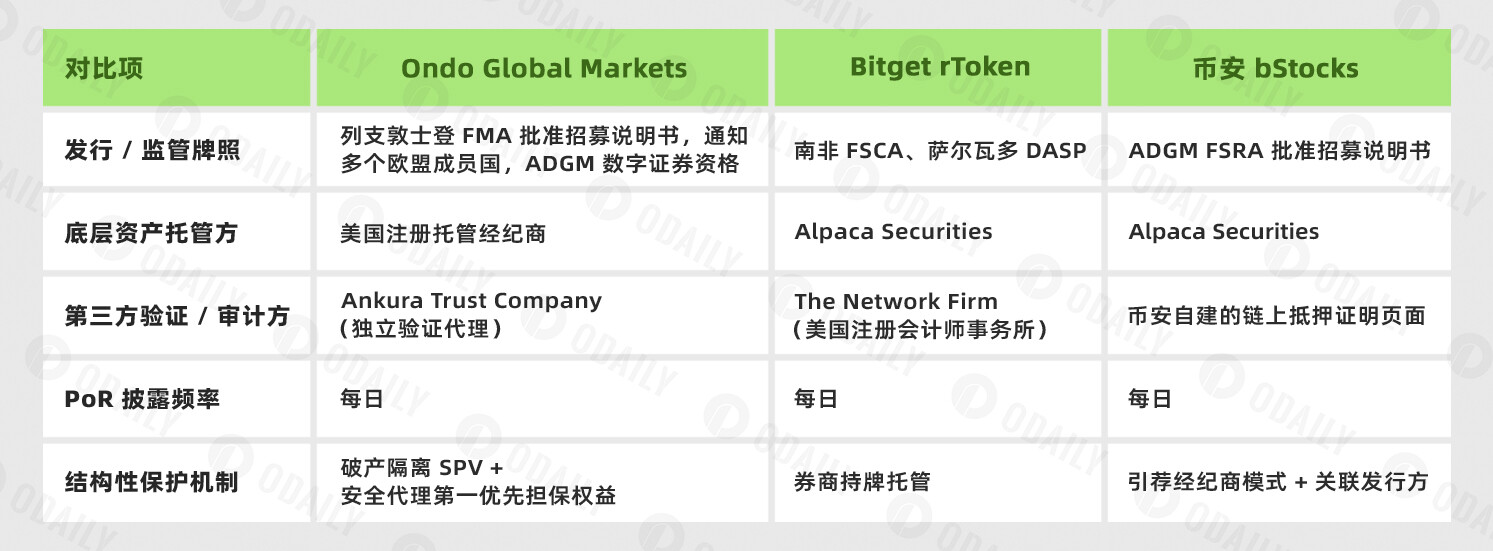
All three adopt an asset protection mechanism combining regulated custody with third-party independent verification, establishing a relatively comprehensive framework in terms of compliance, transparency, and credibility of underlying assets. It can be seen that after several rounds of market consolidation in the crypto space, the major players in the stock tokenization direction have maximized protection for underlying assets. The differences among them are more reflected in specific arrangements such as audit frequency, information disclosure granularity, and the identity of verification parties. However, the perceived experience for users is not significantly different.
Conclusion: Three Products Cater to Investors with Different Needs, Each with Strengths and Challenges
Combining the four dimensions and market rankings, the three paths respectively address different needs in the tokenized stock track.
Ondo Global Markets, with its inherited liquidity model and compliance layout covering multiple jurisdictions, is better suited for institutions that value regulatory frameworks and open on-chain applications, as well as users with high compliance demands from Europe and the U.S. Binance's bStocks, relying on the exchange's native user traffic and on-chain ecosystem integration, offers convenience in trading entry, self-custody, and on-chain circulation, making it more suitable for investors deeply involved in the BNB ecosystem and familiar with on-chain operations. Bitget's rToken, with its diverse product features, is better suited for high-frequency traders and institutional clients who are more sensitive to liquidity, capital efficiency, and cross-scenario asset allocation.
From a longer-term industry perspective, the common challenges facing tokenized stocks may be more noteworthy than the differences between products. Issues such as cross-border financial compliance, whether real market demand can keep up, and accurate pricing during off-hours still need to be further resolved by the industry. As regulatory boundaries gradually clarify and underlying liquidity continues to deepen, different paths will learn from each other through competition, pushing this market from early experimentation to maturity. The boundary once drawn by Wall Street is being slowly rewritten by every on-chain transaction.