






Sau ba năm liên tục giảm vị thế cổ phiếu, Buffett cuối cùng cũng đã hành động


- Ý chính: Berkshire Hathaway đã kết thúc chuỗi 14 quý liên tiếp bán ròng cổ phiếu trong quý II/2026, chuyển sang mua ròng gần 19,8 tỷ USD, đồng thời đầu tư hàng chục tỷ USD vào Alphabet (công ty mẹ của Google) thông qua hình thức private placement, đánh dấu sự điều chỉnh chiến lược đầu tư dưới thời CEO mới Abel - chuyển từ trạng thái quan sát dài hạn sang chủ động triển khai.
- Các yếu tố chính:
- Kết quả tài chính: Tổng doanh thu quý II đạt 101,808 tỷ USD, tăng 10% so với cùng kỳ; lợi nhuận ròng đạt 25,667 tỷ USD, tăng gấp đôi so với cùng kỳ, vượt kỳ vọng thị trường.
- Chuyển hướng đầu tư: Mua vào 23,47 tỷ USD cổ phiếu, bán ra 3,69 tỷ USD, chấm dứt xu hướng bán ròng kể từ năm 2023.
- Tập trung vào Google: Tăng vị thế Alphabet khoảng 10 tỷ USD thông qua private placement, đưa cổ phiếu này vào top 5 khoản nắm giữ lớn nhất, ngang hàng với Apple, Bank of America, chiếm 66% tỷ trọng.
- Mua lại và tiền mặt: Mua lại cổ phiếu trị giá 4,527 tỷ USD, mức cao nhất kể từ năm 2021; tổng tiền mặt và trái phiếu chính phủ Mỹ đạt khoảng 364,7 tỷ USD, giảm so với quý trước.
- Logic chiến lược: Trước đó từng bị chế giễu vì "bỏ lỡ" làn sóng AI, nhưng lựa chọn chờ đợi định giá điều chỉnh, nhấn mạnh kỷ luật đầu tư và biên an toàn dài hạn.
Original: Odaily Planet Daily (@OdailyChina)
Author: Azuma (@azuma_eth)
After the US stock market closed on August 9 (Beijing time), Berkshire Hathaway released its Q2 2026 earnings report.
The report shows that Berkshire's total Q2 2026 revenue reached $101.808 billion, up approximately 10% year-over-year, with net profit attributable to shareholders at $25.667 billion, doubling compared to the same period last year (an increase of about 107%). Both operating profit and net profit significantly exceeded market expectations.
However, the more signal-worthy point in the report is that Berkshire Hathaway finally ended its stock net-selling streak that had lasted over three years (14 quarters), shifting to net buying.
Hoarding $400 Billion in Cash, Berkshire Finally Makes Its Move
According to the earnings data, in Q2, Berkshire Hathaway bought approximately $23.47 billion worth of stocks while selling only $3.69 billion, resulting in net purchases of nearly $19.8 billion, ending the prolonged net-selling state since 2023.
What investors should pay even more attention to is where the capital went. The report disclosed that Berkshire Hathaway's largest move last quarter was a private placement investment of approximately $10 billion in Alphabet (Google's parent company). This officially propelled Google into the ranks of Berkshire Hathaway's top five largest holdings — alongside American Express, Apple, Bank of America, and Coca-Cola. As of the end of June, these five positions accounted for 66% of the stock portfolio, indicating still-high concentration.

Although Buffett has long maintained a cautious stance toward tech stocks, he previously revealed when first building the Google position that the investment was a joint decision made in consultation with Greg Abel (Berkshire Hathaway's current CEO, who officially succeeded Buffett on January 1 this year). Buffett also admitted that missing Google in his early years was a "historic mistake," and this additional investment was based on value investing logic, focusing on Google's search monopoly moat and stable cash flow.
This latest billion-dollar increase, however, was an investment decision made under the leadership of new CEO Abel — which may suggest that in the new landscape where Buffett has stepped back and Abel holds the reins, Berkshire Hathaway's tolerance and participation in cutting-edge technology are increasing.
Beyond returning to net buying in the market, Berkshire Hathaway also executed its first stock buyback in two years during Q2. The report disclosed that the company spent approximately $4.527 billion on buybacks last quarter, marking the highest quarterly figure since 2021; in July, it added over $3.3 billion more in buybacks.
In March this year, Berkshire Hathaway officially announced the resumption of its stock buyback program. At the time, Abel stated that the buyback was because management believed the company's "intrinsic value" exceeded its market price.
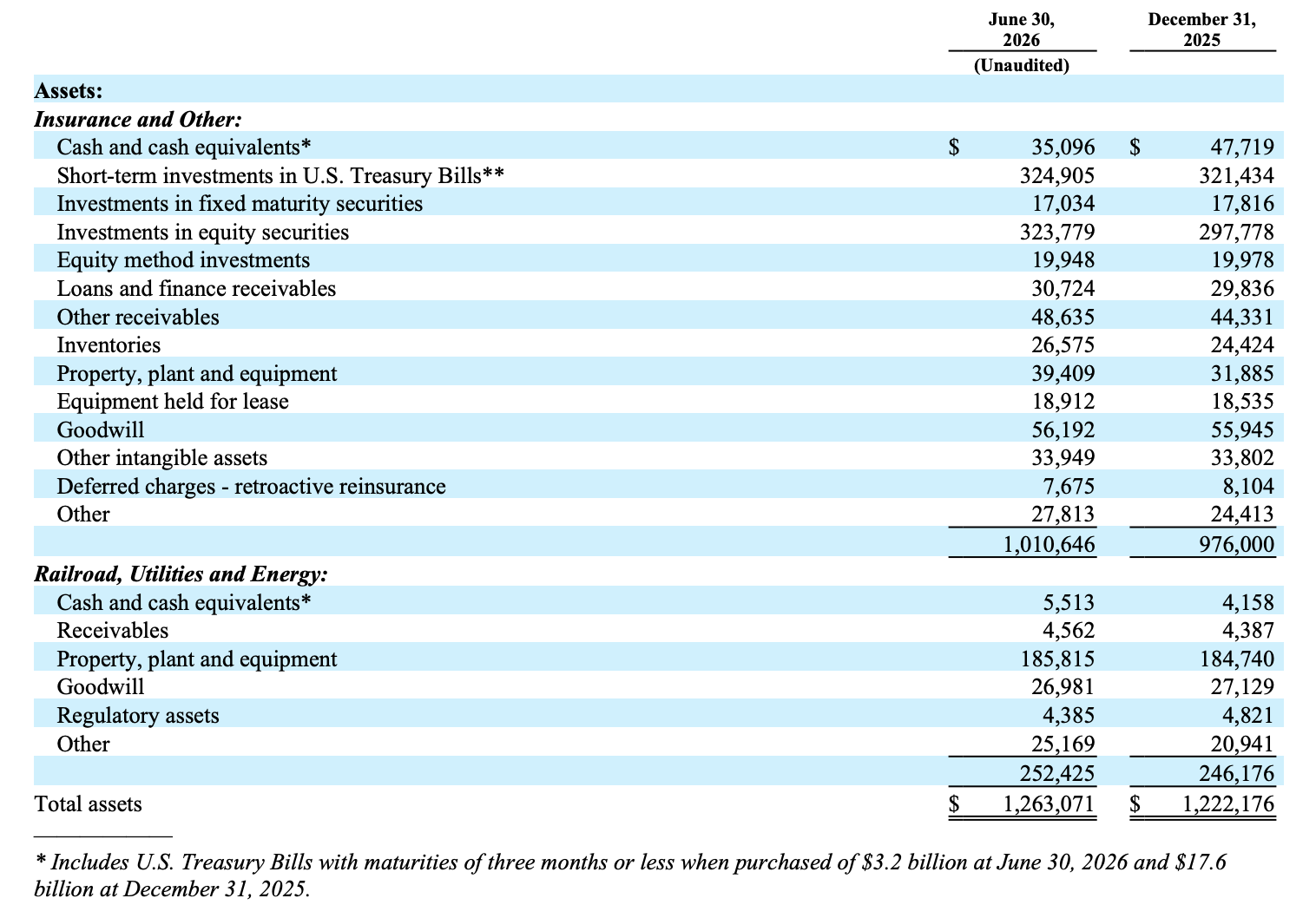
With the shift in investment and buyback pace, Berkshire Hathaway's long-accumulated cash reserves have also begun to change. Over the past few years, one of the company's biggest labels was "cash machine." Due to a lack of large-scale opportunities meeting Buffett's investment criteria, cash and short-term Treasury holdings continued to climb, reaching a historic high of nearly $400 billion by the end of Q1 this year.
However, as stock purchases, buybacks, and industrial M&A (mainly for acquiring petrochemical company OxyChem and homebuilder Taylor Morrison) progressed, Berkshire Hathaway's cash reserves entered a downward trajectory. As of June 30, Berkshire held approximately $35.1 billion in cash and cash equivalents, with short-term US Treasury securities at around $324.9 billion, totaling approximately $364.7 billion — a noticeable decline from $397.38 billion at the end of Q1.
Once Mocked as "Out of Touch with the Times," It Was Actually Silently Watching from the Sidelines
Looking back to the period from 2023 to early 2026.
Over the past few years, the AI technology wave has completely ignited global capital markets, with chip and semiconductor supply chains represented by Nvidia, SK Hynix, Samsung, and Micron becoming the most crowded trading track.
The market was filled with the frenzy of "All in AI." Any fund manager not heavily positioned in semiconductors was deemed outdated, while Buffett and his Berkshire Hathaway, despite sitting on hundreds of billions in cash, chose to observe with near-indifference.
Ridicule followed. "Buffett is out of touch," "Value investing is dead," "The moat theory is obsolete in the face of the AI revolution," "This old man isn't even as good as me" — such criticisms were everywhere. People relished the multi-fold or even tens-of-fold gains in semiconductor stocks, comparing them to Berkshire Hathaway's seemingly tepid share price performance, and hastily concluded that this 90-something old-school investment guru, along with his designated successor Abel, had lost their judgment on the tech revolution.
But Berkshire Hathaway's choice clearly has its own logic. In the Q2 2026 earnings report, Berkshire Hathaway reiterated its iconic warning: "Investment gains and losses in any given quarter are usually meaningless and provide little to no analytical or predictive value."
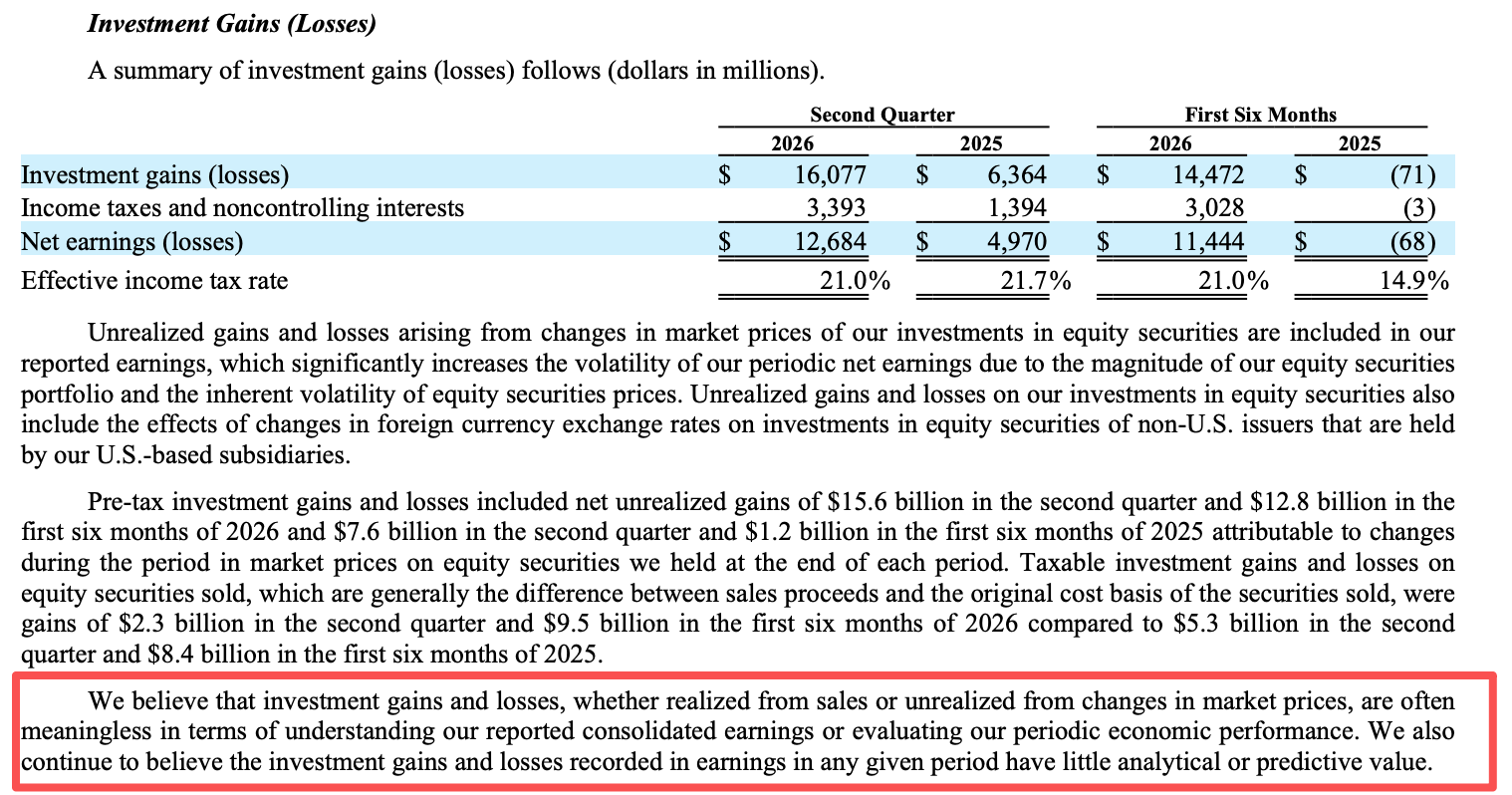
This statement appears to target GAAP accounting standards, but in reality, it reflects a consistent attitude toward short-term market speculation. In the eyes of Buffett and Abel, there may still be doubts about whether the semiconductor industry can escape cyclicality, and uncertainty remains over when the explosive demand for AI hardware will translate into sustainable cash flows.
With the market entering a euphoric phase and semiconductor stock prices reaching high levels, the market environment at that time had completely deviated from Berkshire Hathaway's discipline of "buying great companies at reasonable prices." So while the market was immersed in FOMO sentiment, Berkshire Hathaway chose the most mundane yet DNA-fitting strategy — waiting.
Until recent months, as the semiconductor frenzy suddenly receded, previously overhyped targets experienced sharp pullbacks. Those who once mocked Buffett for "missing the rally" suddenly found that the paper gains from chasing semiconductor highs evaporated quickly in the correction, while Berkshire Hathaway's thousands of billions in cash not only provided an unparalleled margin of safety but also gave it the confidence to be greedy when others are fearful.
The $19.8 billion in net purchases in Q2 is precisely the validation of this discipline. It is worth noting that Berkshire Hathaway did not chase highs at the market's peak but acted decisively on a large scale only after market volatility had brought quality asset prices back to reasonable ranges.
This is the truth Buffett has practiced for decades — investing is not about who runs the fastest, but who survives the longest and laughs last.


