






Polymarket kỷ niệm sáu năm: Từ phòng tắm, lưu vong đến trở về nhà


- Quan điểm chính: Nhân dịp kỷ niệm sáu năm ra mắt, Polymarket đã phát triển từ một thí nghiệm bên lề được sinh ra trong phòng tắm ở New York trong thời gian phong tỏa vì đại dịch, thành thị trường dự đoán được quan tâm nhất toàn cầu, nhận được đầu tư từ ICE, giấy phép từ CFTC và xuất hiện trên Wall Street Journal, các liên đoàn thể thao chính thống và truyền hình trực tiếp. Tuy nhiên, con đường thành công của nó đầy rẫy những xung đột pháp lý và những khúc quanh co của việc "trở về nhà".
- Các yếu tố then chốt:
- Khởi điểm công nghệ và xác nhận ban đầu: Ra mắt vào tháng 6 năm 2020, sử dụng Polygon và USDC để giảm ma sát giao dịch, và lần đầu tiên chứng minh tiềm năng như một tín hiệu cho các sự kiện công cộng thông qua thị trường bầu cử Mỹ năm 2020 (khối lượng giao dịch 8 triệu USD).
- Cú sốc pháp lý và lưu vong hải ngoại: Tháng 1 năm 2022, CFTC cáo buộc nền tảng này vận hành thị trường quyền chọn nhị phân chưa đăng ký, dẫn đến khoản tiền phạt 1,4 triệu USD và buộc phải chặn người dùng Mỹ, bước vào giai đoạn hoạt động ở nước ngoài trầm lắng kéo dài gần ba năm.
- Sự bùng nổ do các sự kiện công cộng thúc đẩy: Sự kiện tàu lặn Titan năm 2023 và chu kỳ bầu cử Mỹ năm 2024 đã giúp nền tảng nhận được sự quan tâm chính thống, với tổng khối lượng giao dịch lên tới hàng chục tỷ đô la, và phản ánh thành công các sự kiện chính trị lớn như việc Biden rút lui khỏi cuộc đua.
- Hòa giải pháp lý và lộ trình trở về: DOJ và CFTC của Mỹ đã không đưa ra cáo buộc vào năm 2025. Polymarket đã có được lối vào khuôn khổ pháp lý Mỹ thông qua việc mua lại sàn giao dịch QCX đã đăng ký với CFTC, và cùng năm đó nhận được thư no-action từ CFTC.
- Chấp nhận cấp tổ chức và thương mại hóa: ICE (công ty mẹ của Sở Giao dịch Chứng khoán New York) đã đầu tư chiến lược với mức định giá lên tới 2 tỷ USD, đưa định giá nền tảng lên 15 tỷ USD; nền tảng đã ký kết hợp tác độc quyền với các liên đoàn thể thao như NHL, UFC, MLB, thử nghiệm phí giao dịch và ước tính doanh thu hàng năm hóa vượt quá 200 triệu USD.
- Tranh cãi và thách thức tương lai: Nền tảng vẫn phải đối mặt với vùng xám pháp lý và các tranh cãi về đạo đức (ví dụ như thị trường hóa các sự kiện thảm họa), dự kiến sẽ phát hành token và airdrop, và người dùng Mỹ vẫn có thể truy cập thông qua trang web nước ngoài.
On June 17, Polymarket celebrated its sixth anniversary.
In the crypto world, six years is a long time. Long enough for a narrative to go from bubble to rubble, and for a product to evolve from a fringe experiment to mainstream infrastructure. Six years ago, Polymarket was just a prediction market cobbled together by a young founder in his bathroom during New York's pandemic lockdown. Six years later, it has entered the balance sheets of Google, WSJ, sports leagues, the CFTC's regulatory framework, and ICE, the parent company of the New York Stock Exchange, becoming the world's most watched "information market."
If you only look at today, Polymarket seems like a typical success story: exploding trading volume, soaring valuation, its founder joining the ranks of the youngest self-made billionaires, and prediction markets moving from crypto circles into mainstream media and live sports broadcasts. But if you pull back the timeline, the story isn't so smooth. It's not a linear history of product growth, but an adventure of being constantly shown the door, yet persistently trying to come back through the front entrance.
Polymarket's earliest proposition was simple: when the world is full of uncertainty, can prices get closer to the truth faster than media, experts, and polls? COVID, the US election, the Titan submersible, Biden's withdrawal, the Trump Whale, the FBI raid, the CFTC approval, the ICE investment – over these six years, it has repeatedly turned real-world events into markets, and just as repeatedly been bitten by the rules of the real world.
So, the significance of Polymarket's sixth anniversary lies in witnessing how a crypto product born in a bathroom came to stand at the intersection of finance, media, sports, and regulation. This article from BlockBeats aims to tell the story of these six years of Polymarket: how it survived, how it was driven out of the US, and how it bought its ticket home.
The Gambler in the Bathroom
In October 2013, an email landed in the inbox of the U.S. Securities and Exchange Commission.
The sender was Shayne Coplan, 14 years old, still a high school student in Manhattan. According to the version he later shared, the email came from a teenager who had read "Flash Boys" and was fascinated by electronic trading networks. The email body was short, but the tone had a unique teenage mixture: half naivety, half confidence.
He first introduced himself, saying he was a sophomore in high school in Manhattan, working on a stock exchange based on an ECN (Electronic Communication Network). His immediate priority was to confirm the idea was "completely legal" and could comply with SEC regulations.

Shayne Coplan
On December 2, 2024, Coplan posted this old email on X with the caption: "What people call an 'overnight success' takes a decade." Looking back over a decade later, the email seems like an overly neat foreshadowing. Coplan certainly didn't know then that what he would eventually build wasn't a traditional stock exchange, but a prediction market where the world could bet on the future with prices. Nor did he know that this market would later be forced out of the US due to regulatory issues, only to try and walk back in through the front door a few years later.
The Prehistory of Polymarket
Coplan grew up in Manhattan, raised by his mother; his father is a film professor at NYU. He attended public school in Hell's Kitchen, not an elite preparatory school for the children of Wall Street. The impression he later gave wasn't that of someone trained in the traditional financial system. He seemed more like a kid raised at the intersection of internet culture, cryptocurrency, startup biographies, and the streets of New York.

Coplan credits his high school graduation to "spark notes, caffeine, and Wikipedia." Photo: Shayne Coplan/Facebook
Around that time, he started getting into cryptocurrency. According to media reports, the entry point even carried a bit of early-internet serendipity: while downloading pirated music, he stumbled upon crypto, started researching it, and even tried building his own mining rig. For many of his peers, the internet was for games, music, and social platforms; for Coplan, it was more like a staircase leading directly to a basement. Following this staircase, he saw a new financial world without teachers, entrance tickets, or age requirements.
In 2014, the Ethereum presale began. Coplan bought ETH at around $0.30 per coin. This early investment later became the seed funding for his startup.
Around the same time, he approached the lyrics website Genius, boldly offering his services. After sending many emails with no response, he simply showed up at their office door. NYMag later described Coplan at the time as having a mop of curly hair and an almost encyclopedic knowledge of billionaire tech entrepreneurs. Genius eventually gave him an internship.
This experience is important for the Polymarket story because it shows that Coplan's early studies weren't focused on finance, but on "how people turn an internet idea into reality." He annotated pages on Genius belonging to Zuckerberg, Travis Kalanick, and others, as if sketching a blueprint for his own future. A teenager repeatedly reading these people's stories, dissecting them, was essentially learning a path: how a fringe idea enters the mainstream world.
He later enrolled at NYU to study computer science but dropped out after just one semester to focus full-time on crypto startups. From 2018 to 2019, he bought the domain union.market and built a product called Union Market, focused on yield-generating digital assets. The project didn't really take off.
But the failure didn't steer him away from the "market" problem. During that time, he read economist Robin Hanson's papers on futarchy. The core idea of futarchy is radical: if markets can aggregate information, could prediction markets help society make decisions? In other words, could prices reflect not just asset values, but also the probability of future events?
Coplan wrote to Hanson, saying he wanted to build a prediction market. Hanson didn't take it too seriously. The reason was simple: prediction markets weren't a new concept. There had been many attempts over the decades, and failures far outnumbered successes. The field always sounded correct but always struggled to enter the mainstream public's life.
By the end of 2019, Coplan had become completely disillusioned with crypto. He was 21, had been a dropout for two and a half years, hadn't achieved significant results, and was running out of money. Looking back at Polymarket's birth, it's easy to tell a "genius founder discovers an opportunity" story. But on the real timeline, it's more like someone hitting rock bottom, still searching for an exit within an old idea.
What truly changed everything was 2020.
COVID Breaks the Mold
In March 2020, New York City became the epicenter of the US COVID-19 pandemic.
Times Square emptied, Broadway closed, restaurants upturned chairs onto tables, subway cars held only a few masked passengers. Ambulance sirens became the city's background noise. Each morning, people's first concern wasn't the weather, but new cases, hospitalizations, death tolls, the governor's press conference, and new lockdown rules.
For most New Yorkers, the lockdown meant fear, stagnation, and endless waiting. Some lost jobs, some left the city, others were trapped in small apartments, endlessly refreshing news feeds.
Everyone was asking the same type of questions: When will the lockdown end? Will cases keep rising? When will a vaccine arrive? Will the presidential election be rewritten by the pandemic? But traditional information channels didn't offer stable answers. Experts, media, the government, social platforms – every voice seemed certain, yet every certainty was quickly overturned by new reality.
This was exactly the ideal environment for a prediction market. Not because people suddenly liked gambling, but because life was filled with unavoidable and unpredictable realities. The pandemic turned "the future" from an abstract concept into something everyone had to deal with daily. Everyone was predicting, but most predictions didn't have a price.
Coplan saw the opportunity.
He developed the product in the bathroom of his Lower East Side apartment. He would later repeatedly refer to it as his "makeshift bathroom office."
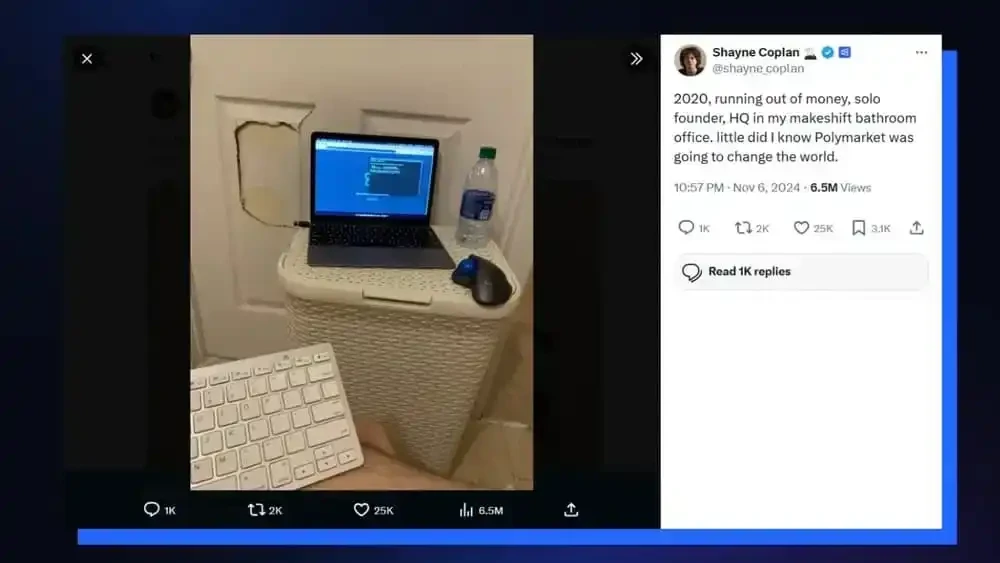
A young man with almost no resources, in the most chaotic time in the world, trying to build a market to price that chaos. The pandemic made everyone a predictor, and Coplan wanted to compress those scattered judgments – from chat groups, news comment sections, expert interviews, and traders' desktops – into a tradeable price.
He had no co-founder, was running out of money, and had to inventory his apartment items, figuring out what to sell for rent. The product's name was still changing: Union.market, Union Marketplace, finally becoming Polymarket. The name later seemed inevitable, but at the start, it was just a new entrance grown from the wreckage of an old project.

Polymarket founder Shayne Coplan, source: CBS '60 Minutes'
In June 2020, Polymarket officially launched. Technically, it used Polygon and USDC for settlement. Compared to earlier Ethereum mainnet prediction markets like Augur, it offered lower fees, faster speeds, and a user experience closer to a regular internet product.
Early markets were straightforward: ETH price, US COVID-19 case trajectory, the 2020 election. These markets seemed disparate, but they pointed to the same question: when the world is surrounded by uncertainty, are people willing to use real money to express their judgment about the future?
Four months later, the answer began to emerge.
In October 2020, the US presidential election entered its final sprint. The pandemic wasn't over, mail-in ballots became a new battleground, the echoes of racial justice protests still reverberated in streets and debates, and the shadow of economic recession weighed on household bills and market expectations. Trump tried to prove he could lead America out of the crisis, while Biden framed the election as a chance to "return to normal."
That fall, every part of American society was being pulled by politics. TV stations ran rolling polls, hosts speculated endlessly in front of red and blue maps; social media was full of conspiracy theories, partisan mobilization, and fights over mail-in ballots; Wall Street tried to assess the direction of taxes, regulation, and fiscal policy; ordinary people sought a bit of certainty between the pandemic and the election. Everyone was asking: Does Trump still have a chance? How solid is Biden's lead? If the count drags on, will the markets crash first?
When Polymarket launched, it was a niche crypto tool, but the election gave it its first real public test. In October, Polymarket completed a $4 million seed round led by Polychain Capital, with participation from Naval Ravikant, 1confirmation's Nick Tomaino, and others.
For a product just out of a bathroom, this funding wasn't just capital; it was a signal: at least a group of crypto investors believed prediction markets could become useful again.
In November, the Biden vs. Trump showdown reached its climax. Polymarket's market price consistently pointed to a Biden victory for weeks before the election. The "Will Trump win?" market saw over $8 million in volume. Looking back now, $8 million is tiny, incomparable to the tens of billions during the 2024 election. But at the time, it was enough to prove one thing: people were willing to trade political judgments on an on-chain market.
This $8 million wasn't the end of a commercial success story; it was the beginning of a product proposition. It proved that Polymarket wasn't just a temporary pandemic toy or a self-indulgent experiment within the crypto bubble. It gave the first visible sample to answer whether "market price can be a real-time signal for public events."
Of course, Polymarket in 2020 was still very small. It was more like a crypto niche tool than a reference source for mainstream political media. Coplan managed his own social media accounts, DMed investors one by one, asking for retweets and likes. Vitalik Buterin tried Polymarket around the same time and praised its UX for being friendly to non-crypto users. This review was crucial because one of prediction markets' biggest past failures was having beautiful concepts but terrible product usability.
Getting Knocked Down by Regulators
In 2021, Polymarket grew from a personal project into a company with over a dozen employees. Users grew from thousands to tens of thousands of MAU. A more complete team started working around it: some focused on product, some on market, some on community, some on handling the constant stream of settlement disputes. It was no longer just Coplan's page built in the bathroom; it was a real trading venue generating prices, controversies, and news material.
The internal team culture was very "rebel/maverick," with the typical vibe of a crypto startup: build it first, get the market running, then deal with rules and boundaries.
It was the 2021 crypto bull market, where almost everyone believed speed was more important than order. DeFi, NFTs, DAOs, GameFi – every day brought a new narrative, each challenging old rules. Polymarket was part of this atmosphere.
Coplan was also accumulating social capital within the crypto culture. Using the identity ethsquiat, he collected a large number of NFTs, early supporting crypto artists like FEWOCiOUS. This wasn't Polymarket's product line, but it helps understand Coplan. For this generation of founders, identity, capital, taste, and product are often intertwined; a wallet address can sometimes tell you who someone is better than a business card.
But Polymarket was different from most crypto products. NFTs could be called art, DeFi a financial experiment, DAOs an organizational innovation. But once prediction markets start dealing with real-world events, they directly bump into the boundaries of financial regulation. Polymarket could call itself an information market, but regulators saw something else: users betting money on event outcomes, which looked like unregistered event contracts trading.
So the CFTC's questions became concrete. The issue was no longer "is your product interesting?" but "do you have the qualifications to offer these contracts?" The more markets Polymarket had, the sharper the questions. ETH price, COVID cases, presidential elections, policy events – users saw these markets as information, but in regulatory documents, they could be binary options.
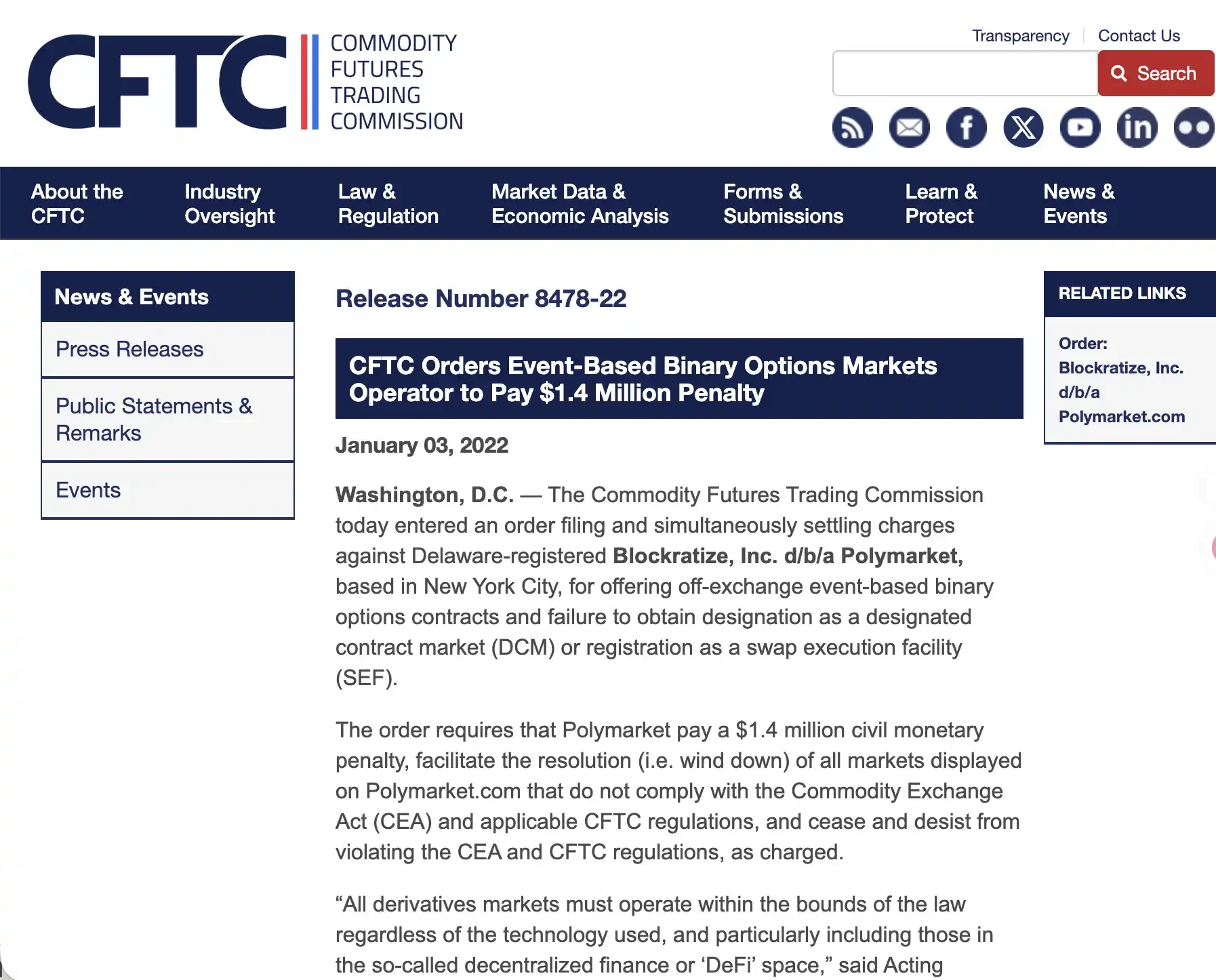
On January 3, 2022, the CFTC issued a cease and desist order against Polymarket. The allegation: Polymarket operated unregistered event-based binary options markets – essentially off-exchange binary options contracts not offered on a designated contract market. The penalty included a $1.4 million civil monetary fine, requiring the winding down of non-compliant markets and cessation of violations. The CFTC also noted that Polymarket received a reduced penalty for substantial cooperation. As of that time, Polymarket had offered over 900 event markets.
Following the penalty, Polymarket began geoblocking US users.
A platform still operating out of New York, still run by an American founder, still serving global political and financial events, was forced to shift its core trading outside the US, even though many of the events it discussed still happened in America.
Exile and Explosion
After being penalized by the CFTC, Polymarket entered a very strange state. It didn't die, but it was no longer whole. It was still running, still serving international users, still listing various markets, but it had lost its most crucial and symbolic home market.
For a New York company, this state was awkward. It wasn't like total failure because the product was still alive; it wasn't like real success because US users were locked out. It felt more like an exile: the company was in the US, but the product had to pretend the US didn't exist.
In May 2022, former CFTC Chairman J. Christopher Giancarlo joined Polymarket's advisory board as chairman. Giancarlo is known as "CryptoDad" in the crypto world. The signal of this appointment was clear: after being hit by regulation, Polymarket started to build its compliance narrative.
But a compliance narrative couldn't immediately change the situation. An advisory board isn't a license, and a former regulator's name doesn't automatically reopen the US market. From 2022 to 2023, Polymarket entered a low period. Operating purely overseas, its scale shrunk. By the end of 2023, its cumulative total trading volume was around $73 million. This number was passable at the time, but compared to the explosion during the 2024 election cycle, it felt like a different era.
Low periods are the hardest to write about and most easily overlooked, because there's no iconic photo to reference, no tweet that becomes a headline, no drama like a regulatory raid. But for a startup, what truly determines fate is often this kind of time: no applause, growth not fast enough, external narrative cooling down, while the team still has to fix the product daily, handle markets, explain settlements, and maintain liquidity.
Coplan didn't give up. The team continued to iterate the product, improve the mobile experience, make pages lighter


