






Bỏ lỡ làn sóng cổ phiếu/crypto, các sàn giao dịch Hàn Quốc buộc phải "đầu cơ shitcoin"


- Quan điểm chính: Các sàn giao dịch tiền mã hóa Hàn Quốc do bị quản lý chặt chẽ, không thể niêm yết các sản phẩm đa dạng như phái sinh, cổ phiếu token hóa, khiến doanh thu phụ thuộc nặng nề vào phí giao dịch spot. Trong bối cảnh kết quả kinh doanh sa sút, để thu hút khối lượng giao dịch, họ buộc phải niêm yết các token "shitcoin" đầu cơ có mã tương tự mã cổ phiếu SpaceX, phản ánh thực tế rằng các quy định bảo hộ lại làm gia tăng rủi ro thị trường và khó khăn kinh doanh cho các sàn.
- Các yếu tố then chốt:
- Quý 1 năm 2026, doanh thu của Upbit giảm 54,6% so với cùng kỳ xuống còn 2.346 tỷ won, doanh thu của Bithumb giảm 57,6% xuống còn 825 tỷ won và ghi nhận lỗ ròng, kết quả kinh doanh đồng loạt đi xuống.
- Hơn 97% doanh thu của các sàn giao dịch Hàn Quốc đến từ phí giao dịch spot, nhưng bị cấm thực hiện các hoạt động như cổ phiếu token hóa, hợp đồng tương lai, phái sinh và ETF, phạm vi kinh doanh cực kỳ hạn hẹp.
- Các sàn giao dịch nước ngoài như Coinbase, Binance, Bybit đã chuyển đổi thành "sàn giao dịch vạn năng", niêm yết các sản phẩm như cổ phiếu token hóa. Trong vòng 24 giờ sau khi SpaceX niêm yết, khối lượng giao dịch trên thị trường tiền mã hóa đạt 9 tỷ USD.
- Các sàn Hàn Quốc không thể tham gia vào bữa tiệc niêm yết của SpaceX, cách cạnh tranh duy nhất là niêm yết các token đầu cơ thu hút sự chú ý đúng thời điểm, chẳng hạn như Spacecoin và SPX6900.
- Động cơ quản lý ban đầu là bảo vệ nhà đầu tư, nhưng đã tước đoạt nguồn thu của các sàn, khiến chúng có xu hướng niêm yết tài sản rủi ro cao hơn khi thị trường thu hẹp, đồng thời kích thích nhà đầu tư chuyển sang các nền tảng nước ngoài như Binance, gây ra sự mất hiệu quả quản lý và thất thoát doanh thu.
- Các tổ chức tài chính Hàn Quốc đang thúc đẩy sự hợp nhất giữa các công ty chứng khoán và sàn giao dịch thông qua việc mua cổ phần vào các sàn giao dịch tiền mã hóa (ví dụ: Hanwha Investment & Securities tăng sở hữu tại Dunamu, Mirae Asset mua lại Korbit), nhưng khả năng các sàn giao dịch truyền thống chuyển đổi thành "sàn giao dịch vạn năng" là cực kỳ thấp.
Original article fromFour Pillars
Compiled by / Odaily Golem (@web3_golem)
Editor's Note: On June 16, the Korean exchange Bithumb listed a memecoin named Spacecoin, followed by Upbit listing an outdated Meme coin, SPX6900. The community widely believes that the reason the two major Korean crypto exchanges listed these tokens is that their tickers coincidentally resemble SpaceX's stock ticker, and the exchanges sought to capitalize on the hype surrounding "memecoins" to attract trading volume.
Against the backdrop of a weakening crypto market and Korean crypto investors turning to stock trading, Korean exchanges saw a collective decline in Q1 2026 performance. Consequently, they urgently need measures to salvage the situation. However, unlike overseas exchanges that can transform into "everything exchanges" by listing a large number of tokenized stocks to meet crypto traders' demands, Korea classifies tokenized stocks as securities, thereby prohibiting crypto exchanges from conducting such transactions. Korean exchanges are also not permitted to trade crypto futures, derivatives, or spot Exchange Traded Funds (ETFs).
Korea's investor-protection-focused regulations have paradoxically pushed crypto exchanges into the most speculative corners of the market. With revenue streams and new product lines like derivatives, tokenized stocks, and prediction markets all prohibited, exchanges, in their quest to boost platform trading volume, tend to favor listing attention-grabbing, and thus more speculative, "memecoin" tokens.
Upbit and Bithumb list "pseudo-SpaceX stocks," shocking the Korean community
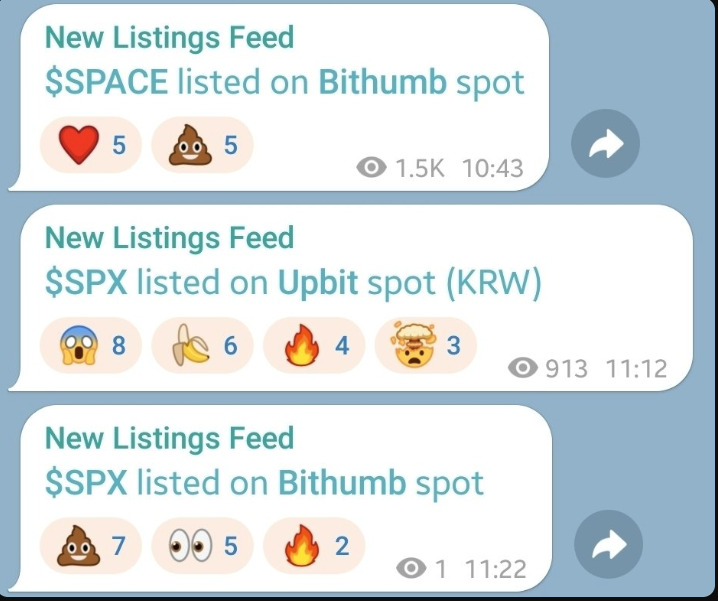
Bithumb and Upbit listed tokens with tickers similar to SpaceX's stock.
On the morning of June 16, the hottest topic in the Korean community was Bithumb listing the obscure token Spacecoin (SPACE) and Upbit listing the Meme coin SPX6900. Some might ask, isn't this just an ordinary token listing announcement? What truly stirred the community was not the listing itself, but the names of the tokens and the timing of the listings.
Four days prior, on June 12, SpaceX was listed on the Nasdaq under the ticker SPCX. As is well known, SpaceX's IPO set historical records, and since stock-related topics now dominate the Korean crypto community, SpaceX became the hottest topic in the space over the weekend.
Therefore, after Upbit and Bithumb's listing announcements, suspicion began circulating within the community that the names and tickers of the tokens listed by these two exchanges closely resembled SPCX, aiming to ride the hype wave and generate trading volume. While the connection might be merely coincidental, this interpretation seems plausible and also reflects the current state of Korean exchanges.
Today, overseas platforms like Coinbase, Binance, and Bybit allow users to directly trade SpaceX and other foreign stocks within the exchange. Due to regulatory restrictions, Korean exchanges cannot offer such products, leaving them perhaps only able to list a token that at least shares a name similar to SpaceX.
But this incident shouldn't merely be dismissed as a joke; it precisely reflects the difficult competitive position Korean crypto exchanges face against their overseas counterparts.
The Current State of Korean Exchanges
Overall performance decline, even incurring losses
The performance of Korea's two largest exchanges in the first quarter of 2026 was poor.
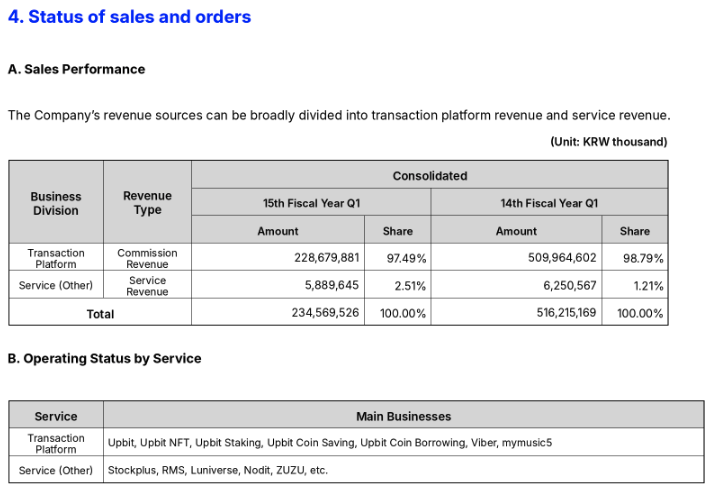
Upbit Q1 2026 Performance. Source: FSS DART
According to the quarterly report filed on May 15 via the Financial Supervisory Service's DART system, Dunamu, which operates Upbit, reported consolidated revenue of 234.6 billion KRW, down 54.6% year-on-year. Operating profit fell 77.8% to 88 billion KRW, and net profit dropped 78.3% to 69.5 billion KRW. Upbit's fee income decreased by 55.2% to around 200 billion KRW, while operating costs rose 22% over the same period, squeezing profit margins.
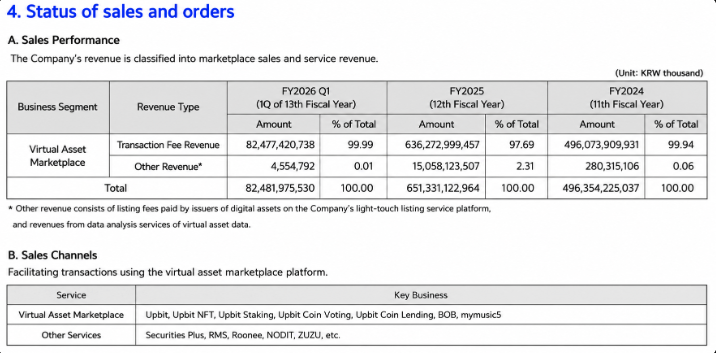
Bithumb Q1 2026 Performance. Source: FSS DART
Bithumb's situation was even more severe. First-quarter revenue plummeted 57.6% to 82.5 billion KRW, operating profit crashed 95.8% to 2.9 billion KRW, and the company posted a net loss of 86.9 billion KRW, its second consecutive quarterly net loss. The direct cause of the loss was a decline in trading volume leading to an 87% drop in fee income. Additionally, the Korea Financial Intelligence Unit imposed a fine of 36.9 billion KRW for violations of the Act on Reporting and Use of Specific Financial Transaction Information, along with a partial business suspension order for six months, factors also reflected in the Q1 results.
The biggest problem for Korean exchanges is that their revenue structure relies almost entirely on trading fees. Trading fees account for approximately 97.5% of Dunamu's revenue and 99.99% of Bithumb's revenue, effectively making fees their entire income. However, rather than any negligence in the exchanges' operational methods, it is the regulatory environment (detailed below) facing Korean crypto exchanges that creates this structure.
Narrow business scope, limited to crypto spot trading
In reality, the business activities available to Korean crypto exchanges are limited to crypto spot trading; other areas are largely inaccessible, with most being restricted, whether by explicit regulation or tacit avoidance. Below are the businesses that Korean crypto exchanges are explicitly not allowed to conduct:
- Tokenized Stocks: In June 2026, the Financial Services Commission and the Financial Supervisory Service began classifying tokenized stocks as securities, not virtual assets. Regardless of the issuance form, securities are governed by the Capital Market Act; under the Electronic Securities Act, only licensed electronic registration institutions can perform electronic rights registration. If a crypto exchange that is not such an institution issues or circulates security tokens, it constitutes unlicensed business. In other words, tokenized stocks, which are rapidly developing overseas, are structurally disallowed assets for Korean exchanges, and this situation is unlikely to change.
- Futures and Derivatives: Korean crypto exchanges can only offer spot trading; they cannot provide derivatives like perpetual futures or options to domestic users. This is less an explicit legal prohibition and more a shadow cast by a previous attempt. Coinone, one of Korea's top five exchanges, operated a contract trading service offering up to 4x leverage starting in December 2016, lasting about a year. Around the end of 2017, following government regulatory measures and a police investigation, the service was completely shut down. In 2018, police treated the service as gambling for operating without financial regulatory approval, referring CEO Cha Myung-hoon and others to prosecutors on charges of running a casino, even arresting 20 users with trading volumes exceeding 3 billion KRW under gambling charges. The case concluded three years later in 2021 without indictment due to insufficient evidence. However, since then, no Korean crypto exchange has involved itself in leveraged or futures trading.
- Implicit Avoidance under Self-Regulation: Korean crypto exchanges are subject to self-regulation by the Digital Asset Exchange Alliance (DAXA), composed of the five major KRW exchanges. Its listing review criteria include opacity due to de-anonymization, potential for securitization, and potential for money laundering. These criteria effectively exclude privacy coins emphasizing anonymity and lead exchanges to avoid listing tokens that might be deemed securities. For similar reasons, assets that could spark securities or gambling controversies, such as exchange tokens or prediction market tokens, are rarely seen on Korean exchanges.
In summary, almost all new areas that overseas exchanges are expanding into – such as crypto derivatives, tokenized stocks, privacy coins, and prediction markets – are restricted for Korean exchanges.
Korean Exchanges Lag Behind in Global Competition
Have Korean Exchanges Lowered Listing Standards?
Recently, the community has accused Upbit and Bithumb of relaxing their listing review standards. The table below provides a complete comparison of tokens listed by Coinbase, Upbit, and Bithumb in 2026:
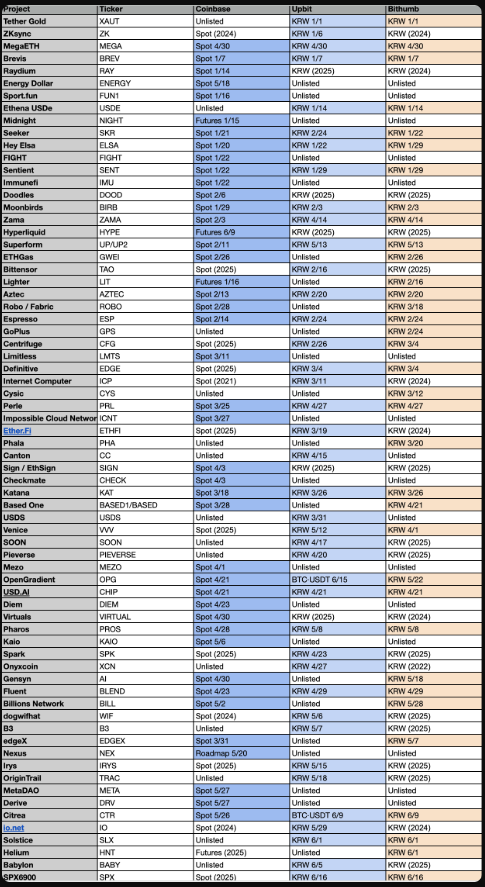
Tokens listed by Coinbase, Upbit, and Bithumb in 2026. Source: Four Pillars (@c4lvin)
In terms of the number of tokens listed, Coinbase leads. Coinbase listed many assets not available on either of the two Korean exchanges, and a significant portion were offered for both spot and futures trading, providing trading opportunities earlier than other platforms. Just considering frequency and timing, Coinbase is actually more aggressive.
In 2026, a considerable number of new KRW tokens listed by Upbit had previously been listed on Bithumb, such as Bittensor (TAO), Internet Computer (ICP), Ether.fi (ETHFI), io.net, dogwifhat, Spark (SPK), and Babylon. Most of these tokens did not have significant trading volume on Bithumb. They are not newly issued assets but tokens already existing in the market that were only added to the platform after listing on Upbit, which might make Upbit's listings seem less fresh.
The perception of declining token quality stems not necessarily from a lowering of standards themselves, but from the diminishing effect of listings on trading volume. In an environment where the trading volume generated by a single token listing quickly dries up, and new assets worth listing are increasingly scarce, Upbit maintains its listing pace by adding tokens already present on Bithumb.
Ultimately, Korean users' complaints are less about a specific ticker and more rooted in the feeling of disparity in convenience compared to other markets, which offer newer products like tokenized stocks.
Korean Exchanges Excluded from the SpaceX Listing Feast
Meanwhile, major overseas exchanges are moving in the opposite direction. They strive to transcend the limitations of virtual assets, aiming to build the so-called "everything exchange" – a single application where all assets can be traded.
Coinbase is the most prominent example. In its Q4 2025 shareholder letter, Coinbase stated that, besides cryptocurrencies and derivatives, it had begun trading stocks and ETFs within its application, offering approximately 3,000 assets to early users, aiming to integrate traditional and digital assets into a unified portfolio experience. The letter also emphasized that Coinbase became the first in the industry to launch 24/7 US perpetual contract products, thus increasing its share of the derivatives market.
Binance's approach is more direct. Since June 1, 2026, Binance has opened US stock trading to eligible users, allowing them to trade over 7,000 US-listed stocks and ETFs directly. Additionally, Binance launched bStocks, which tokenize US stocks on a 1:1 basis, settle in stablecoins, are withdrawable to user self-custody wallets, and support 24/7 trading.
Bybit joined the xStocks alliance and listed tokenized stocks created by a regulated Swiss issuer. These price-tracking tokens are backed by real stocks and are tradable 24/7 using stablecoins.
In short, overseas crypto trading platforms have made tokenized stocks a key promotional focus. The difference in the trading environment between Korea and abroad was most vividly illustrated during the SpaceX listing. For overseas exchanges, this listing was a test of competitiveness in tokenized stocks, prompting them to launch pre-market contract products and tokenized stocks.
Within 24 hours of the SpaceX-related product launch, the entire cryptocurrency market saw trading volume of approximately $9 billion, with Binance alone accounting for $5.6 billion.
In stark contrast, Korean crypto exchanges were unable to participate in this feast. Whether it's tokenized stocks, perpetual contracts, or any product tracking SpaceX, none are permissible for trading within Korea. While major global exchanges conducted billions of dollars in trades around the same hot trend, Korean crypto exchanges had no channel to participate.
Korean Exchanges are Stifled by Regulation
For an exchange unable to compete globally in product variety, the only remaining battlefield is the crypto market itself. Since Korean exchanges' revenue relies on spot trading fees, and they cannot list derivatives or stocks, the sole way to boost trading volume is to list attention-grabbing tokens at the right time.
Korea's strict regulation of crypto exchanges aims to protect investors. It treats leveraged trading as gambling and prohibits it; it filters out security tokens with opaque rights structures; and it excludes assets easily used for money laundering or price manipulation from listing reviews.
However, as this protective mechanism gradually strips exchanges of their revenue streams and product lines, their only remaining tool is listing crypto spot. And the more crypto market trading volume shrinks, the more Korean exchanges tend to list assets that command higher attention and are thus more speculative. Protection at the product stage ultimately fosters the influx of speculative assets at the listing stage. The recent listing of tokens with similar tickers to SpaceX by the two major exchanges is a microcosm of this trend.
A deeper problem is that this protective mechanism is not entirely effective. Korean investors wanting to buy perpetual contracts or tokenized stocks will not easily give up their demands; they will turn to overseas platforms like Binance, Bybit, and Hyperliquid.
In other words, Korean regulation itself cannot eliminate investors' appetite for high-risk trading; it merely pushes that high-risk trading outside the markets under Korean authorities' purview. When taxes and the Crypto-Asset Reporting Framework (CARF) take full effect in 2027, the scale of this offshore trading will become evident from the data. Ultimately, investors take on speculative risk anyway, losing domestic regulatory safeguards, while Korean exchanges forfeit the revenue those trades would have generated.
This structure also makes Korean exchanges themselves fragile: a single product line, virtually all revenue from trading fees, fully exposed to the cyclical fluctuations of trading volume. While Coinbase diversified its revenue streams into custody, stablecoins, tokenized stocks, and derivatives to cushion market downturns, Korean exchanges must weather the same cycles with a single product. As this gap accumulates quarter by quarter, it eventually translates into differences in investment capacity and product competitiveness, which then reappear as the convenience gap felt by domestic users.
Of course, the Korean government is also actively promoting cryptocurrency regulation. A series of plans – including the second phase of the Digital Asset Basic Act, the institutionalization of Security Token Offerings (STOs), approval for corporate trading, and the issuance of KRW stablecoins and spot ETFs – are all slated to commence in 2026, demonstrating the government's commitment. However, even if these new regulations are ultimately enacted, they may not be operated by existing crypto exchanges but handed to licensed entities like securities firms and electronic registration institutions.
Therefore, the convergence currently occurring is not crypto exchanges transforming into securities firms, but securities firms and banks acquiring stakes in crypto exchanges and incorporating them into their own systems. In 2026, Hanwha Investment & Securities increased its stake in Dunamu to 9.84%, becoming the third-largest shareholder; Hana Financial Group holds 6.55%; and Samsung Securities, Samsung Card, and Samsung SDS hold 4%. Korbit was acquired by Mirae Asset Group; Korea Investment & Securities signed a strategic equity investment agreement, acquiring a 20% stake in Coinone, becoming its third-largest shareholder. As financial regulators maintain a cautious stance towards the separation of finance and crypto and lean towards relaxing related restrictions, such alliances are rapidly increasing.
Will Korea allow its crypto exchanges to develop into "everything exchanges" like abroad? This possibility is extremely slim.
However, this article does not advocate for the immediate removal of regulations. Rather, it suggests that a protective framework designed for a bygone era, in a market rapidly trending towards asset convergence, now creates significant hidden costs. Korean crypto exchanges operating under such severe conditions will pass these costs on to users during downturns like the current one. Ultimately, this leads to a situation like today's, where fleeting memecoins with brief trading demand re-emerge, creating more victims.


