Viết sau màn ra mắt của SpaceX: Vốn hóa thị trường 2,1 nghìn tỷ USD, có đáng để theo đuổi?


- Quan điểm cốt lõi: SpaceX IPO vào ngày 12 tháng 6 với giá 135 USD, đóng cửa phiên đầu tiên ở mức 160,95 USD, vốn hóa thị trường 2,1 nghìn tỷ USD. Mặc dù thành công nhưng vẫn thấp hơn kỳ vọng của một bộ phận thị trường, làm nổi bật sự xem xét thận trọng của thị trường đối với định giá cao và các mảng kinh doanh thua lỗ của công ty.
- Các yếu tố chính:
- Giá IPO của SpaceX là 135 USD, mở cửa phiên đầu tiên ở mức 150 USD, đóng cửa ở mức 160,95 USD; cổ phiếu tập trung cao độ, thời gian khóa (lock-up) dành cho ban lãnh đạo lên tới 366 ngày, giá trị vốn hóa lưu hành ban đầu chỉ khoảng 75 tỷ USD.
- Khoản lỗ ròng cả năm 2025 của SpaceX là 4,9 tỷ USD, quý 1 năm 2026 lỗ 4,28 tỷ USD; mảng kinh doanh duy nhất có lãi là Starlink với lợi nhuận hoạt động năm 2025 đạt 4,423 tỷ USD, nhưng mảng phóng vệ tinh lại lỗ 657 triệu USD.
- Trong bản cáo bạch, Musk đã đề xuất kế hoạch kinh doanh năng lực tính toán trong không gian (triển khai công suất 100GW mỗi năm) và tuyên bố thị trường tiềm năng lên tới 28,5 nghìn tỷ USD, vượt xa khả năng sinh lời thực tế, bị chỉ trích là "tiểu thuyết khoa học viễn tưởng".
- Tỷ lệ phân bổ cổ phiếu IPO cho nhà đầu tư cá nhân lên tới khoảng 20%, cao hơn đáng kể so với mức thông thường. Tuy nhiên, diễn biến thị trường cho thấy nhà đầu tư cá nhân quan tâm nhiều hơn đến giá cả, hành vi của họ làm tăng biến động chứ không đẩy mức tăng cuối cùng lên cao.
- Các mốc thời gian quan trọng bao gồm: Tháng 7, rất có thể SpaceX sẽ nhanh chóng được thêm vào chỉ số Nasdaq 100, mang theo hàng chục tỷ USD dòng vốn thụ động; tháng 8, báo cáo tài chính quý 2 và một phần cổ phiếu nội bộ được mở khóa, làm gia tăng sự bất ổn của thị trường.
Original by Odaily Planet Daily (@OdailyChina)
Author: Golem (@web 3_golem)

On June 12th, local time in the US, Elon Musk did not go to New York. Before SpaceX stock (Nasdaq: SPCX) officially landed on the Nasdaq, he chose to stay at the company's headquarters in Texas, standing among employees to complete a remote bell-ringing ceremony.
During this ceremony, Musk once again projected SpaceX's story further into the future. He stated that the company's goal is to send humanity to the Moon, Mars, and even more distant star systems. After the bell ringing, Nasdaq's live stream played Elton John's "Rocketman," adding a romantic footnote to this most anticipated IPO in the history of space commercialization.
But the sentimental part ended there, and the capital market game began immediately. SpaceX IPO was priced at $135, opened at $150 on its first trading day, rose to over $176 intraday, and finally closed at $160.95, temporarily placing its market cap at $2.1 trillion.
Opened at $150, First-Day Market Cap Settles at $2.1 Trillion
SpaceX's IPO has been a global focus since it filed its registration statement with the SEC. The company ultimately set a fixed price of $135 per share for the issuance of approximately 555.6 million shares of Class A common stock, corresponding to a company valuation of $1.77 trillion.
Regarding equity distribution, Musk personally holds approximately 42%, Valor Equity holds about 7.3%, Google holds about 5%, other early venture capital firms collectively hold 10-12%, employees and former employees hold 10-15%, and the shares publicly offered in this IPO account for only 4.2%. Although Musk and his surrounding interest groups hold the majority of SpaceX shares, none of their shares can be sold on the day of listing. The lock-up period for core investors like Musk and Valor Equity is 366 days, while ordinary IPO shareholders (institutions and employees) must undergo a basic lock-up of 180 days, meaning they cannot sell until at least the end of 2026.
Therefore, on the day of listing, June 12th, the initial circulating supply consisted only of the approximately 555.6 million A-class common shares publicly offered in the IPO. SpaceX is a typical "low float, high FDV" project. According to its valuation model, the first-day circulating market cap was approximately $75 billion, which was close to SpaceX's initially planned fundraising amount.
Investors familiar with crypto projects are likely no strangers to high-float manipulation models. Therefore, during the subscription phase, market sentiment quickly fell into FOMO. Reports indicate that SpaceX IPO was oversubscribed by more than four times, with total subscription demand from institutions and retail investors exceeding $250 billion. Retail investors alone applied for over $100 billion, far exceeding the $75 billion offering size. Crypto native participants also joined this feast, but unfortunately, most came away empty-handed. (Related reading: SpaceX On-Chain IPO Dream Shattered: In the $1 Trillion IPO Feast, I Only Got 4 Shares)
It is worth noting that SpaceX unusually planned to allocate up to 30% of its IPO shares to retail investors, significantly lowering the entry barrier for this technological feast. Typically, such large IPOs allocate only 5% to 10% to retail investors. Although SpaceX ultimately allocated only about 20%, it was still double the usual IPO allocation.
The reason for this approach is that SpaceX management believes retail investors will hold their shares for the long term, just as Tesla's core investor base today consists largely of retail investors. Essentially, they still believe retail investors will buy into Musk's vision. However, this time, retail investors proved more rational than expected. (Explained in detail below.)
Before SPCX officially began trading on the Nasdaq, its pre-IPO price on Hyperliquid fluctuated between $170 and $175, corresponding to a company valuation exceeding $2.2 trillion. During the Nasdaq's opening auction phase before the official start, SPCX's indicative opening price was initially reported at $172, up about 29% from the IPO price, broadly in line with pre-market expectations. However, an hour later, the indicative opening price quickly dropped, eventually opening at $150, only about 11% above the IPO price.
According to Gate US stock market data, SPCX rose to around $176 intraday, finally closing at $160.95, up about 19% from the IPO price but only about 7.3% from the opening price. The first-day market cap settled at $2.1 trillion. From the results, SpaceX's first-day performance was certainly successful, making Musk the world's first trillionaire. However, the result was not spectacular and even failed to meet all market expectations.
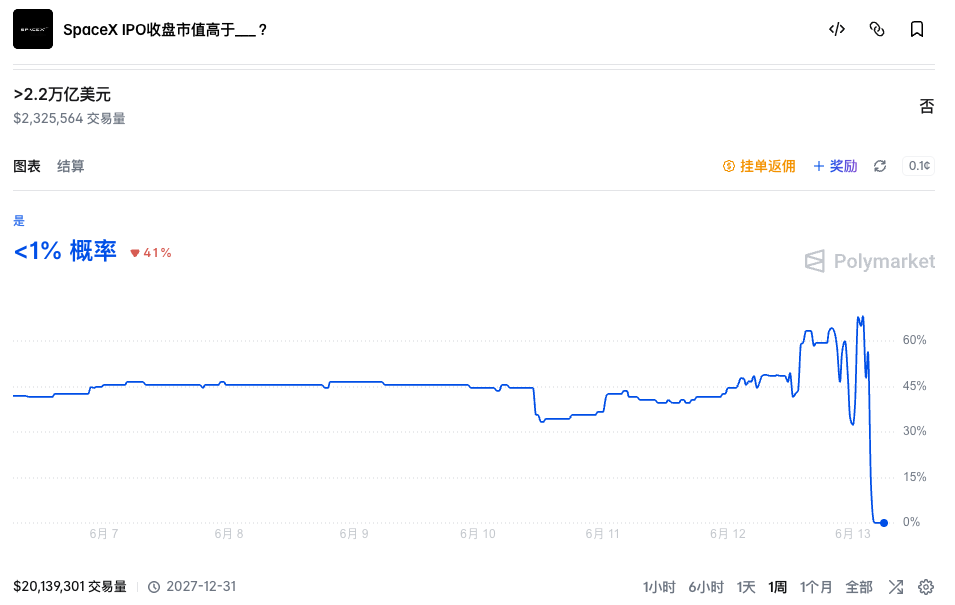
Not only did pre-IPO platforms somewhat struggle with the pricing, but prediction markets also turned out to be inaccurate. In the hours leading up to SpaceX's IPO, the market generally expected its market cap to break above $2.2 trillion. On Polymarket, the probability of "SpaceX IPO closing market cap above $2.2 trillion" was still over 65%, even peaking at 70%.
However, as SPCX opened "relatively low," the probability of this event began to fluctuate wildly. Eventually, SpaceX's IPO closing market cap settled around $2.1 trillion, and the event was resolved as "No."
Retail Investors Affect Volatility, Not Price Appreciation
There is only one reason for this phenomenon: although the market is still willing to believe in SpaceX's narrative and the "Musk premium," SpaceX is simply too expensive. Given a good enough price, even the strongest conviction can be sold.
SpaceX is the first super-giant in human history to "land on the capital market" directly with a trillion-dollar valuation. On its first day of listing, its market cap surpassed technology giants like Meta and Samsung to become the 9th largest company globally. But even the most optimistic retail investors know that the company's current revenue simply cannot support its massive valuation. SpaceX is not yet profitable, reporting a net loss of $4.9 billion for the full year 2025 and a net loss of approximately $4.28 billion for Q1 2026.
Starlink is currently SpaceX's only profitable business. According to the prospectus, Starlink achieved revenue of $11.387 billion in 2025, accounting for 61% of SpaceX's total revenue, with an operating profit of $4.423 billion. It has over 10.3 million global users and more than 9,600 satellites in orbit. In Q1 2026, Starlink generated revenue of $3.257 billion and an operating profit of $1.188 billion. However, this "cash cow" is essentially a side business for SpaceX.
Space launches are SpaceX's main brand. As of the prospectus filing, the Falcon rocket family has completed over 650 launches with a 99% success rate. Its reusable rocket booster technology provides significant cost advantages and technological leadership within the industry. However, SpaceX's biggest external client for launch services is the US government, and this segment operates at a loss. For the full year 2025, SpaceX's launch business incurred an operating loss of $657 million, a loss rate of 16.1%. In Q1 2026, the operating loss soared to $662 million, with a loss rate of 107%.
The reason for these massive losses is SpaceX's increased investment in the Starship program. However, given current technological and usage scenario bottlenecks, Starship is still some distance away from true commercial mass production.
Beyond these two businesses, SpaceX's still-pie-in-the-sky space computing business also factors into its valuation. Compared to the mature Starlink and launch services, Musk's claims regarding the space computing business are truly exaggerated.
Simply put, SpaceX's plan involves sending GPUs into low Earth orbit, using solar power to provide cloud computing power for global AI computing clusters. In the prospectus, Musk stated that SpaceX's goal is to deploy 100 GW of AI computing capacity into orbit annually. Currently, the global AI industry's annual electricity demand is around 15-25 GW. This means SpaceX's planned orbital computing system could theoretically support a roughly 5x expansion of today's global AI industry scale.
Just in case readers don't know what 100 GW represents. The installed capacity of the Three Gorges Dam is roughly 22.5 GW. That means one planned space computing center would be equivalent to 4.4 Three Gorges Dams operating at full capacity.
Furthermore, in the prospectus, SpaceX explicitly stated that its future (mainly AI-related) business could tap into a potential market of $28.5 trillion. For context, China, the world's second-largest economy, had a nominal GDP of approximately $19.4 trillion in 2025. The figure proposed by SpaceX is equivalent to about 1.47 times China's 2025 nominal GDP.
Reading this, one wonders whether this is a stock prospectus or a piece of science fiction. Even the most FOMO-driven investor would need to cool down after seeing these numbers. Research firm CFRA issued a "Sell" rating on SpaceX after its listing, with a target price of $115.
Aside from the mismatch between actual business performance and valuation, the relatively large proportion of IPO shares allocated to retail investors might also be a reason for SPCX's suppressed share price. Musk allocated 20-30% of SpaceX's IPO shares to retail investors. A higher proportion of retail ownership inherently means greater volatility. Retail investors can buy recklessly due to FOMO but can also sell emotionally on a whim triggered by minor fluctuations. Therefore, retail investors primarily affect volatility, not the ultimate price appreciation.
Key Upcoming Milestones for the Game
Of course, whether you are sitting on the sidelines waiting or have already cashed out, for investors following SpaceX, the following three time points are particularly important.
Approximately 15 Trading Days Post-IPO (Expected around July 6th - July 7th)
This is the most crucial time point because SpaceX could potentially be added directly to the Nasdaq 100 index after 15 trading days. In March, Nasdaq specifically amended its rules. Previously, newly listed companies had to wait 3 months to be eligible for index inclusion, but now they can be fast-tracked into the index just 15 trading days after listing if they meet the conditions. Additionally, the requirement for a minimum of about 10% public float was also removed. These new rules seem tailor-made for SpaceX and the subsequent wave of AI tech giants.
If SpaceX is successfully included in the index, it means that tens of billions of dollars in global passive funds would be forced to buy its stock, providing significant support for its share price. So, knowing that there is a very high probability SpaceX will be added to the Nasdaq in July, prompting top-tier funds to buy this stock, would you, as an investor, choose to buy in advance now and sell it to them at a higher price later?
However, on the other side, some US pension funds and long-term insurance funds have already expressed protest. In May 2026, three of the largest US public pension fund managers (with over $1 trillion in assets under management) jointly wrote to Musk, expressing concerns about the passive fund risks that could arise from a fast-tracked index inclusion. In the same month, Randi Weingarten, president of the American Federation of Teachers (representing approximately 1.8 million teachers, healthcare workers, and public employees), directly wrote to the SEC, requesting a special review of SpaceX's IPO.
SpaceX Q2 2026 Earnings Report (Mid-to-Early August)
The second important milestone is SpaceX's Q2 2026 earnings report in August, which will be the company's first performance report card since its listing. If there is no real progress in the business compared to the current situation (realistically, significant progress is unlikely), the stock price could face further downward pressure. Furthermore, the prospectus stipulates that two days after the company releases its Q2 2026 earnings report, eligible internal shareholders (employees, former employees, some early investors) can sell a portion of their locked shares, up to 20% of their total locked shares. If the stock price is 30% above the IPO price and meets this standard for 5 out of 10 trading days, an additional 10% can be unlocked.
This means that in August, the market will not only have to deal with earnings-related volatility from SpaceX but also face the first major stock unlock since its listing – a significant challenge.
Ultimately, whether we will "choke" on Musk's dreams remains to be seen. Based on the first day's performance, while the market chose to believe the story, it didn't completely lose its mind. What will ultimately determine SpaceX's fate is its own real-world performance going forward.
Recommended Reading:
SpaceX On-Chain IPO Dream Shattered: In the $1 Trillion IPO Feast, I Only Got 4 Shares