






Dữ liệu tổng kết: Một kỳ World Cup, thị trường dự đoán đã hưởng lợi bao nhiêu?


- Quan điểm chính: World Cup 2026 đã mang lại sự tăng trưởng đáng kể về khối lượng giao dịch và doanh thu phí cho thị trường dự đoán, nhưng dữ liệu sau giải đấu cho thấy, sự tăng trưởng này chỉ là lợi ích ngắn hạn từ sự kiện, không chuyển hóa thành sự hoạt động lâu dài hay dòng vốn đọng lại cho ba nền tảng lớn (Kalshi, Polymarket, predict.fun).
- Các yếu tố chính:
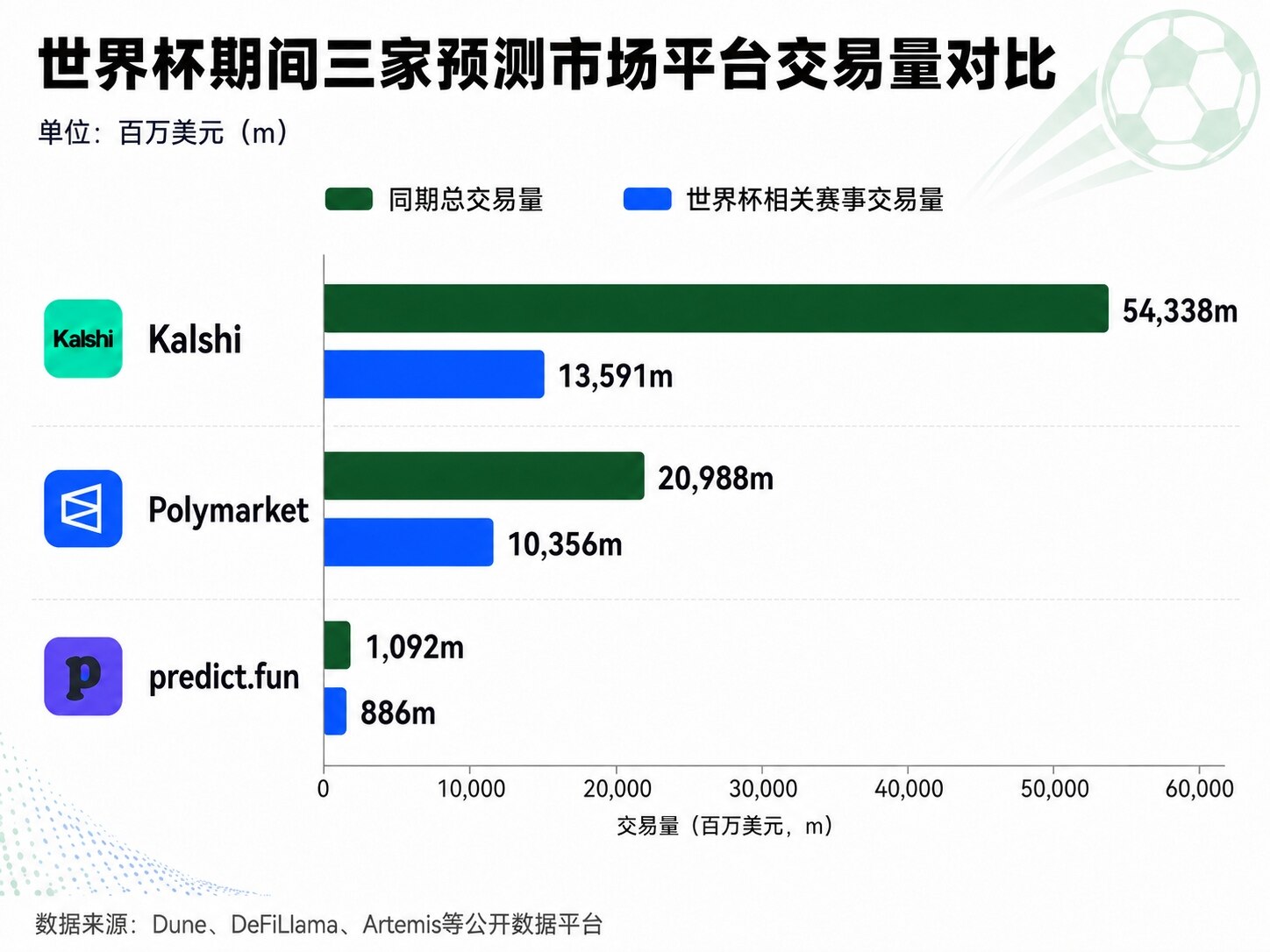
- Trong thời gian World Cup, khối lượng giao dịch liên quan đến Kalshi đạt 13,591 tỷ USD, Polymarket là 10,356 tỷ USD, khoảng cách giữa hai bên thu hẹp còn 1,3 lần; predict.fun với 886 triệu USD khối lượng giao dịch liên quan đã trở thành nền tảng đột phá mới.
- Khối lượng giao dịch trung bình hàng ngày của ba nền tảng trong thời gian diễn ra giải đấu đều tăng hơn 100% (Kalshi tăng 140%, Polymarket tăng 136%, predict.fun gần như tăng gấp đôi), nhưng sau giải đấu (ví dụ ngày 22 tháng 7) đều giảm xuống mức bằng hoặc thấp hơn trước giải.
- Tổng doanh thu phí giao dịch của Kalshi trong suốt World Cup lên tới 473,2 triệu USD, cao nhất trong một tuần vượt 100 triệu USD; Polymarket đạt tổng doanh thu 111,4 triệu USD, doanh thu hàng tuần ổn định ở mức khoảng 20 triệu USD.
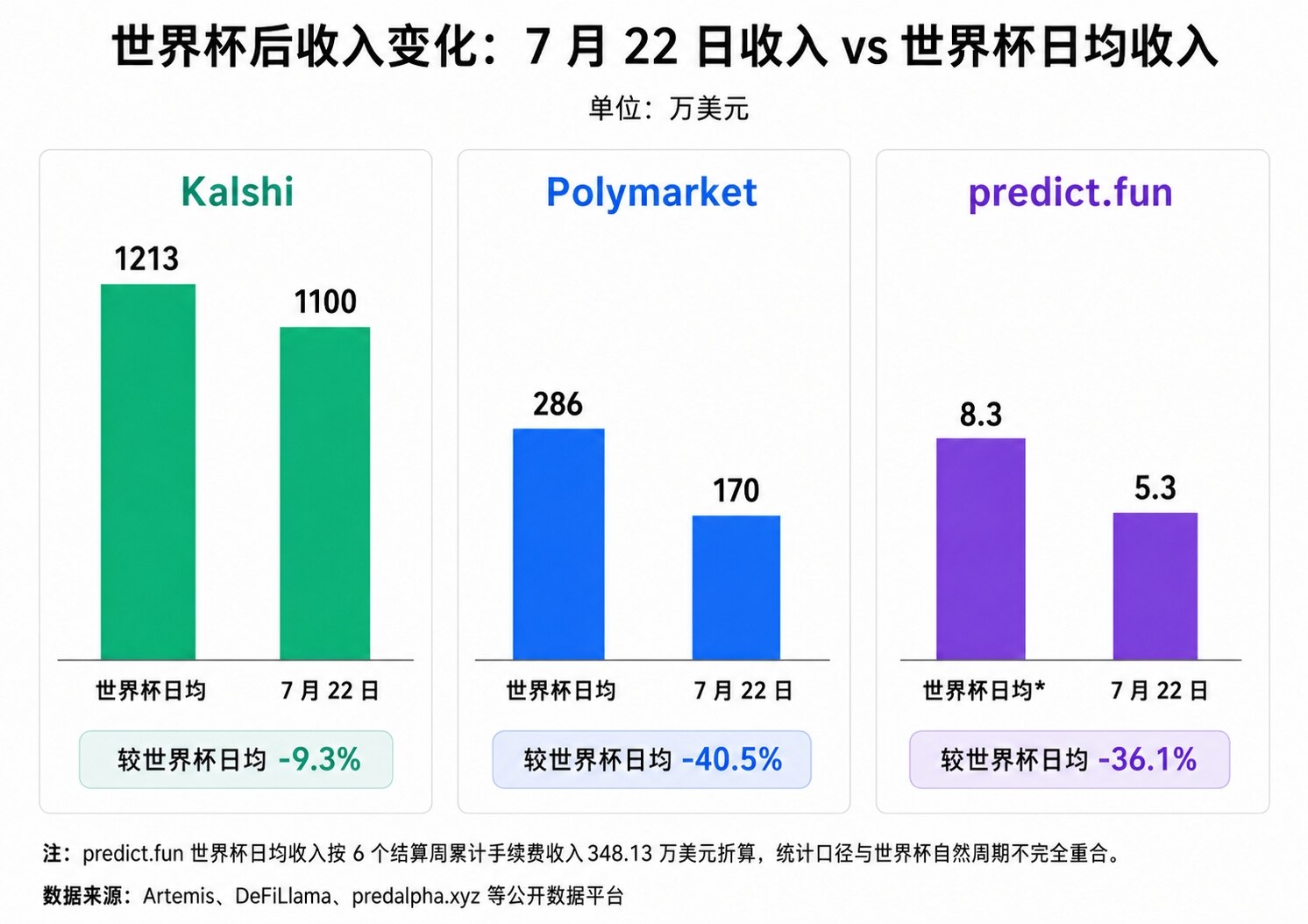
- Về doanh thu phí sau giải đấu, Kalshi chỉ giảm 9,3% xuống còn 11 triệu USD/ngày, mức giảm thấp nhất; trong khi Polymarket và predict.fun lần lượt giảm mạnh 40,5% và 36,1%.
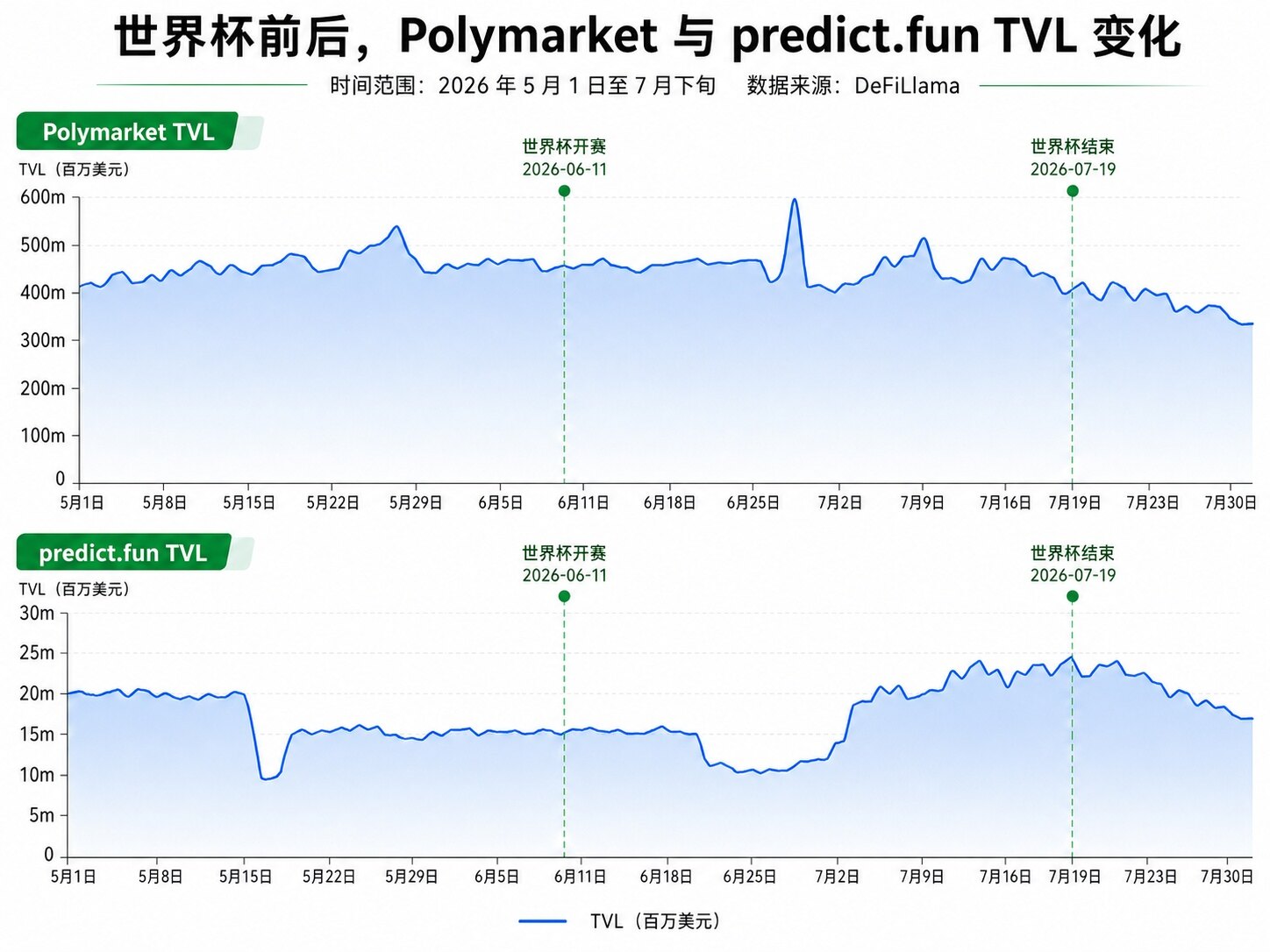
- TVL của Polymarket không tăng song song với khối lượng giao dịch trong thời gian diễn ra giải đấu, mà tiếp tục giảm sau giải xuống còn khoảng 340 triệu USD; predict.fun chứng kiến dòng vốn chảy vào ở nửa sau của giải đấu, nhưng cũng đã giảm trở lại sau giải.
Original: Odaily Planet Daily (@OdailyChina)
Author: Asher (@Asher_0210)

The 2026 World Cup has come to an end, and prediction markets have also undergone a phase of testing.
Over the past six weeks, many users participated in trading match results, progression scenarios, and champion predictions through prediction markets, adding an extra layer of real-time interaction to watching the games. Now that the tournament has concluded, Odaily Planet Daily will review the performance of leading prediction market platforms Kalshi, Polymarket, and predict.fun before, during, and after the World Cup across three dimensions: trading volume, fee revenue, and TVL.
The World Cup Pushed Prediction Market Trading Volumes to New Highs, But Momentum Did Not Sustain
Kalshi Maintains Lead, Polymarket Narrows Gap, predict.fun Breaks Out Thanks to World Cup
Looking at total platform trading volume during the World Cup period, Kalshi still holds a clear lead. During this period, Kalshi's total trading volume reached $54.338 billion, compared to Polymarket's $20.988 billion, making the former approximately 2.6 times larger. However, looking only at World Cup-related events, the gap between the two narrowed rapidly. Kalshi's related trading volume was $13.591 billion, while Polymarket reached $10.356 billion, with the former only about 1.3 times the latter. (Note: Trading volumes discussed in this article are notional.)
Historically, Polymarket's representative markets were more concentrated on the US election, cryptocurrency, and geopolitical events. The World Cup has further elevated the importance of sports markets on the platform, moving them from a supplementary category to a core trading sector. Kalshi's advantage lies in its more diversified trading structure; besides the World Cup, other sports events, politics, and macro markets continue to contribute trading volume, providing more scenarios to sustain activity after the tournament's conclusion.
predict.fun's total platform trading volume during the World Cup reached $1.092 billion, of which World Cup-related markets contributed $886 million. Although its overall scale still lags significantly behind Kalshi and Polymarket, for a platform that has been online for just over six months, nearly $900 million in trading volume brought by this World Cup has made predict.fun one of the most prominent new platforms to emerge from this tournament's dividend.
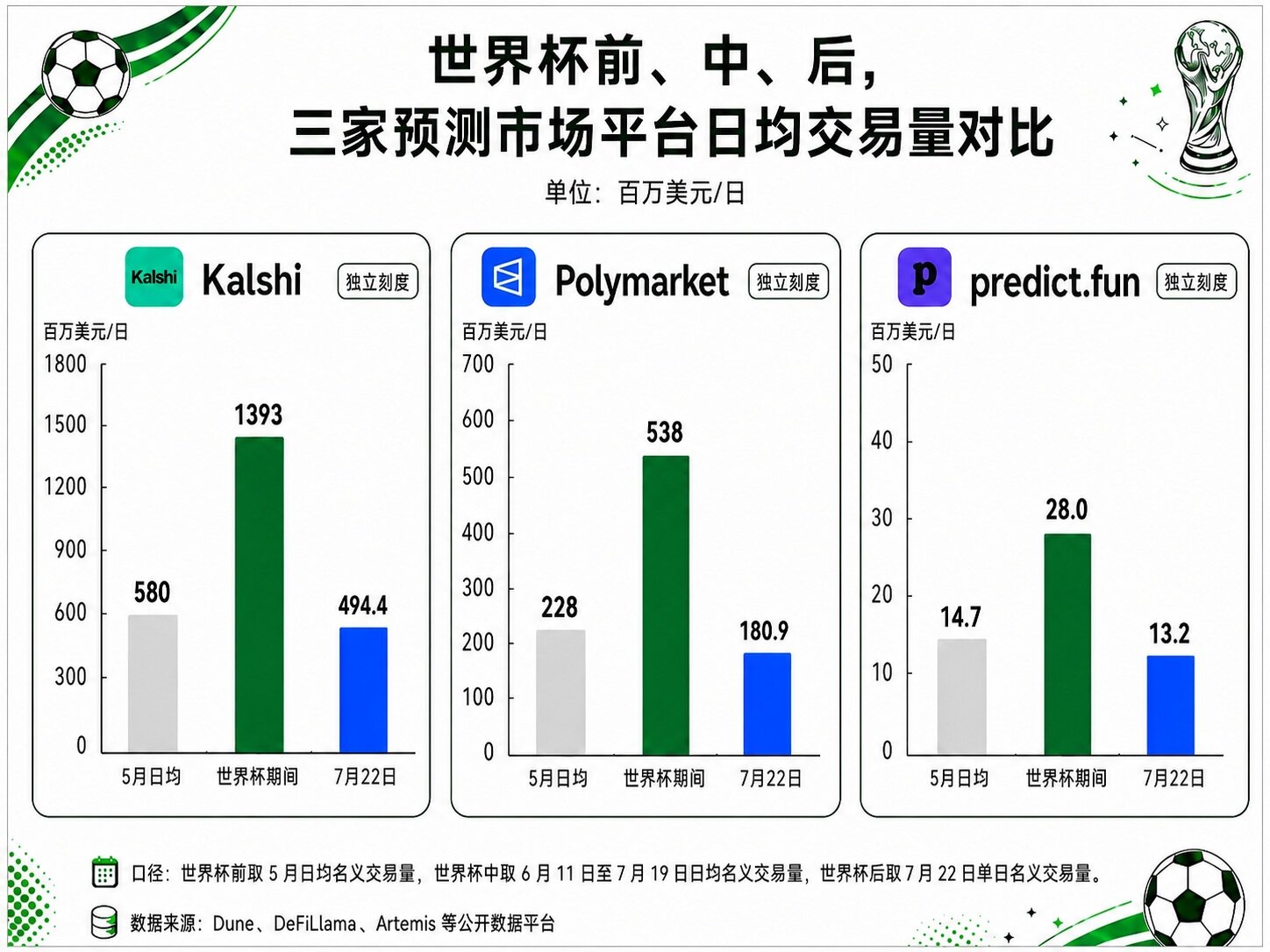
Daily Average Trading Volume Changes of Three Prediction Market Platforms Before, During, and After the World Cup
The increase in trading volume for Kalshi during the World Cup was the most significant. Its average daily notional trading volume in May was $580 million, which rose to $1.393 billion during the tournament, an increase of approximately 140%. On July 22, trading volume fell back to $494.4 million, already below its May daily average.
The magnitude of change for Polymarket was similar to that of Kalshi. Its average daily notional trading volume in May was $228 million, rising to $538 million during the World Cup, an increase of about 136%. On July 22, trading volume dropped to $180.9 million, also below its pre-tournament level.
predict.fun had a smaller base, but the boost from the World Cup was still clear. Its average daily notional trading volume in May was $14.7 million, which rose to $28 million during the tournament, nearly doubling. On July 22, trading volume was $13.2 million, essentially returning to its pre-tournament level.
Looking merely at the one-day trading volume comparison after the World Cup, the growth brought by the tournament appears more like a concentrated release of event-driven traffic, rather than permanently elevating the platforms' daily trading volume to a higher level. Whether it can be raised again depends on whether other sports events and non-sports markets can absorb the trading demand left after the World Cup.
How Much Fee Revenue Did the World Cup Generate for the Three Prediction Market Platforms?
Kalshi's Fee Revenue Consistently Rose as the Tournament Progressed, Exceeding $100 Million in the Fourth Week
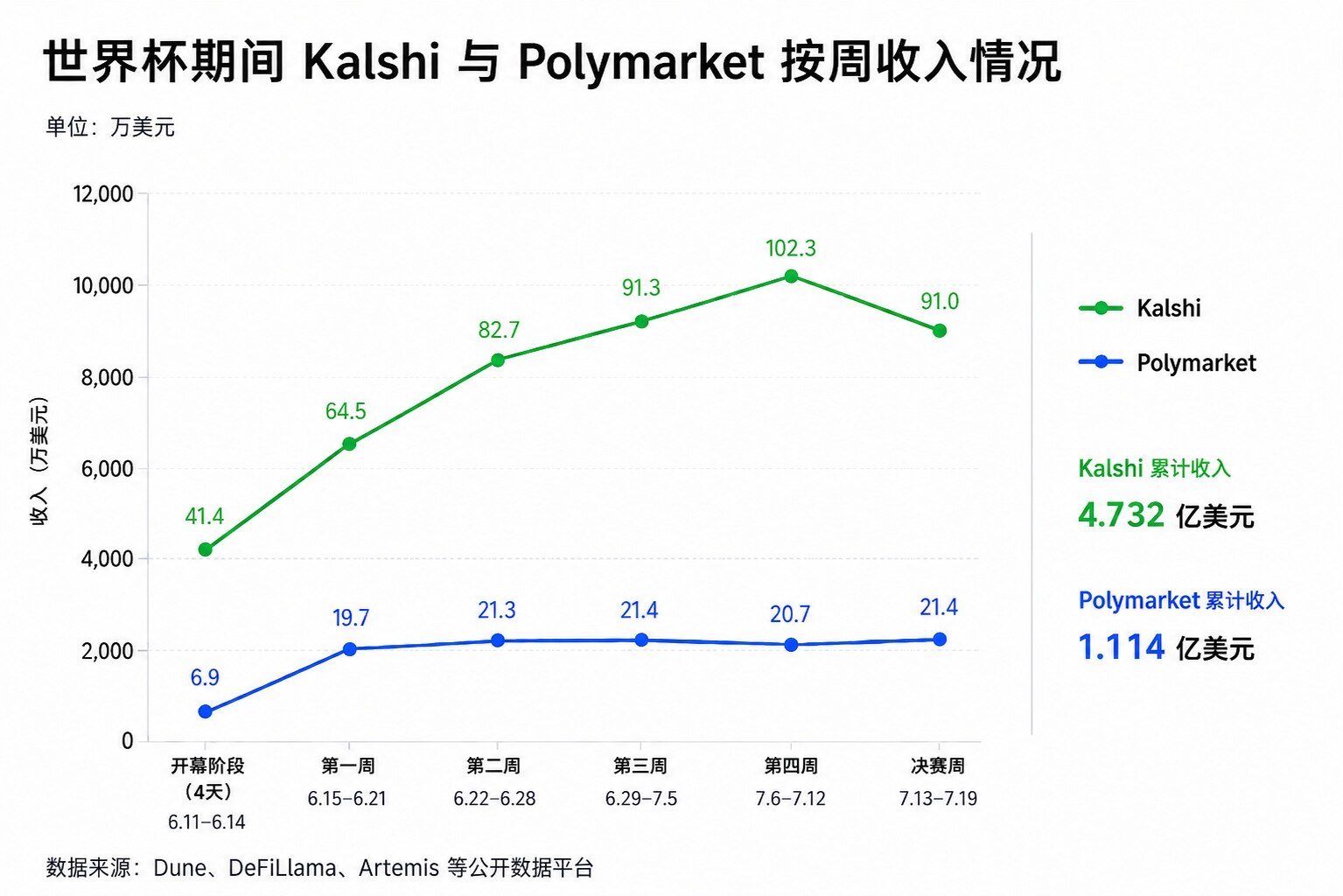
Kalshi's fee revenue curve overall shows a strong upward trend. Revenue for the opening four-day period was $41.4 million, rising to $64.5 million in the first week, further increasing to $82.7 million in the second week, reaching $91.3 million in the third week, and taking another step up in the fourth week with a single-week revenue of $102.3 million, marking the highest point of the entire World Cup period. It slightly decreased to $91 million in the final week. Throughout the World Cup period, Kalshi's cumulative fee revenue reached $473.2 million.
The impact of the World Cup on Kalshi was not just about bringing initial attention at the start of the tournament, but more importantly, it sustained trading enthusiasm well into the latter half of the event. Achieving over $100 million in single-week revenue also means that Kalshi not only benefited from the World Cup dividend in terms of trading volume but also truly converted this traffic into revenue at the platform monetization level.
Polymarket's Fee Revenue Was More Stable, But Did Not Show Similar Acceleration in the Latter Half
Polymarket's fee revenue trend was noticeably flatter. Revenue for the opening four-day period was $6.9 million, rising to $19.7 million in the first week. Subsequently, the second, third, fourth, and final weeks recorded $21.3 million, $21.4 million, $20.7 million, and $21.4 million respectively. Throughout the World Cup period, Polymarket's cumulative fee revenue reached $111.4 million.
Starting from the first week, Polymarket's weekly fee revenue stabilized around the $20 million mark. The World Cup indeed elevated Polymarket's fee revenue to a higher level, but from the second week onward, the platform did not continue to amplify alongside the deepening of the tournament like Kalshi, instead operating within a relatively stable range.
predict.fun Fee Revenue Gradually Increased with the Tournament, Accumulating $3.48 Million Over Six Settlement Weeks
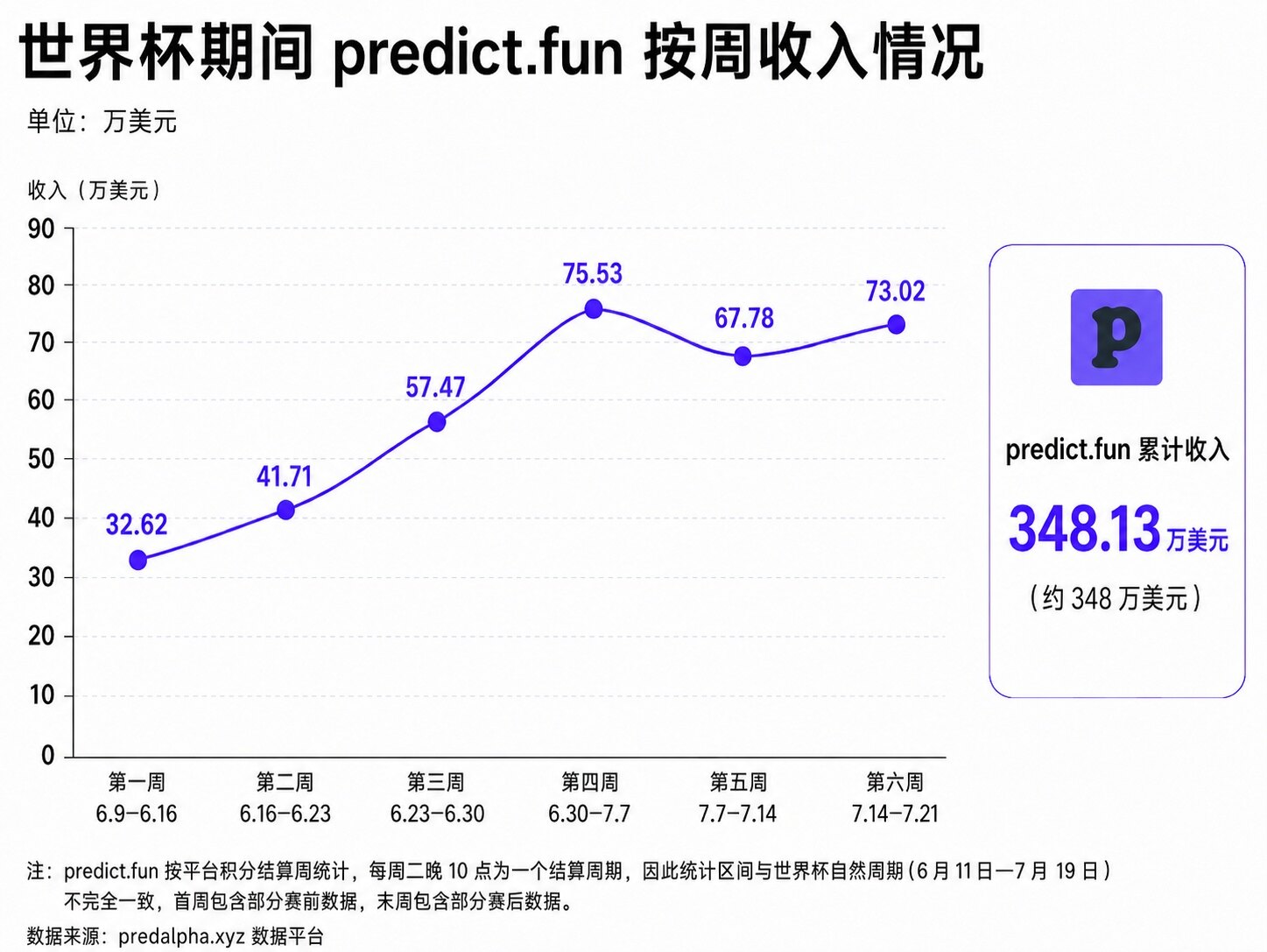
predict.fun's fee revenue is calculated based on the platform's settlement week, which cycles every Tuesday at 10 PM, so it does not perfectly align with the World Cup's natural schedule from June 11 to July 19. The first settlement week was June 9 to June 16, including two days of pre-tournament data; the final settlement week was July 14 to July 21, also incorporating two days of post-tournament data.
Looking at the revenue trend, predict.fun's fee revenue for the first settlement week was $326,200. It then grew for three consecutive weeks, peaking at $755,300 during the period from June 30 to July 7, the highest single-week value within the World Cup cycle. The following two weeks recorded $677,800 and $730,200 respectively. Although these did not set new highs, they were still significantly above the early tournament levels. Cumulative fee revenue over the six settlement weeks during the World Cup reached $3.4813 million.
In the settlement week before the World Cup, i.e., June 2 to June 9, predict.fun's fee revenue was only $159,400. After entering the World Cup cycle, revenue in the first week jumped to $326,200, an increase of approximately 105%. Subsequently, most settlement weeks rose further to over $500,000. Even though the first and last cycles included some pre- and post-tournament data, the boost from the World Cup to predict.fun's fee revenue was still significant.
After the World Cup Ended, Fee Revenue Generally Declined Across All Three Platforms, with Kalshi Seeing the Smallest Drop
Kalshi's average daily fee revenue during the World Cup was $12.13 million. On July 22, it fell to $11 million, a decrease of 9.3%. Among the three platforms, Kalshi experienced the smallest post-tournament decline. While its fee revenue fell from the highs during the event, it remained close to the average daily level seen during the World Cup.
The decline for Polymarket was more pronounced. Its average daily fee revenue during the World Cup was $2.86 million. On July 22, it dropped to $1.7 million, a decrease of 40.5%. The revenue increment generated by the World Cup for Polymarket was relatively concentrated, and this increment quickly dissipated with the tournament's end.
predict.fun's average daily fee revenue during the World Cup was approximately $83,000. On July 22, it fell to $53,000, a decline of 36.1%, similar to the drop experienced by Polymarket. Although the statistical methodology differs slightly from the first two platforms, the post-tournament trend is still clear. The World Cup's boost to predict.fun's fee revenue was also significant, and it declined relatively quickly after the event ended.
The World Cup Did Not Raise Polymarket's TVL, While predict.fun Saw Inflows in the Latter Half of the Tournament
Polymarket's TVL did not increase in tandem with trading volume during the World Cup. At the beginning of May, the platform's TVL was approximately $410 million, and it mostly fluctuated within the $440 million to $480 million range subsequently. After the World Cup started, TVL still mainly fluctuated around this level. Although it briefly spiked in late June and early July, these did not form a sustained upward trend.
After mid-July, TVL began to decline noticeably, falling to around $400 million by the end of the World Cup, and has since further decreased to approximately $340 million. Trading volume expanded significantly during the tournament, but the capital deposited on the platform continued to decrease after it ended, indicating that the World Cup mainly generated high-frequency trading demand without simultaneously converting into long-term retained capital.
predict.fun's trend was more phased. At the beginning of May, its TVL was around $20 million. It briefly dropped to about $10 million in mid-May, then hovered around the $15 million mark until mid-June. In the early stages of the World Cup, TVL did not rise immediately. It only began to recover rapidly in early July, rising to the $20 million to $25 million range during the latter half of the tournament, reaching a cyclical high around the time the World Cup ended.
After the tournament concluded, TVL gradually declined, currently sitting at around $17 million, but still higher than its low point in late June. Compared to Polymarket, predict.fun's capital changes were more closely tied to the progress of the World Cup, with particularly notable capital inflows during the knockout stage.
(Note: Since Kalshi's TVL data cannot be obtained on-chain, this section only discusses Polymarket and predict.fun.)
Summary
The World Cup indeed brought substantial trading volume and fee revenue to prediction markets, but post-tournament data also indicates that this growth did not naturally sustain itself. The average daily trading volume and fee revenue of the three platforms all declined after the event ended, and Polymarket's TVL continued to fall. Mega-events can amplify trading demand in a concentrated manner over the short term, but they may not necessarily directly elevate a platform's long-term activity level.
However, the World Cup dividend was not solely reflected in short-term data. It at least validated that sports events can provide prediction markets with a continuous stream of high-frequency, short-cycle trading scenarios, and it helped many users form a habit of repeated trading throughout consecutive matches.
The World Cup is over, but the competition surrounding user retention, market supply, and normalized trading has only just begun.


