






While the whole world hits new highs, crypto has become that "jealous poor guy."


- Core Thesis: The article points out that the crypto market experienced a "structural underperformance" in 2025-2026, with global liquidity shifting towards assets like US stocks, gold, and South Korean semiconductors. Bitcoin, unable to act as a safe haven and lacking momentum, has turned its holders into the "jealous poor"—those who made no wrong decisions but became relatively poorer because their assets missed the rising tide.
- Key Elements:
- South Korea's KOSPI index rose from 4,000 to 8,000 points, driven by AI chip stocks like Samsung Electronics and SK Hynix. Those who didn't hold these assets mockingly call themselves the "jealous poor."
- "Structural underperformance" differs from a bear market's collective losses: the money hasn't disappeared but has moved to assets hitting new highs like gold and US stocks, deliberately bypassing crypto. This feeling of missing out on gains while still suffering from losses exacerbates holders' anxiety.
- Crypto users and KOLs have started migrating their trading skills to US stocks, such as tracking NVIDIA's earnings and developing monitoring tools. Exchanges are also listing on-chain US stock products to retain users.
- In May 2026, the RMB appreciated against the USD to 6.8, hitting a three-year high. This caused crypto investors holding USDT to incur losses from exchange rate fluctuations, even without moving their assets.
- The article warns against the risk of chasing rallies: current global liquidity is inflating asset prices broadly, but ordinary people are poor at taking profits. They risk repeating the "chasing highs to zero" cycle seen with NFTs and previous altcoin manias.
Original author: David, TechFlow
There is a kind of poverty that strikes not because you did anything wrong, but because you wake up one day and realize you are poorer than everyone around you.
Koreans have coined a term for this: 벼락거지. Literally translated, it means "lightning pauper"—someone struck by a bolt from the blue, instantly reduced from an ordinary person to a poor one.
The term first gained traction during South Korea's housing price surge in 2020, describing those who hadn’t bought a home. Their income remained unchanged, but compared to the skyrocketing property values, they had effectively become poorer out of nowhere.
Recently, the term has made a comeback. This time, it’s because the Korean stock market is mass-producing "lightning paupers."
Over the past six months, the KOSPI index has surged from around 4,000 points to over 8,000 points. Today, the Korean stock market even triggered a circuit breaker after a sharp rise. Samsung Electronics and SK Hynix, two AI memory chip stocks, have propelled the entire nation’s stock market to new heights.
As a result, online forums in Seoul are filled with people mocking themselves: "At the same company, the person across from me earned ten years’ salary in semiconductors, while I did nothing and became a lightning pauper."

This sentiment stings the most for those in the crypto space.
The frustration of "everything around me is rising, but I’m standing still" is something crypto investors have felt more deeply, earlier, and are more reluctant to admit. BTC, once repeatedly hailed as the best asset, has been languishing since the major crash in October last year.
Now, staying in the crypto space waiting for opportunities feels more like a consolation for being bad at stock trading, adding to the torment of being a "lightning pauper."
Structural Missing Out, the Lightning Pauper
Missing out comes in two forms, with vastly different levels of pain.
The first is collective missing out during a bear market. Everyone loses together; your portfolio is in the red, your friend’s is even redder, and no one in the entire market is making money. This kind of missing out hurts less because there’s no reference point.
If you didn’t get in, missing out almost feels like dodging a bullet. The crypto bear market over the past few years is exactly how everyone coped—they got used to it.
This year is different. The crypto space is experiencing an awkward form of structural missing out.
The money hasn’t disappeared; it has simply moved. It has flowed into gold, into U.S. stocks, and even into Korean retirement funds invested in semiconductors. Global liquidity acts like a high-powered pump, sucking money from all directions and channeling it into one record-high asset after another.
But it has bypassed crypto entirely.
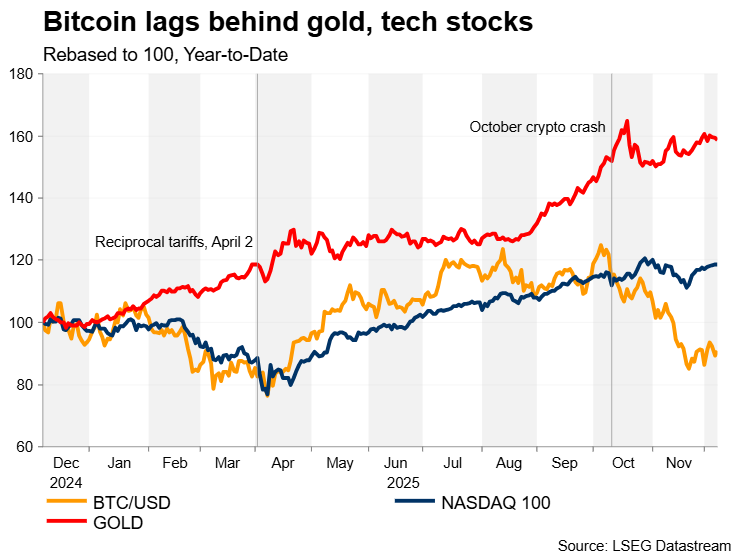
This is entirely different from "everyone being broke together." Everyone else has found a way out, while you stand there watching the money flow past your door without a single dollar coming in. This kind of missing out is far more psychologically devastating than the bear market.
BTC was supposed to be a safe haven, but it doesn’t have gold’s track record. Tech stocks have been hitting new highs, but BTC hasn’t kept pace. Whenever the market panics, BTC is the first to be sold off alongside risky assets. It doesn’t rise when others do, but it never misses a decline. It’s caught in the worst of both worlds.
Those holding BTC wanted a safe haven; it didn’t provide one. They wanted high beta; it didn’t deliver. Neither of the reasons they originally bought BTC has materialized this year.
Losing money is at least a clear, hateable situation—you bet on the wrong direction. But missing out is different. You didn’t do anything wrong; the money just avoids you, leaving you with no specific target to blame.
Thus, the entire crypto space has become the Korean stock market’s trending term: "lightning paupers."
However, crypto natives inherently possess a keen sense of smell and a restless drive. The real reaction of most "lightning paupers" isn’t to lie flat, but to migrate with the trend.
In communities and on social media, discussions have shifted from which altcoin could 10x, to KOLs whose bios still carry crypto tickers now debating Nvidia’s earnings and Tesla’s support levels.
People have simply repurposed the skills they honed trading crypto—reading charts, chasing narratives, enduring volatility—except the targets have changed from altcoins to U.S. stock tickers. Some have even tweaked the scripts they wrote for crypto trading, using vibe coding to whip up a monitoring tool for U.S. stocks, complete with tracking, alerts, and automated orders—all in one package.
Skills weren’t wasted, just applied elsewhere.
Meanwhile, crypto exchanges are actively trying to save themselves and adapt, jumping on the trend by launching various on-chain U.S. stock trading products. After all, Hyperliquid has already set a precedent for the entire crypto market.
So, exchanges selling stocks is a subtle act of retention. Users want assets hitting new highs, so exchanges bring those assets in to keep people from leaving. From retail investors glued to their screens to exchanges listing new tokens, the entire industry is focused on one thing:
Finding ways to ride the wave they missed. Ultimately, it’s all about FOMO in the face of the trend.
Whether willingly or not, everyone understands a fundamental truth: if they don’t adjust their strategy, the asset that’s truly rising will never be the one they’re holding.
Don’t Let FOMO Push You Onto the Last Train
Those who don’t want to leave might still have some capital left—whether it's Dollar-Cost Averaging into BTC or chasing local narratives. Maybe the coin hasn’t gone up, but their U (stablecoin) holdings haven’t decreased. They can hunker down during the bear market and wait for the next wave.
If the principal is still intact, can missing out be treated as if it never happened?
At the start of 2025, the RMB-to-USD exchange rate was still between 7.2 and 7.3. Entering 2026, it has been steadily strengthening. In May, both onshore and offshore rates broke above 6.8, entering the 6.7 range, hitting a three-year high.
What does this mean? Suppose you stayed put, disciplined, without chasing highs or cutting losses. As a result, your U holdings are also losing value. Missing out means others made money while you didn’t; you were standing still. Now, you’re standing still, but the ground beneath you is sinking.
Waiting is not a zero-cost endeavor; waiting itself burns money.
Thus, a natural thought arises: since crypto isn’t working, should I liquidate my positions and FOMO into the assets that are rising? This thought might be more dangerous than the missing out itself.
The feeling of missing out needs to be resolved, but maybe not by chasing in.
Let’s be honest: this crypto cycle has indeed underperformed, and we can’t console ourselves by saying "it will come back." The old logic was a four-year cycle: halving, bull run, new highs. If you missed out, you waited for the next one.
Now, the game has changed. ETFs have turned Bitcoin into a line item on institutional balance sheets. On-chain money is busy buying U.S. stocks, and even exchanges have pivoted to selling stocks... This cycle’s crypto is no longer the same crypto you remember, the one that could 10x overnight.
Expecting it to repeat the old script is like marking the boat to find a lost sword. But admitting crypto is on a downward trend doesn’t mean the stock market is a safe haven.
If you rush in to chase gold, U.S. stocks, or Korean chips, the profit isn’t really due to your insight; it’s the rising tide. Global liquidity is lifting all boats. When the water is high, everyone looks like a good swimmer. The problem is, tides always recede.
The real test isn’t whether you got on board initially. It’s whether you have the skill to trade your chips for cash on the shore before the water recedes.
And that’s precisely what ordinary people are worst at. We’ve seen it time and again in NFTs and altcoins: we can catch the rise, but those who successfully take profits are a rare breed. People always think it will keep going up until it goes to zero.
Switching markets doesn’t automatically erase these weaknesses. If you move the crypto trading playbook to U.S. stocks, you’ll likely also bring along that "can’t bear to sell" mentality.
So, the question of missing out might be a pseudo-problem. Taking profits and getting off the table is the ultimate imperative.
Koreans coined "lightning pauper" to mock themselves for missing out. The English term FOMO means something similar. But if you let someone else’s balance sheet measure your own worth, pushing you to jump into a pool you don’t understand at its highest water level, that’s extremely dangerous.
The real lightning strike is never the train you missed.
It’s the one you barely manage to board, only to forget, once again, at which station you should get off.


