






伯恩斯坦 giải thích: Liệu các đơn đặt hàng dài hạn trị giá 142 tỷ USD có thể chống đỡ được chu kỳ bộ nhớ?


- Quan điểm chính: Báo cáo của Bernstein chỉ ra rằng các thỏa thuận mua hàng dài hạn (LTA) mới và bảo lãnh tài chính của Micron và SanDisk (tổng cộng khoảng 33 tỷ USD) đã cải thiện khả năng hiển thị doanh thu của ngành bộ nhớ, nhưng các bảo lãnh hiện tại chỉ bao phủ khoảng 0,6% nhu cầu bảo vệ tiềm năng, không thể loại bỏ hoàn toàn biến động chu kỳ, vai trò của chúng giống như một tấm đệm giảm xóc trong chu kỳ suy thoái hơn là một "kẻ kết thúc chu kỳ".
- Các yếu tố chính:
- Quy mô LTA hạn chế: Tổng bảo lãnh của Micron và SanDisk là khoảng 33 tỷ USD, nhưng mô hình của Bernstein ước tính doanh thu cần được bảo vệ trong 3-5 năm tới lên tới 5,2 nghìn tỷ USD, tỷ lệ bảo lãnh quá thấp, khách hàng vẫn có thể vỡ nợ trong thời kỳ suy thoái sâu.
- Phân hóa cơ cấu khách hàng: Các công ty đám mây Mỹ là khách hàng lý tưởng cho LTA, nhưng khoảng 30%-50% thị phần từ người tiêu dùng, khách hàng Trung Quốc... khó có thể được bao phủ, nhu cầu giao ngay này vẫn sẽ thúc đẩy biến động chu kỳ.
- Sự khác biệt về cơ chế bảo lãnh: Micron sử dụng bảo lãnh có trọng số nghiêng về cuối kỳ, chi phí vỡ nợ trong giai đoạn cuối hợp đồng cao hơn; SanDisk sử dụng bảo lãnh số tiền cố định, tương đối ổn định trong suốt thời hạn hợp đồng, nhưng cả hai đều không thể bảo vệ hoàn toàn trong chu kỳ suy thoái.
- Hỗ trợ từ nhu cầu mới nổi: Nhu cầu AI (ví dụ: HBM, suy luận NAND) cung cấp hỗ trợ đáy cho chu kỳ, nhưng HBM chia sẻ năng lực sản xuất với DRAM thông thường, và lợi nhuận đỉnh không thể ngoại suy trực tiếp.
- Làm mềm chu kỳ chứ không kết thúc: LTA cung cấp tấm đệm bằng cách tăng chi phí vỡ nợ của khách hàng (ví dụ: từ bỏ bảo lãnh, mất quan hệ cung ứng), nhưng khi giá giao ngay giảm sâu, khách hàng vẫn có thể đưa ra quyết định dựa trên hiệu quả chi phí.
TL;DR
- Bernstein focuses on Micron and SanDisk's new LTAs, believing long-term purchase agreements are improving memory revenue visibility.
- The two companies disclosed combined RPO of approximately $142 billion and financial guarantees of about $33 billion, but far below the model protection scope.
- LTAs can increase the cost for large customers to walk away, but consumer, Chinese customer, and spot demand will still retain cyclical fluctuations.
In its latest report, Bernstein puts long-term purchase agreements in the memory industry back in the spotlight: Micron and SanDisk have signed a batch of new LTAs with purchase commitments, minimum prices, and financial guarantees, attempting to create a floor for profitability in the coming years.
This floor is not as thick as it seems.
According to public filings and conference calls from Micron and SanDisk, Micron has signed 16 strategic customer agreements, of which 14 have cumulative minimum revenue of approximately $100 billion calculated at minimum contract prices, with related cash deposits and financial commitments totaling about $22 billion. SanDisk's three current quarterly contracts correspond to approximately $42 billion in minimum contract revenue, with five agreements totaling over $11 billion in financial guarantees.
The combined guarantee of about $33 billion for the two companies indeed makes it more expensive for large customers to walk away. But Bernstein's model estimates the revenue scope that may need LTA protection over the next 3-5 years at approximately $5.2 trillion. By this metric, the existing guarantees represent only about 0.6%.
This is precisely the divergence the report aims to highlight: LTAs are changing the negotiating position between memory companies and large customers, but they act more as a cushion for the downside cycle rather than transforming DRAM and NAND into utilities.
Large Customers Locked into Long-Term Agreements, Guarantees Becoming Real Money
LTAs are not complicated. Customers commit upfront to purchase volumes over several years, and suppliers provide supply assurances and pricing mechanisms. If customers fail to purchase, they may forfeit prepaid guarantees or bear other economic costs.
What's different this time from past memory industry purchase intentions is the inclusion of financial guarantees in the contract structure.
As of June 2026, Micron has signed 16 strategic customer agreements, including 4 hyperscale customers and 3 mid-size customers. Under 14 of these agreements, cumulative minimum revenue calculated at minimum contract prices is approximately $100 billion, with expected cash deposits and related financial commitments of about $22 billion. This figure includes agreements signed and those signed post-quarter, not fully reconciling with the balance sheet's period-end RPO.
SanDisk disclosed that as of April 3, 2026, its RPO was $41.6 billion. The company also mentioned in its earnings call that three current quarterly contracts provide approximately $42 billion in minimum contract revenue, five agreements have over $11 billion in financial guarantees, and coverage extends to over one-third of FY27 bit supply.
The mechanisms differ between the two companies. Micron's guarantees are more back-end weighted. As the contract progresses and customers' remaining purchase obligations decrease, the guarantee as a percentage of RPO increases, making abandonment more costly later. SanDisk's approach is closer to fixed-amount guarantees, with the guarantee amount expected to remain relatively stable over the contract period.
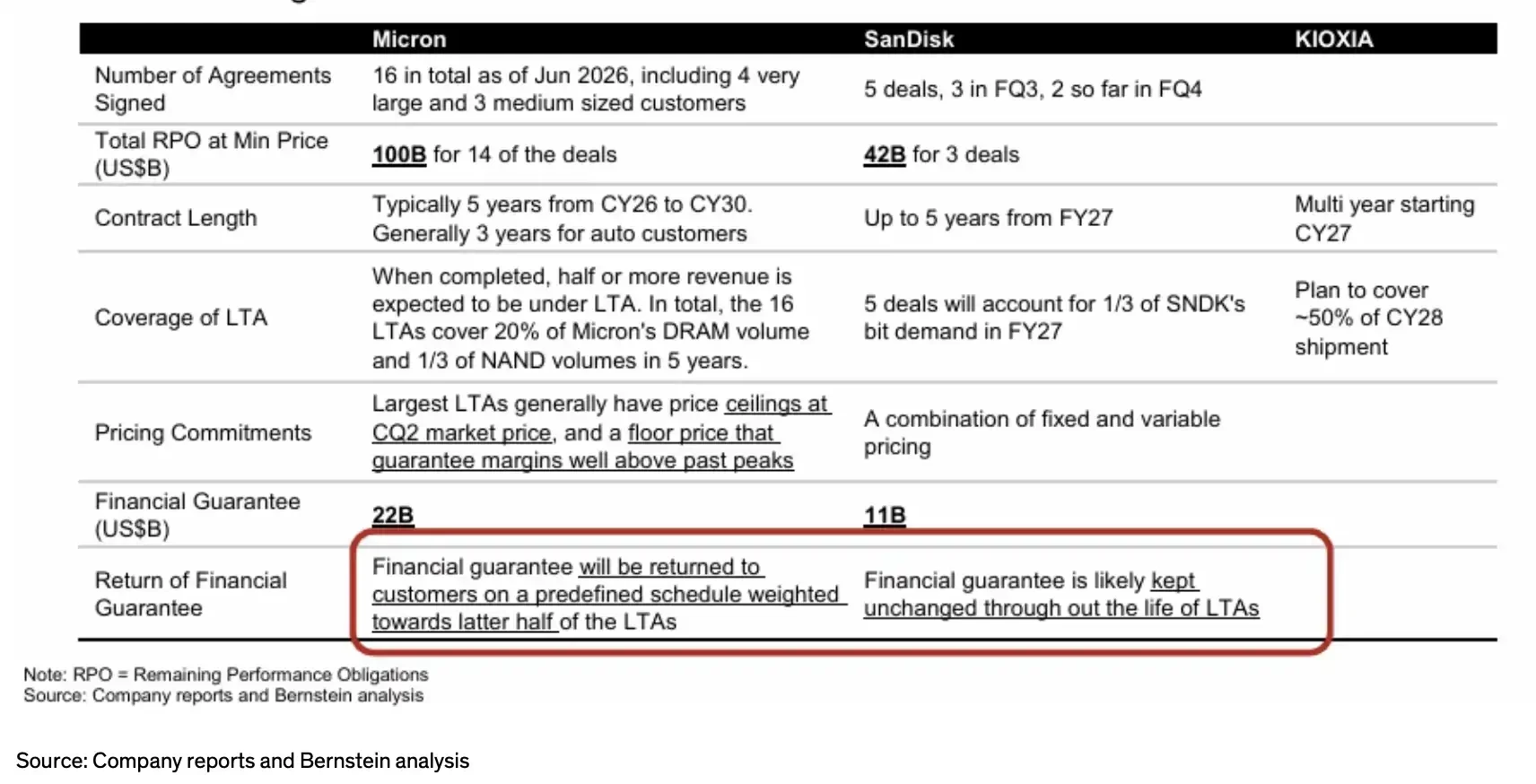
Micron: 16 agreements, RPO ~$100 billion, guarantees ~$22 billion; SanDisk: 5 agreements, RPO ~$42 billion, guarantees over $11 billion.
Bulls focus on this point most. The biggest problem in the memory industry in the past was that profitability collapsed too quickly when prices fell. If large customers are willing to pay guarantees for long-term supply, suppliers can at least gain clearer revenue baselines, and capital expenditure and capacity planning don't have to be entirely dictated by spot prices.
The $33 Billion Guarantee Isn't Thin, But It Can't Fully Cover a Deep Downturn
The scale of guarantees and the revenue scope needing protection are not on the same level.
Bernstein uses a model to estimate that if LTAs were to cover potential revenue over the next 3-5 years, the corresponding protection scope would be about $5.2 trillion. This figure is based on the report's model estimate; public company filings do not directly disclose similar industry-wide revenue metrics, and distinctions need to be made between memory, total semiconductor revenue, and supplier sample revenue.
Even so, the 0.6% guarantee ratio illustrates one thing: LTAs cannot fully protect profitability in all pricing scenarios.
If spot prices only decline moderately, it is not cost-effective for customers to walk away. Losing guarantees, damaging supply relationships, and potentially missing out on scarce capacity in the future are costs sufficient to make customers continue performing. AI server, cloud provider, and data center customers have stronger demand for stable supply than typical consumer electronics customers.
But when prices fall deeply enough, customers will still do the math. As long as the remaining purchase volume is still large and the spot price is low enough relative to the contract floor price, customers may find it cheaper to buy on the open market, even if they lose the guarantee.
The back-end weighted mechanism can mitigate this issue. The further into the contract, the lower the remaining RPO, and the higher the ratio of guarantee to remaining obligations, making it more costly for customers to abandon the contract. Protection may be stronger later in the contract, and memory cycles often need more protection later on.
It is still not unconditional insurance. The protective strength of an LTA depends on three factors: how low the spot price drops, how much purchase obligation the customer has left, and how much of the guarantee remains.
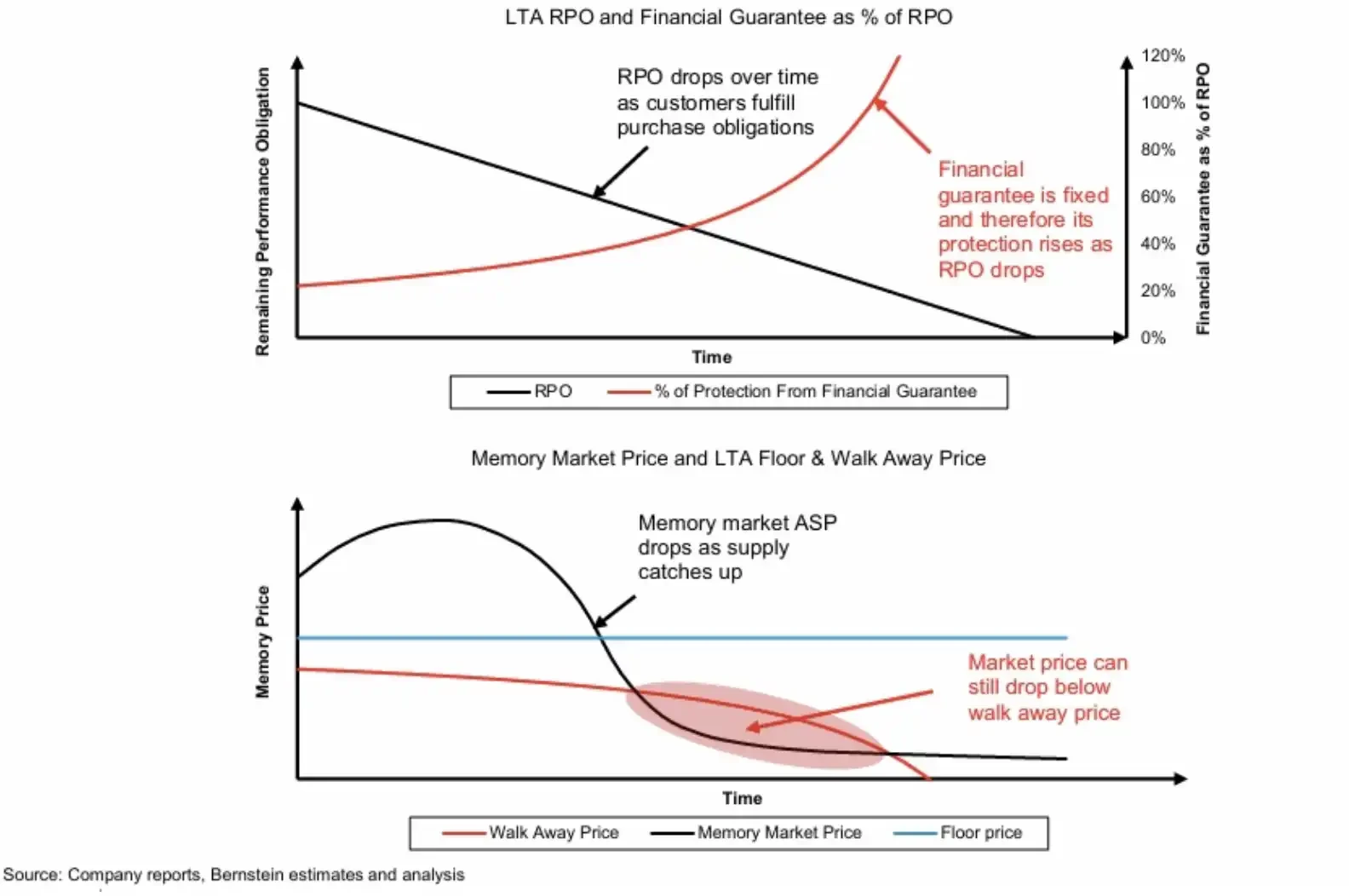
RPO declines over time, Guarantee/RPO ratio rises; if spot ASP falls too far below the contract floor price, customers may still choose to walk away.
This is also the core of the bull-bear divergence. Bulls see that memory companies have finally secured long-term commitments with real money from customers. Bears worry that the scale of these commitments is still insufficient to protect peak profitability, and when the down cycle is deep enough, customers will still act based on cost.
Not All Memory Demand Is Willing to Be Locked into LTAs
LTAs also have a practical ceiling: not all customers are suitable for signing long-term agreements.
US cloud providers are the most ideal candidates. They have high demand, strong credit, sensitivity to stable AI infrastructure supply, and greater incentive to lock in supply through long-term agreements. Micron has largely completed negotiations with US CSPs and is continuing to work with Chinese CSPs, enterprises, and some other customers.
Consumer business is different. SanDisk's CFO has stated that the consumer business is "more transactional" and LTAs are "not applicable." Mobile, PC, and consumer storage channels are accustomed to purchasing based on price and inventory cycles; when prices fall, customers naturally want to maintain flexibility rather than being locked into multi-year floor prices.
Chinese customers may not necessarily become stable buyers under LTAs either. On one hand, Chinese cloud providers and end customers may prefer domestic suppliers. On the other hand, the expansion of domestic DRAM and NAND supply will add uncertainty to long-term purchase commitments.
Bernstein estimates that 30%-50% of the overall DRAM and NAND end market may be difficult to cover with LTAs. Even if leading suppliers lock in US large customers, a significant portion of the market will continue to operate based on spot prices, short-term orders, and cyclical expectations.
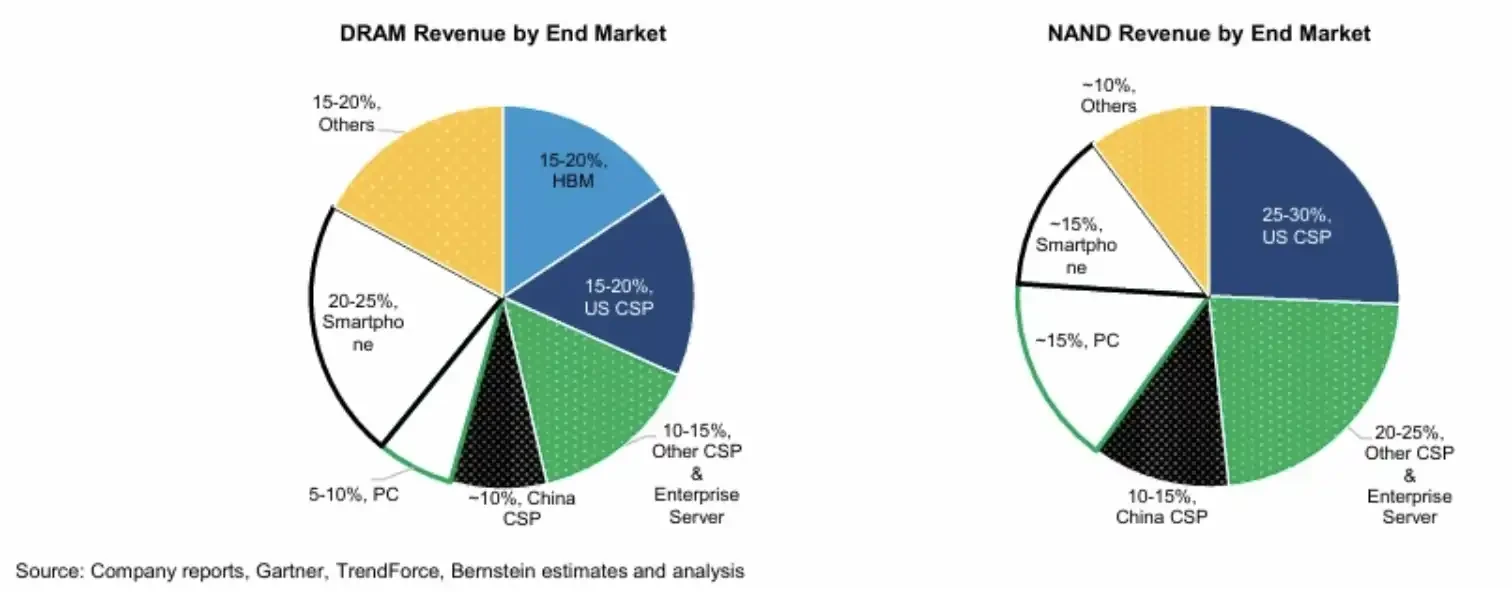
A breakdown of the DRAM/NAND end market shows demand from Chinese CSPs, enterprise servers, consumer/PC, smartphones, etc., beyond US CSPs, with approximately 30%-50% of the market potentially difficult to cover by LTAs.
As long as a sufficiently large portion of demand remains in the spot or short-term contract system, price signals will not disappear. As long as price signals exist, supplier capacity expansion, customer inventory reduction, and channel order cancellations will continue to amplify cyclical volatility.
AI Demand Supports Valuations, But Peak Profitability Cannot Be Directly Extrapolated
One reason the market is willing to give memory companies higher valuations is that AI demand has changed the bottom morphology of this cycle.
On the DRAM side, HBM demand remains strong. Bernstein's Asia team predicts that HBM prices in 2027 could rise 2-2.5x compared to 2026. While conventional DRAM commercial prices have already risen significantly, they may remain high over the next 12 months. Although HBM is more stable than general memory, it shares some production capacity with conventional DRAM, and capacity allocation can affect other product lines.
On the NAND side, AI inference and longer context windows also bring new demand expectations. Early AI training mainly consumed HBM and DRAM, but with the increase in inference, Agentic AI, and long-context applications, storage demand may continue to rise. It's important to note that statements regarding Vera Rubin related capacity should not be simply written as "GPU's NAND capacity"; Nvidia's official page discloses 20.7TB of HBM4 GPU memory.
In this environment, the value of LTAs is more about locking in a portion of the high-cycle revenue. If AI demand continues to be strong, suppliers can secure some large customer purchases through long-term agreements. If prices fall, the guarantees and floor prices can slow down the decline in profitability.
SanDisk's stress tests also point to similar conclusions. Bernstein's model shows that under more severe assumptions, LTAs can still make FY29-FY30 EPS higher in most penetration rate scenarios compared to a no-LTA scenario, with particularly stronger protection in later periods. However, the same set of stress tests also indicates that peak profitability cannot be simply extrapolated. Under lower operating margin scenarios, EPS could be significantly below current run rates.
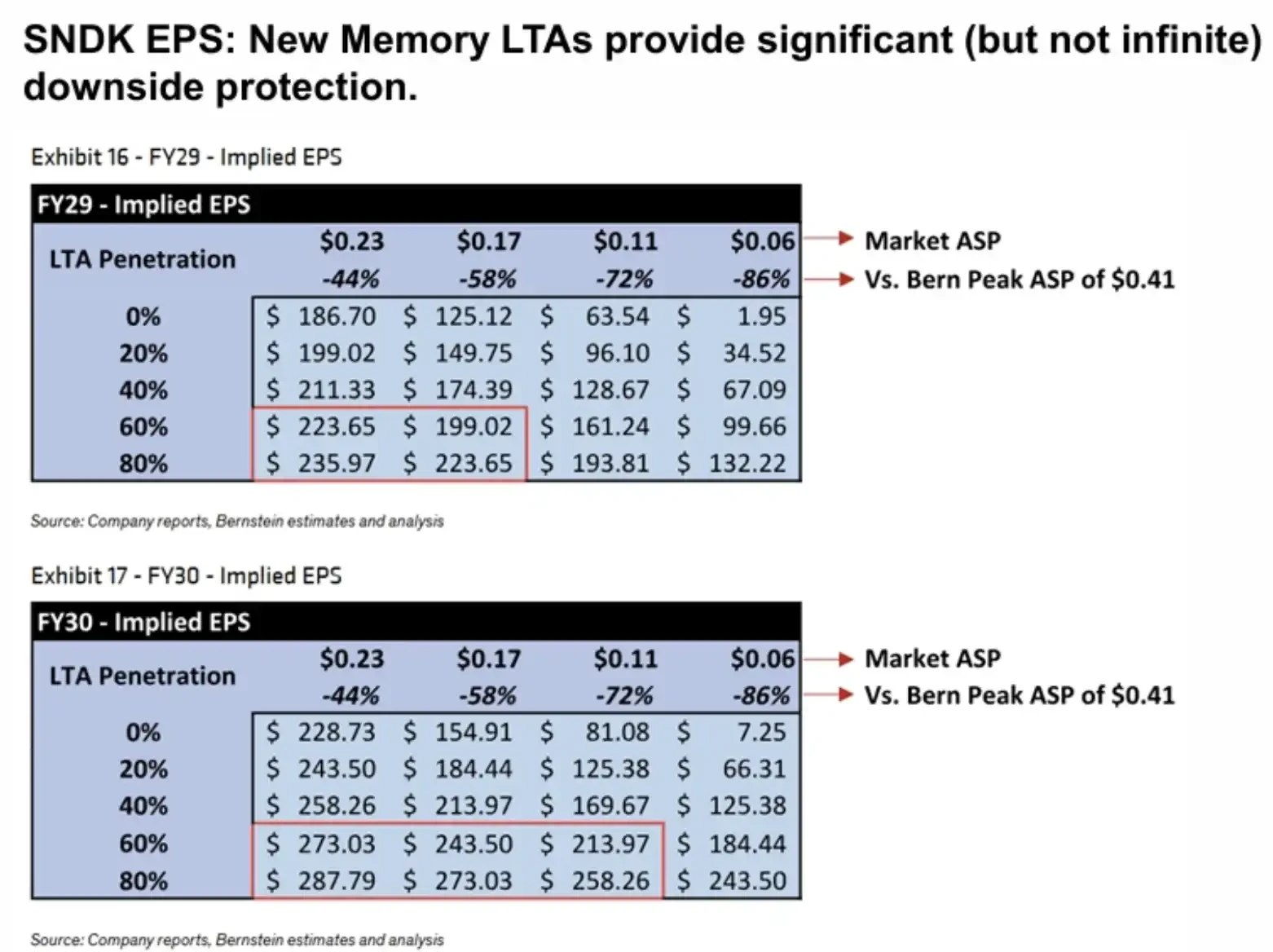
SanDisk FY29-FY30 EPS sensitivity table shows a wide EPS range under different ASP and LTA penetration rates; LTAs improve the downside scenario but cannot lock in peak profitability.
The most valuable takeaway from this report is not that "the memory cycle is over," but that "the cyclical downturn may be softened."
Micron and SanDisk securing long-term agreements and financial guarantees indicates that large customers are willing to pay for supply certainty in the AI era. For memory companies, this will enhance revenue visibility over the next few years and make it easier for capital markets to believe that the profitability floor is higher than in the past.
The limitations are equally clear. The $33 billion in guarantees provides only a partial buffer. Consumer, Chinese customer, and some transactional demand will not all enter long-term agreements. Bernstein also estimates that China's DRAM share could rise from about 8% to 16% in the coming years, and NAND could also face stronger supply pressure after 2028.
What LTAs truly need to prove is not whether they can be signed during a boom, but whether customers will honor them during the next down cycle, whether the guarantees will be painful enough, and whether suppliers will maintain capacity discipline. Until these issues are resolved, LTAs are a new buffer pad for the memory industry, not the kill switch for its cycle.


