






BTC's Three Post-Market Scenarios and a Clash of Two Strong Forces | Special Analysis


- Core Thesis: Based on Elliott Wave Theory and multi-timeframe technical analysis, this article projects the trends of BTC and HYPE. It posits that BTC is currently at a critical directional decision point, while HYPE requires attention to the breakout of the $45.76 level. Specific trading strategies and risk control plans are provided accordingly.
- Key Elements:
- BTC's daily adjustment structure presents three scenarios: a new uptrend initiated (bullish view), a complex five-wave adjustment (bearish view one), and a larger-scale adjustment (bearish view two). Scenario two is considered low probability due to the excessive time extension of the D-wave.
- This week, the core focus for BTC is the 4-hour level consolidation zone C (approximately $75,000-$78,500). A firm hold above the upper range would indicate continued consolidation, while a breakdown below the lower range could trigger a daily-level correction.
- Short-to-medium-term strategy for BTC is clear: maintain a neutral stance and observe. For short-term trades, use 30% of capital to go long above $78,500-$79,500 or go short below $73,500-$75,000, with strict stop-losses in place.
- HYPE's daily chart shows a seven-segment structure, with segments 1-2, 2-3, and 3-4 forming a "rising consolidation zone." This week's key is whether the price can break above the previous high of $45.76 to confirm the continuation of the uptrend.
- Short-term HYPE strategy revolves around the upper and lower bounds of this consolidation zone ($38.41 and $34.44). Go long when the price pulls back and stabilizes at support levels; go short if support levels are effectively broken. Position size should be controlled under 30% with strict adherence to stop-losses.
The market never lies; it only remains silent.
As prices hover around key zones, both bulls and bears are waiting for an answer.
Over the past week, Bitcoin completed the wide-range volatility we previously anticipated within the core area of $79,500 to $80,600. The market has validated the effectiveness of the technical logic through its price action. But validation is only the starting point; the real battle begins this week.
BTC's daily adjustment structure stands at a crossroads of three paths: Is it the starting point of a new impulsive wave, or the continuation of a larger-scale correction? Wave analysis can provide a framework, but the market ultimately votes with price. For HYPE, a clear seven-section structure can be traced. Whether it breaks through the $45.76 level will be the most closely watched variable this week.
In this week's article, we will continue to analyze from a multi-timeframe perspective, sorting out the structure, judging the direction, and formulating plans. The strategy is ready; maintain your own rhythm.
Summary of Key Trading Views for This Week:
• BTC Multi-timeframe structure analysis (detailed in Part 1)
• BTC price forecast and medium & short-term trading strategies for this week (detailed in Part 2).
• HYPE daily level structure analysis (detailed in Part 3)
• HYPE price forecast and short-term trading strategies for this week (detailed in Part 4)
Market Validation of Last Week's Trading Strategy:
• Validation of BTC price forecast: In last week's article, we pointed out focusing on the battle between bulls and bears for the core $79,500 to $80,600 area, and judged that the market would likely experience wide-range volatility. Current market action roughly validates our previous view.
I. Bitcoin Multi-Timeframe Structure Analysis
1. BTC Daily Level Structure Analysis: (Three wave count scenarios for BTC's subsequent movement)
Bitcoin Daily K-line Chart:
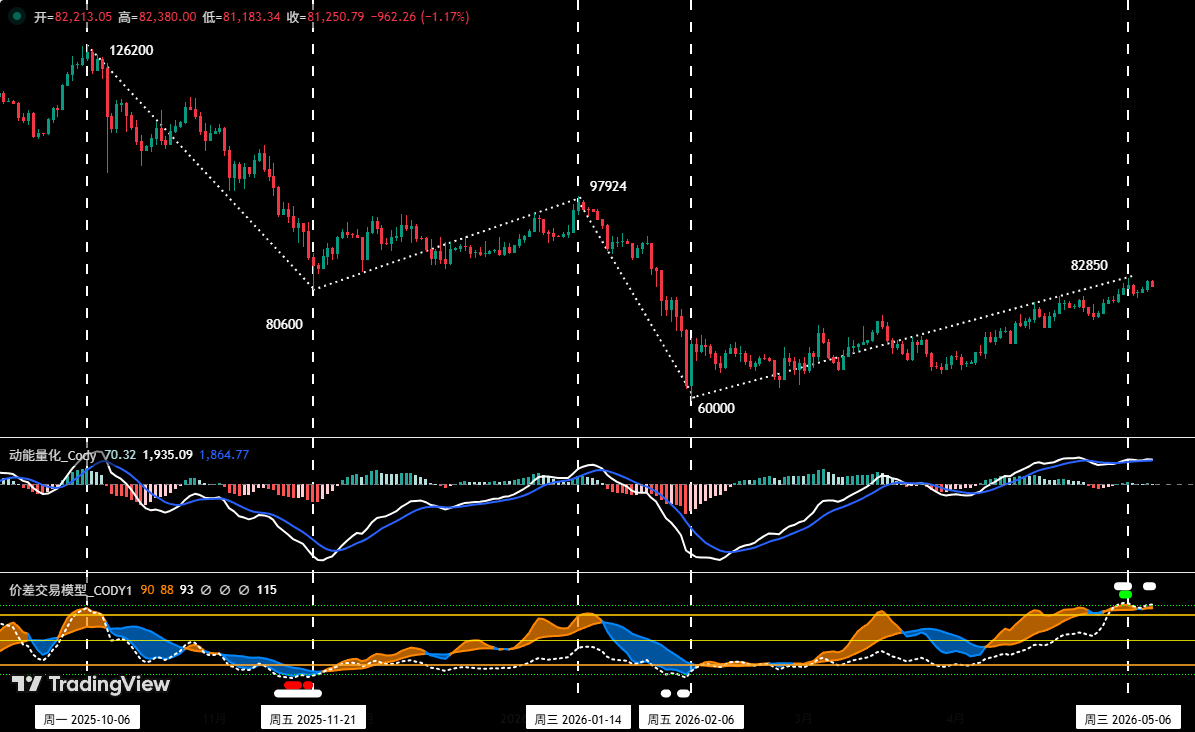
Figure 1
As shown in Figure 1, since hitting the high of $126,200 in October 2025, Bitcoin has entered an adjustment cycle lasting about 7 months (216 days). The market is currently divided on the subsequent direction. The bearish view argues the downtrend isn't over; after the recent bounce ends, the price will resume its correction and break below the $60,000 low. The bullish view holds that the correction from $126,200 ended at $60,000, with the trend reversing. They believe the rally since February is the start of a new uptrend. Next, based on Elliott Wave rules, we will analyze this daily correction structure and propose three technical scenarios for your reference.
① Scenario 1: Correction Complete, New Impulsive Wave Starts (Bullish View)
This view posits: The daily-level correction from the previous high of $126,200 completed an A-B-C three-wave structure, with wave C ending at $60,000. Currently, it is in the early stages of a major Wave I (the initial impulse wave of an uptrend).
• Wave A (Decline): From $126,200 (2025-10-06) to $80,600 (2025-11-21), lasting 46 days, max decline of approx. 36%.
• Wave B (Bounce): From $80,600 (2025-11-21) to $97,924 (2026-01-14), lasting 54 days, max gain of approx. 21.5%.
• Wave C (Decline): From $97,924 (2026-01-14) to $60,000 (2026-02-06), lasting 23 days, max decline of approx. 38.7%.
• Major Wave I (Uptrend Initiation): From $60,000 (2026-02-06) to present, running for 94 days, with a max gain of approx. 38.1% so far. Still in progress.
• Potential Major Wave II (Corrective Wave): After Major Wave I ends, the subsequent corrective wave will not break below $60,000.
② Scenario 2: Complex Five-Wave Correction, Currently in Wave D Bounce (Bearish View 1)
This view argues: The daily-level correction from the previous high of $126,200 might complete an A-B-C-D-E five-wave structure. It is currently in Wave D bounce.
• Wave A (Decline): From $126,200 (2025-10-06) to $80,600 (2025-11-21), lasting 46 days, max decline of approx. 36%.
• Wave B (Bounce): From $80,600 (2025-11-21) to $97,924 (2026-01-14), lasting 54 days, max gain of approx. 21.5%.
• Wave C (Decline): From $97,924 (2026-01-14) to $60,000 (2026-02-06), lasting 23 days, max decline of approx. 38.7%.
• Wave D (Bounce): From $60,000 (2026-02-06) to present, running for 94 days, with a max gain of approx. 38.1% so far. Still in progress.
• Potential Wave E (Decline): After Wave D bounce ends, the subsequent corrective wave might break below $60,000.
③ Scenario 3: Larger Degree (e.g., Weekly) Correction, Currently in Wave B Bounce (Bearish View 2)
This view suggests: The daily-level correction from the previous high of $126,200 could be part of a larger A-B-C three-wave correction structure. It is currently in Wave B bounce.
• Wave A (Decline): From $126,200 (2025-10-06) to $60,000 (2026-02-06), lasting 112 days, max decline of approx. 52.5%.
• Wave B (Bounce): From $60,000 (2026-02-06) to present, running for 94 days, with a max gain of approx. 38.1% so far. Still in progress.
• Potential Wave C (Decline): After Wave B bounce ends, the subsequent corrective wave might break below $60,000.
④ Summary:
• Analyzing from the perspective of wave theory's time rules and form harmony, in Scenario 2, Wave B and Wave D are corrective waves of the same degree. However, the current Wave D bounce cycle (94 days) has significantly exceeded Wave B's cycle (54 days). Therefore, the excessive extension of Wave D in time disrupts the balance of the wave structure, significantly reducing the probability of this scenario.
• Based on the above analysis, if Scenario 2 is excluded, the probability of the market choosing Scenario 1 (Bullish) or Scenario 3 (Bearish) increases accordingly. Determining which is more likely involves a comprehensive judgment of more dimensions, which we will analyze in depth in the next weekly review.
2. In-Depth Analysis of BTC Hourly Level Structure: (Using the 4-hour timeframe)
Bitcoin 4-hour K-line Chart
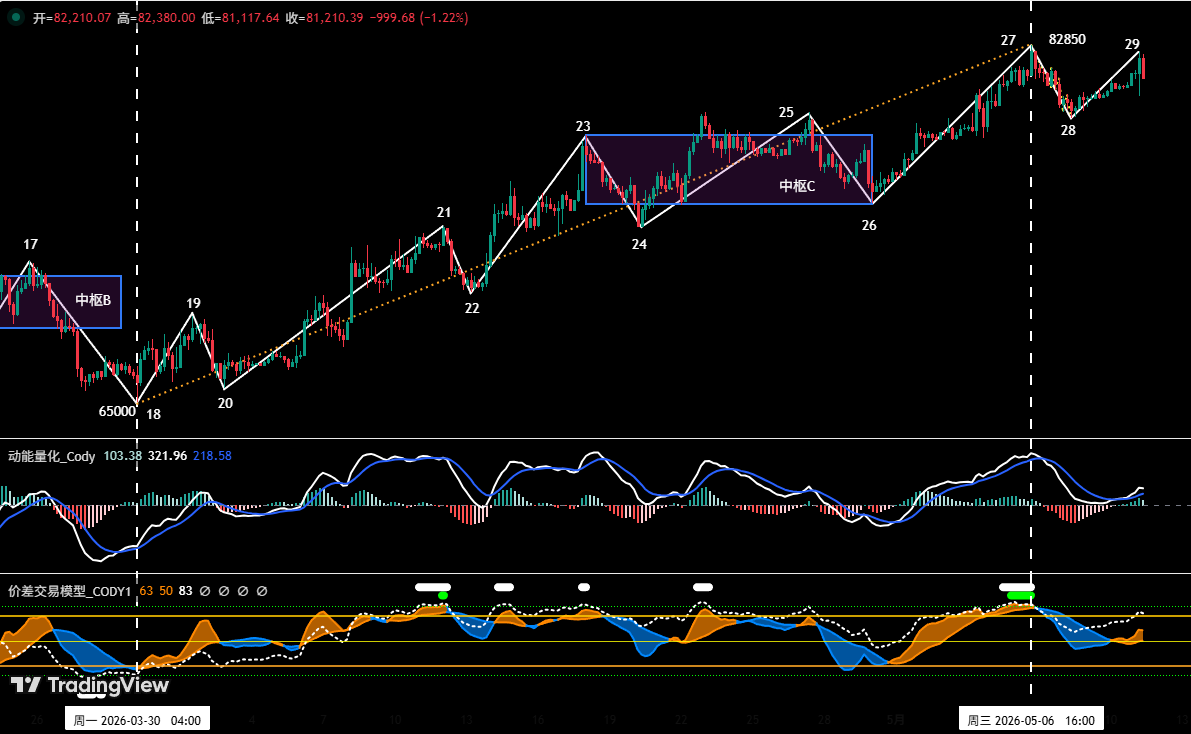
Figure 2
As shown in (Figure 2), the price is currently above the central pivot C, running in segment 28-29.
• If the price effectively holds above the resistance/support of the upper rail of pivot C (approx. $78,500), a high-level wide-range consolidation pattern will be maintained.
• If the price effectively breaks below the support of the lower rail of pivot C (approx. $75,000), a daily-level correction might be initiated.
II. Bitcoin Price Forecast and Trading Strategy for This Week
1. BTC Price Forecast for This Week:
Core View This Week: The key is to observe the battle between bulls and bears for the upper and lower rails of pivot C. The gain or loss of this area can serve as an important basis for judging whether the price can continue its recovery or turn downwards.
2. Key Resistance Levels:
• First Resistance Zone: $83,500 ~ $84,500 area (Previous high-volume consolidation zone for bulls and bears)
• Second Resistance Zone: $89,000 ~ $90,500 area (Previous consolidation platform)
3. Key Support Levels:
• First Support Level: $78,500 ~ $79,500 area (Near upper rail of pivot)
• Second Support Level: $73,500 ~ $75,000 area (Previous key support level)
• Third Support Level: $69,500 ~ $70,500 area (Previous key support level)
4. Trading Strategy for This Week (Excluding unexpected news impact)
① Medium-term Strategy:
Bitcoin Daily K-line Chart: (Position Monitoring Model)
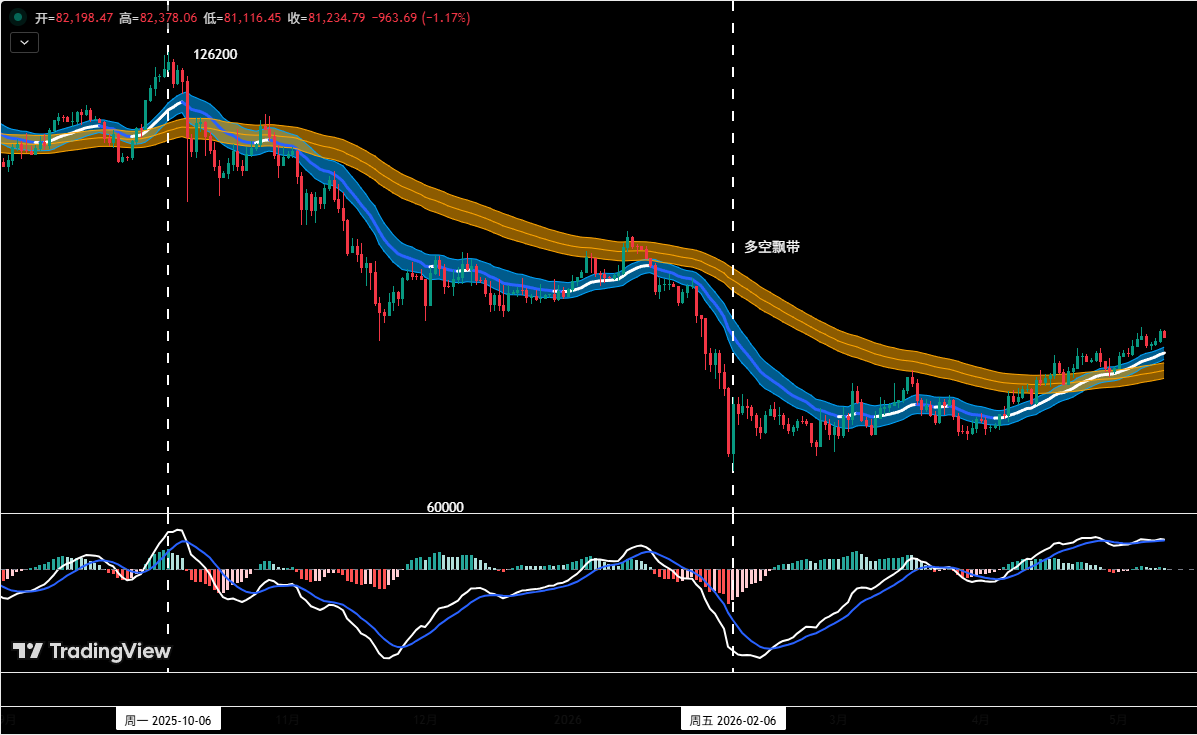
Figure 3
Position Monitoring Model: As shown in Figure 3, based on trading rules, the medium-term direction of the market is still unclear. This week, maintain a neutral stance (no position) for medium-term trades, patiently wait for a clear direction before entering, and avoid chasing rallies or selling into declines.
② Short-term Strategy: Use 30% of capital with a stop-loss, seeking "spread" opportunities based on support and resistance levels. (Using the 30-min/60-min timeframe).
③ For short-term operations, to dynamically respond to complex market evolution, we have prepared two specific action plans, A/B.
• Plan A: Effectively Hold Support, Go Long on Dips.
• Entry: When the price effectively holds above the $78,500~$79,500 area, combined with a bottom signal from quantitative models, establish a long position below 20% of capital.
• Risk Control: Initial stop-loss set below $78,500.
• Exit: When the price rallies near key resistance levels combined with model signals, gradually close the position to lock in profits.
• Plan B:Effectively Breakdown of Support, Go Short on Rallies.
• Entry: When the price effectively breaks below the $73,500~$75,000 support area combined with a top signal from quantitative models, establish a short position below 30% of capital.
• Risk Control: Initial stop-loss set above $76,500.
• Exit: When the price drops to key support levels combined with model signals, gradually close the position to lock in profits.
III. HYPE Daily Level Structure Analysis:
HYPE Daily K-line Chart
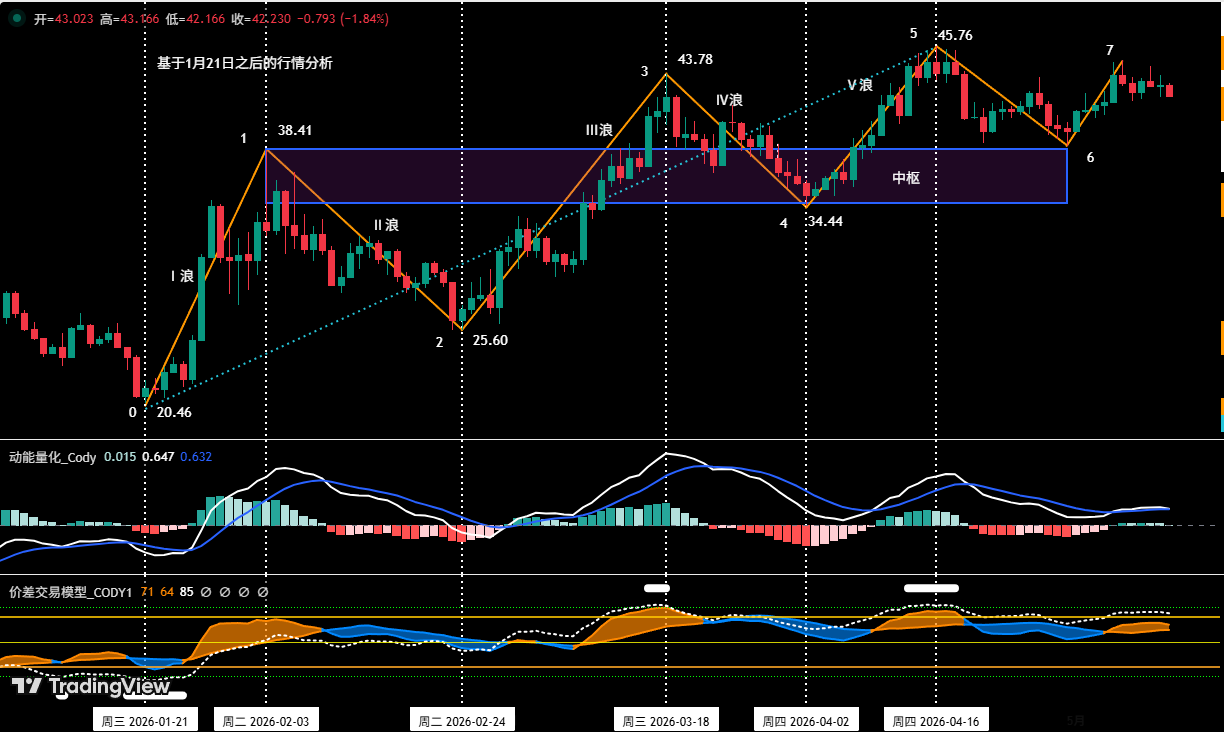
Figure 4
1. As shown in (Figure 4), the rally in HYPE from the low of $20.46 on January 21st can be divided into a seven-section structure (0-1, 1-2, 2-3, 3-4, 4-5, 5-6, 6-7) on the daily chart. In the first five sections, the price made higher highs, forming a rising structure. In the last two sections, because endpoint 7 ($44.79) is lower than endpoint 5 ($45.76), it is tentatively considered a corrective structure.
2. (Figure 4) shows that because sections 1-2, 2-3, and 3-4 overlap each other, they jointly form an "upward central pivot".
IV. HYPE Price Forecast and Short-Term Trading Strategy for This Week
1. HYPE Price Forecast for This Week:
Core Views for HYPE This Week:
• Focus on whether the price can break through the previous high of $45.76 in subsequent price action. If it does, the current structure is still within a daily-level uptrend.
• Monitor the battle between bulls and bears near the upper and lower rails of the central pivot.
2. HYPE Short-Term Trading Strategy for This Week:
• Short-term operations this week will be formulated around the gain or loss of two key price levels: the upper pivot rail ($38.41) and the lower pivot rail ($34.44).
• Long Strategy: If the price pulls back near $38.41 and finds support with a stabilization signal, combined with bottom signals from two major models, consider a small long position (position size must be below 30%) and strictly adhere to stop-loss rules.
• Short Strategy: If the price effectively breaks below the support near $34.44, combined with top signals from two major models, consider a small short position (position size must be below 30%) and strictly adhere to stop-loss rules.
V. Special Reminder:
1. Upon Entry: Immediately set the initial stop-loss.
2. When Profit Reaches 1%: Move stop-loss to entry cost (breakeven point) to protect capital.
3. When Profit Reaches 2%: Move stop-loss to a position locking in 1% profit.
4. Continuous Tracking: For every additional 1% gain in price, move the stop-loss up by 1% to dynamically protect and lock in profits.
Financial markets change rapidly; all market analysis and trading strategies require dynamic adjustment. All views, analysis models, and trading strategies mentioned in this article are derived from personal technical analysis, serve only as personal trading logs, and do not constitute investment advice or trading signals. The market carries risks; invest cautiously and do not make decisions based solely on this content.


