






MSX US Stock Daily Observation: Cybercab Officially Launched, Marking a Key Step for Tesla Toward Large-Scale Autonomous Driving, Shares Surge on the News


- Core View: Tesla's Cybercab has officially launched in Austin and opened to public operations. With its low per-vehicle cost of $25,000 and low operating cost of $0.81 per mile, combined with a third-party commercial procurement model, it is driving Tesla's autonomous driving business from technical validation into the commercialization and platformization expansion phase.
- Key Elements:
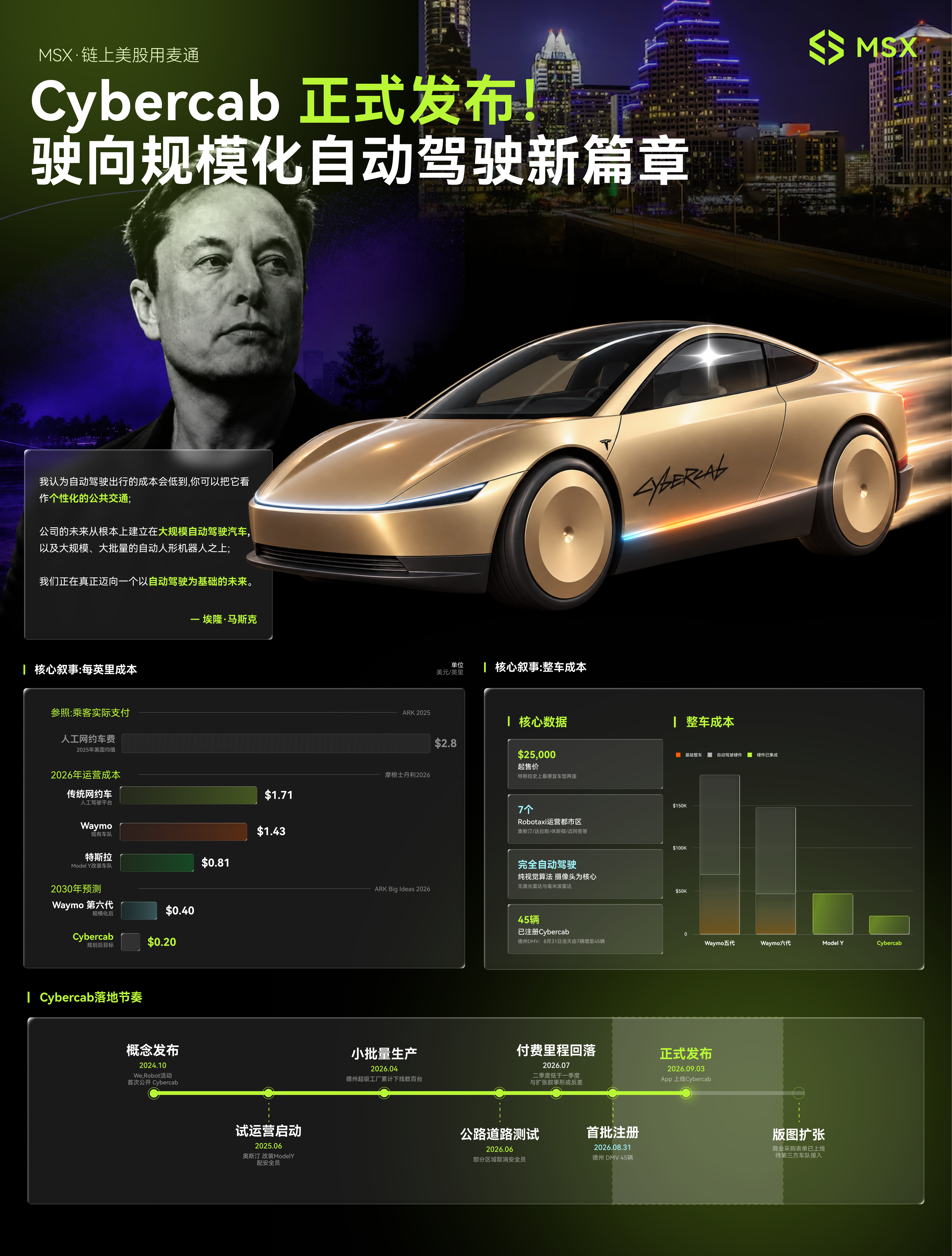
- The Cybercab went live in Austin on September 3, 2026. With no steering wheel or pedals, a two-seat layout, and a starting price of $25,000, it is Tesla's most affordable model. The Texas factory shifted to mass production in April, and registrations grew from 7 vehicles to 45 within half a month by the end of August.
- Morgan Stanley estimates per-mile operating costs as follows: Tesla at $0.81, Waymo at $1.43, and traditional ride-hailing at $1.71. In terms of per-vehicle cost, the Cybercab ($25,000) is far lower than Waymo's fifth-generation (approximately $200,000) and sixth-generation (approximately $125,000) vehicles, with the latter's autonomous driving hardware seeing a price reduction of over 50% compared to the previous generation.
- Robotaxi already covers seven metropolitan areas, with Miami, Houston, and Dallas having removed in-car safety operators. Paid mileage in Q2 stood at approximately 700,000 miles, down 36% quarter-over-quarter, attributed to the need to accumulate dedicated mileage data using Cybercabs temporarily fitted with aftermarket steering wheels.
- Tesla also launched a commercial procurement intent form on the same day, opening third-party fleet purchasing and operations, with the aim of transforming the capital-intensive Robotaxi business into a replicable "manufacturing + software + operating network" platform model.
- On the launch day, the stock rose approximately 6% intraday, suggesting that market expectations for Tesla's growth are shifting from its core manufacturing business to the new growth curve brought by autonomous driving platformization.
【MSX Research Institute · US Stock RWA Daily Observation】 is a signature daily report produced by MSX Matong, a leading RWA trading platform. Leveraging our strong macro research capabilities, we capture the core pulse of global traditional US stocks, liquidity changes, and the RWA tokenization market, helping you gain forward-looking access to high-quality assets.
Today's Observation
Tesla's Cybercab officially opened to the public in Austin on September 3, and attendees of the launch event could hail a ride that same day. The vehicle has no steering wheel, no pedals, seats only two passengers, and starts at $25,000. The real watershed isn't the car itself, but two sets of costs: according to Morgan Stanley's estimates, the per-mile operating cost for Tesla is $0.81, Waymo $1.43, and traditional ride-hailing $1.71; in terms of per-vehicle cost, Waymo's sixth-generation is approximately $125,000 and fifth-generation approximately $200,000, while the Cybercab comes in at $25,000. On the same day, Tesla also launched a commercial purchase intent form, signaling its desire for third parties to buy and operate the vehicles.
Data in a Minute
Cybercab officially launched in Austin on September 3, 2026, with the first batch of public passengers hailing rides that day, offering point-to-point pickup within a geofenced area
Starting price of $25,000, two-seat layout, no steering wheel or pedals — the most affordable vehicle in Tesla's history
The Texas Gigafactory transitioned to full production lines on April 21, 2026, having previously only produced test units; by July, several hundred units had been spotted near the factory
Texas DMV registration data shows Cybercab registrations increased from 7 to 45 vehicles on August 31
Per-mile operating costs, as estimated by Morgan Stanley: Tesla at $0.81, Waymo at $1.43, and traditional ride-hailing platforms at $1.71
Per-vehicle costs, as estimated by Morgan Stanley: Waymo's fifth-generation Jaguar I-PACE at approximately $200,000 and sixth-generation Ojai at approximately $125,000, of which the base vehicle is sourced from Zeekr at approximately $38,000, with sixth-generation autonomous driving hardware priced below $20,000 — a reduction of more than 50% compared to the previous generation
Robotaxi currently covers 7 metropolitan areas: Austin, Dallas, Houston, Miami, Tampa, Orlando, and the San Francisco Bay Area. Miami, Houston, and Dallas have already removed in-vehicle safety operators
Paid mileage in Q2 was approximately 700,000 miles, compared to approximately 1.1 million miles in Q1, a 36% quarter-over-quarter decline. Musk explained that the company first needs to accumulate model-specific mileage using Cybercabs equipped with added steering wheels and pedals; on the same day, Tesla launched a commercial purchase intent form to solicit third-party fleet purchases and operations
MSX View
Cybercab's launch in Austin signals that Tesla's autonomous driving story is shifting from "technology narrative" to "commercialization realization." A $25,000 per-vehicle cost combined with an operating cost of approximately $0.81/mile gives Tesla the opportunity to build advantages on both vehicle cost and operating cost fronts, while also providing Robotaxi with the economic foundation necessary for large-scale expansion.
The emergence of a third-party commercial purchase intent form further expands the imagination space of this story: Tesla doesn't necessarily need to buy all vehicles itself or bear the full burden of fleet assets. Instead, by exporting Cybercab, autonomous driving software, and the operations network to third parties, it can transform Robotaxi from a capital-intensive business into a replicable platform model.
From one city to ten cities, and then to more operators joining in, Cybercab is turning the scaling of autonomous driving from concept into a roadmap. On launch day, the stock price rose approximately 6% intraday. What the market is repricing may well be this new growth curve — from "building cars" to "building an autonomous driving platform."
About MSX Matong
MSX is a leading RWA trading platform dedicated to providing secure, efficient, and transparent access to global financial markets. As one of the world's earliest on-chain US stock trading platforms, MSX has always been at the forefront of the industry, leading market transformation through continuous innovation.
The platform deeply integrates blockchain technology with compliance frameworks, offering comprehensive spot and derivatives trading of nearly 400 tokenized stocks and Pre-IPO assets, perfectly bridging the gap between traditional finance and the digital asset industry.
Centered on its core mission of "enabling free flow of high-quality assets," MSX has built a diversified digital financial services ecosystem covering US stock spot and perpetual contracts, crypto-to-crypto trading, Pre-IPO, and the Matong Research Institute, designed to provide global investors with round-the-clock, high-performance access to premium assets.
Official Website: https://msx.com/
Chinese TG:https://t.me/MSXOfficial
Global TG:https://t.me/MSXGlobal
Now available simultaneously on the global App Store and Google Play.
Risk Disclaimer: The macro economy and US stock market are highly volatile. This content is provided solely for academic and research observation purposes by the Matong Research Institute and does not constitute any investment advice.


