Crypto US Stock Watch: CRCL, HOOD, COIN, and MSTR — What Are They Trading On?


- Core Thesis: The stock price drivers for three key companies (Circle, Robinhood, Strategy) at the intersection of US equities and Crypto are diverging significantly. Structural shifts in their business models and competitive landscapes are occurring, leading the market to price in different core variables for each.
- Key Factors:
- Circle's (CRCL.M) stock price anchor has returned to USDC circulation. Its profitability is highly dependent on "average USDC circulation × reserve yield." Current USDC circulation has decreased by approximately 7.4% from its March peak to $73.7 billion.
- Robinhood (HOOD.M) launched Robinhood Chain, moving upstream from a traditional brokerage to penetrate on-chain finance, threatening Coinbase’s valuation scarcity. However, Base still accounts for 62% of global adjusted stablecoin transaction volume, demonstrating significant network effects.
- Strategy (MSTR.M) broke the "buy-only, never-sell" narrative by recently selling 3,588 BTC (approximately $216 million) to pay preferred stock dividends. This marks a shift from a unidirectional financing flywheel to active capital management.
- A turning point for Circle's stock requires observing three resonance signals: recovery in DeFi activity, consecutive net issuance of USDC, and expectations that profitability won't be offset by interest rate cuts and distribution costs.
- The competition between Robinhood and Coinbase is fundamentally a battle for the "cross-asset financial gateway." The former controls traditional investors and securities assets, while the latter possesses crypto-native users and stablecoin distribution advantages.
Over the past few weeks, three noteworthy trends have emerged in the intersection of U.S. equities and Crypto.
Circle (CRCL.M) is still digesting the pressure from the decline in USDC circulation and the cooling of on-chain DeFi; Robinhood (HOOD.M) has regained market favor through its proprietary public chain, further transferring competitive pressure to Coinbase (COIN.M); Strategy (MSTR.M), meanwhile, has begun to materially sell Bitcoin, breaking the market's long-held unilateral perception that it "only buys, never sells."
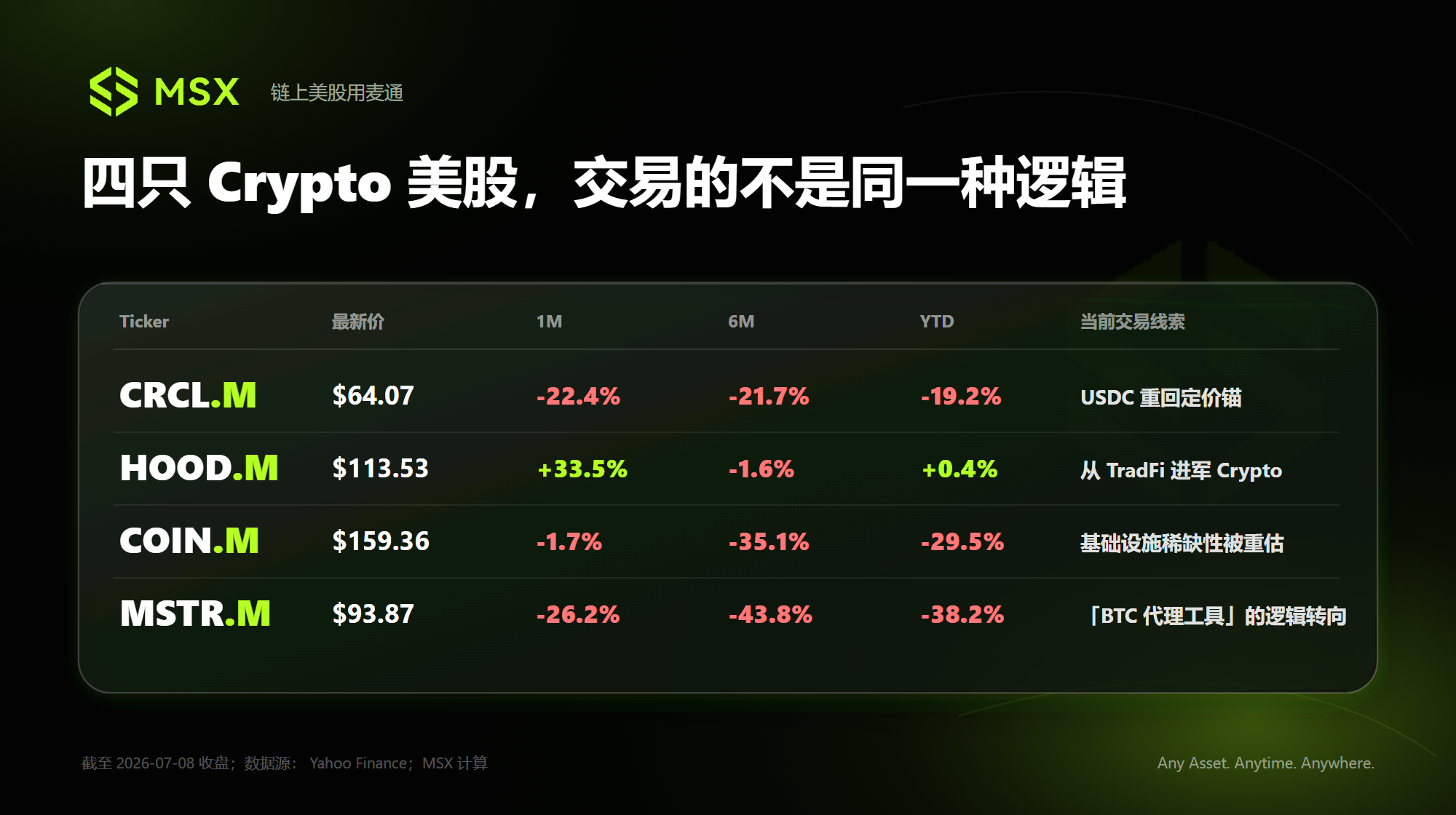
As of the close on July 8th, CRCL.M, HOOD.M, COIN.M, and MSTR.M stood at $64.07, $113.53, $159.36, and $93.87, respectively. On the surface, they all operate in the intersection of U.S. equities and Crypto, but the core variables driving their stock prices recently have started to diverge significantly:
- Circle's focus is shifting back to USDC circulation and DeFi sentiment;
- The competition between Robinhood and Coinbase is extending from trading platforms to asset issuance, user onboarding, and on-chain settlement;
- Strategy is no longer just facing Bitcoin price fluctuations, but rather a balance between mNAV, financing costs, and cash expenditures;
In other words, the market is now pricing different things for each of them.
1. Circle: Bubble Clearing, USDC Returns as CRCL's Pricing Anchor
The most noteworthy change for Circle currently is that the relationship between the CRCL.M stock price and USDC is gradually shifting from a temporary disconnect post-IPO towards a fundamental resonance.
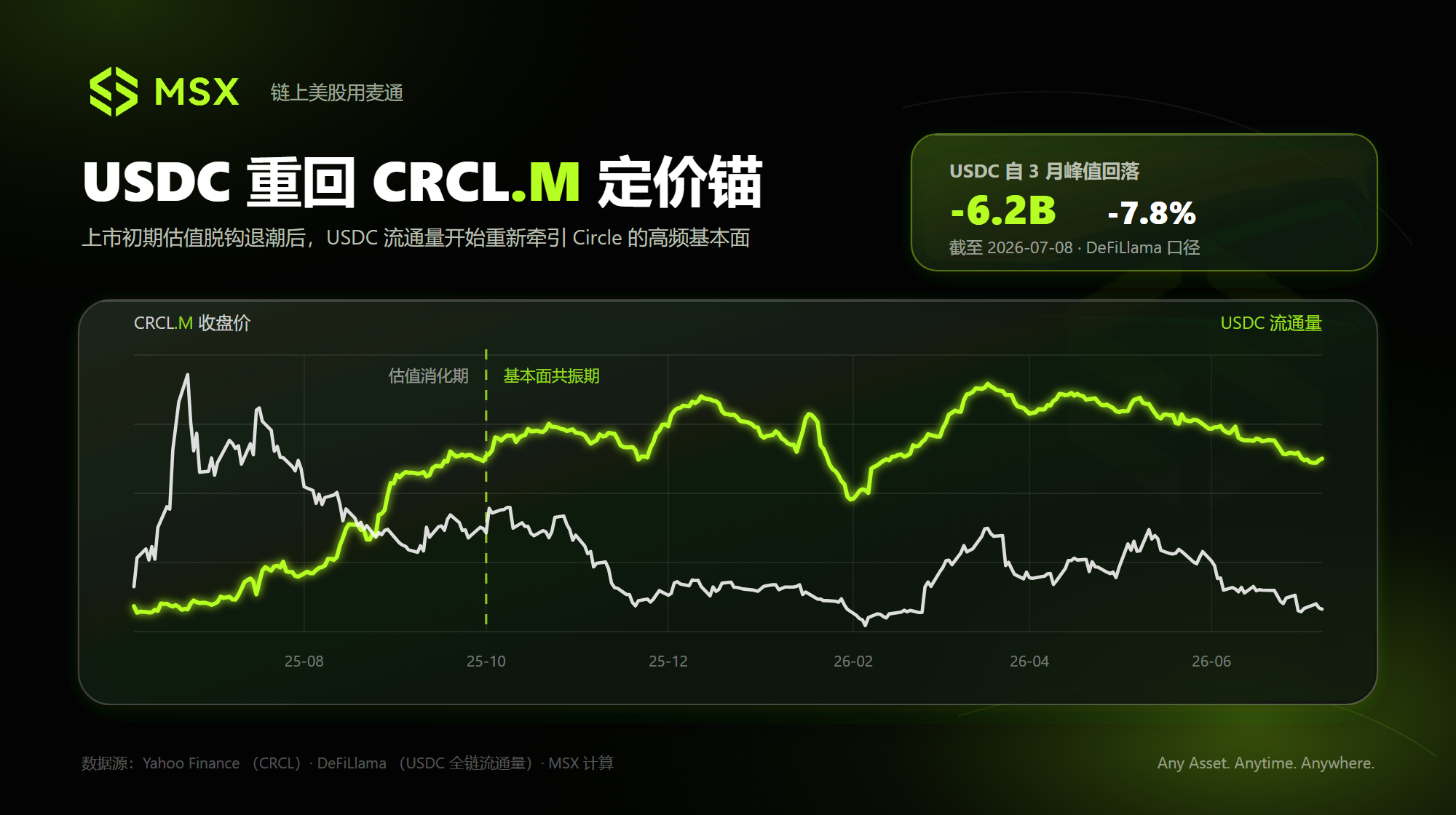
MSX Maitong mapped the comparison curve between the CRCL.M stock price and USDC circulation since Circle's IPO, revealing two distinct pricing phases.
The first phase was the valuation digestion period after Circle's listing, roughly lasting from June 2025 to the end of the year.
Back then, as the first major stablecoin issuer listed on U.S. stocks, CRCL.M saw its price driven to an all-time closing high of $263.45 by factors like scarcity, low float, and IPO sentiment, far exceeding the changes in USDC fundamentals.
Subsequently, as the low-float premium and listing sentiment gradually faded, a sustained valuation regression began. During the same period, USDC circulation was still growing, causing the two curves to move in opposite directions. This significantly dragged down the full-cycle correlation coefficient.
The second phase began around late 2025 to early 2026. The initial IPO valuation bubble cleared, and CRCL's marginal pricing started reverting closer to USDC circulation and Circle's operational data. The directional resonance between the two curves strengthened considerably:
- From late January to early February, USDC circulation rapidly declined, and CRCL hit a phase low during the same period;
- From February to mid-March, USDC resumed expansion, reaching a phase peak of approximately $79.6 billion. CRCL also experienced a significant rebound;
- After late March, USDC growth stalled and gradually turned to net contraction. CRCL subsequently re-entered a downward trend;
- By July 6, USDC circulation had fallen to about $73.7 billion, a decrease of approximately $5.9 billion or about 7.4% from the March high.
The fundamental reason behind this is that USDC is the most critical balance sheet variable in Circle's current revenue model. For instance, in Q1 2026, its reserve income reached $653 million, accounting for about 94% of total revenue and reserve income, a YoY increase of 17%.
This growth was primarily driven by a 39% YoY increase in average USDC circulation, partially offsetting the impact of a 66 basis point decline in reserve yield.
After all, Circle's other revenue during the same period was only about $42 million...
This also implies that Circle's current profit logic can still be broadly simplified to "Average USDC Circulation × Reserve Asset Yield – Distribution Costs – Operating Expenses."
Of course, reserve income is not synonymous with shareholder profit. Circle still needs to pay substantial fees to Coinbase, exchanges, and other distribution channels, but it sufficiently illustrates the sensitivity of financial results to USDC scale.
Continuing to trace this reveals that USDC circulation itself is closely tied to the risk appetite and capital demand of the Crypto market, especially DeFi. This explains why a DeFi slowdown directly impacts USDC – the vast majority of USDC demand originates from on-chain lending protocols, perpetual contracts, liquidity pools, and institutional on-chain settlements.
The common characteristic of these use cases is that capital isn't just passing through USDC briefly; it needs to reside in protocols or accounts in the form of USDC for extended periods.
Therefore, when DeFi activity rises and capital flows into lending, trading, and liquidity protocols, the demand for USDC inventory tends to increase synchronously. Conversely, when DeFi confidence is shaken, investors redeem funds, deleverage, and exit on-chain yield strategies. USDC might then be transferred back to exchanges, swapped for other stablecoins, or redeemed directly for USD.
The KelpDAO/rsETH incident in April this year was a classic stress test. In this attack, undercollateralized rsETH was used as collateral for borrowing in protocols like Aave, rapidly spreading risk through collateral pools, lending pools, and yield strategies.
Within 48 hours of the incident, total DeFi TVL dropped from approximately $99.497 billion to $86.286 billion, a decrease of about $13.21 billion or roughly 13.3%.
Aave's TVL specifically fell from about $26.4 billion to $17.9 billion, as many users attempted to withdraw stablecoins, creating sustained net outflow pressure on on-chain capital. Chronologically, this also corresponds to the point where USDC began to contract after reaching its phase peak of around $79.6 billion, while CRCL weakened again after its March rebound.
However, theoretically, the CRCL stock price is also influenced by factors like interest rate expectations, market risk appetite, earnings guidance, and valuation levels. USDC cannot explain all fluctuations, but after the IPO scarcity premium faded, it has increasingly become Circle's most important high-frequency fundamental indicator.
So, how should we judge the turning point for CRCL's stock price going forward?
From a trading perspective, seeing a single week of USDC issuance increase is insufficient to confirm a reversal in CRCL. Short-term issuances could arise from a single institution rebalancing, an exchange replenishing liquidity, or temporary settlement needs. More noteworthy is whether three groups of signals can resonate continuously:
- Is DeFi activity recovering? Focus on whether the TVL, lending demand, stablecoin deposits, and protocol revenue of core protocols like Aave/Sky, Morpho, Pendle, and Lido are recovering synchronously. Only when capital re-enters protocols generating real collateral, trading, and yield demand will sustainable USDC inventory demand form;
- Is USDC transitioning from single-week issuance increases to consecutive net issuance? Circle discloses USDC issuance, redemptions, and circulation changes weekly. Conversely, two to four consecutive weeks of net issuance are more meaningful, reducing noise from short-term capital allocation;
- Are Circle's profit expectations no longer being offset by rate cuts and distribution costs? Even if USDC growth resumes, if the Fed cuts rates rapidly, or if Circle cedes more reserve yield to compete for channels like Hyperliquid, exchanges, and others, the contribution of USDC incremental growth to shareholder profits could be lower than expected. Therefore, monitoring whether the reserve yield, distribution costs, and the profit margin on revenue after distribution costs are stabilizing is also necessary;
In a nutshell, when DeFi TVL, stablecoin lending demand, and protocol revenues begin to recover synchronously, coupled with several consecutive weeks of positive net USDC issuance, CRCL.M's fundamentals may reach an upward inflection point that can be traded.
Beyond this, Circle is also pushing for USDC to become the core quotation and settlement asset for on-chain trading platforms like Hyperliquid, while expanding the CPN cross-border payment system, the Arc public chain, and AI Agent payment infrastructure.
These deployments will determine whether Circle can gradually escape the singular valuation framework of "relying on interest margin from U.S. Treasury reserves and dependence on Coinbase/Base for distribution."
But at least in the short term, the resonance between DeFi activity and weekly net USDC issuance remains the most direct signal for judging a fundamental turning point for CRCL.
2. Robinhood Chain: Squeezing Coinbase, More Than Just Another L2
On July 1st, Robinhood officially launched the Robinhood Chain mainnet.
This is an Ethereum L2 built on Arbitrum technology, but Robinhood's goal is clearly not just to create another general-purpose public chain. Instead, it aims to gradually connect its brokerage business, stock tokens, wallet, lending, perpetual contracts, and AI trading capabilities into an on-chain issuance and settlement system under its own control.
Currently, the new generation of Robinhood stock tokens can be traded 24/7 on Robinhood Chain, enter lending pools, or be used as collateral for other DeFi trades. Its wallet also integrates with on-chain trading platforms like Uniswap and Lighter, while Robinhood Earn offers stablecoin lending services via Morpho.
The capital market responded quickly. Robinhood's stock price rose 8.35% on July 1st and closed at $113.53 on July 8th, an increase of about 13% from June 30th.
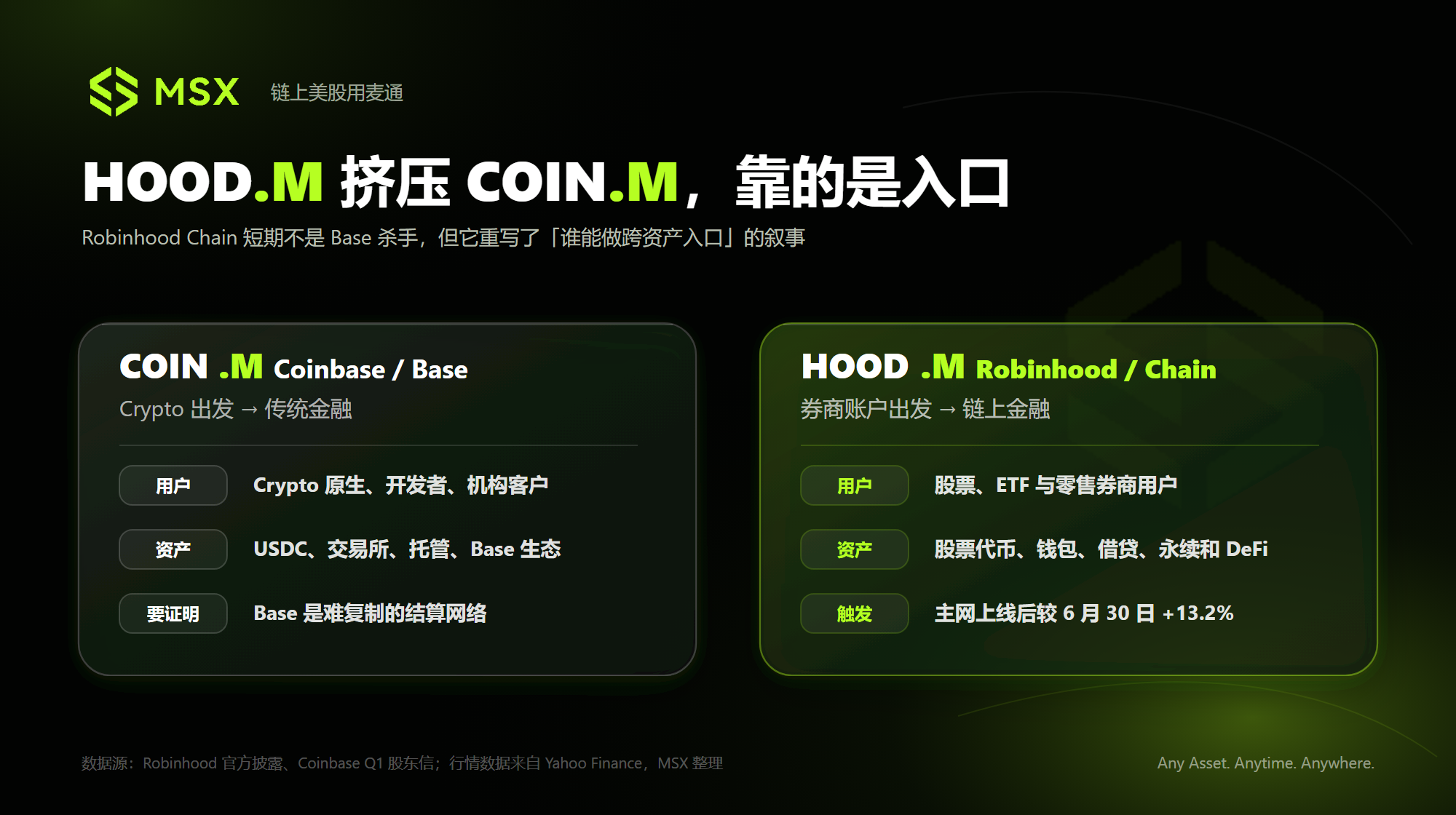
However, a closer comparison reveals that compared to Coinbase's Base, the difference between the two chains isn't primarily in underlying technology or TPS, but rather in the user and distribution entry points each controls:
- Base is closer to native crypto users, aiming to become the universal on-chain operating system for developers, stablecoin payments, and AI Agents;
- Robinhood Chain starts with traditional brokerage users, attempting to bring assets like stocks and ETFs directly into on-chain trading and DeFi;
To be fair, Robinhood Chain is hardly a "Base killer" in the short term.
According to statistics disclosed by Coinbase based on Artemis data, in Q1 2026, Base accounted for approximately 62% of global adjusted stablecoin transaction volume. During the same period, over 90% of on-chain AI Agent stablecoin transaction volume occurred on Base.
Coinbase's advantage in stablecoin distribution is also evident. In Q1, its products held an average of about $19 billion in USDC, over a quarter of total USDC circulation, and captured approximately 50% of USDC's overall economic benefits over the past year.
This means Base currently possesses not only on-chain traffic but also the network effects formed by Coinbase's exchange, custody, institutional clients, and USDC distribution. In terms of stablecoin balances, developer ecosystem, or on-chain liquidity, Robinhood Chain is currently difficult to directly challenge Base's established advantages.
But the deeper threat Robinhood poses to Coinbase isn't about taking Base's TVL in the short term.
It's more about proving that a publicly listed brokerage with tens of millions of retail users, broker-dealer licenses, and a securities asset entry point can also build its own wallet, public chain, and on-chain financial products, keeping users, assets, order flow, and fees as much as possible within its own ecosystem.
If Coinbase follows a path "starting from Crypto, expanding towards traditional finance," then Robinhood Chain represents the completely opposite direction – starting from U.S. stocks and the brokerage system, moving backwards into Crypto and on-chain finance.
From this perspective, Coinbase controls native crypto users, stablecoins, and on-chain infrastructure; Robinhood controls traditional investors, securities accounts, and stock assets. When both types of platforms ultimately evolve towards the complete system of "Account + Assets + Trading + Wallet + Public Chain," the competition is no longer just over a single chain's developers or TVL, but over who becomes the next-generation cross-asset financial gateway.
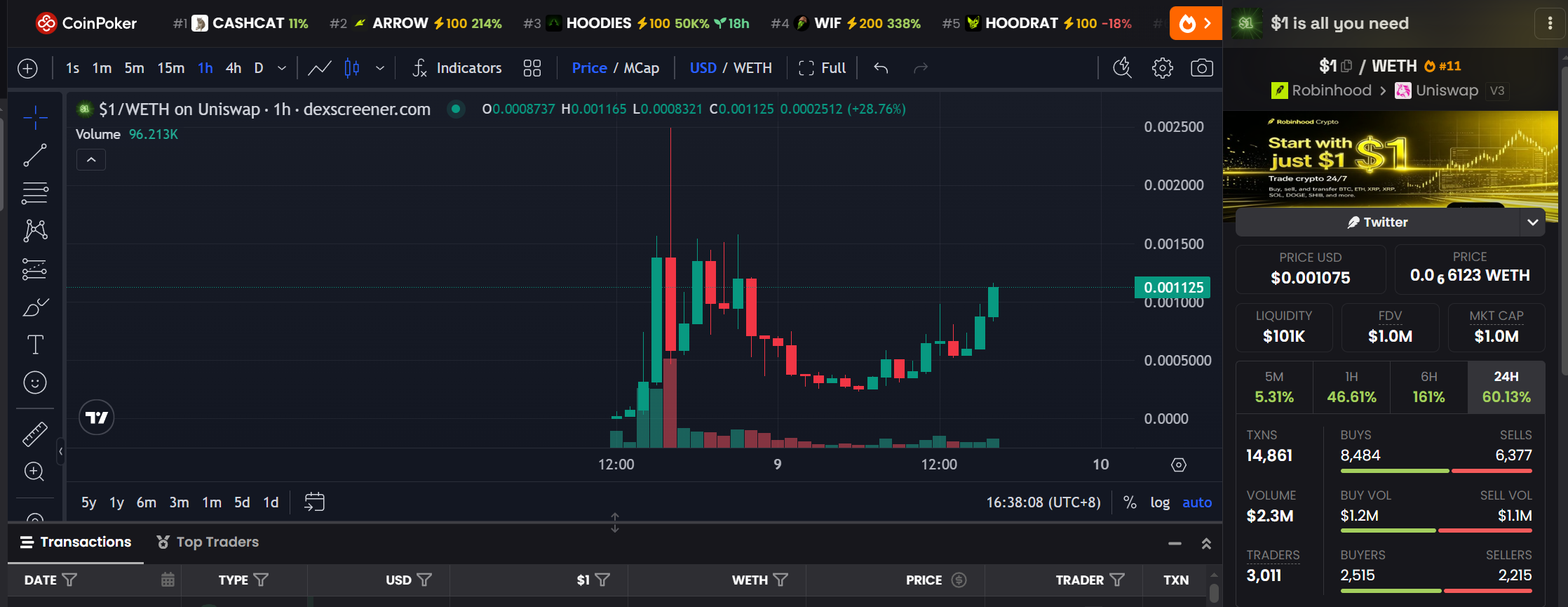
An interesting observation sample is that after the Robinhood Chain mainnet launch, it quickly witnessed a wave of meme token speculation similar to Base's early days. For instance, "$1" borrows its name from Robinhood's long-standing brand memory of "low-barrier investing" where you could buy even $1 worth of stock.
As the speculative sentiment for related tokens rapidly heated up, it even led many Robinhood users who originally traded U.S. stocks to flock and ask how to get on-chain to buy memes.
These memes naturally have no direct relationship with the stock tokens officially launched by Robinhood, but they are undoubtedly the most efficient cold-start tool for a new chain, quickly attracting native on-chain capital, traders, and developers into the new ecosystem.
From this perspective, the meme frenzy at least indicates that Robinhood Chain is capable of not only hosting traditional assets but also attracting Crypto-native capital and speculative traffic, potentially becoming the most differentiated source of incremental growth in this on-chain traffic cycle.
Of course, the business loop for Robinhood Chain is not yet fully closed. According to Robinhood's official disclosures, Robinhood Chain currently operates independently from its main brokerage and Crypto accounts. It is not yet a settlement network fully integrated with existing brokerage accounts, capital, and order systems.
But the change has already irretrievably happened.
In the past, Coinbase enjoyed a scarcity premium as the "purest Crypto infrastructure platform in the U.S. stock market." However, with Robinhood and others building their own on-chain settlement networks, this scarcity is being gradually diluted, making Coinbase no longer the only publicly-traded company capable of packaging traditional financial assets, stablecoins, trading, and a public chain together.
Therefore, the near-term impact of Robinhood Chain on Coinbase may not immediately appear in Base's TVL or Coinbase's current revenue. Instead, the more concerning factor is that COIN.M's long-term valuation narrative and infrastructure scarcity are being fundamentally reassessed.
3. Strategy's Giant Ship Turns: From "Buy, Buy, Buy" to "Starting to Sell"
Another piece of news changing market perception comes from MicroStrategy (now Strategy).
Strictly speaking, this wasn't Strategy's first time selling Bitcoin. In early June, the company sold 32 BTC, but the consecutive sales of 3,588 BTC from June 29th to July 5th held true symbolic significance from a capital management perspective:
- From June 29th to 30th, it sold 1,363 BTC at an average price of approximately $59,256, netting about $80.8 million;
- From July 1st to 5th, it sold 2,225 BTC at an average price of approximately $60,773, netting about $135.2 million;
The two transactions together raised roughly $216 million. These funds were used to pay preferred stock dividends and replenish the USD reserves consumed for this purpose. As of July 5th, Strategy still held 843,775 BTC with an average cost basis of approximately $75,476; its USD reserves remained at $2.55 billion.
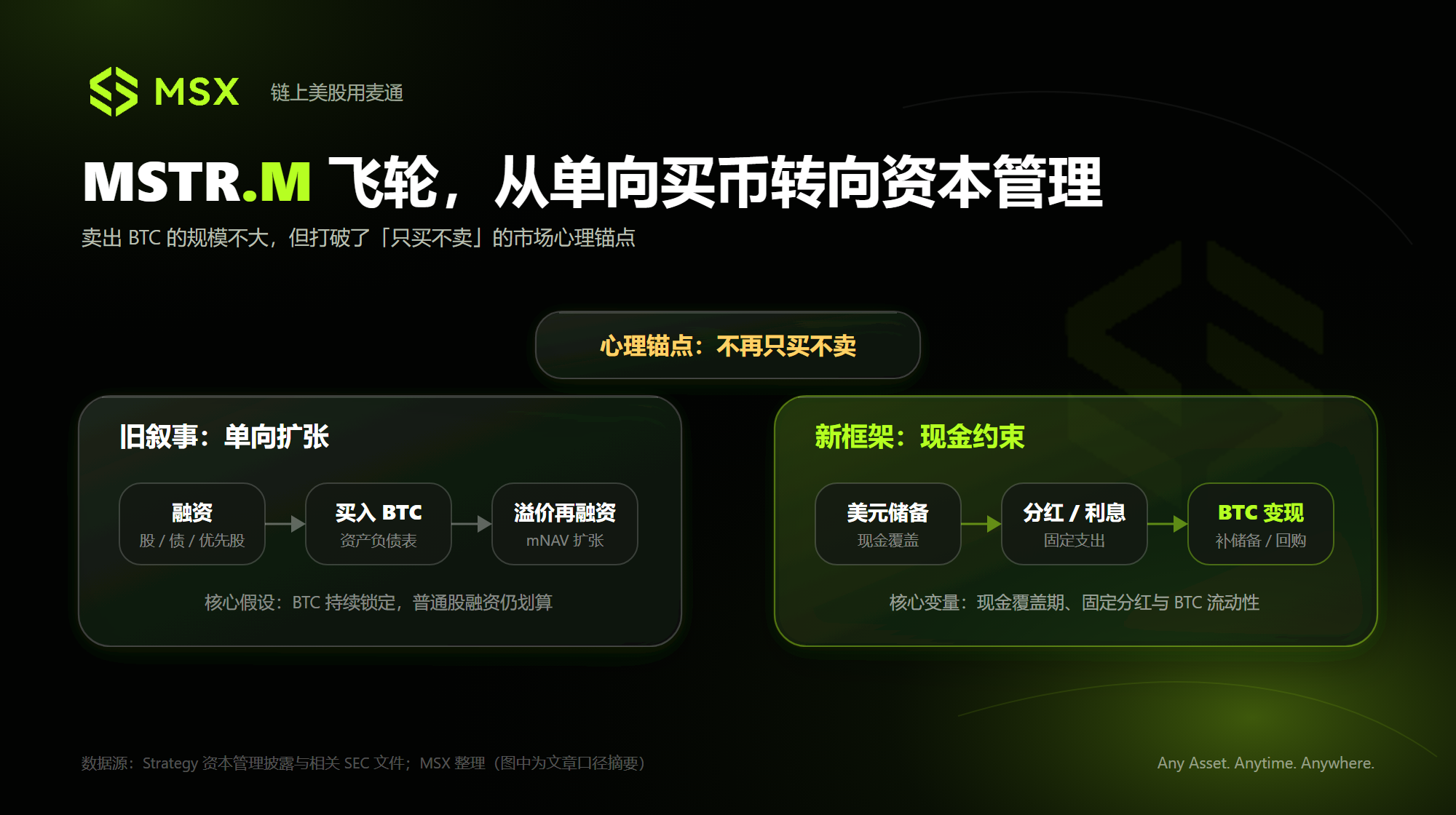
In terms of scale, this sale represents only about 0.42% of the BTC holdings before the sale. Clearly, this doesn't indicate Strategy has started systematically betting against Bitcoin. However, it broke an important psychological anchor for the market – Strategy's Bitcoin is no longer an asset permanently locked away on the balance sheet; it can be actively sold to meet the real-world costs of its capital structure.
So why now?
In the past few years, Strategy's business model could be simplified into a one-way financing flywheel: "Issue common stock, convertible notes, or preferred stock -> Raise funds to buy Bitcoin -> BTC rise boosts net asset value and stock price -> Rely on valuation premium to continue financing and buying more Bitcoin."
Therefore, the most critical variable is MSTR's premium over its Bitcoin net asset value, commonly referred to in the market as mNAV.
This also implies:
- When MSTR's mNAV is significantly above 1x, the company can issue stock at a price higher than its Bitcoin NAV. Using the proceeds to buy BTC, as long as the issuance price is high enough, this operation can increase the BTC amount per share, achieving so-called "accretion";
- But when mNAV contracts towards 1x, the effect of further issuing common stock diminishes rapidly. The financing scale obtained might no longer compensate for the dilution caused by new shares.
Ultimately, when common stock financing is no longer advantageous, the optimal direction for capital allocation might reverse, leading to actively selling BTC to supplement cash.
This is precisely the core change introduced by Strategy's new capital management framework announced