







Original title: Charts of the Week: Head In The Neoclouds
Original author: Moses Sternstein, a16z
Editor's note: Amid a new wave of compute investment driven by generative AI, discussions about AI infrastructure are shifting from "whether there are enough GPUs" to "who can provide compute in a sustainable way." As model training and inference demands alongside data center expansion become consensus, a more fundamental issue emerges: Can the rapid growth in compute demand truly translate into stable profits and cash flow?
In the "Charts of the Week" published by a16z New Media, author Moses Sternstein examines new cloud companies such as CoreWeave, Nebius, and Applied Digital, discussing the growth, valuation, and profitability contradictions in the AI compute market. He then extends the analysis to horizontal SaaS, model routing, and talent competition at frontier labs.
In this article, the author does not simply judge whether AI demand is strong. Instead, he dissects the current AI trade into a set of more fundamental structural questions: How is existing infrastructure being repriced, why isn't revenue growth improving market expectations in tandem, and why is the competitive focus in the AI industry shifting from pure expansion to efficiency and returns?
First, there is the rediscovery of infrastructure value. In the past, land along railroad lines, natural gas pipelines, and cable television networks served specific industries before being repurposed into telecommunications and internet infrastructure. Today, a similar asset revaluation is occurring again. Some new cloud companies, originally serving cryptocurrency mining, already possess operational experience in power, data center facilities, cooling systems, and high-density computing. After the surge in AI demand, these capabilities quickly transformed into scarce compute supply. The significance lies in the fact that competition in AI infrastructure isn't starting entirely from scratch; early advantages often come from the recombination of old assets, energy resources, and engineering capabilities.
Second, there's the coexistence of high revenue growth and profitability uncertainty. The early revenue growth rates of new cloud companies like CoreWeave once surpassed those of cloud giants like AWS at their inception, but capital markets haven't granted them a similar level of recognition. The reason is that new clouds aren't typical asset-light software businesses. GPU procurement, power access, data center construction, chip depreciation, and debt interest all rise in tandem with scale, sometimes even faster than revenue growth. This implies that revenue expansion only proves robust AI compute demand; it doesn't automatically demonstrate that the business model has a sufficiently high return on capital. What the market is truly waiting for is whether these companies can convert orders and revenue into sustainable free cash flow.
Third, software value is being re-differentiated based on AI impact. Previously, the market feared generative AI would broadly erode the moats of SaaS companies, but Atlassian's performance shows that AI can also be a tool to increase customer spending and product stickiness. Meanwhile, cybersecurity and observability software continue to command valuation premiums because AI expands potential risks and increases enterprise reliance on mature solutions. This means the so-called "SaaS apocalypse" won't happen uniformly. Whether AI replaces products, pressures prices, or expands demand is becoming the new standard for software valuation divergence.
Fourth, AI applications are shifting from "piling on tokens" to optimizing tokens. Previously, enterprises tended to directly call the most capable models or give engineering teams a budget to experiment on their own. Now, companies like Databricks are using intelligent routing to match different task difficulties with models of varying price and performance, reducing costs while maintaining results. A decline in the unit price of tokens doesn't necessarily mean a contraction in total AI spending: when unit costs drop and application scenarios multiply, total token consumption and overall market size can still continue to rise. Efficiency and demand aren't mutually exclusive; they may form a mutually reinforcing cycle.
If one were to compress this article into a single judgment, it would be: AI infrastructure has already proven it can generate rapid growth, but the next phase's outcome will depend on whether companies can convert that growth into higher capital efficiency. In this sense, the subject of this article isn't just whether the CoreWeaves can become the next cloud giants, but whether the entire AI industry can move from compute expansion to sustainable commercial returns.
The following is the original content:
Head in the Neoclouds
At the beginning of the 20th century, the Southern Pacific Railroad Company held numerous dormant construction rights on cleared land connecting cities and towns across the United States. The railroad's right-of-way was much wider than the tracks themselves, leaving plenty of developable corridors along the route.
So, the railroad company laid a communications network along its tracks and named it the "Southern Pacific Railroad Internal Networking Telephony." By the 1970s, the company began commercializing this network, opening it up to a broader user base.
Then, two things happened simultaneously: on one hand, the monopoly in the long-distance telephone market came to an end; on the other, fiber optic cables became commercially viable. The existing communication corridors were converted into fiber optic lines, and this network later became known by its acronym, "Sprint." Assets that once served railroads thus became the infrastructure backbone of the telecommunications revolution.
The railroad company wasn't alone in repurposing existing physical networks into larger-scale commercial technology infrastructure.
In the 1980s, the Williams Company converted idle natural gas pipelines into fiber optic conduits, founding WilTel. This company was later sold and eventually renamed WorldCom. By the 90s, the one-way coaxial cables laid for cable television underwent a massive, costly upgrade, eventually becoming the foundation for Comcast and Charter to offer broadband internet services to consumers.
This brings us to another type of company: those that also sit on ready-made infrastructure, assets now being drastically remodeled and repriced to meet the needs of an emerging technology—the "neocloud" companies.
Simply put, neocloud companies mostly originated in the energy and compute-intensive cryptocurrency mining business before the AI wave arrived. Suddenly, whoever had access to power, infrastructure, and experience in building and managing high-intensity compute loads—and in CoreWeave's case, a massive inventory of GPUs—found themselves in one of the hottest races around.
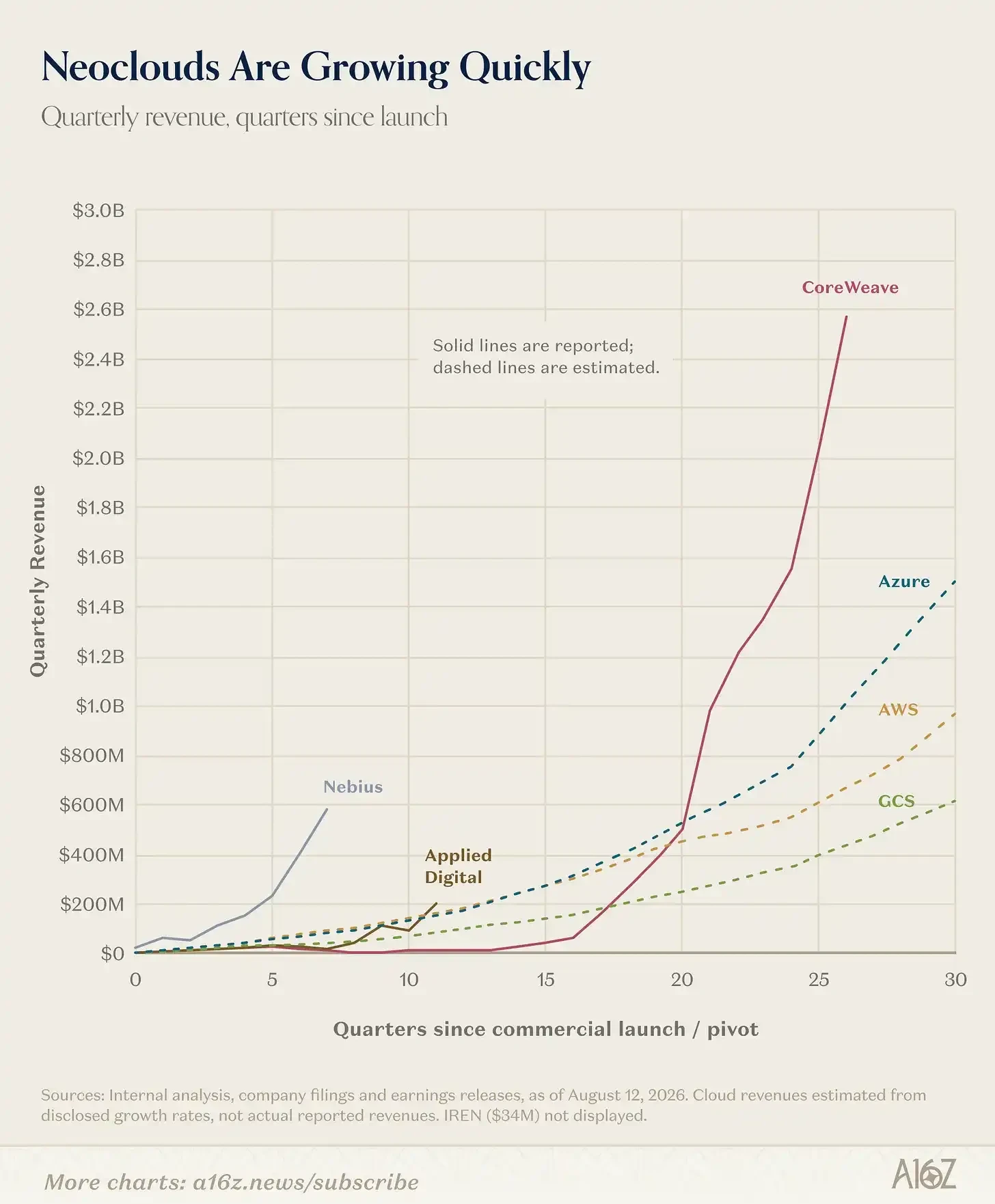
Of course, this isn't a strictly like-for-like comparison. But if you look at the three largest publicly traded neocloud companies, their revenue growth rates are indeed striking.
We can only estimate the early cloud revenue of hyperscalers, but the general trend is clear: neocloud companies are growing extremely fast, noticeably faster than the three major cloud providers did in their early stages.
It's worth noting that in the overall compute sales market, neocloud companies are still relatively small players.
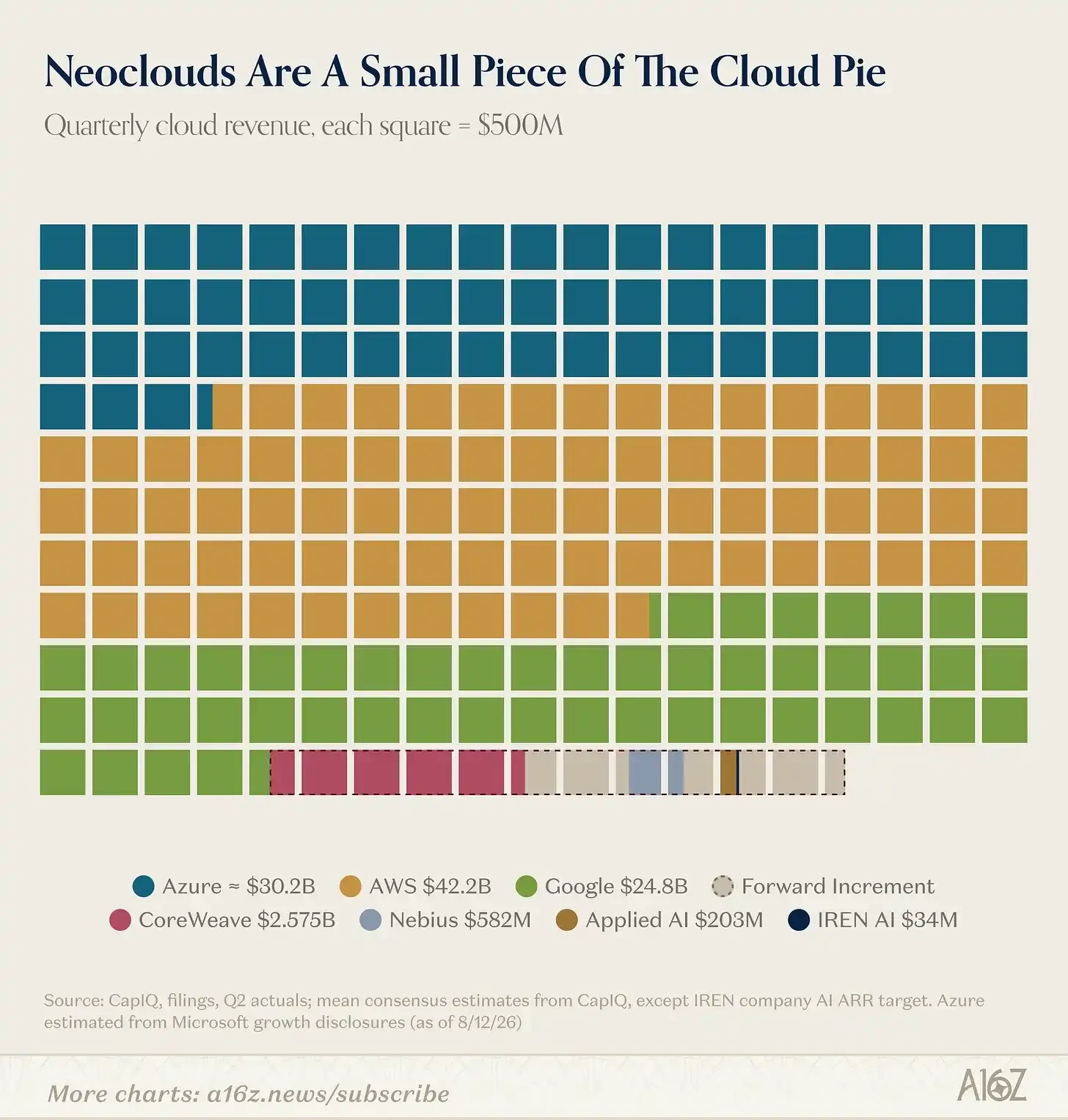
They still have a long way to go to reach the scale of the hyperscalers.

The revenue generated by hyperscalers each quarter is orders of magnitude higher than that of neocloud companies. But at the same time, CoreWeave took only about 25 quarters to reach $2.6 billion in revenue, a milestone AWS didn't hit until its 40th quarter. Again: these companies are growing very, very fast.
With such high growth rates and riding the AI industry tailwind, investors should theoretically be quite excited. To some extent, they are, but the reality is a bit more complex.
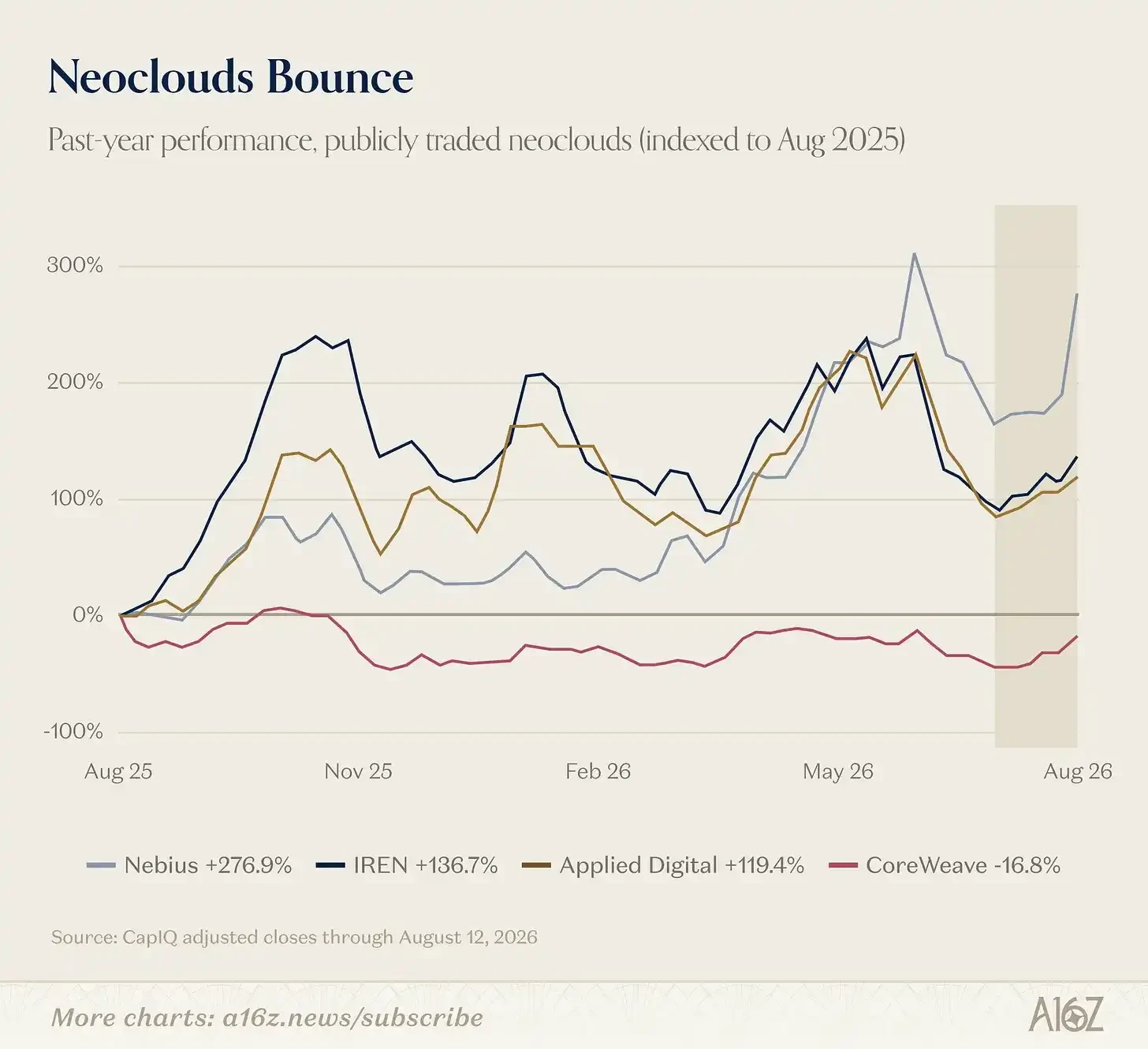
Although these companies' most recent earnings reports were generally solid, CoreWeave's stock has still fallen about 16% over the past year; only Nebius is somewhat closer to its previous highs.
So, the story is still largely positive, but for the largest neocloud company, the appeal is clearly somewhat weaker.
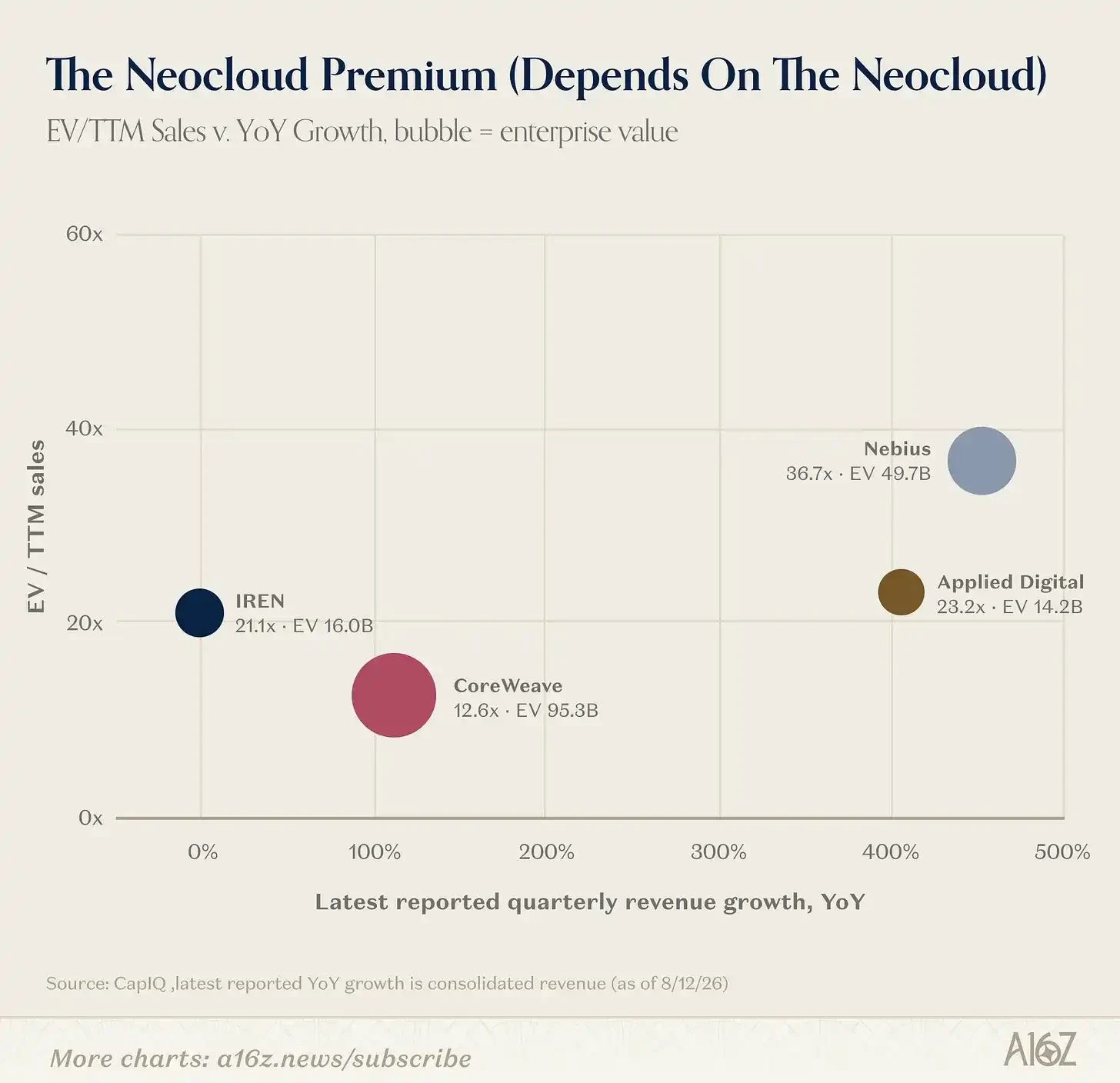
The relatively muted recent market performance is partly because many growth expectations may already be reflected in valuations.
For capital-intensive businesses like neoclouds, price-to-sales ratio isn't the most suitable valuation metric, but it's still intuitive for illustration. The smaller, faster-growing Nebius and Applied Digital command much higher valuation premiums than the much larger CoreWeave. CoreWeave's revenue is still doubling, but it can't match the 400% to 450% growth rates of the top names.
If there's a real problem for neocloud companies, it's not growth, but long-term profitability. Neocloud companies need continuous investment in chips, power, and physical infrastructure to scale, and none of these costs are cheap:
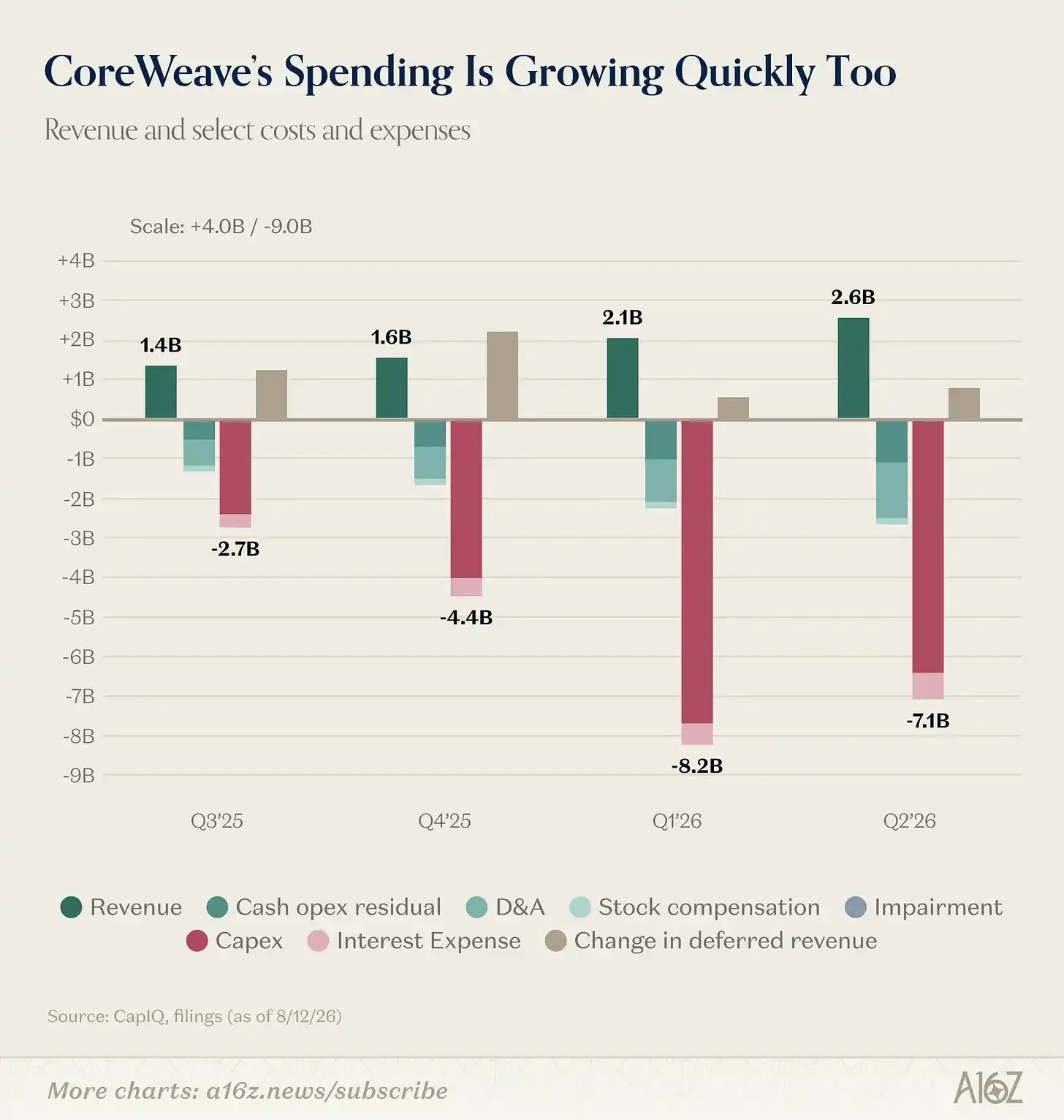
Take CoreWeave as an example. Its revenue growth is indeed impressive, but its capital expenditures are even more staggering. Other massive costs include chip depreciation—which already exceeds half of revenue—and rising interest expenses from debt taken on to build expensive infrastructure ahead of demand.
This article isn't intended to make a judgment on whether neocloud companies will ultimately succeed or whether their current stock prices are justified. Aside from the topic's inherent buzz, the real point here is that neocloud companies perfectly epitomize the bull-bear tug-of-war within the entire AI trade.
On one hand, they operate in a vertical market—compute—that is far larger than anyone previously expected and still expanding, achieving growth rates rarely seen in history. On the other hand, the costs of building such companies are also at historic highs, requiring massive, continuously depreciating fixed infrastructure.
Horizontal SaaS Resurgence?
Here's a brief update on the ever-shifting landscape of the "SaaS apocalypse." One company that was hit hardest in the previous software sell-off has performed quite well over the past month.
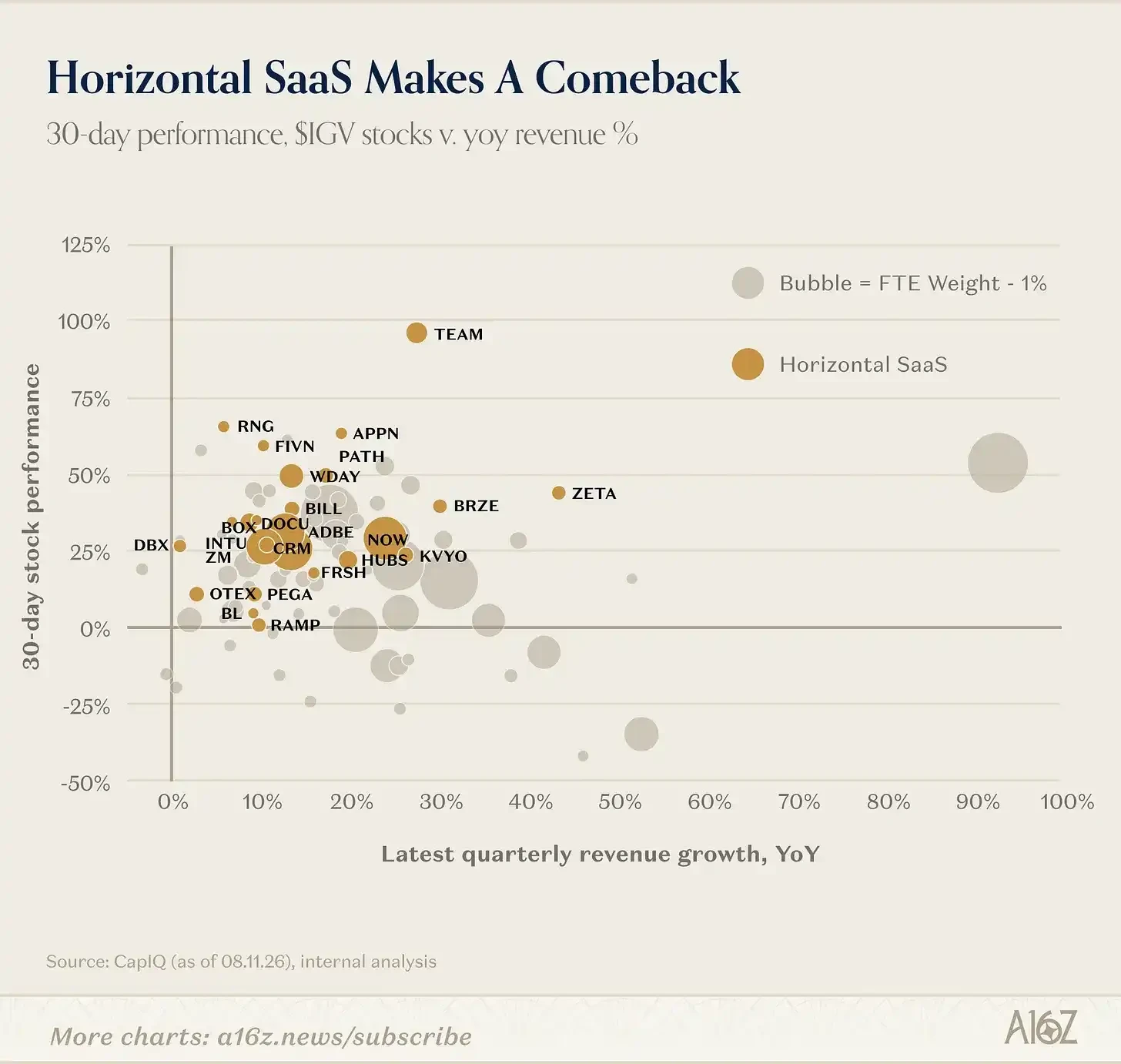
Over the past 30 trading days, horizontal software companies have been among the top performers in the IGV software ETF—although they've given back some of those gains since this data was collected.
Overall, the fundamentals of these companies remain solid. Atlassian, in particular, hasn't succumbed to the AI disruption as the market previously expected.
The productivity software company delivered a "double beat" on earnings and guidance: cloud revenue grew 31% year-over-year, and its backlog of revenue grew even faster. But perhaps the more critical signal is that AI is becoming a growth driver, not a headwind. Atlassian stated that its AI assistant Rovo has seen widespread adoption; meanwhile, customers using Rovo are spending at nearly twice the growth rate of non-Rovo users.
This is good news for Atlassian, good news for Rovo, and good news for horizontal SaaS.
However, the overall valuation of horizontal SaaS still lags slightly behind other software categories.
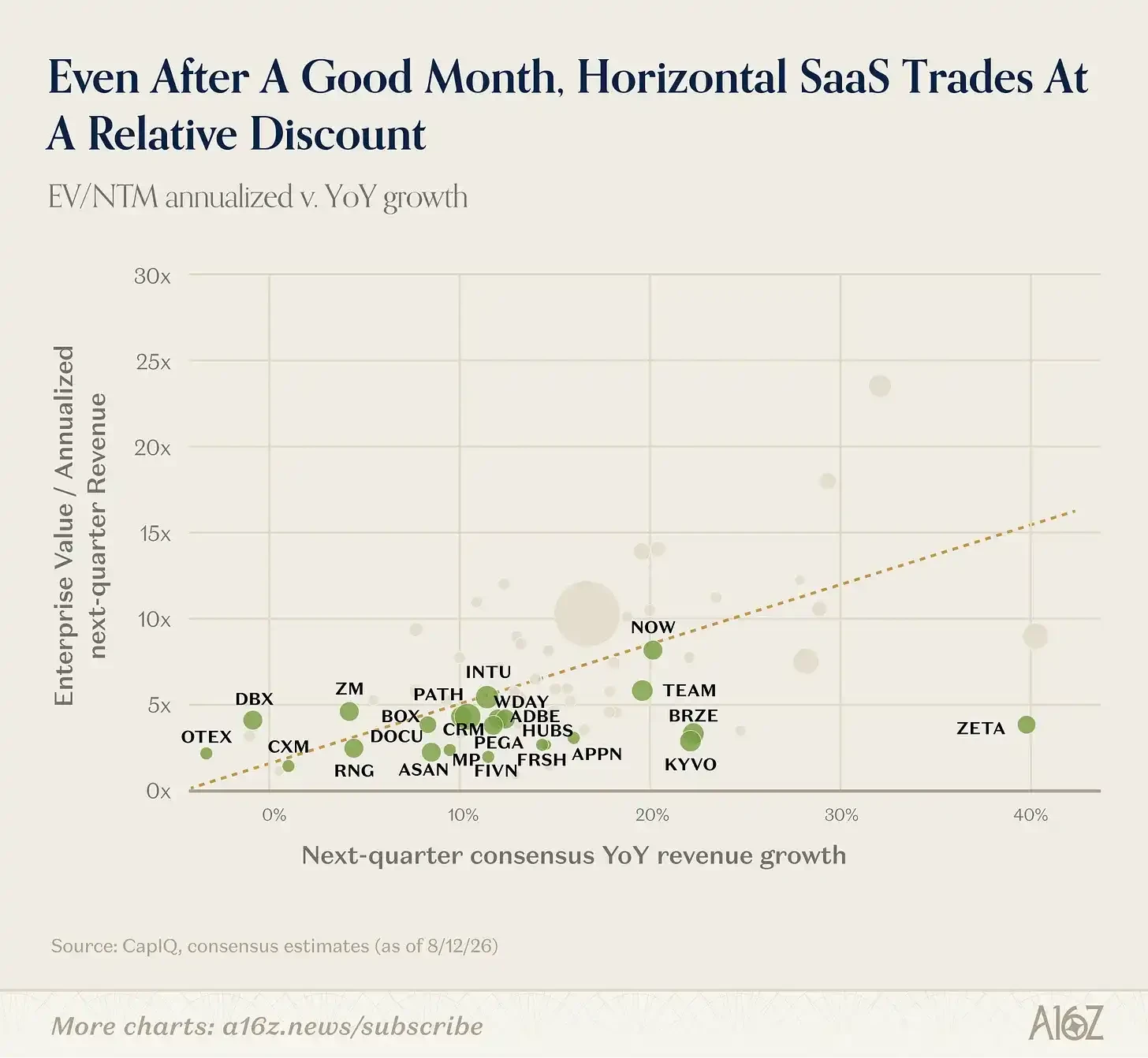
With few exceptions, horizontal SaaS companies, including Atlassian, generally trade below the levels implied by the "growth-valuation multiple" trend line.
Again, horizontal SaaS has only had a relatively good "month." One month's performance isn't nearly enough to convince the market that the "SaaS apocalypse" has been called off.
Of course, if your software business is in cybersecurity or observability, that's a different story—for these companies, the so-called "SaaS apocalypse" never happened.
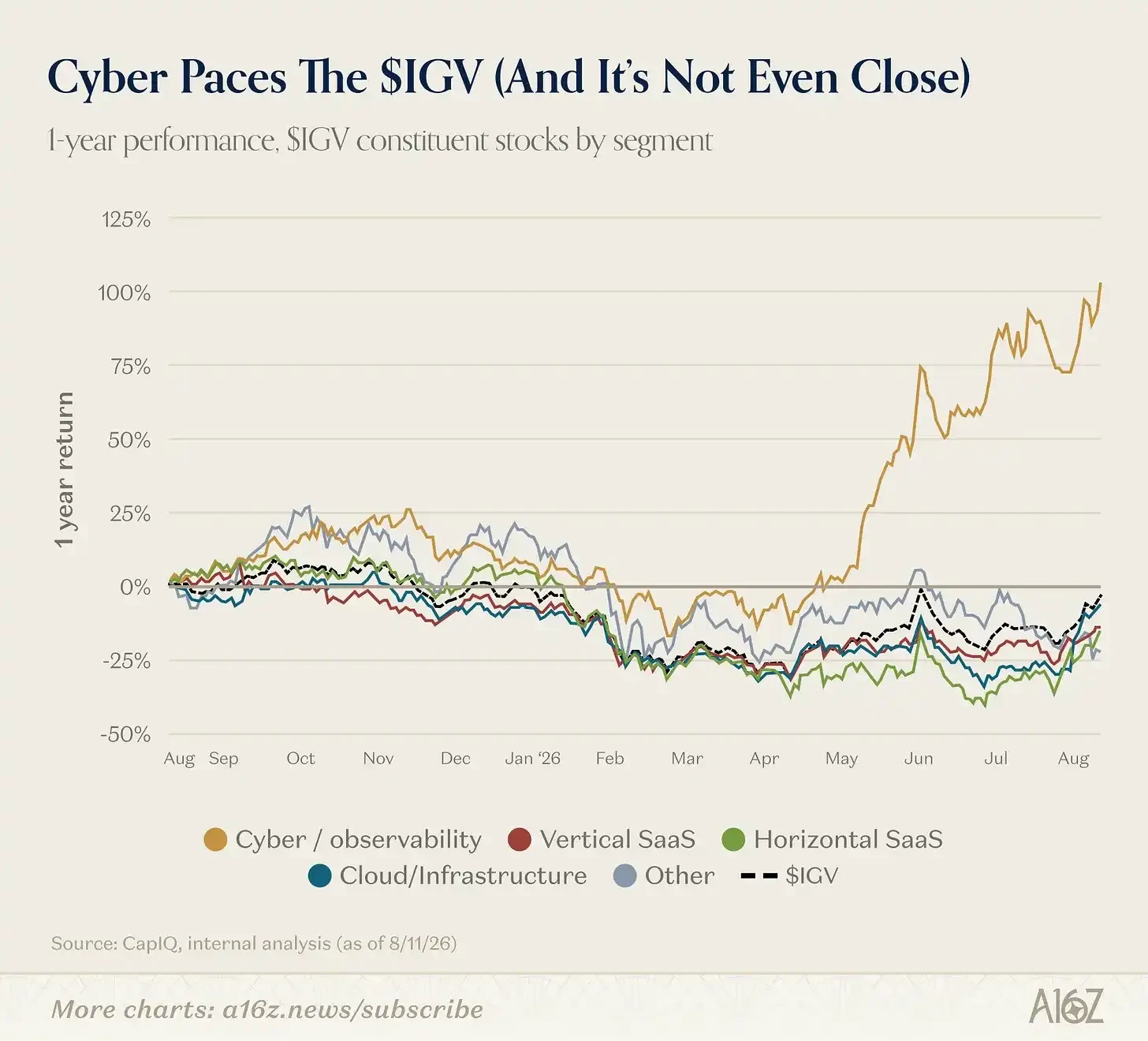
The cybersecurity sector continues to significantly outperform other categories in the IGV software ETF. In this space, AI has actually become a tailwind: there's a broad perception that AI raises awareness of cybersecurity threats, and no enterprise customer is going to cobble together its own security solution through "vibe coding."
Whether this logic ultimately holds up, of course, remains to be seen. But at least for now, the situation for traditional software companies is far from uniform.
Investors are highly focused on whether AI will be accretive or erosive for each company, constantly revising their views with each new batch of data—and rightly so.
Toward the Efficiency Frontier of Token Spending
The market landscape around model usage, token consumption, and token spend management continues to evolve in various interesting ways.
Take Databricks, for example.
Instead of taking a winner-take-all approach to questions like "Which model should we use?" or "Which model is the best?" and instead of just giving engineers a budget to spend as they see fit, Databricks asked a different question: "What if we developed a system to automatically route the right tasks to the right models?"
Databricks isn't the only company doing this, but it has developed a "Smart Router," and the results have left it quite pleased.
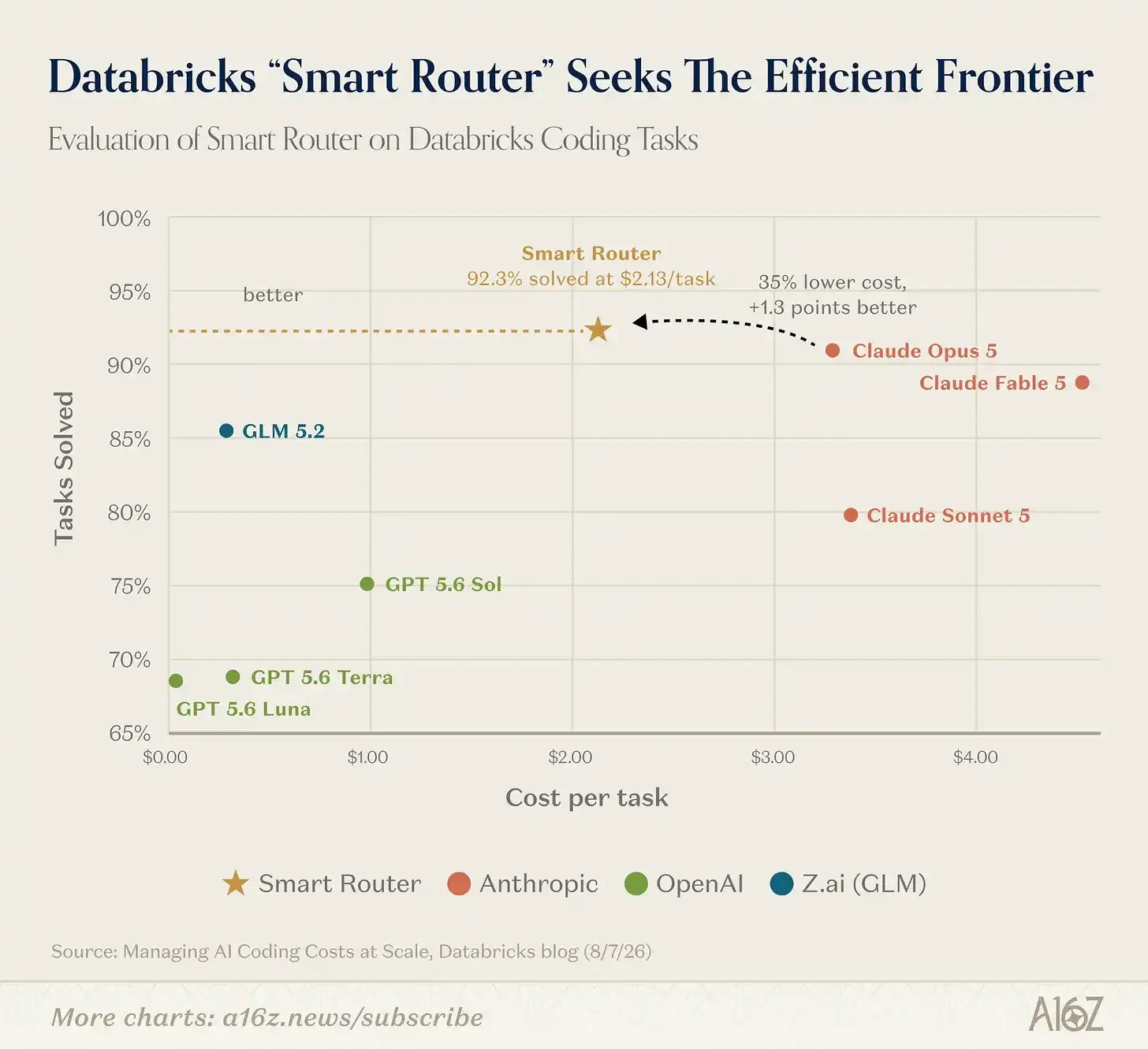
Reportedly, Databricks' router can call upon more capable, higher-priced models when necessary and use weaker, cheaper models when conditions allow, thereby "consistently reducing average task costs by more than 30%."
Overall, pursuing the "efficiency frontier" for token spend is hardly a bad thing. It means demand is still growing, and use cases are expanding not only at the cutting edge of performance but also toward less capable models. In the initial bearish narrative, these less-than-best models were expected to be quickly phased out.
As we've mentioned before, efficiency gains expand the reach of demand—a Jevons paradox-like dynamic that the market wants to see.
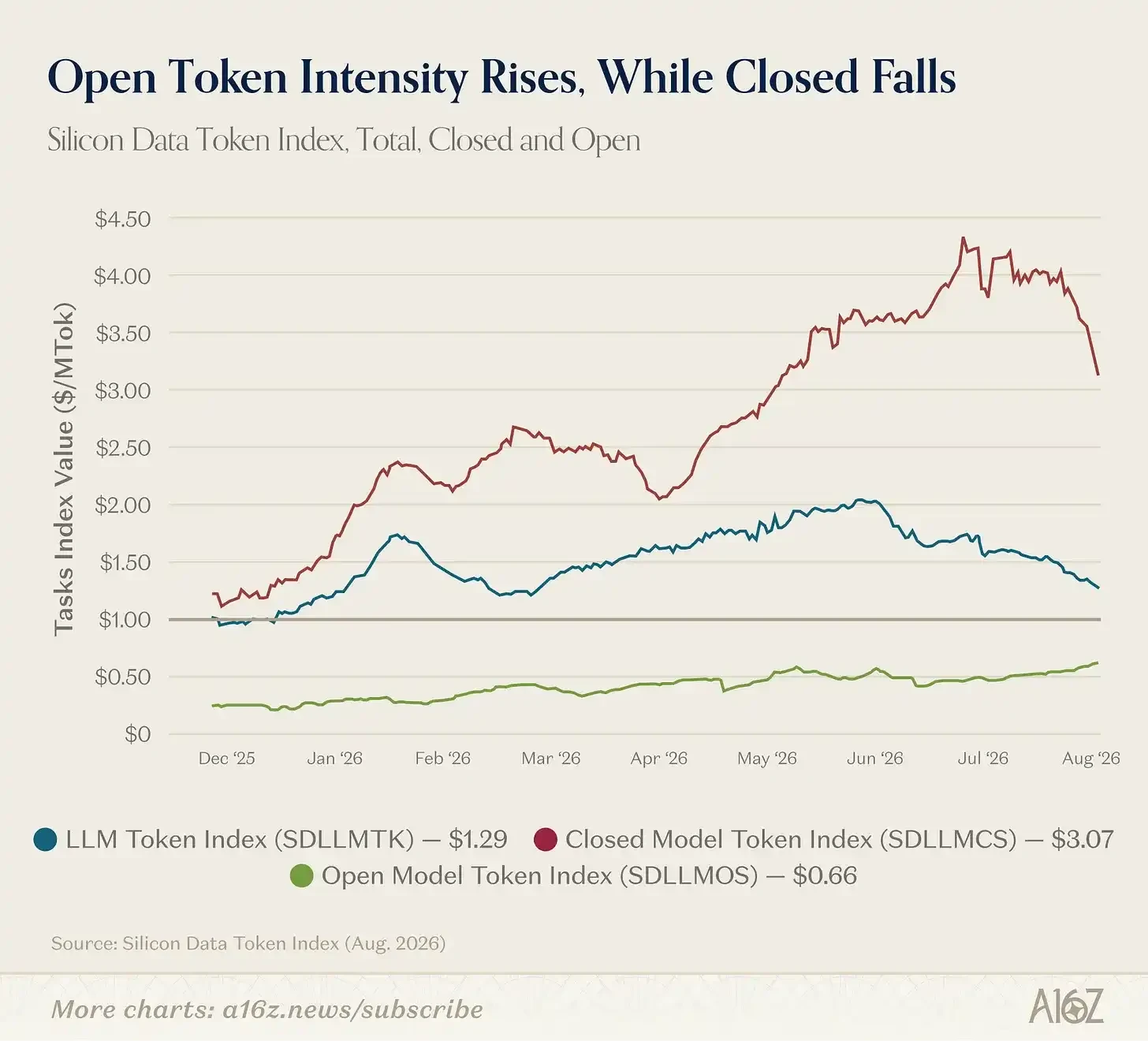
Silicon Data's Token Price Intensity Index shows that overall price intensity is declining, especially as lower-priced open models capture a larger share of an expanding market.
It's worth clarifying again a frequently misunderstood concept: these indices measure the cost intensity of token spending, not the absolute dollar amount. It depends on both the number of tokens consumed and their blended cost. This means that even if the price per token falls, total token consumption and total spend can still continue to rise.
What truly matters is that overall demand continues to grow, and pricing and model selection moving toward the efficiency frontier only further fuels that growth. It's especially worth noting that "AI demand" or "AI adoption" isn't a single, monolithic concept. There remains a huge gap between heavy users and everyone else. This clearly shows that "always using the best model" might work for some enterprises, but it certainly doesn't work for all.
The market is now rapidly forming more alternative options. Overall, this is a good thing.
According to data from Ramp, an enterprise spend management platform, all companies are increasing their AI spending, but the gap between the median spender and the top 10%, as well as between the top 10% and the top 1%, is extremely wide.
Ramp's data tends to skew toward tech companies, and that should be considered when interpreting it. But the data shows that companies in the top 10% of spenders allocate roughly 50 times more per capita on AI than the median company.
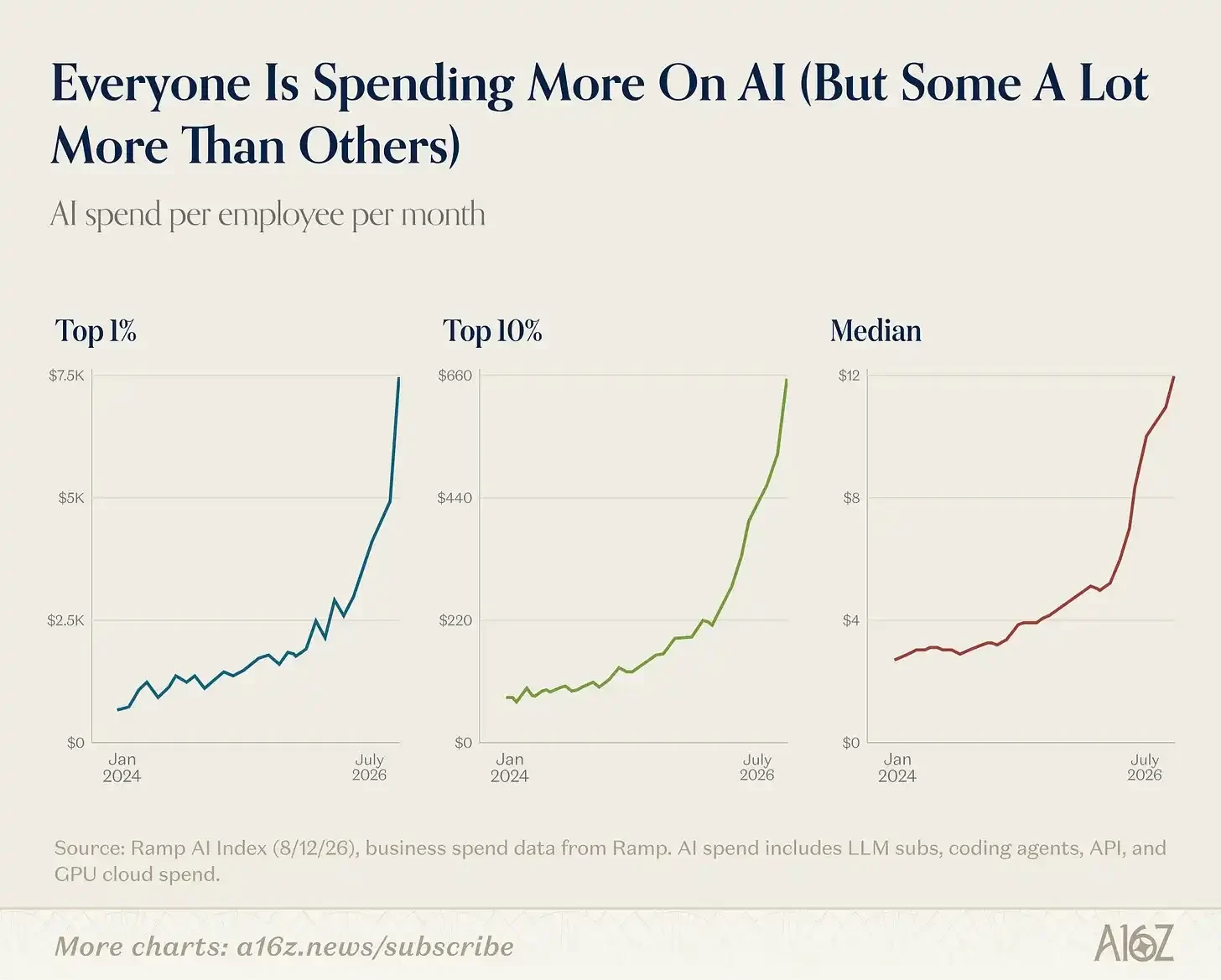
This distribution is likely no accident. Companies that can unlock more value from AI spending are probably the very ones investing the most—even if not every company fits this pattern, a significant portion certainly does.
A Boston Consulting Group analysis of 107 public companies found that companies in the top two quintiles for token usage saw noticeably faster revenue growth than others.
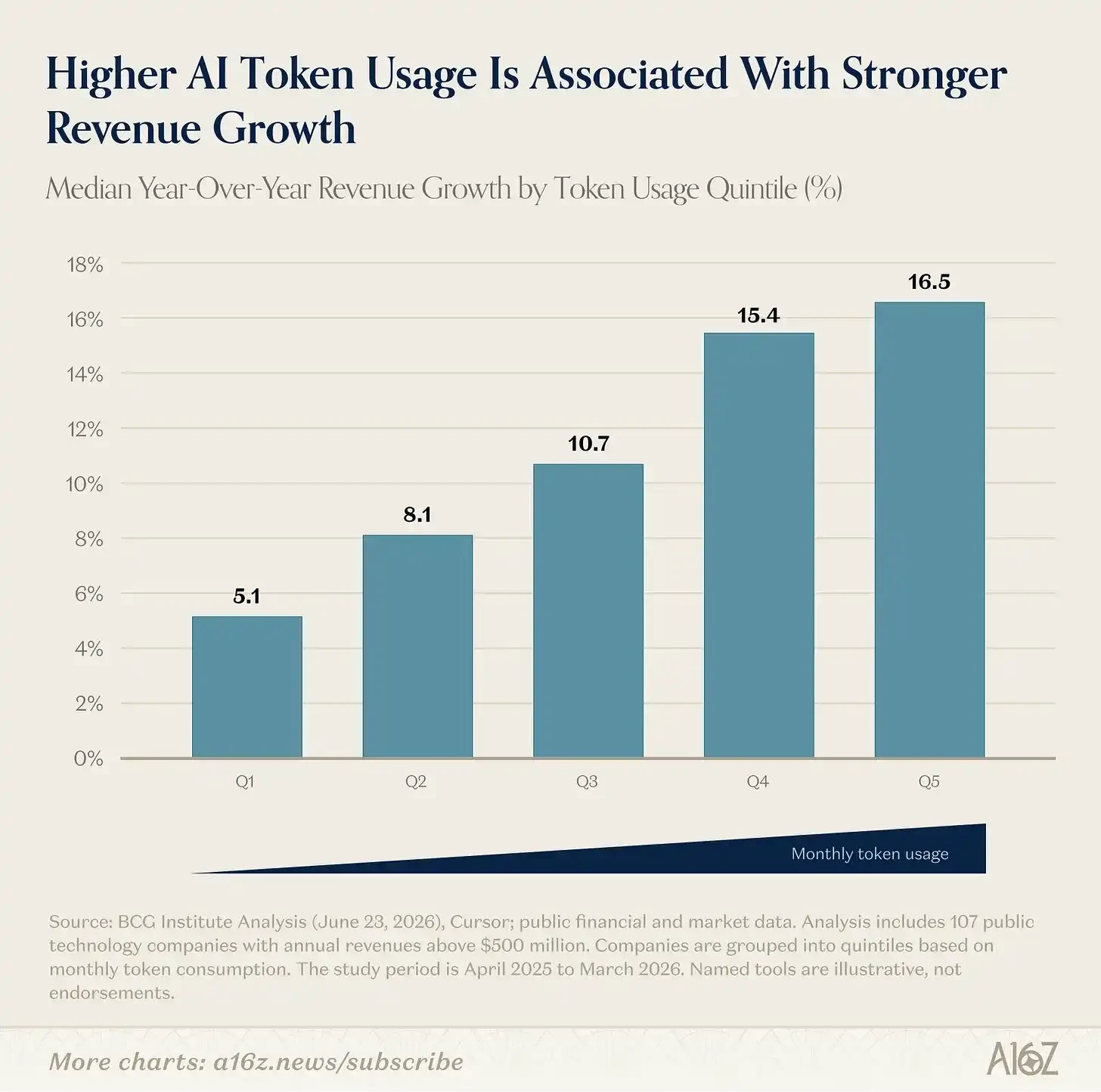
The core point here is that token demand and usage efficiency are mutually reinforcing: the more value companies derive, the more tokens they consume.
Of course, there's a constant trade-off between investment and return, and R&D always involves some upfront costs. But for the vast majority of enterprises, recklessly "piling on tokens" was never an effective strategy.
Therefore, the fact that companies will increasingly not need to resort to such practices is clearly a good thing.
The Frontier Lab Talent War
New Media recently had two outstanding team members join OpenAI, so we'll close with a few interesting charts on talent acquisition at frontier AI labs.
Dario Amodei recently said he worries employees are putting money above mission. Based on data from Levels.fyi, this concern might not be unfounded.
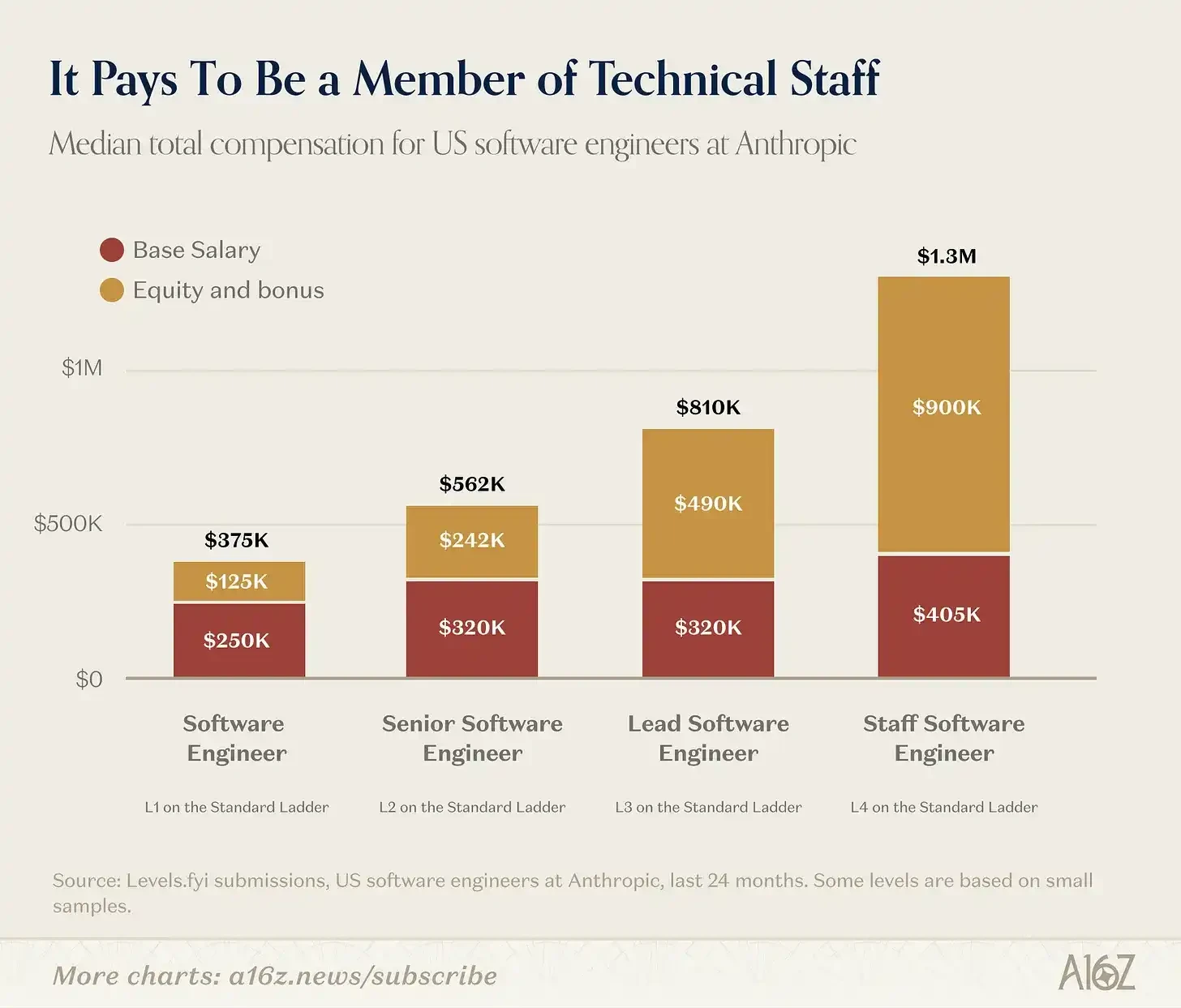

Taking


