






Securitize เผยผลประกอบการฉบับแรกหลังเข้าตลาดหุ้นไม่สวย “โทเค็นไนซ์สินทรัพย์แบบ合规” ขายไม่ออกจริงหรือ?


- มุมมองหลัก: ผลประกอบการฉบับแรกหลังเข้าตลาดหุ้นของบริษัทโทเค็นไนซ์ Securitize ออกมาไม่ดีนัก รายได้หดตัวและขาดทุนขยายตัว ส่งผลให้ราคาหุ้นร่วงลงอย่างหนัก แม้มูลค่าสินทรัพย์ภายใต้การจัดการแบบโทเค็นไนซ์จะทำสถิติ新高 แต่ธุรกิจหุ้นโทเค็นไนซ์ยังไม่ได้เริ่มต้นจริงๆ ตลาดจึงตั้งคำถามอย่างจริงจังต่อความสามารถในการสร้างรายได้เชิงพาณิชย์ภายใต้กลยุทธ์ที่ให้ความสำคัญกับ compliance
- ปัจจัยสำคัญ:
- รายได้Q2ของSecuritizeอยู่ที่14.43ล้านดอลลาร์สหรัฐ ลดลง5%เมื่อเทียบรายปี และลดลง26%เมื่อเทียบรายไตรมาส ต่ำกว่าที่คาดการณ์ไว้ที่20.6ล้านดอลลาร์สหรัฐ ขาดทุนสุทธิ21.68ล้านดอลลาร์สหรัฐ ขาดทุนต่อหุ้นสูงกว่าที่ตลาดคาดการณ์มาก ราคาหุ้นหลังตลาดปิดร่วงลงเกิน20%
- มูลค่าสินทรัพย์ภายใต้การจัดการแบบโทเค็นไนซ์ทำสถิติ新高ที่4.3พันล้านดอลลาร์สหรัฐ เพิ่มขึ้น9%เมื่อเทียบรายปี ปริมาณการซื้อขายบนแพลตฟอร์มเพิ่มขึ้น147%เมื่อเทียบรายปีเป็น5.3พันล้านดอลลาร์สหรัฐ แต่สินทรัพย์ภายใต้การดูแลรวม (AUA) ที่24.3พันล้านดอลลาร์สหรัฐลดลงประมาณ20% สะท้อนว่าธุรกิจดั้งเดิมหดตัว
- ปริมาณการซื้อขายพุ่งสูงแต่รายได้ลดลง ชี้ให้เห็นว่าแพลตฟอร์มอาจบีบอัดค่าธรรมเนียมการซื้อขายหรือรูปแบบธุรกิจไม่ชัดเจน ไม่สามารถดึงมูลค่าจากการใช้งานได้อย่างมีประสิทธิภาพ นี่คือสาเหตุหลักที่ราคาหุ้นร่วงลง
- Securitizeยังคงเดินหน้าขยายโครงสร้าง compliance: ร่วมมือกับComputershareและContinentalพัฒนาตลาดหุ้นโทเค็นไนซ์ ได้รับอนุมัติการดูแลจากFINRA บริษัทย่อยได้รับ資格เป็นที่ปรึกษาการลงทุนจดทะเบียนกับSEC และรวมธุรกิจภายใต้การกำกับดูแลสี่ประเภทเข้าด้วยกัน
- SECZเป็นหุ้นโทเค็นไนซ์เพียงตัวเดียวที่เปิดตัวแล้ว มูลค่าตลาดบนเชน2.6พันล้านดอลลาร์สหรัฐมาจากการมีส่วนร่วมของผู้ถือหุ้นครั้งเดียว而非การซื้อจากนักลงทุนระดับรอง ข้อมูลอาจสร้างความเข้าใจผิด ธุรกิจหุ้นโทเค็นไนซ์ที่แท้จริงยังไม่ได้เริ่มดำเนินการจริง
Original | Odaily Planet Daily (@OdailyChina)
Author|Golem (@web 3_golem)
After the U.S. stock market closed on August 12, tokenization company Securitize released its Q2 2026 earnings report, marking its first financial results since going public in July. However, the report was far from impressive. Following the announcement, Securitize (SECZ) saw its after-hours share price drop by more than 20%.
According to the Q2 report, Securitize recorded revenue of $14.43 million in the second quarter, down 5% year-over-year and 26% quarter-over-quarter, falling short of analysts' expectations of $20.6 million. The company reported a net loss of $21.68 million, with a loss per share of $2.37, versus market expectations of a $0.15 loss.
On the operational side, performance was relatively solid. Securitize's tokenized asset management scale reached a record $4.3 billion in Q2, up 9% year-over-year, with seven tokenized assets each exceeding $100 million in assets under management. Platform trading volume surged 147% year-over-year to $5.3 billion. However, Securitize's total assets under administration (AUA) fell to $24.3 billion in Q2, a decline of approximately 20%. This suggests that while Securitize's tokenized asset management is growing, its traditional fund services business is shrinking.
Trading volume grew 147% while revenue declined 5%, implying that Securitize either significantly compressed trading fees to attract investors, tilted its portfolio toward zero-margin assets, or its business model remains unclear and unable to extract value from usage.
In short, Securitize—widely regarded as the first tokenization platform stock—has seen its revenue continuously shrink, which is unacceptable to investors and is the primary reason for the stock's decline.
At 20:30 Beijing time on August 13, Securitize will hold its Q2 earnings call. Whether it can pull the stock back during regular trading hours depends on how CEO Carlos Domingo "frames" the narrative.
Still Committed to Compliance
Securitize is a company that tends to "stick to its principles." Its pursuit of compliance in tokenization is unwavering, which is why its biggest and most proud operational achievement in Q2 2026 was a series of compliance-driven partnerships.
For example, Securitize has established partnerships with Computershare and Continental, the first and third largest transfer agents in the U.S., to jointly develop a tokenized stock market. This collaboration builds on Securitize's existing relationship with the New York Stock Exchange (NYSE), aiming to help NYSE build a digital trading platform for tokenized stocks—though no timeline for the platform's launch has been announced.
On the regulatory front, Securitize also received FINRA approval to custody tokenized securities in a compliant manner. In international markets, Securitize was selected by Atlas Capital as its tokenization partner to launch USAFi under Dubai's VARA framework. USAFi is a digital security and marks the first project Securitize has issued under Dubai VARA's asset-referenced virtual asset rulebook.
In late July, Securitize's subsidiary, Securitize Capital, officially obtained SEC-registered investment adviser status, enabling it to work more closely with asset managers and institutional investors on tokenized investment strategies. Securitize's U.S. platform now integrates four regulated business lines: SEC-registered investment adviser, SEC-registered broker-dealer, SEC-registered transfer agent, and fund administration services.
Beyond these partnerships, Securitize has made little additional progress at the operational level. On July 2, Securitize went public on the U.S. stock market and simultaneously tokenized its own stock, SECZ, on Avalanche and Solana—its first major tokenized stock on-chain. CEO Carlos Domingo has also stated that the company is actively advancing stock tokenization and exploring the tokenization of other companies' IPOs.
However, a month has passed, and SECZ remains the only tokenized stock Securitize has launched this quarter. Securitize's approach of refusing to advance actual products until all compliance procedures are fully in place is testing investors' patience.
Tokenized Stock Business Sees No Real Progress
Securitize remains the largest tokenization platform. According to RWA.xyz data, the total market capitalization of RWAs issued by Securitize is approximately $5 billion, leading the second-place platform, Ondo, by about $1.4 billion.
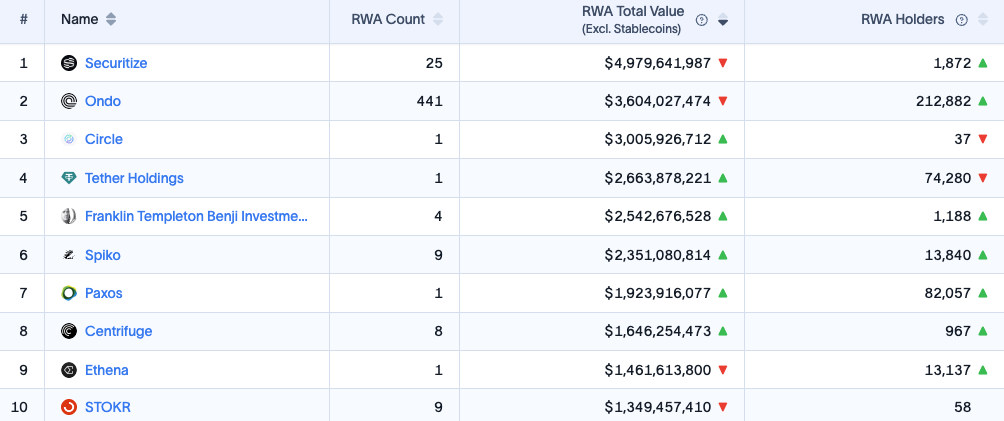
Ranking of tokenization platforms by total on-chain RWA market cap
But this fact has been known for some time and no longer excites the market. Prior to its listing, Securitize's business was primarily institutional, with its issued RWA assets mostly comprising bonds, private credit, and money market funds. Frankly speaking, Securitize's value as the leading tokenization platform was already reflected in its IPO valuation. As such, post-listing market attention has focused on its performance in the incremental market of new tokenized stocks.
According to RWA.xyz data, Securitize's tokenized SECZ currently holds the highest on-chain circulating market cap (on-chain issuance multiplied by share price) among tokenized stocks. However, this figure is clearly misleading.
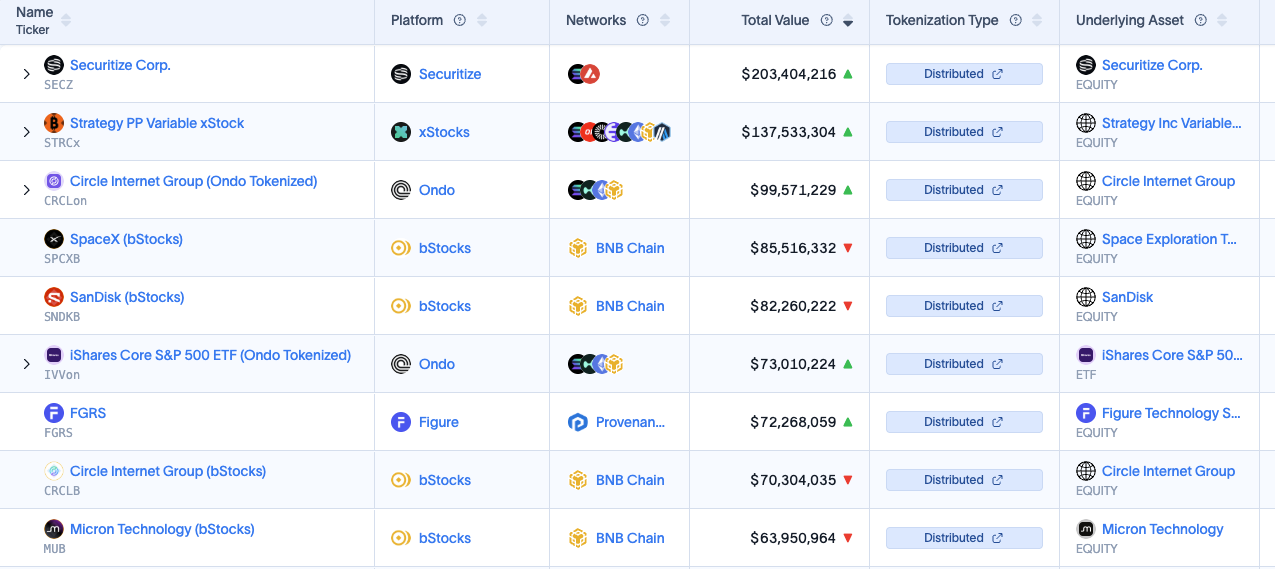
Ranking of tokenized stocks by on-chain market cap
SECZ's issuance model differs entirely from tokenized stocks on other platforms. On most platforms, the issuance process involves investors first submitting purchase requests, with the platform then issuing tokenized stocks 1:1 to users—meaning on-chain market cap fluctuates with actual buyer demand. In contrast, SECZ's tokenized stock issuance was based entirely on a one-time shareholder participation event. At the time of listing, Securitize issued $260 million worth of SECZ tokenized stocks on-chain, all distributed to shareholders, meaning no secondary investors participated in the purchase.
Therefore, SECZ's on-chain market cap cannot serve as evidence of strong performance in Securitize's tokenized stock business. Excluding SECZ, it becomes nearly impossible to assess the market's acceptance of Securitize's tokenized stocks or compare its trading volume and issuance figures against other tokenization platforms, because Securitize's tokenized stock business hasn't truly begun yet.
As of pre-market trading on August 13, Securitize's market cap had fallen to $1.28 billion. On its first day of trading, Securitize's market cap peaked at nearly $2 billion, with a closing price of $12.3 per share—now down 36%.
In the early days of listing, some analysts attributed SECZ's decline to SPAC structural changes rather than fundamental deterioration. In mid-July, investment bank Benchmark reaffirmed its buy rating on SECZ with a $16 price target. However, the post-earnings drop in SECZ genuinely reflects investor concerns over shrinking revenue and the uncertain trajectory of its tokenized stock business.
The tokenized stock market has long faced a disconnect between the "tokenization compliance narrative" and "secondary market reality." If judged by the former, Securitize's current development remains steadily positive. But the market currently judges by the latter, where metrics like market share, real trading volume, and user count matter far more than the number of licenses.
Securitize has yet to experience its "LeEco moment."
Recommended Reading


