






连续减仓三年股票后,巴菲特终于出手了


- 核心观点:伯克希尔·哈撒韦在2026年第二季度结束连续14个季度的股票净卖出,转向近198亿美元的净买入,并以百亿级私募投资谷歌母公司Alphabet,标志其在新任CEO阿贝尔领导下调整投资策略,从长期观望转向主动布局。
- 关键要素:
- 财务表现:第二季度总营收1018.08亿美元,同比增长10%;净利润256.67亿美元,同比翻倍,超市场预期。
- 投资转向:买入股票234.7亿美元,卖出36.9亿美元,终结自2023年以来的净卖出趋势。
- 重仓谷歌:私募增持Alphabet约100亿美元,使其成为前五大重仓股,与苹果、美国银行等并列,占比66%。
- 回购与现金:回购45.27亿美元,创2021年来新高;现金及美债合计约3647亿美元,较上季度下降。
- 策略逻辑: 此前被嘲讽“踏空”AI浪潮,但选择等待估值回调,强调投资纪律和长期安全边际。
Original: Odaily Planet Daily (@OdailyChina)
Author: Azuma (@azuma_eth)
After the US stock market closed on August 9 (Beijing time), Berkshire Hathaway released its Q2 2026 earnings report.
The report showed that Berkshire's total revenue for Q2 2026 reached $101.808 billion, up approximately 10% year-over-year. Net income attributable to shareholders was $25.667 billion, more than doubling from the same period last year (up roughly 107%). Both operating profit and net income significantly exceeded market expectations.
However, the more signal-laden point in the report is that Berkshire Hathaway finally ended its streak of net stock selling that had lasted over three years (14 consecutive quarters), shifting to net buying.
Holding $400 Billion in Cash, Berkshire Finally Makes Its Move
According to the earnings report, Berkshire Hathaway purchased approximately $23.47 billion in stocks during Q2, while selling only $3.69 billion, resulting in net buying of nearly $19.8 billion—ending the prolonged net selling trend that began in 2023.
What deserves even more attention from investors is where the capital went. The report disclosed that Berkshire Hathaway's largest move last quarter was an additional investment of approximately $10 billion in Alphabet (Google's parent company) through a private placement. This officially elevated Google into the ranks of Berkshire Hathaway's top five largest holdings by market value—alongside American Express, Apple, Bank of America, and Coca-Cola. As of the end of June, these five positions collectively accounted for 66% of the equity portfolio, reflecting an extremely high level of concentration.

Although Buffett has long maintained a cautious stance toward tech stocks, he previously revealed during his initial stake in Google that the investment decision was made jointly with Greg Abel (Berkshire Hathaway's current CEO, who officially succeeded Buffett on January 1 of this year). Buffett has also admitted that missing Google in his early years was a "historical mistake," and this follow-up investment was driven by value-investing logic, focusing on Google's search monopoly moat and stable cash flow.
This latest billion-dollar increase, however, represents an investment decision made under the leadership of new CEO Abel—which may indicate that under the new landscape where Buffett has stepped back and Abel holds the reins, Berkshire Hathaway's tolerance for and participation in cutting-edge technology is increasing.
Beyond returning to net buying in the market, Berkshire Hathaway also conducted its first stock buyback in two years during Q2. The report disclosed that the company spent a total of approximately $4.527 billion on buybacks last quarter, marking the highest quarterly level since 2021; it added over $3.3 billion in buybacks in July.
In March of this year, Berkshire Hathaway officially announced the resumption of its stock buyback program. At that time, Abel stated that the buyback was driven by management's belief that the company's "intrinsic value" exceeded its market price.
With the shift in investment and buyback pace, Berkshire Hathaway's long-accumulated cash reserves have also begun to change. Over the past few years, one of the company's biggest labels has been that of a "cash machine." Due to a lack of large opportunities meeting Buffett's investment standards, the company's cash and short-term Treasury holdings continued to climb, reaching a historic high of nearly $400 billion by the end of Q1.
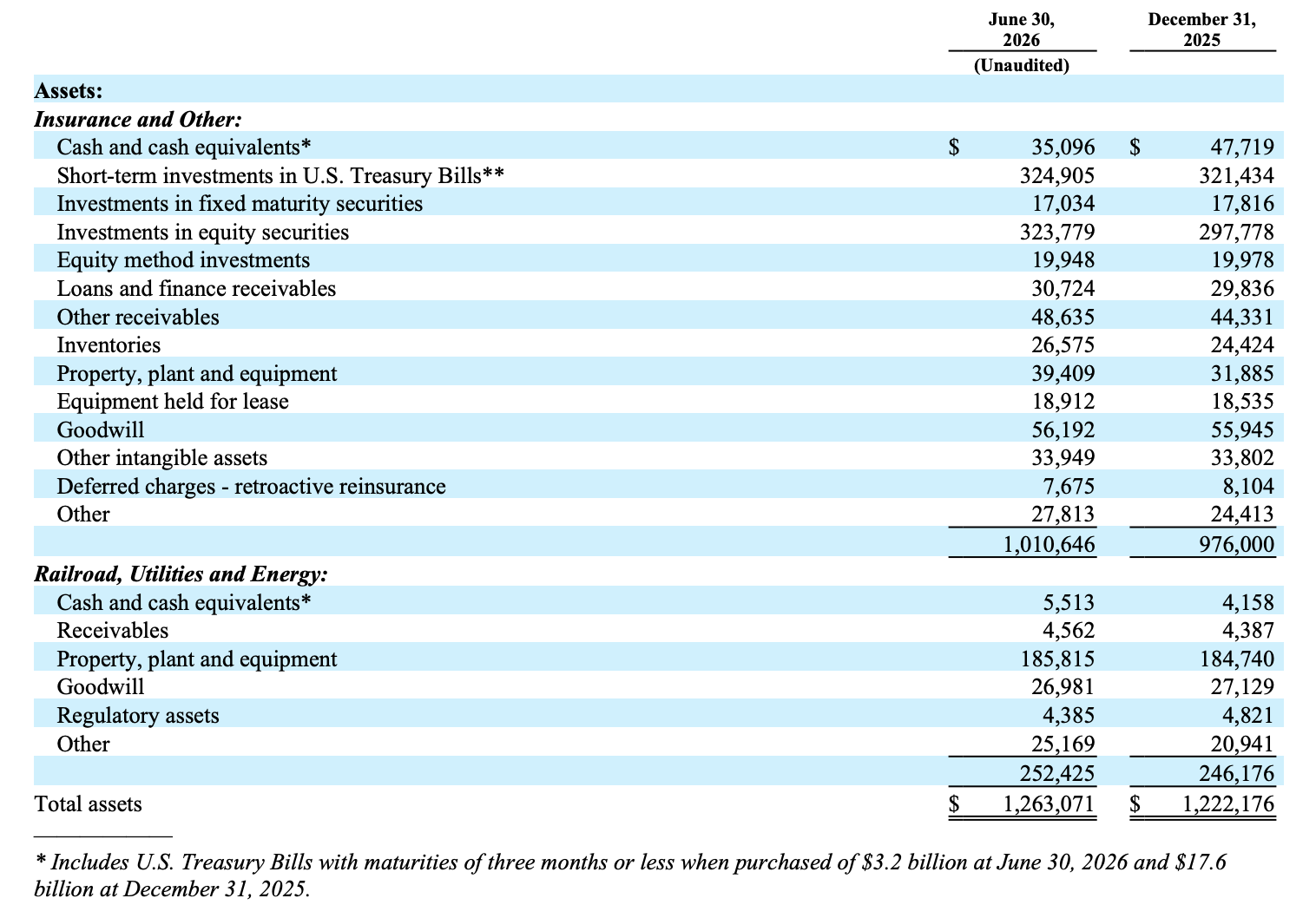
But as stock purchases, buybacks, and industrial acquisitions (primarily the acquisitions of petrochemical company OxyChem and homebuilder Taylor Morrison) unfolded in succession, Berkshire Hathaway's cash reserves entered a downward trajectory. As of June 30, Berkshire held approximately $35.1 billion in cash and cash equivalents, with short-term U.S. Treasury holdings of around $324.9 billion, totaling approximately $364.7 billion—a notable decline from the $397.38 billion recorded at the end of Q1.
Once Mocked as "Out of Touch," Berkshire Was Actually Watching Quietly from the "Edge of the Era's Rapids"
Let's rewind to the period from 2023 through early 2026.
Over the past few years, the AI technology wave completely ignited global capital markets, with chip and semiconductor supply chain companies such as Nvidia, SK Hynix, Samsung, and Micron becoming the most crowded trading tracks.
The market was saturated with "All in AI" fervor. Any fund manager without heavy semiconductor exposure was deemed outdated, while Buffett and his Berkshire Hathaway—despite sitting on hundreds of billions in cash—chose to remain almost coldly on the sidelines.
Mockery soon followed. "Buffett is out of touch," "Value investing is dead," "The moat theory is obsolete in the face of the AI revolution," "The old man isn't even as good as me"—such doubts were relentless. People marveled at the multi-fold or even tens-of-fold gains in semiconductor stocks, compared Berkshire Hathaway's seemingly tepid share price performance, and hastily concluded that this 90-something old-school investment master, along with his handpicked successor Abel, had lost their judgment on the technological revolution.
But Berkshire Hathaway's choice clearly had its own logic. In the Q2 2026 earnings report, the company reiterated its signature warning: "Investment gains and losses in any given quarter are typically meaningless, offering virtually no analytical or predictive value."
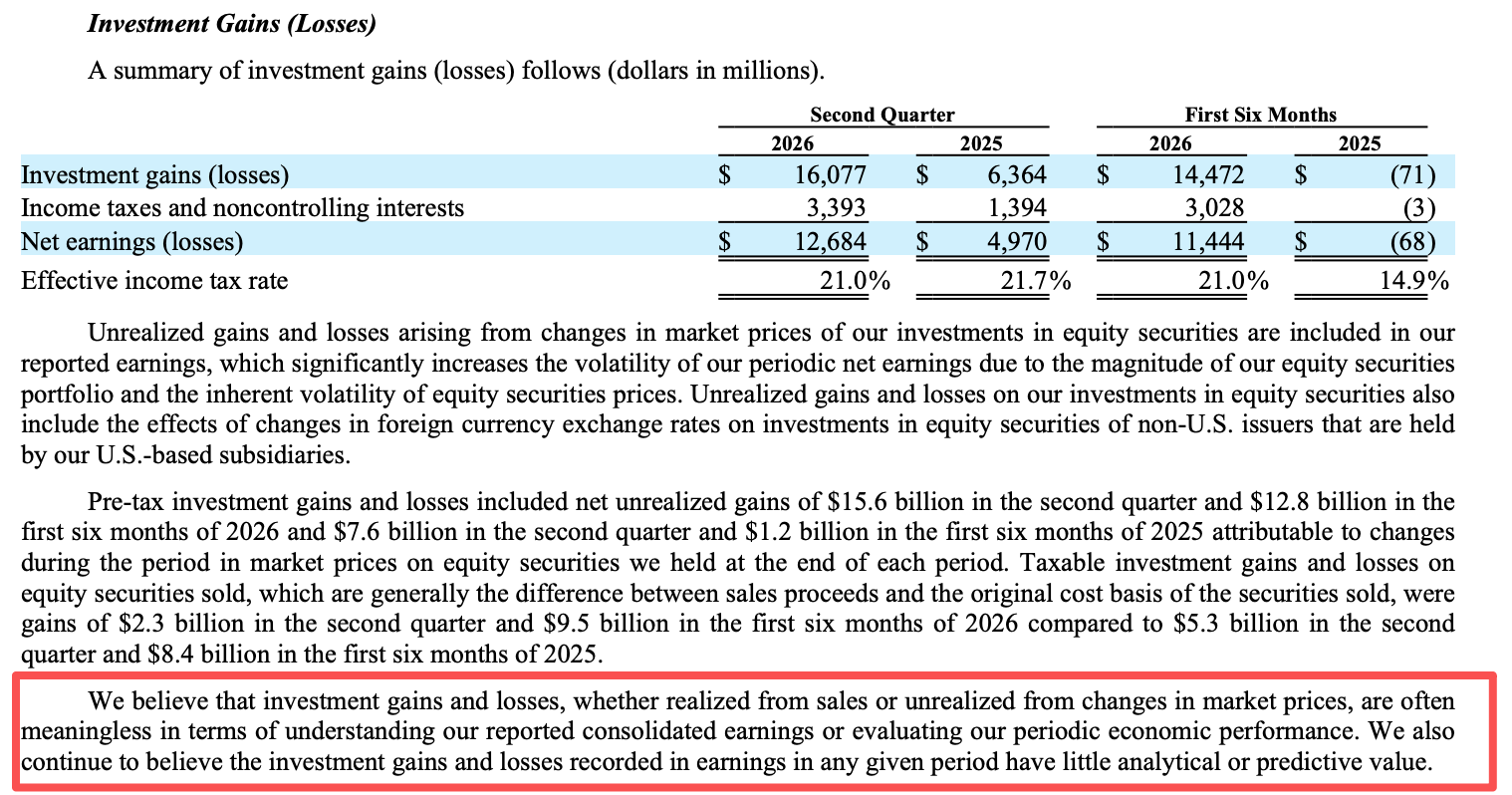
On the surface, this statement appears aimed at GAAP accounting standards, but in reality, it reflects a consistent attitude toward short-term market speculation. In the eyes of Buffett and Abel, doubts likely remain about whether the semiconductor industry can shake off its cyclicality, and there is also uncertainty regarding when the explosive demand for AI hardware will translate into sustainable cash flow.
As the market entered a frenzy phase and semiconductor stock prices soared, the market environment at that point had completely diverged from Berkshire Hathaway's discipline of "buying great companies at fair prices." So, while the market was immersed in FOMO sentiment, Berkshire Hathaway chose the most unexciting yet most in-character strategy for its DNA—waiting.
Until recent months, as the semiconductor craze suddenly receded, previously over-hyped targets experienced sharp pullbacks. Investors who once mocked Buffett for "missing the boat" suddenly discovered that their book profits from chasing semiconductor highs evaporated rapidly during the correction. Meanwhile, the hundreds of billions in cash on Berkshire Hathaway's balance sheet not only provided an unparalleled margin of safety but also gave it the confidence to be greedy when others are fearful.
The $19.8 billion in net buying during Q2 is a validation of this discipline. Notably, Berkshire Hathaway did not chase the market at its peak; rather, it deployed capital at scale only after market volatility had brought quality asset prices back to reasonable levels.
This is precisely the truth Buffett has practiced for decades—investing is not about who runs fastest, but who survives longest and laughs last.


