急跌!中国光刻机吓哭华尔街?


On July 27 Eastern Time, the three major US stock indices appeared calm on the surface.
- The Dow Jones Industrial Average rose 0.51% to 52,210.08 points;
- The S&P 500 index edged up 0.02% to 7,413.18 points;
- The Nasdaq Composite Index fell 0.18% to 24,932.08 points.
However, on this night, the once red-hot AI hardware sector over the past six months became the main drag on the market. The semiconductor sector led the decline, with the Philadelphia Semiconductor Index (SOX) falling over 5% intraday before closing down 2.23%.
Looking at the constituent stocks, whether market leaders or new upstarts, all underperformed:
Lithography machine leader ASML (ASML) closed down 5.80% at $1,655.26, with intraday losses widening to over 8% at one point; AI chip leader Nvidia (NVDA) closed down 4.99% at $196.51, marking its largest single-day drop since June 5, with its market cap shrinking by nearly $250 billion in a single day to $4.76 trillion, allowing Apple to reclaim the title of the world's most valuable company. AMD closed down 5.17% at $494.95.
Memory chip stocks fell even more sharply. Sandisk closed down 11.02%, SK Hynix ADR plunged 7.47% to $143.02, falling below its $149 IPO price just 12 trading days after listing; Micron Technology saw intraday losses of over 7% before narrowing to 2.25% by the close. Semiconductor equipment manufacturers such as Applied Materials, KLA Corporation, and Lam Research all fell over 3%.
Notably, the market exhibited a clear rotation from high-valuation sectors to lower-valuation ones: funds flowed out of the crowded AI infrastructure trade and into platform companies with more stable cash flows, pushing Apple's stock to a new high. In contrast, Chinese assets strengthened against the trend, with the China Internet Index rising over 2.5%. Xiaomi's ADR surged 8.97%, while Tencent and Alibaba both rose over 2%.
Why Did a Rumor About "Chinese Lithography Machines" Cause ASML to Plunge?
On July 27 during trading hours, US tech media outlet The Information, citing two sources, published an exclusive report: A state-owned enterprise in Shanghai, China, has begun manufacturing immersion deep ultraviolet (DUV) lithography machines. The first batch of equipment is expected to be delivered to SMIC, Hua Hong Semiconductor, and ChangXin Memory Technologies by 2026, targeting the 28nm process. Production capacity is planned at approximately 5 units in 2026, expanding to 20 units by 2027.
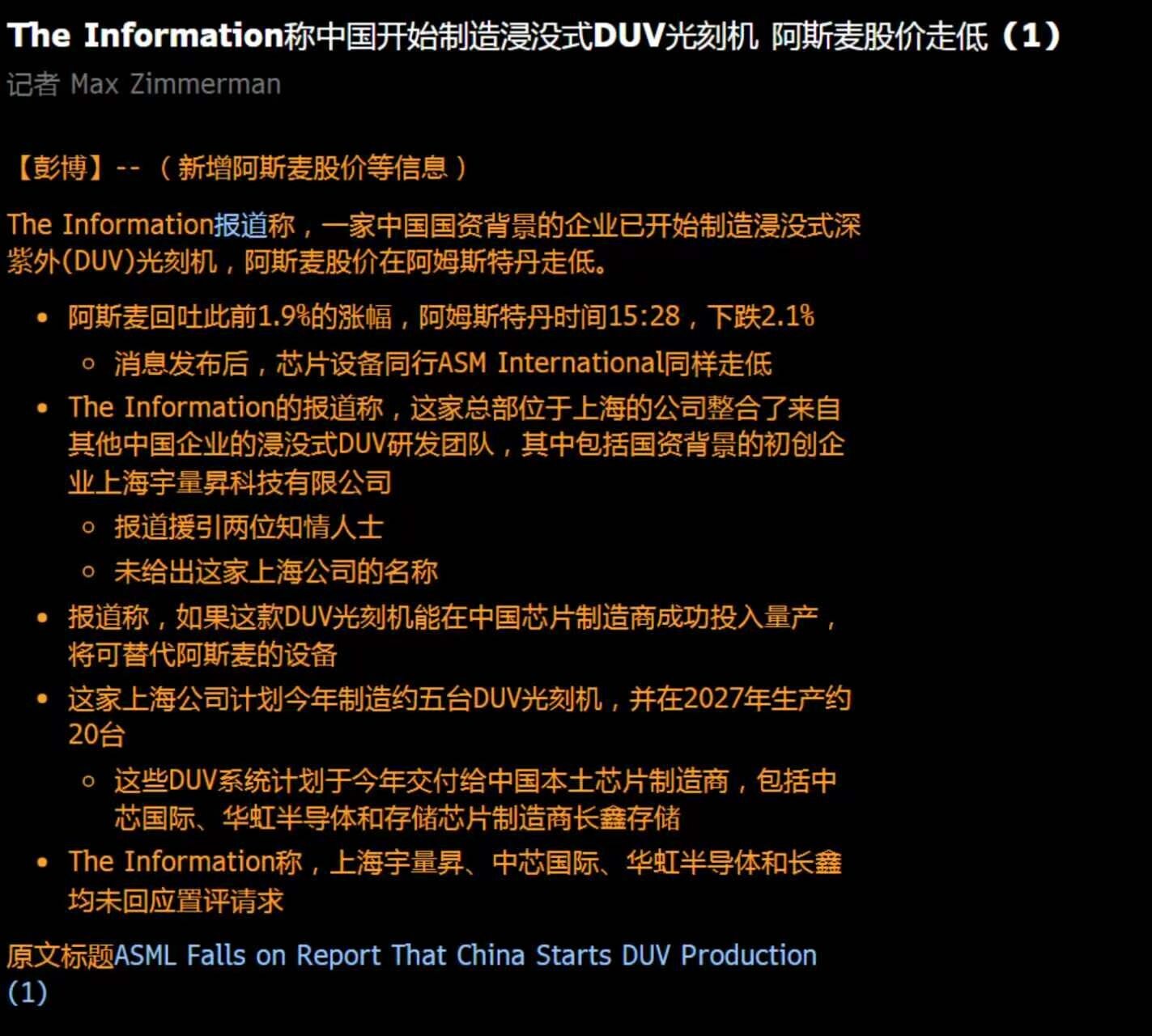
The report stated that most of the machine's components are sourced domestically, but several key parts still rely on Japanese suppliers. In terms of throughput, overlay accuracy, and long-term stability, it still lags behind ASML's comparable models.
Upon the news, ASML plunged over 8% intraday. Within half an hour, the Philadelphia Semiconductor Index and the entire US semiconductor equipment sector simultaneously sold off.
A Real Question: How Far Has China's Lithography Technology Actually Come?
Lithography machines were once the most famous "bottleneck" for China's semiconductor industry, precisely because of their uniquely critical position in the entire supply chain.
Simply put, a lithography machine acts as the "printer" for chip factories. The shorter the wavelength, the finer the lines that can be etched.
Among these, DUV (Deep Ultraviolet Lithography) determines whether a country can "make chips." DUV uses a 193nm wavelength, supporting the vast majority of chips globally, including automotive, industrial, memory, and IoT applications. The mature 28nm and above process nodes all rely on DUV. While ASML currently dominates this space, the technological barrier is relatively "climbable."
On the other hand, EUV (Extreme Ultraviolet Lithography) determines whether a country can "make the best chips." EUV uses a wavelength of only 13.5nm and is indispensable for sub-7nm mobile CPUs and AI training chips. Globally, only ASML can manufacture these machines, each costing over $150 million, and they are strictly banned from export to China by the US.
If the global chip supply chain were a production line, China originally had no place: The US controls EDA design software and core IP, Japan monopolizes photoresist and high-purity chemicals, the Netherlands' ASML holds the throat with lithography machines, while Taiwan and South Korea are responsible for assembling the design and equipment into final chips.
Therefore, the reason this "rumor" had such a significant impact is not due to its inherent technological impressiveness—5 units, 28nm, Chinese-made DUV is negligible compared to ASML's annual shipments of hundreds of units. What truly unsettled Wall Street was the broader picture of China's semiconductor self-sufficiency that it reflected.
At the DUV level, China may have already achieved a breakthrough from 0 to 1 and is beginning to ramp up production. According to public information, Shanghai Micro Electronics Equipment' SSA800 28nm immersion DUV machine has been delivered in batches to SMIC, achieving a yield rate of over 90% and a domestic sourcing rate of over 85%. Xinkailai's dry DUV machine, combined with SAQP (Self-Aligned Quadruple Patterning) technology, has completed verification on SMIC's 28nm production line, achieving an 85% yield rate and enabling equivalent 5nm process nodes. Coupled with previously stockpiled ASML DUV equipment (estimated by Dutch media to be "sufficient for 5 to 10 years"), China's supply chain security baseline for mature process nodes is being consolidated.
However, at the EUV level, the journey "from principle to prototype" remains long. The highest power achieved by domestic laboratory EUV light sources is 5080W, only one-fifth of ASML's commercial standard. The surface roughness of mirrors from the Changchun Institute of Optics, Fine Mechanics and Physics is 0.12-0.2nm, still about four times worse than Zeiss's 0.05nm. With over 100,000 components and a supply chain completeness of less than 20%, industry consensus suggests that small-scale validation might only be possible after 2030. High-end mobile chips below 7nm and AI training chips cannot be produced domestically in the short term.
So, Does China's Hard Tech Really Have the Power to "Shake US Capital Markets" Again?
The answer is a mixed bag.
"Half is real": The self-sufficiency of the mature process node supply chain has transitioned from a "lab story" to a "production line reality." China is no longer necessarily ASML's "must-have" option in its largest single market globally. This is the core source of the emotional resonance that caused ASML to plummet 8% and US semiconductor equipment stocks to weaken collectively.
"Half is illusion": The impact of 28nm DUV machines is actually insufficient to crash the entire Philadelphia Semiconductor Index. Five DUV machines, even if they completely replaced ASML sales (at roughly €200 million each), would have a negligible impact on ASML's annual revenue (around €30 billion in FY2025). Moreover, these machines still require months or even years of production line verification regarding precision, yield, and stability before they can truly replace ASML.
Thus, this "rumor" was a spark—but it ignited a haystack already soaked in anxiety. The real source of the fire lies elsewhere.
Nvidia's $750 Billion Flywheel Is the True Root Cause of the Decline
Removing the China DUV news from the equation, what remains is a long-brewing internal crisis of confidence in the US stock market.
The more fundamental reason for the collective sell-off in chip stocks this round is the renewed market concern over Nvidia's "circular financing" model, which has now transmitted to the credit markets—Nvidia's credit default swap (CDS) spread surged 14 basis points in a single day, setting a record high.
Nvidia has been very active recently. First, it announced a massive supply chain cooperation deal with South Korea's SK Group worth over $500 billion. Then, yesterday it was reported to be planning to provide OpenAI with a computing power lease guarantee of up to $250 billion, specifically to support SoftBank's development of a 10-gigawatt super data center in Ohio.
These two major initiatives alone total over $750 billion.
During the rally over the past few months, the capital market essentially ignored the "elephant in the room"—Nvidia's growth model essentially involves providing financing, investment, and equity to its downstream customers. These companies, after receiving the funds, continue to buy Nvidia's chips. Capital circulates within the industry chain. Nvidia's revenue growth is highly dependent on its customers' financing capabilities. If any link in this chain breaks, the model is inevitably unsustainable.
From Goldman Sachs to "Big Short" investor Michael Burry, serious warnings have been issued over the past few months about this "circular financing": once the financing environment deteriorates, or if companies heavily invested in AI ultimately fail to achieve profitability, the entire AI spending chain will face amplified losses.
Goldman Sachs analyst Chris Hussey put it more bluntly: The core reason for the S&P 500's stagnation over the past two months is market skepticism about the sustainability of AI infrastructure investment, not macro factors like oil prices or interest rates. Supporting evidence is that excluding AI-related stocks yesterday, the S&P 500 actually rose by 0.80%.
Market Outlook
In fact, this round of pullback in US stocks did not start just last night. As early as mid-July, the SOX index had already retraced over 20% from its June peak, entering a technical bear market. The weighting of chip stocks in the S&P 500 has risen from about 8% a few years ago to over 20%, and the daily rebalancing mechanism of leveraged ETFs has further amplified the decline.
However, every sell-off needs a plausible reason to justify the panic. This time, it was the turn of China's lithography breakthrough "myth."

Looking back at China's semiconductor industry, self-sufficiency is a long-term process with different phases and tracks—we are closing the gap in certain areas, but we are far from reaching a level that can cause "substantial fear" on Wall Street.
The panic on Wall Street last night was more about beginning to stare at the cracks in its own most crowded AI trade. Meanwhile, China's hard technology sector is quietly putting down roots on its own, much longer track.