自由现金流暴跌91%,Meta的AI豪赌有多贵?


- 核心观点:Meta 2026年第二季度营收因AI广告增长强劲,但受诉讼、重组费用和AI算力投入激增影响,净利润下滑14%,自由现金流暴跌91%,引发市场对AI投资回报率的担忧。
- 关键要素:
- 营收与利润分化:总营收608亿美元,同比增长28%;净利润158.48亿美元,同比下滑14%,每股收益低于华尔街预期。
- 广告业务增长:AI驱动的广告展示量同比增14%,平均单价增12%,应用全家桶日活用户达36亿。
- Reality Labs亏损:营收4.31亿美元,运营亏损46.2亿美元,自2021年累计亏损约856亿美元。
- 算力成本飙升:资本支出310.8亿美元,研发支出同比增长67%至217亿美元,自由现金流从85.5亿美元骤降至7.84亿美元。
- 一次性费用拖累:35.8亿美元非经营性费用,包括24亿美元法律诉讼计提和11.8亿美元裁员遣散费。
- AI商业化路径:计划将算力用于训练大模型、优化广告、开发个人智能体,并尝试通过Muse系列模型进入企业服务市场。
- 未来指引谨慎:三季度营收指引中位数625亿美元低于预期,全年资本支出指引下限上调至1300亿美元,增速预期放缓。
Original Author: Li Hailun
Original Editor: Xu Qingyang
Original Source: Tencent Technology
Meta posted a strong revenue surge in Q2 driven by AI advertising, but profits took a hit due to litigation costs, layoffs, and rising computing expenses.
On July 29, US local time, Facebook parent company Meta Platforms released its Q2 2026 earnings report for the period ending June 30, after the US stock market closed.
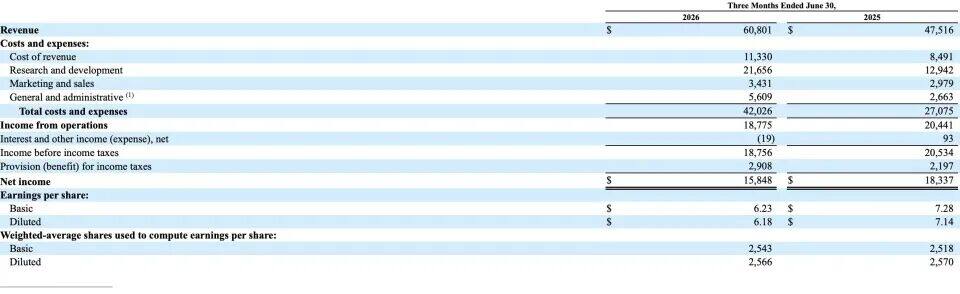
According to the report, Meta's total revenue for the quarter reached $60.801 billion, a year-over-year increase of 28%. However, due to one-time expenses such as legal provisions, restructuring severance costs, and a sharp increase in computing spending, net profit fell 14% year-over-year to $15.848 billion, with diluted earnings per share at $6.18.
Market sentiment turned cold immediately after Meta's earnings release. As EPS fell short of Wall Street expectations and the midpoint of the Q3 revenue guidance was set at $62.5 billion—slightly below the average Wall Street estimate of $63.1 billion—Meta's stock dropped over 6.37% in after-hours trading, hitting $548.30. Before the report, Meta's stock had already fallen for 10 consecutive trading days, erasing about 13% of its market value since July 15.
As tech giants race toward an AI-driven endgame, with open-source large models, agent ecosystems, and computing infrastructure entering deeper waters, Wall Street's scrutiny of "AI return on investment (ROI)" has become unprecedentedly direct and stringent.
The strong revenue growth and lukewarm market reaction reveal investors' deeper concerns amid basic business growth: Can Meta's robust digital advertising base support the pressure from trillions in computing spending and a sharp decline in free cash flow?
AI Drives Ad Growth, Reality Labs Still Burning Cash
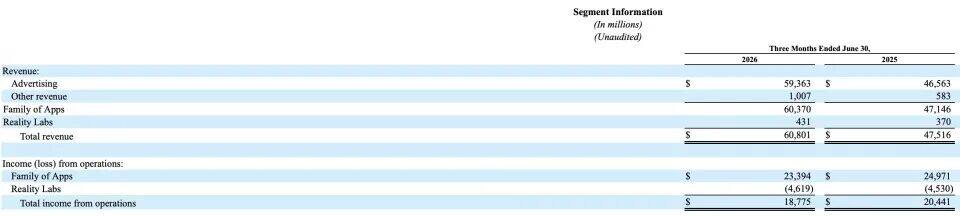
From a segment perspective, Meta's core business this quarter shows a pattern of "strong advertising base supporting, Reality Labs revenue recovering but losses widening."
The "Family of Apps" segment, the core cash flow source for the group, performed steadily, covering social platforms like Facebook, Instagram, WhatsApp, and Threads. In June 2026, the Daily Active People (DAP) across the family of apps averaged 3.60 billion, up 3% year-over-year. Specifically, Instagram's daily active users officially surpassed the 2 billion mark in Q2, and Threads' Monthly Active Users (MAU) reached 500 million.
Meta's advertising business in Q2 saw growth in both volume and price: ad impressions increased 14% year-over-year, and the average price per ad rose 12% year-over-year. Commenting on this performance, Meta founder and CEO Mark Zuckerberg said in the earnings statement: "AI is accelerating our core business today, driving our next-generation products, and opening up entirely new enterprise opportunities. The financial results are starting to show, and I'm optimistic about the future potential."
Analysis by CNBC suggests that despite macroeconomic uncertainties, AI algorithmically restructured ad targeting systems (like Advantage+) are continuously improving conversion efficiency, providing Meta with a stable cash flow base.
For the Reality Labs segment, responsible for the metaverse and smart hardware, Q2 revenue was $431 million, up from $370 million a year ago and exceeding analyst expectations of $423.4 million. The quarterly operating loss was $4.620 billion, slightly wider than the $4.53 billion loss in the same period last year but better than the analyst estimate of a $5.07 billion loss.
Since 2021, Reality Labs has accumulated an operating loss of approximately $85.6 billion. The segment's current focus is primarily on the Ray-Ban Meta smart glasses developed in partnership with EssilorLuxottica. With new frame styles and AI features being introduced, Meta is trying to position these glasses as a hardware terminal for personal AI assistants.
Soaring Computing Investment, Meta's Free Cash Flow Plunges 91%
Breaking down the total costs and expenses of $42.026 billion in Q2 (up 55% year-over-year), the increase mainly stems from two drivers: rigid investment in infrastructure and one-time non-operating expense provisions.
In terms of R&D and hardware construction, Meta's Q2 R&D expenses increased 67% year-over-year to $21.7 billion. Meta is accelerating its data center deployment globally.
Meta also announced a joint venture with BlackRock to build a data center in El Paso, Texas, with a total development cost of approximately $14 billion. The regional investment scale for the Louisiana data center expansion will exceed $50 billion. The company also plans to invest over $13 billion CAD to build its first data center in Alberta, Canada.
In addition to computing expenses, the Q2 income statement included $3.58 billion in one-time non-operating expenses, a primary factor dragging down EPS below expectations. Of this, $2.40 billion relates to legal costs associated with ongoing regulatory scrutiny concerning the use of social media platforms by teenagers and its impact on mental health. The Wall Street Journal noted that multiple lawsuits are scheduled for trial in the US this year, potentially leading to further losses.
Another $1.18 billion represents severance costs for layoffs, corresponding to the restructuring of approximately 8,000 employees initiated in May 2026. As of June 30, Meta's global headcount was 75,472, down 1% year-over-year.
Meta CFO Susan Li explained during the conference call that excluding the $2.4 billion legal provision and $1.18 billion in severance costs, Meta's Q2 operating profit would have achieved approximately 9% year-over-year growth, instead of the reported 8% decline.
However, the metric most alarming to the capital market was the contraction in free cash flow. While cash flow from operations was $31.86 billion in Q2, after deducting a massive $31.08 billion in quarterly capital expenditures, free cash flow plummeted from $8.55 billion a year ago to $784 million, a year-over-year decline of 91%.
The pressure on free cash flow is not unique to Meta but is a common reality for all big tech companies in the AI arms race. For context, Google parent company Alphabet's quarterly capital expenditure surged to $44.9 billion during the same period, directly turning its free cash flow negative for the first time in history.
Ryan Lee, Senior Vice President of Product and Strategy at Direxion, noted in an interview that while Meta didn't slip into negative free cash flow, the figure falling below $1 billion is still noteworthy, reflecting the company's massive current cash burn rate.
Zuckerberg Seeks New AI Outlets: Personal Agents and Enterprise Services
According to analysts, Meta's business model differs from competitors that have cloud service systems. While Microsoft has Azure, Google has Google Cloud, and Amazon has AWS, Meta lacks a large-scale native cloud business and primarily relies on ad revenue to support its AI capital expenditures.
Consequently, Meta is attempting to adjust its AI strategy and commercialization approach.
In early July, Meta launched the Muse Spark 1.1 model. This is a significant product following Meta's $14.3 billion investment in June 2025, which brought in Scale AI founder Alexandr Wang to lead the technical team, focusing on agents and code generation, priced lower than comparable products from OpenAI and Anthropic. However, the Muse Image feature launched during this period, which generated images using Instagram public accounts, drew criticism and has since been halted.
Regarding the future application of its massive infrastructure, Zuckerberg elaborated on his clear vision for analysts during the earnings call. He stated that the vast majority of computing power purchased will be prioritized for training next-generation large models, optimizing the core advertising business, and delivering personal AI agents and new products to users. He also anticipates building the capability to serve large enterprise clients.
Just one day before the earnings release, Zuckerberg published a bylined article in the Wall Street Journal and gave an exclusive interview. He explicitly stated that powerful AI tools should be widely disseminated and benefit the entire society. He opposed the monopolization of AI power in the hands of a few closed-source institutions and reiterated Meta's core vision: striving to deliver "Personal Superintelligence" to every ordinary user, thereby seeking broader technological and commercial justification for its high capital expenditures.
Capital Expenditure Guidance Raised, Q3 Growth Expected to Slow
Regarding future performance outlook, Meta's financial guidance leaned cautious, which was also the main reason for the pressure on its stock price in after-hours trading.
For Q3 2026, the company expects total revenue to be between $61 billion and $64 billion (assuming a roughly 1% negative impact from foreign exchange). The midpoint of this guidance is $62.5 billion, below the average analyst estimate of $63.15 billion to $63.24 billion. Some foreign media analysis suggests that this implies Q3 revenue growth slowing from 28% in Q2 to a range of 19% to 25%, sparking market concerns about decelerating ad revenue growth and the ROI realization timeline for AI.
On the spending guidance front, Meta raised its investment floor. The company adjusted its full-year 2026 capital expenditure guidance range from the previous $125 billion to $145 billion to $130 billion to $145 billion, raising the lower end by $5 billion.
Considering the $2.4 billion legal expense recognized in Q2, the lower end of the full-year total expense guidance was raised to $165 billion to $169 billion. The effective tax rate for the second half of the year is estimated to be between 15% and 17%. However, the company still explicitly stated that it expects its full-year operating income to exceed the 2025 level.
Meta's Q2 earnings report reflects the realities the company faces during its AI transformation: The core advertising business remains fundamentally solid, providing cash flow for frontier exploration. However, the extremely high capital threshold for AI infrastructure like data centers and GPU purchases significantly squeezes free cash flow, while one-time legal and restructuring costs dragged down current profits.
For the capital market and investors, the key to observing Meta going forward is whether its annual $100 billion-plus hardware infrastructure investment can be monetized through its Muse series of large language models—by unlocking enterprise services, achieving high-price computing rentals, and quickly translating into viable commercial output.
Zuckerberg emphasized on the Q2 earnings call that although EPS fell short of expectations due to legal costs and significant investments in AI computing and talent this quarter, the company's revenue surged 28% year-over-year to $60.8 billion, demonstrating strong underlying business vitality.
Zuckerberg stated that AI technology has fully accelerated its core advertising and recommendation algorithms, and spurred the rollout of new product lines like personal and enterprise AI agents. Addressing market concerns about capital expenditure growth, he reiterated that Meta's goal is "to put superintelligence directly into everyone's hands," and stressed that against the backdrop of AI computing shortages, its full-stack in-house development and forward-looking infrastructure plans will build an irreplaceable long-term competitive advantage and high returns for the company.
Special correspondent Wu Ji also contributed to this article.