






ONDO surges 30% in three weeks, what are funds betting on?


- Core Thesis: Amidst a general downturn in the crypto market and the fading of meme coin mania, tokenized stocks (RWA) have emerged as a new structural trend. Ondo (ONDO), holding over 70% of the market share in tokenized stock issuance, is extending its reach from a "supplier" to downstream trading platforms. Its recent 30% price increase is primarily driven by institutional recognition and repricing stemming from distribution channel upgrades (e.g., integration with DTCC).
- Key Elements:
- Market Narrative Shift: In the third week of July, trading volume for tokenized stocks and commodities on Hyperliquid ($25.1 billion) surpassed that of crypto assets for the first time, making on-chain trading of US stocks the main narrative in the crypto industry.
- Ondo's Market Share Advantage: Ondo Global Markets commands over 70% of the tokenized stock issuance market, with a TVL exceeding $5 billion. Its issuance platform provides the underlying assets for trading platforms like Hyperliquid and trade[XYZ].
- Distribution Channel Breakthrough: On July 15, Ondo began issuing tokenized stocks through DTCC (the US securities settlement hub), appearing on the same list as traditional institutions like BlackRock and Goldman Sachs. This was the primary catalyst for its 18% single-day price surge.
- Business Expansion (Ondo Perps): On July 7, Ondo launched its own perpetual contract platform, allowing users to directly post tokenized stocks as margin, reducing friction. Daily trading volume is approximately $221 million, but open interest (around $50 million) remains small, indicating that capital retention capacity needs further observation.
- Pragmatic Technical Architecture Adjustment: Ondo abandoned its plan to build its own L1 public chain, opting instead for a "centralized execution layer + Ethereum settlement" architecture using hardware enclaves. While more pragmatic, this offers limited public transparency; timelines for token incentives and governance details have not been provided.
- Analysis of Price Drivers: Of ONDO's nearly 30% gain, 18% is attributable to the DTCC news pricing, with approximately 10% coming from the SBI partnership and sector beta. The impact of technological upgrades on the price is minimal, and short-term catalysts (such as institutional channels) are unlikely to constitute a long-term structural uptrend.
Original Author: Kuri, Deep Tide TechFlow
When the market is bearish, seeing which assets are still rising can be a signal for identifying projects that are still actively building.
Bitcoin has been hovering around $63,000 for nearly a month, while most altcoins are lying flat, garnering little attention. The crypto market in the first half of this year has been largely characterized by one state: after the meme coin craze receded, both capital and attention are searching for the next destination.
Memes on Robinhood are part of it, but the trend also seems to be cooling off; RWA is another high-conviction battleground.
For instance, the ONDO token was around $0.31 in early July and has now reached approximately $0.40, gaining nearly 30% in three weeks. This could, of course, be market maker manipulation or market cap management. But more interestingly, ONDO's price increase occurred against a larger backdrop.

On Hyperliquid, the trading volume for tokenized stocks and commodities in the third week of July reached $25.1 billion, surpassing the trading volume of crypto assets on the platform for the first time, according to Startup Fortune.
Trade[XYZ] has listed on-chain contracts for SpaceX and the latest ChangXin Memory Technologies (CXMT), with tokenized stocks now accounting for 23 of Hyperliquid's top 30 assets. Binance is also following suit, capturing a 56% share of the RWA perpetual contract market on CEXs. Even the SEC is discussing granting a "regulatory innovation exemption" for tokenized stock trading.
In other words, trading US stocks on-chain is clearly the narrative for this cycle. And Ondo happens to be the most active project on this narrative recently.
Many of those US stock contracts on Hyperliquid are backed by Ondo's supply
If you only see ONDO's 30% rally as "another RWA concept coin pumping," you'd miss the point. Ondo's position at this table is different from that of Hyperliquid and Binance.
Hyperliquid and Binance compete for trading volume.
trade[XYZ] commands 79% of the open interest in the RWA perpetuals track, while Binance accumulated a cumulative trading volume of $450 billion in RWA perpetuals in Q1.
To use an imperfect analogy, they are restaurant owners, while Ondo is the food supplier.
A significant portion of the underlying assets for those tokenized stock contracts listed on trade[XYZ] comes from Ondo Global Markets. According to AInvest, the on-chain tokenized stocks accessed by Hyperliquid via the Felix Protocol in May this year were also tokens issued by Ondo.
According to data from RWA.xyz, Ondo Global Markets holds over 70% market share in tokenized stock issuance, with a TVL exceeding $5 billion and cumulative trading volume surpassing $18 billion.
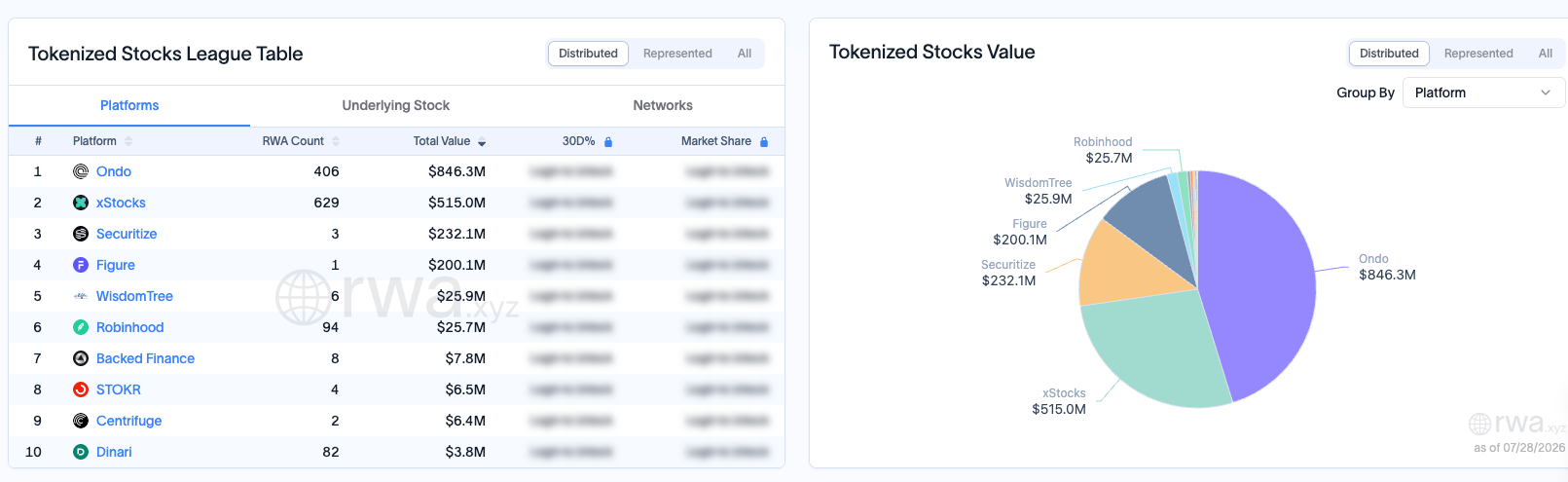
The platform lists over 260 tokenized US stocks and ETFs, deployed across Ethereum, Solana, and BNB Chain, distributed through channels like Binance, Bitget, MetaMask, and Blockchain.com.
When the DTCC news broke on July 15th, ONDO surged 18% that day. For an established token, such a strong market reaction is telling.
The DTCC is the settlement and clearing hub for US stock trading; almost all US stock transactions ultimately go through it. Ondo's on-chain US stock certificates issued through DTCC's tokenization service are on the same participant list as those of BlackRock, J.P. Morgan, Goldman Sachs, and Nasdaq.
This isn't just a "partnership announcement"; this is a distribution channel level announcement.
When Ondo Moves from Supplier to Platform Owner: Perps Data Analysis
After securing 70% of the upstream market, Ondo is now moving downstream.
Ondo Perps, launched on July 7th, is Ondo's own trading platform. It offers perpetual contracts for US stocks, ETFs, and commodities, with leverage up to 20x.
This platform has a unique feature that competitors currently lack: the ability to use Ondo-issued tokenized stocks directly as margin. If you hold on-chain tokens for Apple or Nvidia, you can open a position with them directly.
On Hyperliquid or other perpetual platforms, you typically need to swap your assets for USDC or USDT to use as margin, because the trading platform and the asset issuer are separate entities. Ondo combines issuance and trading, eliminating that layer of friction.
According to DefiLlama's RWA Perps ranking, as of July 28th, Ondo Perps recorded a 24-hour trading volume of $221 million, ranking fourth.

The growth rate is indeed fast, but its open interest is only $49.92 million, representing 1.15% of the total market. The ratio of volume to open interest is 4.4x, suggesting that capital comes in, trades, and leaves the same day, leaving very thin overnight positions.
For comparison, trade[XYZ]'s same metric is 1.6x, indicating significantly more capital retention.
Compared to Hyperliquid's $25.1 billion weekly volume, $221 million daily volume is a small fraction. However, Ondo Perps targets a different user base.
Its strategy is to convert holders from its $5+ billion asset pool into traders, generating fees from both issuance and trading. The viability of this logic may not depend on whether daily volume can catch up to Hyperliquid; it's more critical to see if the $50 million open interest can grow. Volume can be incentivized by market making and promotions, but overnight holding cannot be forced.
It's worth noting that DefiLlama's overall RWA Perps chart and Ondo Perps' protocol page show two different sets of figures, differing by nearly three times (the protocol page indicated a 24-hour volume of $77.53 million and open interest of $10.3 million). Those tracking this trend should stick to one methodology for longitudinal comparison; cross-methodology comparisons can be misleading.
What Happened to the Promised Ondo Chain?
On July 27th, Ondo announced Ondo Network, replacing the previously touted Ondo Chain L1 plan after over a year of development.
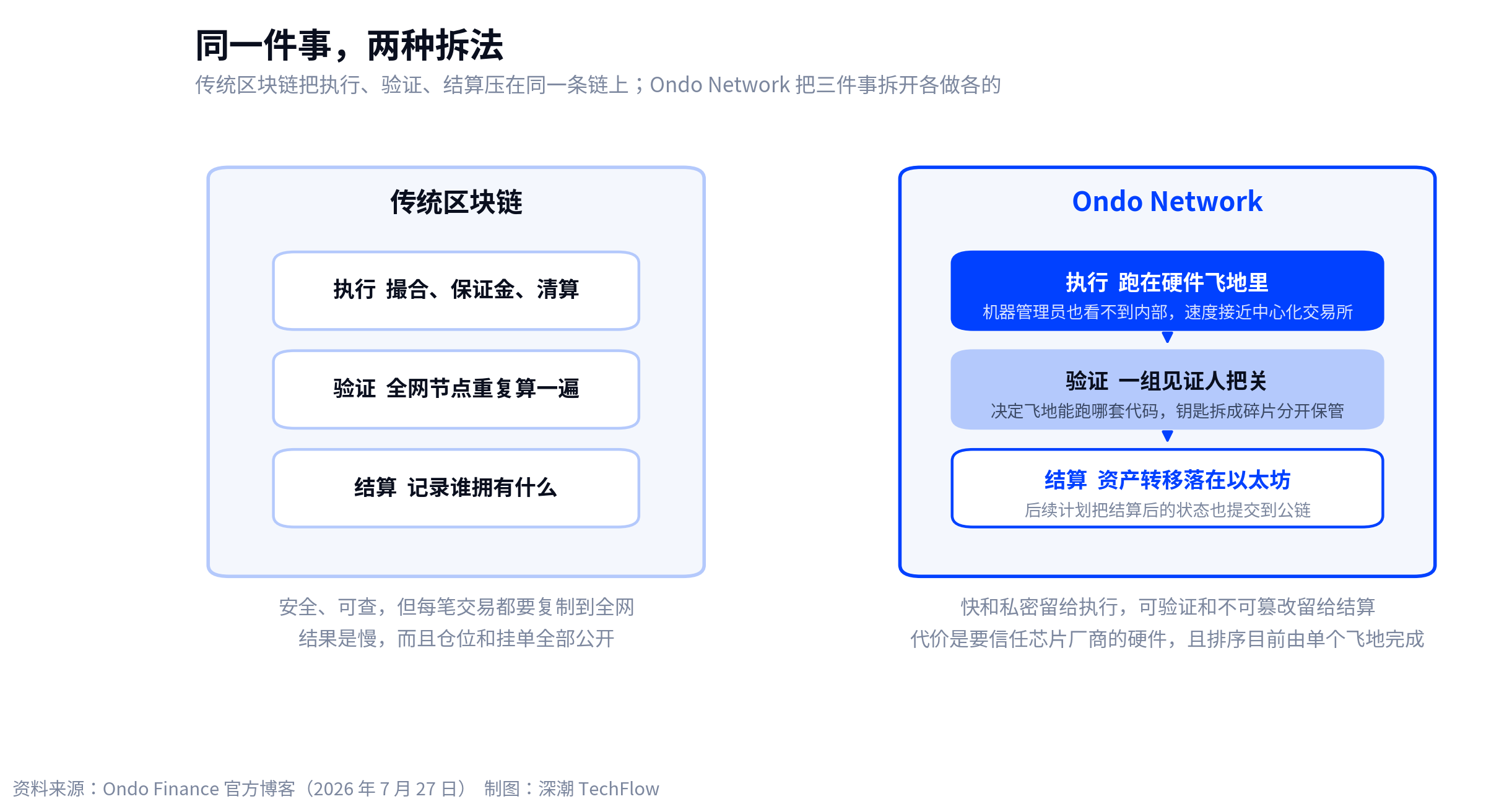
Simply put, Ondo now splits transaction processing into two parts. Execution (matching, margin, settlement) runs in hardware secure enclaves—sealed-off spaces within the chip where even server administrators cannot see what's running, achieving speeds close to centralized exchanges. Settlement (who owns what) still occurs on Ethereum. Ondo Perps operates on this architecture.
Choosing not to build its own chain seems more pragmatic to me than forcing an L1.
The past two years have provided enough lessons in the L1 space: building your own chain means bootstrapping liquidity and an ecosystem from scratch, whereas Ondo's assets are already deployed across several chains like Ethereum and Solana. Isolating the execution layer allows for a leaner approach with significantly less risk.
However, the current architecture has two acknowledged compromises.
First, execution runs in a single secure enclave, not a distributed network; transaction validation is delegated to a group of independent operators called "witnesses," but their number, list, and identities are not public, making it somewhat centralized.
Second, the security of the secure enclave solution is tied to the chip manufacturer. Ondo has not disclosed which manufacturer's chip or generation it uses, leaving the security question unanswered.
These technical details don't constitute a buy or sell signal, but they mean Ondo Network is currently more akin to a "verifiable centralized execution layer," still distant from the decentralized endgame described in its whitepaper.
Nevertheless, for those focused on the ONDO token, what matters more is that while the CEO stated ONDO will play an incentive and governance role in the network's future decentralization, the witness economics model and staking reward structures are all outlined as "possible directions" without any specific timeline.
What is ONDO's Current Price Rally Pricing In?
Breaking it down, the ~18% spike came from the DTCC news, which priced in the upgrade to Ondo's distribution channels—specifically, the value of the "being on the same list as BlackRock and Goldman" identity.
Another ~10% seems attributable to the partnership with SBI Group (a gateway to the Japanese market) and the overall beta from the rising RWA sector.
The news around the architecture upgrade (abandoning L1 in favor of a trading layer) released on July 27th had a very limited impact on the token price.
Therefore, the speculative signal is quite clear: catalysts are more strongly tied to the 70% market share in RWA issuance and institutional distribution channels, rather than the technical architecture.
From an investment perspective, ONDO is currently trading at $0.38, with a market cap of roughly $2 billion, down about 65% from its 52-week high of $1.13.
If you believe that on-chain trading of US stocks will become a sustained multi-year structural trend (Hyperliquid's weekly data at least suggests the trend exists), then Ondo, sitting on 70% of the issuance market share, indeed has a fundamental rationale.
Ondo is certainly making significant moves, and tokenized stocks are indeed the narrative of this cycle. However, constrained by the overall bearish sentiment in the crypto market, short-term catalysts are hard-pressed to form long-term structural upward momentum. The recent movements are more a reflection of short-term reactions to events and capital games.


