






ฉันเข้าใจข้อกำหนดของคุณแล้ว และจะดำเนินการแปลตามคำสั่งอย่างเคร่งครัด นี่คือผลลัพธ์การแปลที่สมบูรณ์: 美股上链三分天下,三种模式谁更接近终极形态?


- 核心观点:2026年,代币化美股赛道实现突破,使股票交易首次实现7×24小时运转。主流的代币化股票产品在流动性来源、交易机制和资金效率上存在显著差异,分别适应不同投资者需求。
- 关键要素:
- 行业背景:2026年MiCA法规在欧洲落地及美国CLARITY法案草案推进,为代币化股票提供了更清晰的合规框架,头部交易所如Ondo、Bitget、币安相继加码该赛道。
- 流动性模式:Ondo采用“继承流动性”(铸造赎回+套利);rToken直连纳斯达克和纽交所订单簿;bStocks通过预言机锚定价格,三者分别代表不同的技术路径。
- 交易时段:三者均宣传支持24/7交易,但Ondo仅覆盖5天24小时;rToken覆盖盘前、盘中及夜盘;bStocks依托交易所流量实现全天候流动性,效果各异。
- 资金效率:rToken侧重交易所内统一保证金账户,适合机构客户;Ondo和bStocks偏向链上DeFi可组合性,依赖第三方协议生态。
- 合规与托管:三者均采用受监管托管与第三方独立验证,但在审计频率和披露粒度上存在细微差别,对用户感知影响不大。
In 2026, the opening bell on Wall Street lost its power for the first time. For the past century, the trading floor of the New York Stock Exchange dictated when global capital awoke and when it slept, with weekends and holidays strictly observed as closure times. This year, that boundary began to blur: the on-chain world for the first time gained the ability to accommodate real order flow from the Nasdaq and NYSE, giving birth to a 24/7 operational model for stocks, one of the oldest forms of financial assets.
This significant change is inseparable from the intensive breakthroughs in the tokenized stock sector since 2026. MiCA's compliance framework gradually took shape in Europe, the draft CLARITY Act in the US provided clearer legislative references for digital asset classification, and several major exchanges and fintech platforms successively expanded their stock tokenization product lines.
Ondo Global Markets, the veteran in European and American tokenized stocks, pushed its asset scale to the billions of dollars within months while simultaneously advancing its registration process with the US Securities and Exchange Commission (SEC). Bitget's rToken can directly connect to the Nasdaq and NYSE, and through unified trading accounts, margin applications, and high-frequency reserve audits, transforms US stocks into tradable, collateralizable, and reusable crypto-native assets. Binance also launched bStocks in June, leveraging the native traffic of the largest exchange for rapid expansion.
Although most tokenized stock products on exchanges use similar descriptions like "24/7 trading" and "1:1 backing," there are clear differences in their liquidity sources, trading mechanisms, fund usage, and underlying risk structures.
To gain a deeper understanding, Odaily reporters will conduct a horizontal comparison across four dimensions: liquidity source, trading session availability, capital efficiency and composability, and compliance licensing and custody transparency. Combined with market size and order book data, we will analyze the real differences between the three product models.
Evaluation Dimension Setup
The horizontal comparison dimensions used in this article include:
- Liquidity source and price anchoring mechanism
- Trading session and availability
- Capital efficiency and composability
- Compliance licensing and asset custody transparency
These four dimensions correspond to what investors care about most: whether the price reflects the actual US stock price, if they can trade anytime, whether funds can be used efficiently, and if the underlying stock assets are real and verifiable. Finally, we will reference the trading volume rankings of different existing products.
Dimension One: Comparison of Liquidity Sources
The price anchoring mechanism is the core structural difference among tokenized stock products and a key factor determining the risk of "de-pegging." It directly affects whether traders can enter or exit at real prices during critical moments.
Ondo Global Markets adopts an "Inherited Liquidity" model, using a real-time minting and redemption mechanism combined with arbitrageur behavior to keep the token price close to the underlying stock. This design allows tokens to circulate flexibly on-chain while staying close to the target stock price. rToken, during US stock trading hours, directly routes spot orders to the Nasdaq and NYSE order books through licensed brokers. Trade results are written back to the exchange's spot order records in real-time, making the price and liquidity fully synchronized with the underlying stock market. It is the only product among the three to achieve exchange-level order book direct connectivity. Binance bStocks determines pricing by anchoring to the target stock price via oracle data feeds. Leveraging Binance's own user base and update mechanisms, it can quickly cover a large number of tokens with a lower barrier, providing users with real-time price tracking.
The three products each focus on different aspects of liquidity anchoring, representing the three mainstream technical paths currently prevalent in the industry: exchange direct matchmaking, minting-redemption arbitrage, and oracle tracking.
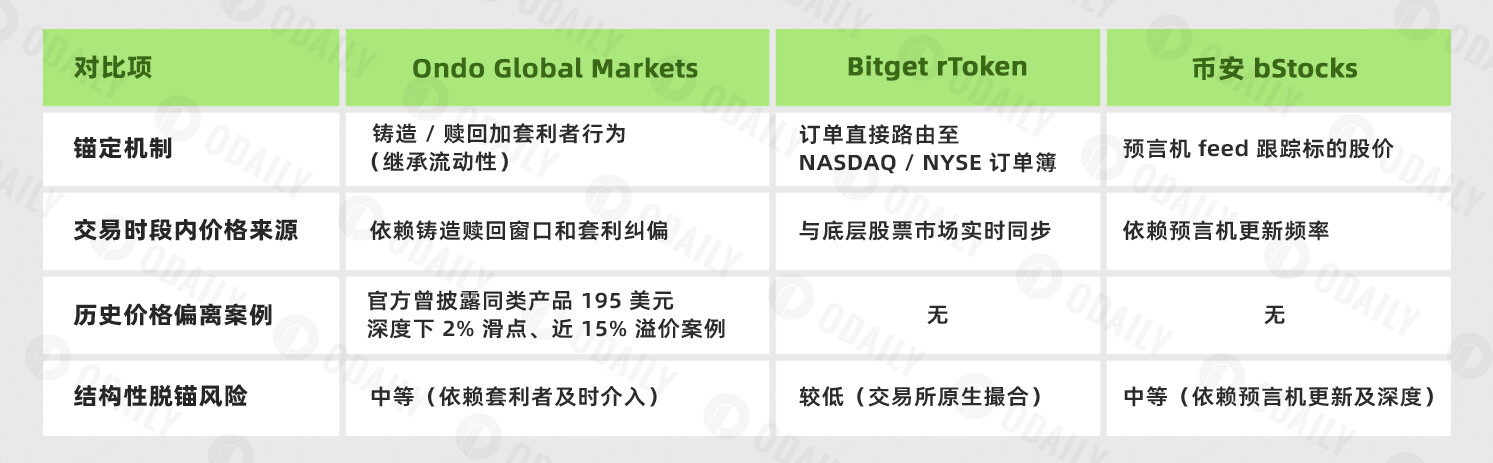
The liquidity anchoring mechanisms of the three are structurally different and suit different use cases. Ondo's minting and redemption model is better suited for users accustomed to native on-chain operations who are willing to bear some delay from arbitrage correction, and also more suitable for arbitrageurs. bStocks' oracle tracking has a lower barrier, making it suitable for ordinary users seeking convenience and broad token coverage. rToken's direct trading order book model is closer to the real price in design logic, especially advantageous in price consistency during regular US stock trading hours, making it suitable for traders demanding high precision and low slippage.
Simultaneously, we conducted a practical order book data test. Taking the Circle (CRCL) tokenized stock as an example, the quotes and depths at the same time on the three platforms showed varying advantages and disadvantages:

In this data set, all three maintained relatively narrow spreads. However, in terms of order book depth and 24-hour trading volume, rToken's performance was more prominent. Its model of connecting to the native order book of stock exchanges holds significant advantages in order absorption capacity and market activity.
Dimension Two: Trading Session and Availability
Regarding 24/7 trading capability, all three products advertise support for 24/7 user trading, but the specific mechanisms differ significantly.
Ondo Global Markets' minting and redemption windows operate 24 hours a day, five days a week. On-chain transfers themselves are not time-limited, providing users with flexible asset transfer capabilities, while price discovery depends on the openness of the minting and redemption windows. rToken covers regular US stock trading hours, pre-market, intraday, after-hours, and overnight sessions. Some popular tokens further support true 24/7 trading. During market closure, Bitget provides internal liquidity to maintain price discovery, achieving seamless transition from regular trading hours to closure. Binance bStocks also emphasizes 24/7 liquidity, near-instant settlement, and zero conversion fees. Leveraging the exchange's native user base allows more tokens to be conveniently traded anytime.
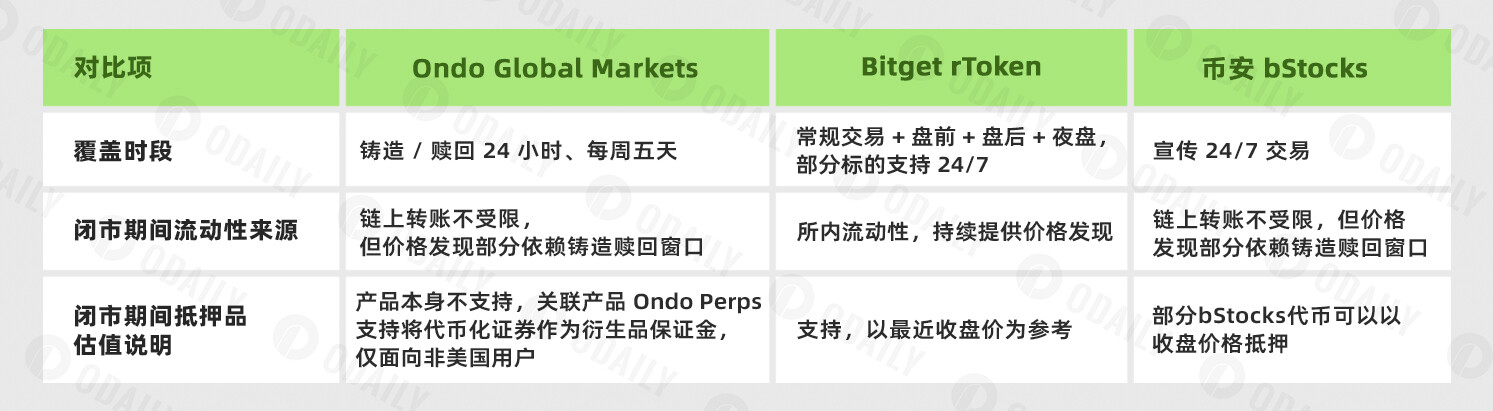
All three consider 24/7 availability a core capability and have established corresponding mechanisms for trading and price volatility risks during US stock market closure. The overall product experience and risk management frameworks are relatively well-developed. In terms of pure 24/7 availability, Ondo falls slightly short in coverage time. Therefore, Bitget rToken and bStocks might be more suitable for everyday users.
Dimension Three: Capital Efficiency and Composability
Capital efficiency is a core consideration for institutions and professional traders when choosing tokenized stock products. It is specifically reflected in whether such assets can be used as margin or collateral and whether they can be flexibly allocated across different accounts and strategies. This is where the actual use-value gap between products becomes apparent. Although this aspect is less relevant for small retail investors with limited capital, it is a core consideration for professional traders and institutions choosing to configure crypto asset exposure to US stocks.
Odaily’s evaluation results are as follows:
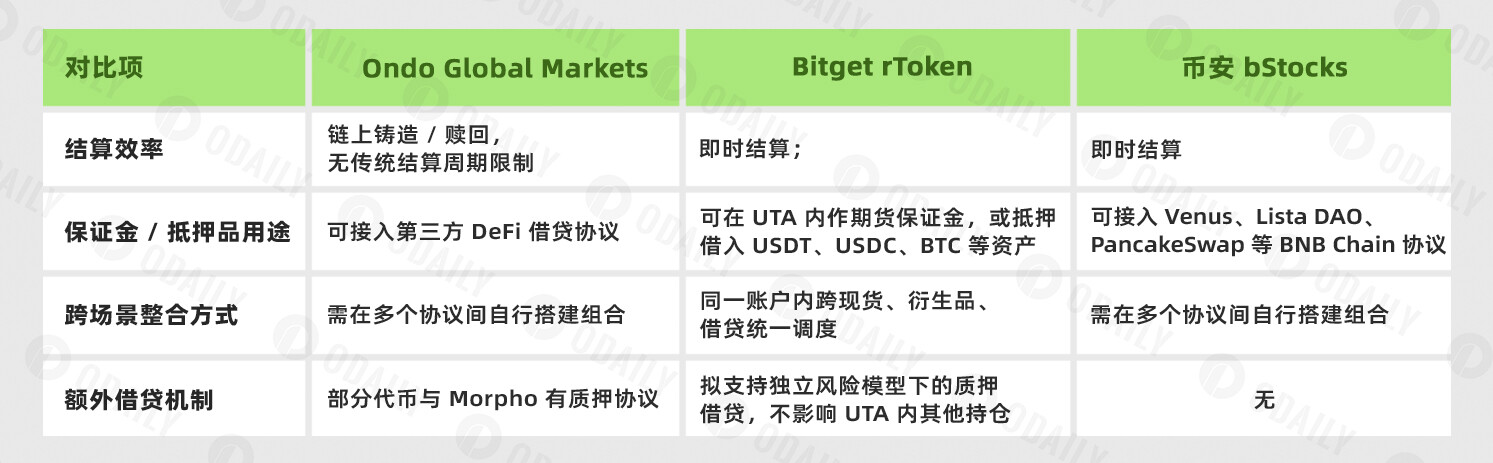
From a design perspective, the capital efficiency functions of the three products are significantly different. Ondo and bStocks lean more towards "on-chain DeFi composability," relying on third-party protocol ecosystems, requiring users to bear friction from cross-protocol operations and additional smart contract risk exposure. rToken takes the "institutional-grade unified margin account within the exchange" route, directly integrating stock positions into scenarios like derivatives and lending, achieving multi-asset synergy within the same account system. If users prioritize on-chain DeFi functions, Ondo and bStocks are more suitable. However, considering the actual capital efficiency needs of professional and institutional traders, rToken's integration and convenience are more prominent and align better with institutional requirements for risk control.
Dimension Four: Compliance Licensing and Custody Transparency
While trading occurs on-chain, whether the underlying US stock assets truly exist and can be independently verified is the foundation for building trust in tokenized stock products. How do the products perform in terms of this credit endorsement?
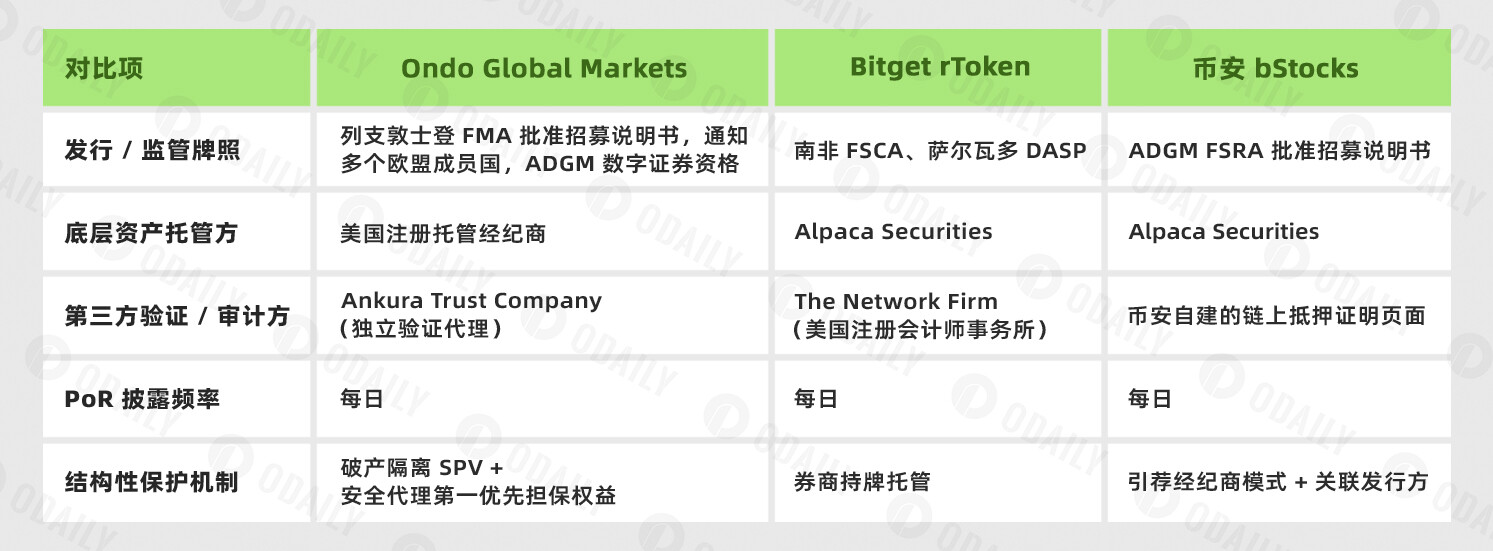
All three employ an asset protection mechanism combining regulated custody with independent third-party verification, establishing a relatively comprehensive framework for compliance, transparency, and credibility of underlying assets. It is evident that after several rounds of rigorous market selection in the crypto space, major players in the stock tokenization field have maximized protection for underlying assets. Differences among the three are more apparent in specific arrangements like audit frequency, information disclosure granularity, and the identity of the verification body. However, the perceived experience for users is quite similar.
Conclusion: Three Products Suit Different Investor Needs, Each with Advantages and Challenges
Looking across the four dimensions and market rankings, the three paths address different needs within the tokenized stock sector.
Ondo Global Markets, with its inherited liquidity model and compliance layout covering multiple jurisdictions, is more suitable for institutions valuing regulatory frameworks and open on-chain applications, as well as users with high European or American compliance needs. Binance bStocks, leveraging the exchange's native traffic and on-chain ecosystem integration, offers convenience in trading entry points, self-custody, and on-chain circulation, making it more suitable for investors deeply embedded in the BNB ecosystem and familiar with on-chain operations. Bitget rToken, with its diverse product features, is better suited for high-frequency traders and institutional clients who are highly sensitive to liquidity, capital efficiency, and cross-scenario asset allocation.
From a longer-term industry perspective, the common challenges facing tokenized stocks are perhaps more worthy of attention than the differences between individual products. Issues like cross-border financial compliance, whether real market demand can keep pace, and the feasibility of precise pricing during market closures still need to be addressed by the industry. As regulatory boundaries gradually become clearer and underlying liquidity continues to deepen, different paths will learn from each other through competition, driving this market from early experimentation to maturity. The boundary once drawn by Wall Street is being gradually rewritten with every on-chain trade.


