






Is the market trend on the Robinhood chain worth paying attention to?


- Core Viewpoint: The meme coin market on the Robinhood chain has fallen into chaos following a 35% plunge in the leading token $CASHCAT. While the short-term correction is normal, in the long run, there are both opportunities and challenges regarding whether the Robinhood chain can leverage its user base to surpass Solana and Base and become the next main battleground for meme coins.
- Key Elements:
- $CASHCAT has pulled back from a market cap high of $230 million to $150 million, a decline of approximately 35%, cooling the overall sentiment on the Robinhood chain.
- Following news of a suspected purchase by the Robinhood CEO's address, the price of $1 surged from $800,000 to $15 million. However, after the news was debunked, it fell back to $1 million, highlighting the speculative nature of the market.
- A hacker stole the SpaceXAI official Twitter account to pump $SCATMAN to a market cap of $2.5 million, which subsequently went to zero. Similar incidents are seen as "signs of doom" on the chain.
- This round of the market lacks a clear second-place leader, similar to the previous trends of the "space dog" $ASTEROID and $ANSEM. Insufficient capital is the core constraint.
- The current meme coin market is essentially an "attention prediction market." The short-term decline is due to the correction of the leading token and a lack of sustained catalysts. Positions in potential targets like $GME and $JUGGERNAUT are in a left-side trading phase.
- In the long term, the Robinhood chain is expected to attract retail capital by leveraging its user base (participants from the GameStop event) and traditional investment channels, driving the expansion of the meme coin ecosystem.
Two days ago, $CASHCAT briefly approached a market cap high of $230 million, but has since pulled back to around $150 million, a decline of nearly 35%.
With the $CASHCAT pullback, the momentum on the Robinhood chain has started to turn chaotic and cool down. Yesterday, a token called $1 rapidly surged from a market cap of about $800,000 to roughly $15 million after news emerged that an address suspected to be linked to the Robinhood CEO had bought in. However, this news was quickly debunked, and the token has since fallen back to a market cap of just over $1 million.
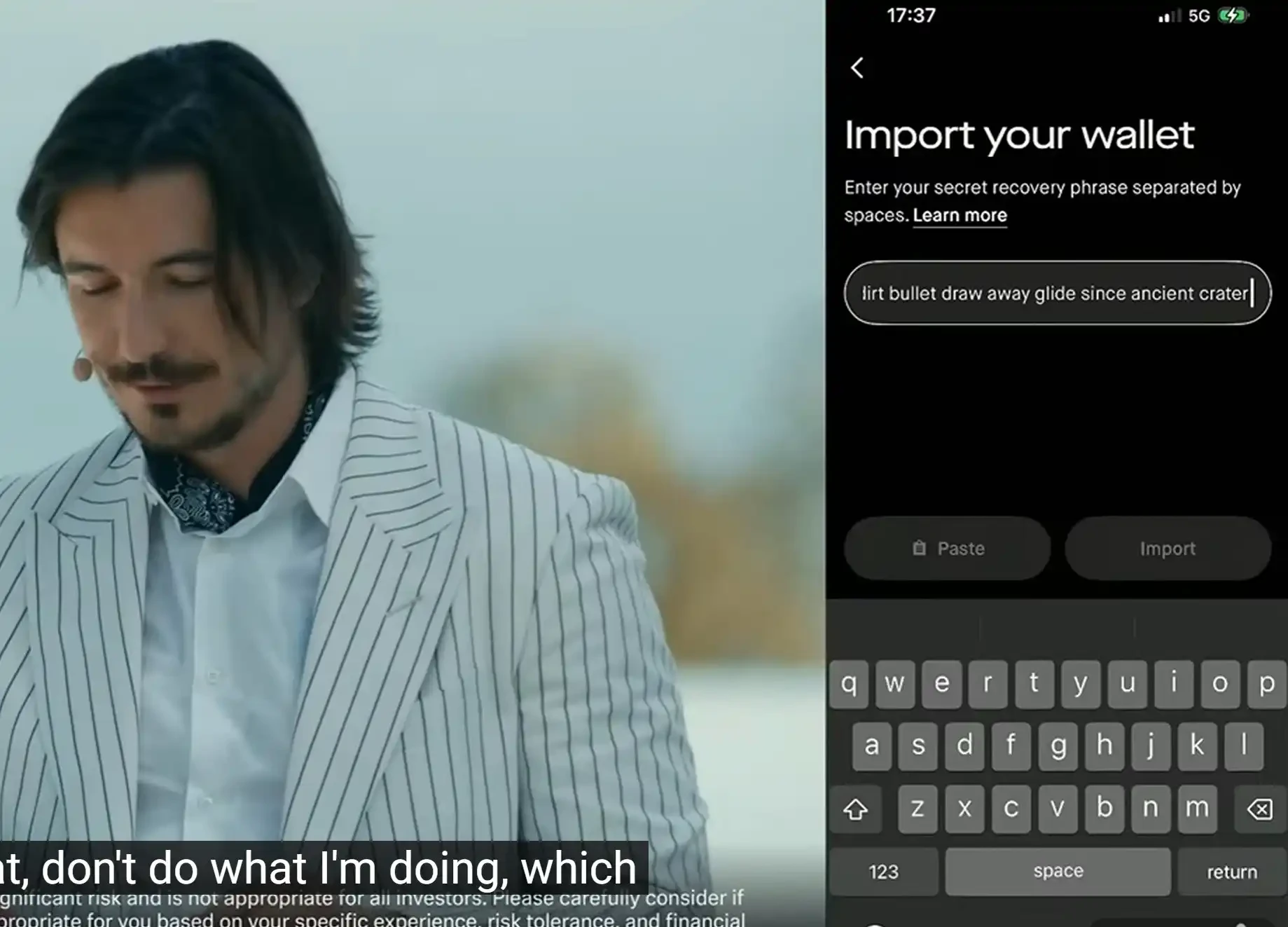
The address in question was used by the Robinhood CEO for a live demonstration, during which 9 out of 12 seed phrase words were inadvertently exposed. Due to this partial leakage, the address had already been compromised a year ago.
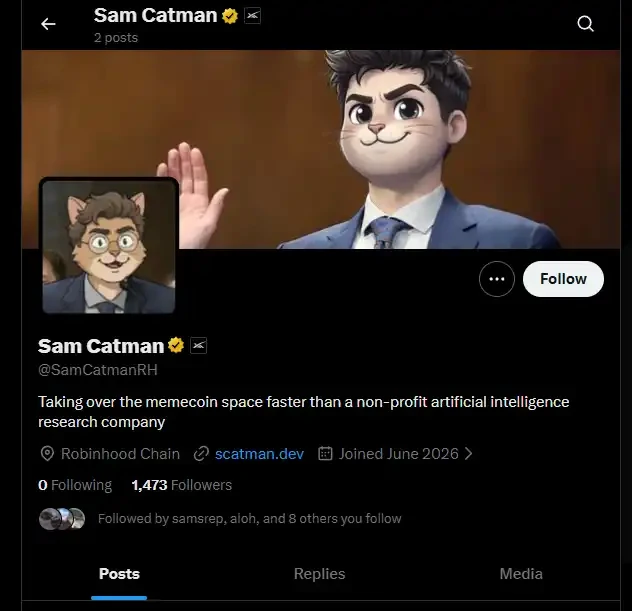
Another token that experienced wild swings yesterday was $SCATMAN. Hackers stole the official SpaceXAI Twitter account, adding an affiliate badge to the X account of this coin, which satirizes Sam Altman, and retweeted posts. At its peak, the token's market cap exceeded $2.5 million, but it now sits at less than $100,000.
The overall sentiment on the Robinhood chain had already been dampened by the $CASHCAT pullback. Combined with events seen as "signs of the end" – such as the "suspected wallet buy" and hackers compromising social media accounts to orchestrate rug pulls – some players have started to declare, "The Robinhood hype is over."
Is it really over? To answer this, we need to analyze several market cycles this year to provide short-term and long-term perspectives.
Short Term: A Normal Correction
If we look back at the most direct catalysts behind $CASHCAT's surge, one is this tweet from Robinhood CEO Vlad Tenev:
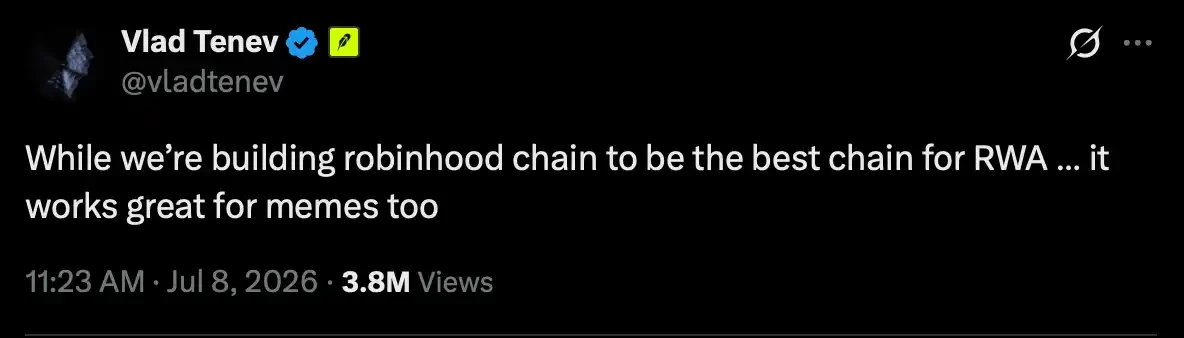
"When we build the Robinhood chain into the best RWA chain, it's also great for memes."
Also on the morning of July 8th, Vlad followed the official $CASHCAT account on X, causing the token's market cap to instantly spike from $10 million to nearly $50 million and continue climbing upward.
Both catalysts were indispensable. One conveyed the attitude that "The Robinhood CEO supports meme coins on our own chain," and the other signaled that "CASHCAT is the designated leader on Robinhood."
Rewind to July 2nd, when the Robinhood mainnet first launched. There were some players interested in this new chain, but not many. They were mostly following the logic of "panning for gold on a new chain." No one could have predicted that less than a week later, the Robinhood CEO would personally get involved, catapulting everyone's expectations to an incredibly high level.
Because of this unforeseen shift in expectations – from "underground to the heavens" – the market began re-pricing the Robinhood chain's prospects, and on a massive scale. Narratives emerged like "The Robinhood chain can bring retail stock traders on-chain" and "$CASHCAT listing on Robinhood could replicate the success of DOGE and SHIB." The rapid surge of $CASHCAT further exacerbated the market's FOMO sentiment.
However, the day's price action also planted some seeds of trouble. The key issue was that apart from $CASHCAT, no clear second-place leader emerged. This is very reminiscent of other market cycles this year:
The ETH mainnet rally led by "Space Dog" $ASTEROID lacked a prominent second-place token, though it benefitted from supporting narratives like Uniswap v4 hooks with tokens such as $UPEG and $SATO.
The Solana rally led by $ANSEM also had no clear second-place token; only assets directly related to the Ansem narrative saw gains.
In both those cycles, the market hoped the leading token would reach a $1 billion market cap, allowing liquidity to spill over into other narratives and expand the scope of PvE targets. But neither succeeded. The primary reason remains a lack of on-chain capital; a $1 billion market cap is exceedingly difficult under current market conditions. Secondly, the explosive growth of these leaders originated from sudden attention events. "Space Dog" surged because Elon Musk agreed to make it the SpaceX mascot, and $ANSEM surged because Ansem himself claimed it. Growth stems from attention events, and subsequent upward movement requires even larger attention-grabbing events as fuel. However, neither of these tokens ever experienced another attention event capable of catalyzing further FOMO.
When attention events cannot be sustained or amplified, the market's nature becomes **arbitrage** rather than **long-term holding**. When nearly all active on-chain players flocked to the Robinhood chain to pan for gold, they began archeologically analyzing Robinhood's tweets, looking for angles. This included $JUGGERNAUT, a meme image the Robinhood CEO replied to as his favorite; the $GME rally that Robinhood famously "pulled the plug on" years ago; and $WALLET, a token allegedly deployed by a Robinhood employee. In reality, this was the spread of FOMO from those who missed out on $CASHCAT. It's reminiscent of people rushing to buy salt during the Fukushima nuclear leak years ago – regardless of whether they actually needed salt, they grabbed it just in case. If it paid off, great; if not, no harm done.
Everyone is chasing and trying to front-run the next target Robinhood might interact with, betting on the unknown. This clearly illustrates that the current meme coin market is almost entirely an **attention prediction market**. The short-term correction is therefore logical. The leading token $CASHCAT fell, and Robinhood offered no further statements that could spark another wave of frenzy. Tokens suspected of being orchestrated by "insider groups," like $JUGGERNAUT and $HOODRAT, failed to break through and hold the $20 million market cap threshold. This indirectly confirms that, so far, the Robinhood chain cycle is not significantly different from the $ASTEROID and $ANSEM cycles.
At this stage, excluding "insider group" schemes, assets capable of maintaining relative stability – and are more likely to receive Robinhood interaction over a longer timeframe, or possess their own narrative independent of direct Robinhood interaction – include $GME, which holds in the $2-3 million market cap range. The expectation is that Robinhood will likely mention $GME again in the future, or that events like GameStop's own stock price movements or the sudden return of Roaring Kitty could catalyze an upswing. Another is $JUGGERNAUT; the Robinhood CEO mentioned it was his favorite meme image. If he mentions it again, it could trigger another significant rally.
But such positioning is very "left-side" investing – betting on potential attention and bearing little resemblance to traditional meme coin community building. Expectations that Robinhood will continuously support the meme coin ecosystem or eventually list its own chain's meme coins are premature and overly optimistic. Yet, it is precisely through such optimism that massive gains like $CASHCAT are achieved. You can't win the lottery if you don't buy a ticket.
Long Term: The Existence of Competition Inspires Optimism
The "Space Dog" cycle ended, and players returned to Solana. BSC's brief "token distribution" cycle ended, and everyone returned to Solana. Solana's advantage in the meme coin market has somewhat reached the level of user habit. "If you want to play memes, go to Solana" is becoming a habit, even a culture.
Because of this foreseeable competition, Robinhood's nascent chain sparks long-term speculation. "What if the Robinhood chain becomes the next Base, Solana, or even surpasses them, bringing back the full-fledged meme bull market on its platform?"
This isn't impossible. After all, the "stock meme-ification" trend is intensifying, and Robinhood was the former headquarters of retail investors, the very ground zero of the GameStop event. Its user base consists of stock traders who accept, are accustomed to, or even enjoy meme-driven trading. If a $GME meme coin on the Robinhood chain rallies and is promoted through channels accessible to traditional investors, a similar scenario could bring both users and capital on-chain.
Meme coins, or trading centered around memes, are the direction of the future. Positive and negative news are merely fluctuations in market sentiment; meme coins simply make this process more direct and engaging. As the market scale expands, negative memories of fragmentation, scams, etc., will naturally fade, because players will no longer need to compete for scraps from a limited pond.
The long-term expectation for the Robinhood chain is an expectation of Robinhood the company's deep and sustained support for meme coins, and more fundamentally, an expectation for meme coins to gain a much wider audience.


