






South Korean securities firm’s earnings “miss” expectations sends SK Hynix plunging 12%, memory sector under broad pressure


- Core Viewpoint: South Korean securities firm KIS lowered its Q2 earnings forecast for SK Hynix, triggering a sharp stock price decline. The primary reason is not deteriorating fundamentals, but rather its excessively high revenue share from HBM (High Bandwidth Memory). Long-term contract price locks caused average selling price increases to lag behind market expectations; however, the logic of long-term earnings sustainability remains unchanged.
- Key Elements:
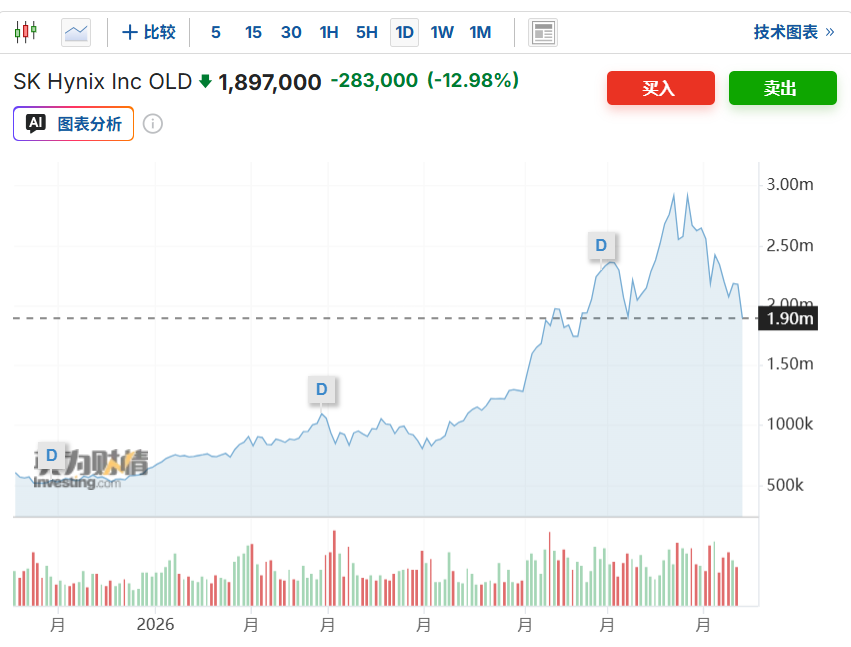
- KIS forecasts SK Hynix’s Q2 operating profit at approximately 60.4 trillion won, about 8% below the market consensus of 65 trillion won. This directly caused the stock price to fall over 10% in a single day, a 33% correction from its historical high.
- The core reason for the earnings miss: HBM, due to fixed prices from long-term agreements (LTAs), failed to fully capture the spot price appreciation benefits of DRAM (average price up 30%) and NAND (average price up 50%) during the same period.
- KIS points out that the forecast downgrade is solely a correction of LTA price assumptions, not a concern over performance, and maintains its target price of 3.8 million won with an ‘overweight’ rating. It expects the Q2 2026 operating profit margin to reach a record high of 74.6%.
- Fragile market sentiment, coupled with fund cashing out after SK Hynix’s US ADR listing, intensified selling pressure. This pressure cascaded to Hong Kong-listed leveraged ETFs (dropping over 22% in a single day) and A-share memory concept stocks.
- Industry trend: As LTA contract structures extend to 3-5 years, the core valuation driver is shifting from single-quarter ASP growth to earnings sustainability. An increasing share of contract revenue will reduce earnings volatility.
Original Author: Long Yue
Original Source: Wall Street News
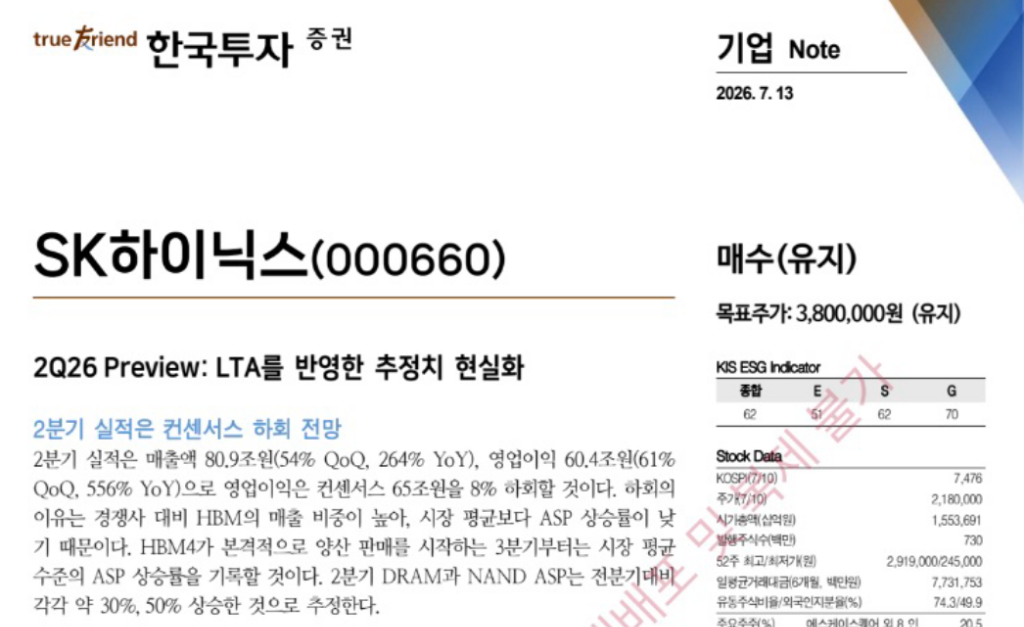
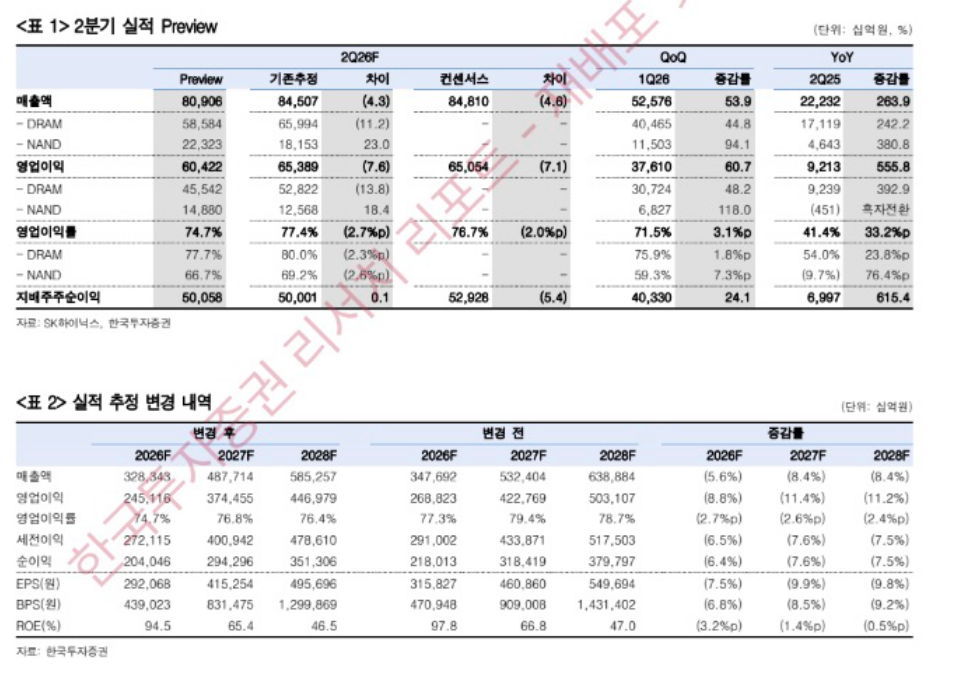
On July 13, South Korean local brokerage KIS released a forecast report for SK Hynix's second-quarter performance. It estimates SK Hynix's Q2 revenue at 80.9 trillion Korean won, up 54% quarter-over-quarter and a massive 264% year-over-year; operating profit is forecast at 60.4 trillion Korean won, up 61% quarter-over-quarter and 556% year-over-year.
The numbers look impressive, but here's the issue: Market consensus expected operating profit of 65 trillion Korean won, and KIS's forecast is about 8% below that consensus.
This deviation directly ignited market turmoil.
After the South Korean stock market opened, SK Hynix's stock price rapidly fell over 10%, breaking through the 2 million Korean won mark. From its historical high on June 25, the stock has corrected 33% in just three weeks.
High HBM Ratio Dragged Down ASP Instead
In its report, KIS explained the core reason for the profit falling short of consensus: SK Hynix's HBM (High Bandwidth Memory) revenue share is higher than its peers, and its shipment proportion is high, leading its average selling price (ASP) growth to lag behind the market average.
This logic seems counterintuitive at first glance — if HBM is a premium product, shouldn't a higher share mean more profit?
The key lies in the pricing structure. HBM prices are typically locked in through Long-Term Agreements (LTAs), making contract prices relatively fixed and unlikely to increase sharply with short-term market fluctuations. In contrast, regular DRAM and NAND have higher price elasticity in the spot market, so their ASP increases more during market-wide price hikes.
SK Hynix's higher HBM ratio means it has "reaped less benefit from the price increase" during this market upcycle compared to its peers.
While the average spot prices of regular DRAM and NAND continue to soar — KIS forecasts DRAM ASP to rise about 30% quarter-over-quarter in Q2 and NAND by about 50% — Hynix's overall ASP growth was "held back" by HBM's contract prices.
Downgrade Due to LTA Recalculation, Not Fundamentals Deterioration
KIS clearly stated in the report that this downward revision is not due to performance concerns, but rather a revised result after incorporating the price assumptions of signed Long-Term Agreements (LTAs) into the forecast.
The report states: "This is a result of incorporating signed LTAs into price assumptions and realistically adjusting the forecast; it does not reflect concerns about performance."
KIS also lowered its operating profit forecasts for 2026 and 2027, by about 9% and 11%, respectively, compared to previous estimates. However, the brokerage emphasizes that starting from official mass production of HBM4 in the third quarter, the upward trend in average selling prices will drive Hynix's overall ASP higher, and by then, SK Hynix's ASP growth will return to the market average level.
KIS predicts that the operating profit margin for Q2 2026 will reach 74.6%, a new all-time high, and will continue to rise sequentially each quarter thereafter.
The brokerage maintains its target price of 3.8 million Korean won and a buy rating, believing that this forecast adjustment is only a short-term disturbance and does not change the medium to long-term upward trend in performance.
"A 556% Surge Missed Estimates": Cracks in Market Sentiment
A 556% year-over-year increase is an extremely strong number in any industry. But the logic of the capital market is: What matters is not how much it increased, but whether it met expectations.
The market had already fully priced in the consensus expectation of 65 trillion Korean won. KIS's forecast was about 4.6 trillion Korean won lower than this figure, effectively declaring that "expectations were too high."
This triggered two layers of concern: first, the direct impact of missing short-term performance expectations; second, whether the high HBM ratio constitutes a structural risk — meaning the more SK Hynix bets on HBM, the more its ASP flexibility is constrained during the contract price lock-up period.
Compounding this, SK Hynix just listed on the U.S. stock market last Friday. Some funds that had placed "IPO bets" chose to cash out after the ADR listing, further exacerbating the selling pressure.
Sell-off Spreads: Hong Kong ETFs and A-Share Memory Stocks Fall in Tandem
SK Hynix's decline quickly transmitted to surrounding markets.
In Hong Kong, the 2x Long SK Hynix Leveraged ETF fell over 22% in a single day, and the 2x Long Samsung Electronics ETF dropped over 13%.
A-share memory concept stocks also fell in tandem, with major names like GigaDevice, Ingenic Semiconductor, Biwin Storage, and Longsys Electronics all declining by more than 7%.
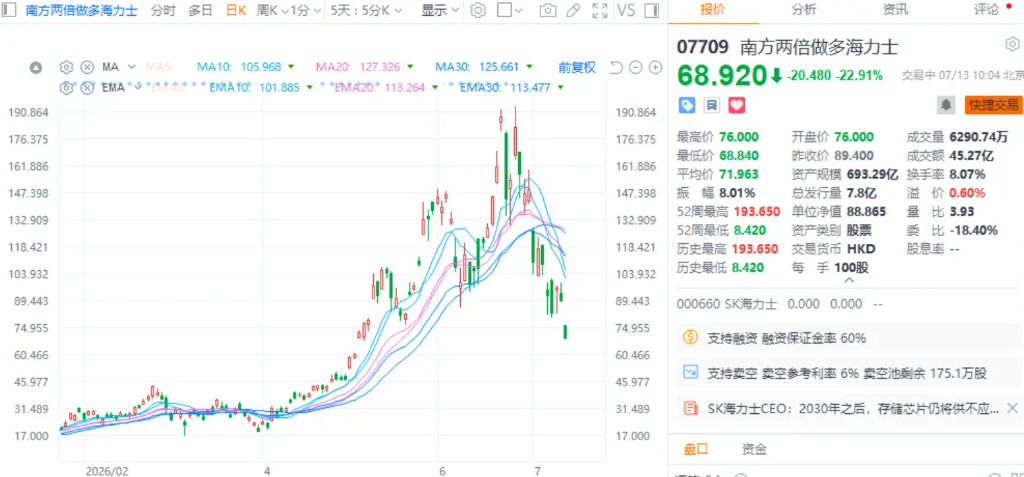
However, from a broader perspective, the storage semiconductor sector has entered an adjustment phase over the past half-month. Some stocks have fallen over 20%, touching the threshold of a technical bear market. Behind this are factors like global funds rebalancing their allocations within the AI sector and across different markets, including the "sell chips, buy cloud" rotation logic, and the phased rebound in the Hong Kong market attracting capital back from A-shares.
Brokerages: Long-Term Logic Intact, Focus on Profit Sustainability
Despite causing market turbulence, KIS's overall stance in the report is not pessimistic.
The brokerage believes that as the memory industry shifts towards a 3-to-5-year LTA contract structure, the core driver of corporate valuation will transition from "single-quarter ASP growth" to "how long high profitability can be sustained."
The KIS report states: "From now on, the focus should be on the sustainability of profitability. The expansion of LTAs is reducing the long-standing earnings volatility in the memory industry."
The brokerage expects that with the increase in contract-based revenue share and the supply squeeze caused by HBM capacity expansion, SK Hynix's high profitability will be maintained over the long term, and its valuation will be repriced accordingly.
The target price of 3.8 million Korean won still implies substantial upside from the current stock price, so KIS maintains its buy rating.


