






Vitalik and Aya's Conversation in Hong Kong: The Ethereum Ecosystem Is Entering a Multi-Node Future


- Core Insight: Ethereum is transitioning from a coordination model centered around the Ethereum Foundation (EF) to a multi-node ecosystem where the EF focuses on core protocol values, and specialized organizations like Ethlabs and Ethereum Institutional collaborate through division of labor. This reflects the EF's "subtraction philosophy," aiming to enhance the ecosystem's long-term resilience and institutional adoption capabilities.
- Key Elements:
- The EF was restructured on June 23rd, with an organizational structure covering five layers: Protocol, Access, User, Community, and Institution. The goal is to focus on long-term strategy and core values such as CROPS (Censorship Resistance, Open Source, Privacy, Security).
- An independent R&D organization, Ethlabs, was established, founded by former EF researchers and supported by Bitmine, Joe Lubin, and others. It focuses on developing protocols for the next stage of requirements, including institutional adoption and Agentic Finance.
- Ethereum Institutional was launched as a non-profit organization, taking over the EF's institutional engagement functions. It promotes Ethereum as a neutral digital public infrastructure to global policymakers and institutions.
- Etherealize continues to drive the integration of Ethereum with traditional finance, focusing on tokenization, native settlement, and institutional-grade privacy, aiming to build financial infrastructure for a trillion-dollar market.
- EF Executive Director Aya Miyaguchi emphasized the "Walk-away Test" philosophy, where the EF's success lies in the system's ability to function independently without the EF, reducing ecosystem dependency to foster competition.
- Vitalik Buterin distinguished between core protocol development (requiring long-term coordination and consensus) and L2 development (resembling a free market), stressing that the EF should serve the long-term trust and neutrality of the protocol.
- The ETH HK Hub was established in Hong Kong, connecting the Chinese-speaking and global communities, and serving as an important node for institutional adoption and builder coordination in Asia, operated by SNZ and ETHTAO.
Author: @cynthiaju333; Reviewer: @NPC_Leo
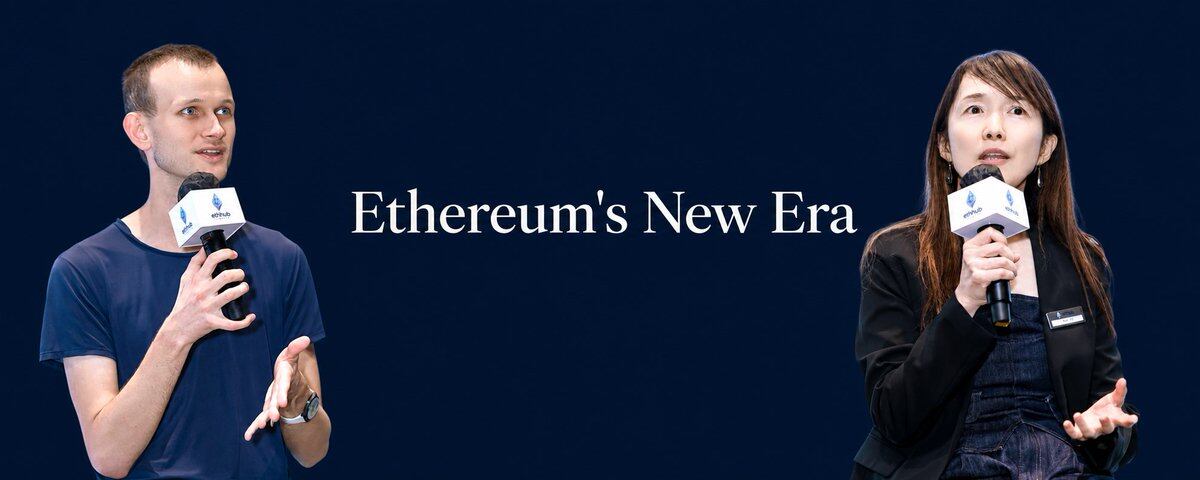
Over the past two months, a series of significant events have occurred in the Ethereum ecosystem: the Ethereum Foundation (EF) completed its organizational restructuring, Ethlabs was established as an independent non-profit R&D organization, Ethereum Institutional officially launched as an independent institutional onboarding gateway, and Etherealize continued to drive the Ethereum narrative towards Wall Street and capital markets. The community has engaged in extensive discussions surrounding the EF's organizational restructuring, the formation of new community-driven teams, institutional adoption initiatives, and the division of R&D and governance structures.
On April 21, 2026, ETH HK Hub officially opened in Hong Kong, featuring two important dialogues. One was a Chinese conversation between Vitalik Buterin and Hong Kong Legislative Council member Duncan Chiu. They discussed the development of the Chinese-speaking community over the past twelve years, Layer 2, core protocol development, quantum resistance roadmap, Layer 1 scaling, and the areas truly worth building for Ethereum builders going forward. The other was an English roundtable between EF Chair Aya Miyaguchi, Council member Duncan Chiu, and Ecosystem Fund Partner QZ. It focused on the EF's role, the Subtraction Philosophy, the Walk-away Test, and Hong Kong's position within the Ethereum ecosystem.
Looking back two months later, how can we gain a deeper understanding of the changes within the entire Ethereum community? The two dialogues between Vitalik and Aya offer crucial reflection and reference points, making it easier to understand that Ethereum is entering a new phase of development—a future of multi-node community possibilities and continued evolution.
What Happened to Ethereum in the Past Two Months?
On May 24, Vitalik Buterin published a long post on his X account, publicly elaborating on his personal views regarding the EF's future direction. He emphasized that the EF will pursue "longevity over breadth", reducing ETH sales and the foundation's financial expenditures, and focusing more on its core values CROPS (Censorship/Capture resistance, Openness, Privacy, Security). He also pointed out that the EF is not the center of Ethereum, but rather "one node, with a defined purpose," advocating for a pluralistic landscape of multiple focused nodes collaborating within the ecosystem.
On June 23, the EF officially announced its new organizational structure on its official blog. The new structure includes the Protocol Layer, Access Layer, User Layer, Community Layer, and Institution Layer, along with operational and management support structures. Through this restructuring, the EF has aligned its organizational form more closely with long-term strategic goals, ensuring the future sustainable development of Ethereum.
Around the same time, Ethlabs, an independent non-profit R&D organization, was announced, co-founded by five former EF senior researchers: Ansgar Dietrichs, Barnabé Monnot, Caspar Schwarz-Schilling, Josh Rudolf, and Julian Ma. Its initial funding support comes from Bitmine, Sharplink, Joe Lubin, SNZ, and others. Its goal is to prepare Ethereum for the next phase of institutional adoption, agentic finance, DeFi, stablecoins, and RWAs, collaborating with the EF in different areas to advance Ethereum protocol development and build a multi-node ecosystem.
On July 1, the EF's Global Policy and Strategy Team released a guide for governments and institutions: "Ethereum for Governments & Institutions: Why Neutral Infrastructure Matters Now." This report actively helps global policymakers and large institutions gain a deeper understanding of Ethereum. Its core premise is that: today's world needs a "shared, neutral digital public infrastructure not controlled by any single centralized entity," and Ethereum is the public, programmable network designed for this purpose.
On the same day, Ethereum Institutional officially launched as an independent non-profit organization, positioning itself as the "dedicated institutional front door" for the Ethereum ecosystem. It takes over the institutional outreach work handled by the Ethereum Foundation's go-to-market team over the past year, operating with a clearer mission, broader geographic coverage, and long-term financial independence. Its key focus areas include Institutional Education & Engagement, Institutional Insights, ETH & Ecosystem Marketing, Standards & Best Practices, and Institutional Events.
Concurrently, Etherealize continues to bridge Ethereum with traditional finance. Its website positions itself as "Rewiring Wall Street with Ethereum," building multi-trillion-dollar market financial infrastructure for tokenization, native Ethereum settlement, and institutional-grade privacy. Wall Street's interest in Ethereum is shifting from proofs-of-concept and pilot projects towards viewing the public chain as production infrastructure; discussions are expanding from stablecoins to tokenized stocks, bonds, real estate, and investment funds.
Together, these events point to a larger shift: Ethereum is moving from a stage where the Ethereum Foundation (EF) bore the brunt of coordination and public narrative, to a new stage where multiple specialized organizations undertake different capabilities. The EF is increasingly focusing on protocol governance, credible neutrality, self-sovereignty, and long-term resilience. Ethlabs takes on R&D and infrastructure capacity building for the next phase of adoption. Ethereum Institutional handles institutional education, standard-setting, market awareness promotion, and serves as the entry point for global financial institutions. Etherealize continues to drive Ethereum's narrative into capital markets and traditional finance.
These organizations are not part of a single centralized plan, nor should they be simplistically understood as outsourcing or replacements for the EF. They collectively reflect the emergence of a clearer division of capabilities within the Ethereum ecosystem: protocol neutrality, institutional adoption, capital market narrative, applied research and development, and local community coordination are being shouldered by different nodes.
More precisely, Ethereum is entering a new developmental phase and ecosystem structure. And looking back at the scene at ETH HK Hub on April 21, it becomes clear that what Vitalik and Aya discussed that day were precisely the long-term principles underlying this change.
EF Chair Aya on the Subtraction Organization Philosophy
During the roundtable at ETH HK Hub, Aya Miyaguchi repeatedly discussed a concept: the Walk-away Test.
Her point was that the EF's long-term goal is not to become a larger, more controlling central organization, but to ensure the entire system can continue to function even without the EF.
She stated: "Ethereum must pass the Walk-away Test—even without the Ethereum Foundation, the entire system should be able to operate normally."
Aya recalled on site that she joined the EF during the ICO boom. At the time, many suggested the foundation rapidly expand, establishing positions like CTO and CMO like traditional tech companies, taking on more centralized functions.
But the EF did not do this.
She explained: "If the foundation builds everything for the entire ecosystem, participants will become dependent. In the long run, this weakens competition, and without competition, optimal solutions cannot emerge."
Behind this lies Ethereum's fundamental belief: the health of the system comes not from the strength of a single organization, but from the ecosystem's ability to continuously generate new capabilities, new organizations, and new builders.
So when Aya says: "Success means the Foundation does less, while Ethereum becomes stronger."
This statement gains a more concrete context two months later.
From this perspective, the emergence of Ethlabs, Ethereum Institutional, Etherealize, and global Ethereum community Hubs appears more as an external manifestation of the EF's Subtraction Philosophy: as the base protocol matures, the ecosystem no longer requires an all-powerful command-and-control center, but rather multiple organizations with shared beliefs, independence from one another, each undertaking different responsibilities.
Vitalik on the Boundaries of Protocol Coordination
In his dialogue at ETH HK Hub, Vitalik also made a very important distinction that resonates strongly today.
He said, "Core protocol development and L2 development are completely different in difficulty. L2 is more like a free market. If an outsider builds something better, they have a chance to win."
But core protocol is different. Core protocol development requires long-term coordination with existing developers, building consensus among client teams, researchers, the community, and upgrade roadmaps.
Therefore, the truly important question is: Are these efforts still serving Ethereum's long-term protocol goals? Are they still upholding credible neutrality, security, privacy, censorship resistance, and Ethereum's fundamental properties as public infrastructure?
Ethereum's most core work remains enabling a decentralized protocol to continuously evolve through long-term coordination.
Why Hong Kong?
In Aya's roundtable, she mentioned that "the community Hub emerging in Hong Kong is itself an embodiment of the EF's Subtraction Philosophy."
If Ethereum's future is not driven by a single center but built collaboratively by multiple independent nodes, then local Hubs are not just event spaces or community activity organizers. They represent a new form of ecosystem infrastructure.
They connect not just developers, but also institutions, researchers, capital, policymakers, public goods builders, and new entrants coming from traditional finance, AI, hardware, stablecoins, RWAs, and payments into Ethereum.
Hong Kong sits precisely at these intersection points. It is an international financial hub, a place where Eastern and Western capital, policy, and technological contexts meet; it connects Chinese-speaking builders with the global Ethereum community and is adjacent to Shenzhen's hardware, AI, and manufacturing ecosystem.
Therefore, when Hong Kong and Singapore appear in Ethereum Institutional's global roadmap, when SNZ becomes a supporter of Ethlabs, when ETH HK Hub becomes Asia's first physical Ethereum community center—they all point towards a common trend: Asia is becoming a crucial node for Ethereum's institutional adoption and builder coordination.
This is also the role SNZ and ETH HK Hub aspire to play. Our role is to establish a long-term coordination node in Hong Kong and Asia, where builders, researchers, institutions, capital, policymakers, and the global Ethereum community converge, extending dialogues from events into longer-term construction.
Two Months Later, What Has Truly Changed?
Over the past two months, many have asked: What happened to the EF? Who left? Who founded new organizations? Will Ethlabs replace the EF? Does Ethereum Institutional mean Ethereum is actively vying for the institutional market?
Starting again from the two dialogues on April 21, perhaps the answers become clearer.
The EF is increasingly focusing on what it should protect most: protocol neutrality, long-term security, openness, privacy, censorship resistance, and self-sovereignty. At the same time, more specialized organizations are emerging within the ecosystem, undertaking R&D, institutional adoption, capital market narratives, local community coordination, developer education, and policy communication.
The EF doing less does not mean Ethereum is doing less. On the contrary, it requires more people, more organizations, more regions, and more Builders to step up.
Perhaps the biggest narrative of the past two months is that Ethereum continues to prove what it has always believed:
A resilient ecosystem relies on continuously generating new nodes, new modes of collaboration, and new builders.
The existence of ETH HK Hub is precisely to participate in such a future.
ETH HK Hub is co-operated by SNZ and ETHTAO, with support from the Ethereum Foundation.


