






日本央行无法打赢的战争


- 核心观点:日本央行为支撑日元进行的史无前例的干预与加息努力,因美日巨大利差和自身高达250%的政府债务导致的财政抑制,注定难以打赢这场汇率保卫战。
- 关键要素:
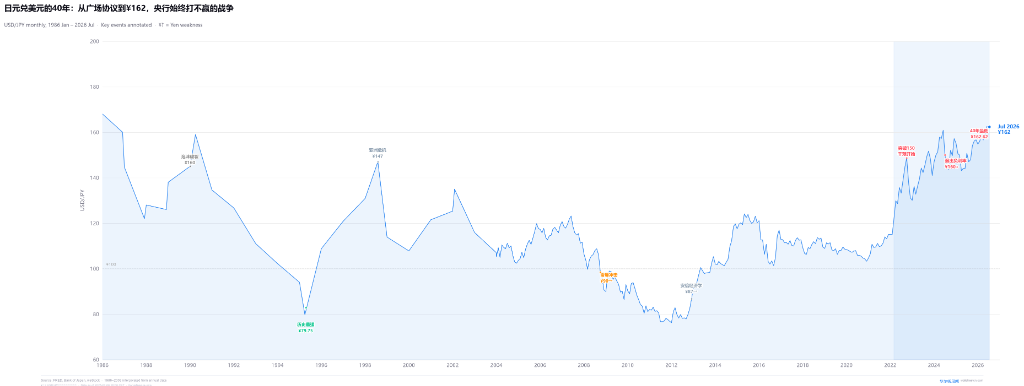
- 日本财务省于2026年4-5月投入11.7万亿日元干预汇率,创单月历史纪录,但日元在六周内便贬至162.62,创近40年新低。
- 美元与日元间275个基点的利差催生了持续的套息交易机制,对冲基金日元净空头仓位处于极端水平。
- 日本2026财年预算中偿债支出(国债费)达31.3万亿,占财政收入的25%,加息将导致利息支出暴增,形成“央行加息、财政放水”的自我抵消困境。
- 日元贬值导致2026年上半年中小型企业破产数达5346家,同比增7.1%,其中直接因汇率波动破产的企业数创历史新高。
- 高盛已将美元兑日元12个月目标价上调至165,市场认为2027年6月前触达该水平的概率为72%。
Original Source: Wall Street CN
Between April 28 and May 27, Japan's Ministry of Finance spent 11.7 trillion yen buying the yen. This was the largest single-month intervention in Japan's forex history.
On June 30, the yen fell to 162.62 against the dollar – its lowest since December 1986. It touched that level again during trading on July 8. Today, it continues to trade above 162.
11.7 trillion yen held for less than six weeks.
It's not that the Bank of Japan didn't try. In June, the policy rate was raised to 1%, the highest in 31 years. Since ending negative rates in March 2024, cumulative rate hikes have exceeded 100 basis points. Combined with the 9.8 trillion yen intervention in 2024, the Ministry of Finance has spent over 21 trillion yen in dollar reserves over the past two years.
Goldman Sachs is not convinced. On July 6, strategist Karen Reichgott Fishman revised their one-year USD/JPY target from 155 directly to 165 – one of the most bearish predictions on Wall Street. Market pricing implies traders see a 72% probability of reaching 165 before June 2027.
This isn't a "hike another 25 basis points" problem. The BoJ is fighting a war it was destined to lose from the start.
The 275 Basis Point Gravity
The forex market doesn't trade absolute values; it trades differences.
The Fed's benchmark rate is 3.50-3.75%, the BoJ's is 1%. A difference of 275 basis points. Latest CFTC data shows hedge fund net short yen positions are at extreme levels for recent years.
275 basis points means a trade repeated countless times daily: borrow yen (with inflation over 3%, a 1% interest rate means a real negative rate), convert to dollars, buy US Treasuries yielding over 4.5%. Excluding exchange rate movements, the annualized carry return exceeds 3%. For every yen depreciation, the return increases a bit more.
This isn't just "market sentiment." It's a mechanism. Carry trades don't care if the BoJ hikes 25 or 50 basis points, they only care about the interest rate differential between the US and Japan. As long as the Fed doesn't cut rates – and oil prices are surging, Iran tensions are escalating, the shadow of US inflation is far from gone – the yen isn't facing the BoJ; it's facing the gravitational field of the entire dollar system.
The 11.7 trillion yen intervention was absorbed by the market in under six weeks, not because the amount was too small, but because the direction was wrong.
For Every 4 Yen in Tax Revenue, 1 Yen Goes to Interest Payments
More fatal than the US-Japan rate differential is Japan's fiscal situation – a chain tied around the BoJ's ankle, tightening the more it struggles.
The FY2026 budget totals 122.3 trillion yen, a record high. Of that, "national debt service" – spending to repay government bond principal and interest – is 31.3 trillion yen, up a full 3 trillion from 28.2 trillion the previous year, consuming a quarter of the budget.
The Japanese government gives 1 yen from every 4 yen of tax revenue to its creditors.
More troubling, this number is accelerating.
The 10-year JGB yield has risen from 0.25% in 2022 to 2.88% today. The Japanese government isn't repaying old debt; it's rolling over old debt with new debt. Government debt exceeds 250% of GDP. Maturing debt must be repaid with newly issued bonds, and the interest rate on new debt is over a dozen times higher than the old debt. Within the 31.3 trillion debt service cost, the growth rate of the interest portion far outpaces principal repayment. Interest begets interest; the snowball grows on its own.
If the 10-year JGB yield rises another 100 basis points – not an aggressive move; the BoJ continuing to hike, or even just reducing bond purchases, could achieve this – debt service costs would easily exceed 35 trillion yen and head towards 40 trillion. At that point, for every 3 yen in tax revenue, 1 yen would go to interest payments.
This is the BoJ's rate hike ceiling. It's not that inflation doesn't allow it, or politics doesn't allow it; it's that the Ministry of Finance has directly calculated the cost: if you hike another 50 basis points, the yen might not appreciate by 100 points, but our interest bill will increase by trillions first. The market also makes this calculation – so rate hikes don't boost the yen; instead, they reinforce the market's certainty that the BoJ will ultimately be restrained by the Ministry of Finance.
Brake and Accelerator
The Ishiba administration's attitude towards fiscal policy is exactly opposite to the BoJ's.
In the FY2026 budget, defense spending breaks 9 trillion yen, increasing for the 14th consecutive year, reaching 2% of GDP in FY2025. The ruling coalition is discussing a possible suspension of the consumption tax on food, which would reduce annual revenue by 4 to 5 trillion yen. Various economic stimulus measures and household subsidies continue to be added. Nomura Securities warned earlier this year that this "Ishiba trade" model – Japanese stocks up, yen down, long-end JGBs under pressure – has market pricing logic strikingly similar to UK PM Truss's 2022 "mini-budget": the government spends without limits, and the market does the pricing.
There is only one difference. Truss was gone in 45 days. Japan's fiscal expansion has lasted for thirty years.
Rate hikes tighten monetary policy; bond issuance loosens it. The central bank steps on the brakes, the Ministry of Finance floors the accelerator. More ironically, the BoJ itself is the largest holder of JGBs – while its monthly trillions-of-yen bond purchase program is being scaled back, as long as it continues buying, every 1 yen of JGBs purchased releases 1 yen into the market. So it tightens with one hand and loosens with the other; the two actions offset each other.
The market doesn't need to be an economist to see: every card in the BoJ's hand is neutralized by another card.
5,346 Companies
Behind the numbers are real costs.
On July 8, Tokyo Shoko Research reported that in the first half of 2026, 5,346 companies with liabilities of 10 million yen or more declared bankruptcy, up 7.1% year-on-year, the fifth consecutive year of increase, and the first time surpassing 5,000 in the first half of a year in 12 years.
Companies bankrupted directly due to yen depreciation numbered 45, up 32.3% year-on-year, the highest since records began. The wholesale industry bore half the burden – 23 out of 45, compared to just 14 during the same period last year. Additionally, bankruptcies due to labor shortages rose 37.7%, and those due to price hikes rose 27.6%.
These figures reveal a fact overshadowed by "record profits for large corporations": yen depreciation is not universally beneficial.
Labor shortages are the flip side of the same coin. Major corporations lure young workers with high wages. It's not that small companies lack orders; they lack people to do the work. Concurrent data from Teikoku Databank shows "bankruptcies due to labor shortages" hitting an all-time high.
No Winning Hand
Three paths, three directions, all with costs.
No rate hike. The yen continues to fall, import costs keep rising, SMEs keep collapsing. Social discontent keeps mounting.
Rate hike. Bond interest payments skyrocket, fiscal sustainability is jeopardized, the market bets the central bank will eventually be reined in by the government – the yen continues to fall because the market sees an "exit illusion," not tightening resolve.
Rate hike plus balance sheet reduction. JGB yields surge, global carry trades reverse, Japanese investors sell off overseas assets and repatriate funds – the yen might appreciate in the short term, but the August 2024 script is on the table: that time, the BoJ's unexpected rate hike didn't trigger a steady yen recovery; it triggered a global stock market crash.
None of the three paths work, because the problem fundamentally isn't something monetary policy can solve. Japan's 250% government debt, its continuously shrinking working-age population, its year-after-year expanding fiscal deficit – these aren't things a 25 basis point rate adjustment can change.
On July 6, when Goldman Sachs adjusted its target to 165, the market wasn't waiting for the next BoJ meeting. It was pricing in something deeper: whether the BoJ has any chance of winning.
The answer is becoming increasingly clear: it was destined to lose from the start.
162.62 is not the end, and 165 probably isn't either. Unless a miracle of fiscal discipline returns, or the Fed cuts rates significantly, this "impossible trinity" will only lock itself tighter. The direction of the yen doesn't depend on Tokyo; it depends on Washington, Riyadh, and the deeper currents of global capital flows.
What the BoJ can choose is merely, in this war it was destined to lose, whether to lose slowly or lose badly.


