






Analyzing the semiconductor "chemical key" hydrofluoric acid concept stocks: The industry chain is fully priced, differentiation has only just begun


- Core Thesis: Driven by AI capacity expansion and rising supply chain costs, the price of electronic-grade hydrofluoric acid continues to rise, leading to a significant surge in the stock prices of related A-share sectors. However, attention should be paid to the fundamental divergence among individual stocks. Most companies' profits mainly come from non-semiconductor businesses or rely on expectations; only a few enterprises with G5 production capacity and customer certifications have real performance support.
- Key Factors:
- Electronic-grade hydrofluoric acid is indispensable for precisely dissolving silicon oxide in chip manufacturing. G5 grade products (suitable for 14nm and below processes) generate high profits due to technical barriers and customer certification hurdles (cycle of 2-3 years), with gross margins reaching 50%-60%. The global shortage of high-end supply is nearly 70%.
- Leading A-share companies like Do-Fluoride (4万吨/年 G5 capacity, certified for TSMC's 3nm, etc.) and Juhua Group (3万吨/年 G5 capacity) have scale advantages. However, Do-Fluoride's 480% profit growth in Q1 2026 was mainly driven by the price increase of lithium hexafluorophosphate (a lithium battery material), not hydrofluoric acid.
- There is a large gap between the stock price surge and fundamentals for companies like China Juhua Microelectronics and Jiangmen Jianghua Microelectronics. China Juhua only reported a profit of 6.37 million yuan in Q1, and the company has publicly denied having direct hydrofluoric acid business dealings or price increase agreements with Samsung, etc.
- Crystal Clear Electronic Material Co. is in a relatively favorable position. Its G5 electronic-grade sulfuric acid has been supplied in bulk to SMIC, with revenue share rising from 5% to 20%. With real orders materializing, its stock price is only 7% away from its 52-week high.
- Regarding capital flows, taking Do-Fluoride as an example, institutional seats have been continuously net selling, while retail investors (hot money) are net buying, showing typical characteristics of overheating market sentiment for thematic stocks. With a high turnover rate (around 20%), there is significant profit-taking pressure.
- Short-term catalysts (price hikes by Korean manufacturers, mid-year reports, CXMT IPO) could support sentiment, but the mid-year report season will be the key point for fundamental verification. Stocks whose performance cannot match their valuations will be the first to decline.
Original Author: David
Electronic-grade hydrofluoric acid has been in high demand lately.
On July 1, Taiwan's Economic Daily News reported that TSMC, Samsung, and SK Hynix are all scrambling to purchase this material, with suppliers having already raised prices by 20% to 30%.
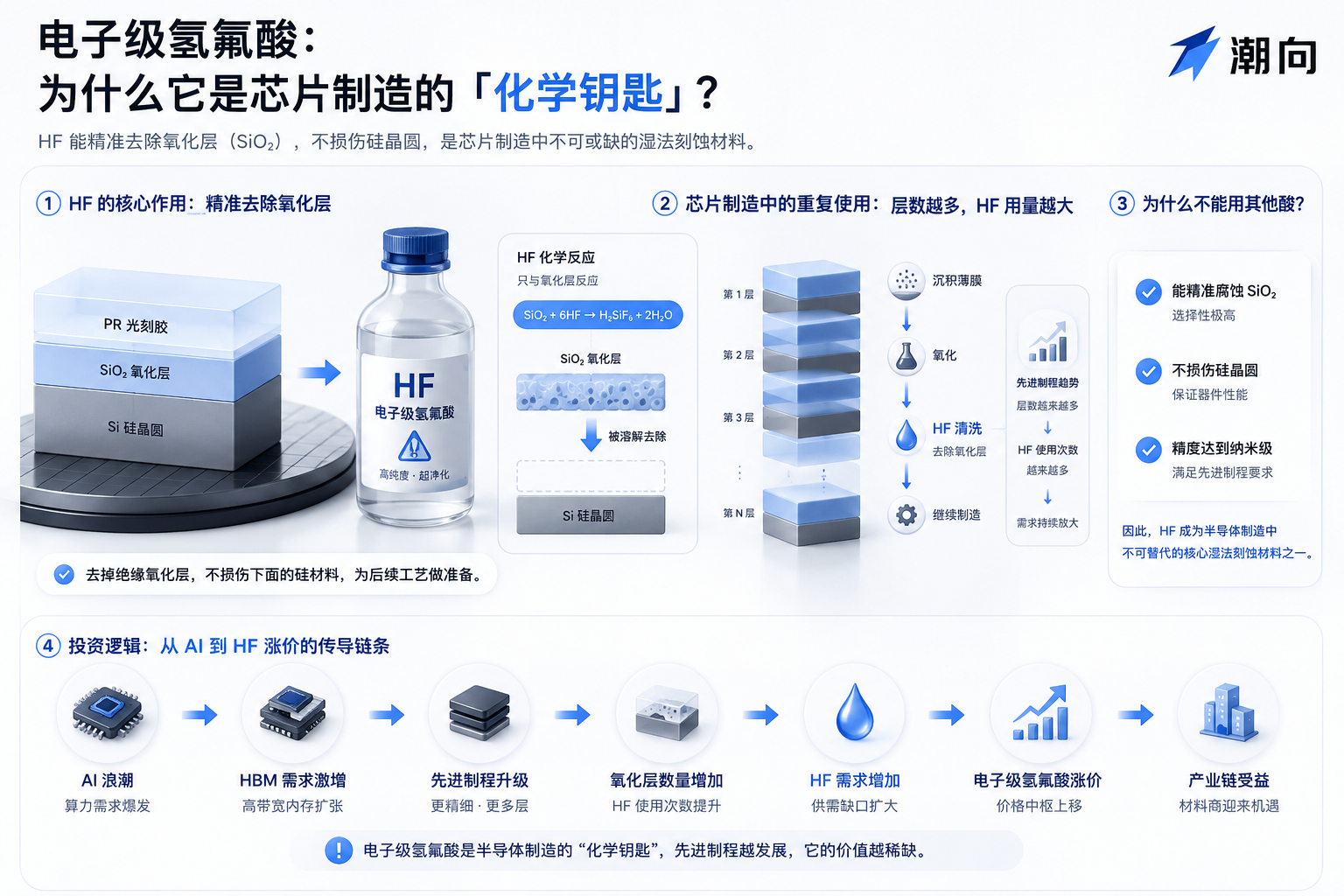
Simply put, during chip manufacturing, a layer of silicon oxide film forms on the wafer surface, which must be precisely dissolved using chemicals before proceeding to the next steps. That's what electronic-grade hydrofluoric acid does:
It dissolves silicon oxide without damaging the underlying circuits, making it **one of the chemicals with the highest consumption in wafer cleaning and etching processes**. The industry calls it the **"chemical key"**.
Producing hydrofluoric acid requires fluorite and sulfuric acid. Disruptions in shipping through the Strait of Hormuz have pushed up sulfur prices, causing sulfuric acid prices to follow suit, thus raising production costs; South Korean domestic material suppliers have been forced to start purchasing raw materials in large quantities from mainland China at a premium approximately 40% higher than at the beginning of the year.
Following this logic, the A-share fluorochemical sector began its rally in mid-May and has already seen significant gains, with a number of related stocks trading near their 52-week highs.
The market is generally familiar with and has accepted narratives like shortages, price hikes, and domestic substitution.
At this stage, it's more important to identify which companies in this broad rally have real earnings delivery and which are merely being carried along by market sentiment.
From Fluorite to G5: A Deep Dive into the Industry Chain
The raw material chain for electronic-grade hydrofluoric acid is quite short: fluorite (calcium fluoride) reacts with sulfuric acid at high temperatures to produce anhydrous hydrogen fluoride (AHF), which is then repeatedly purified to obtain electronic-grade products of varying purity levels.
Purity grades are divided into five levels, G1 to G5, according to the SEMI international standard. **G5 is the highest grade**, meeting the requirements for advanced process nodes of 14nm and below – the production lines run by TSMC, Samsung, and SMIC, as well as memory products like HBM that demand extremely high cleaning purity.
The distribution of profits along this chain is highly uneven.
- Upstream fluorite and anhydrous hydrogen fluoride are commodity products, with high volumes but thin margins, their prices tied to the cycles of sulfuric acid and non-ferrous metals;
- Midstream regular electronic-grade hydrofluoric acid (G1 to G4) faces many competitors, transparent pricing, and average profits.
- The real money is concentrated in the G5 segment: according to industry data cited by East Money, the spot price for G5 products ranges from 180,000 to 200,000 RMB/ton, with leading companies achieving gross margins of 50% to 60%. The global supply gap for high-end G5 is nearly 70%, leading to persistent spot shortages.
The reason G5 is so profitable lies in two major barriers:
- Technology: Purity must reach 7N to 11N (99.99999% to 99.999999999%). The refining capability of the production process directly determines whether the product is usable.
- Certification: Entering the supply chains of TSMC, Samsung, and SK Hynix requires a certification period typically lasting two to three years. Volume supply can only begin after passing. With these two barriers combined, only a handful of companies globally can meet both simultaneously.
Japanese companies have long held a monopoly in this area.
Stella Chemifa, Morita Chemical, and Central Glass together account for nearly 40% of global high-end production capacity and boast the best technical indicators globally. South Korean companies like Soulbrain and ENF Technology focus mainly on the mid-to-low end (G3 to G4), with minimal domestic G5 capacity and relying on China for 90% of their anhydrous hydrogen fluoride raw materials.
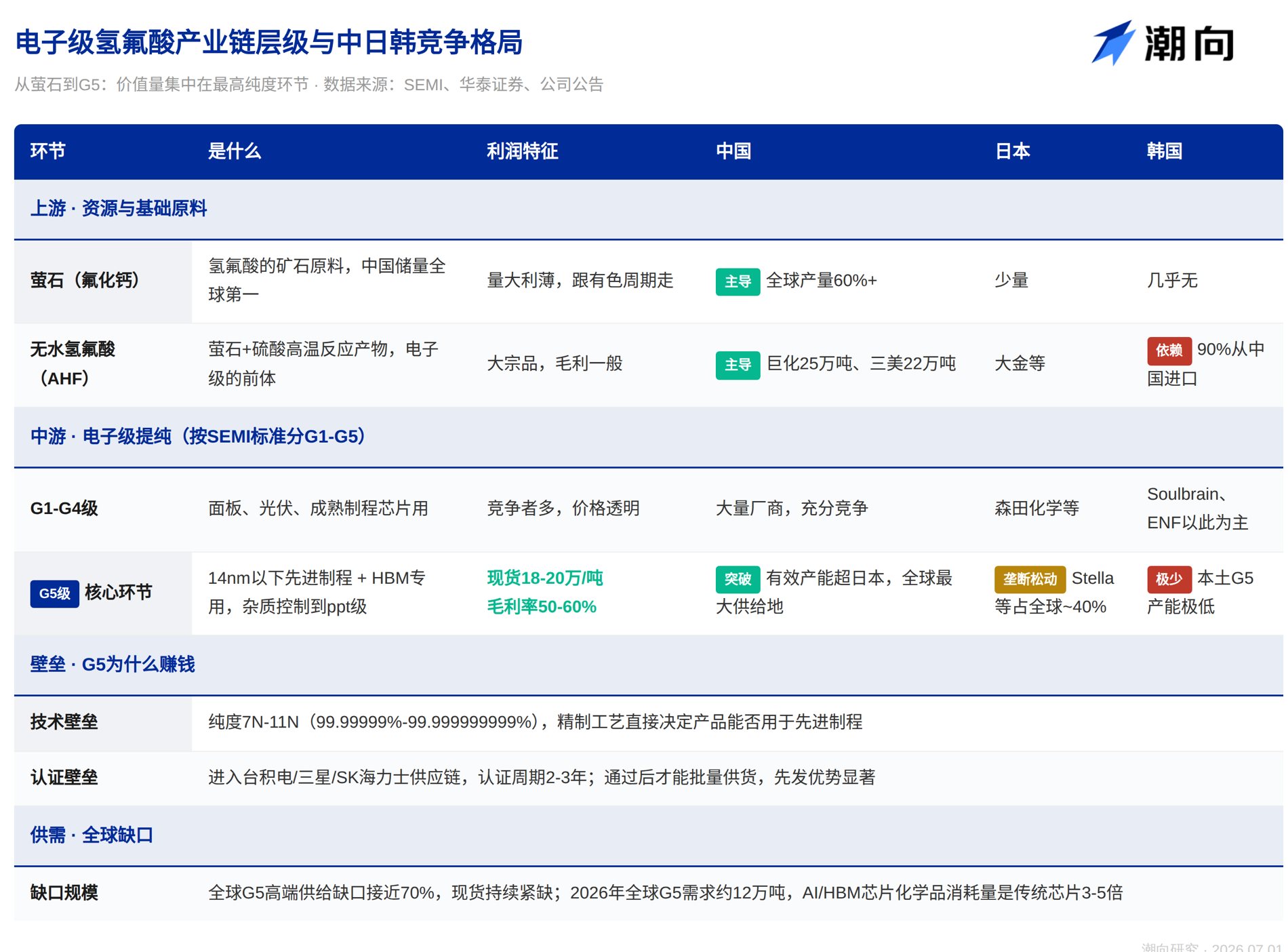
Chinese manufacturers have successfully broken through G5 technology in recent years, and China's effective domestic capacity now surpasses Japan, making it the world's largest source of high-end supply. Based on G5 capacity and customer certifications, A-share related stocks can be roughly divided into three tiers:
Tier 1: Mass production of G5 with certifications from major international companies
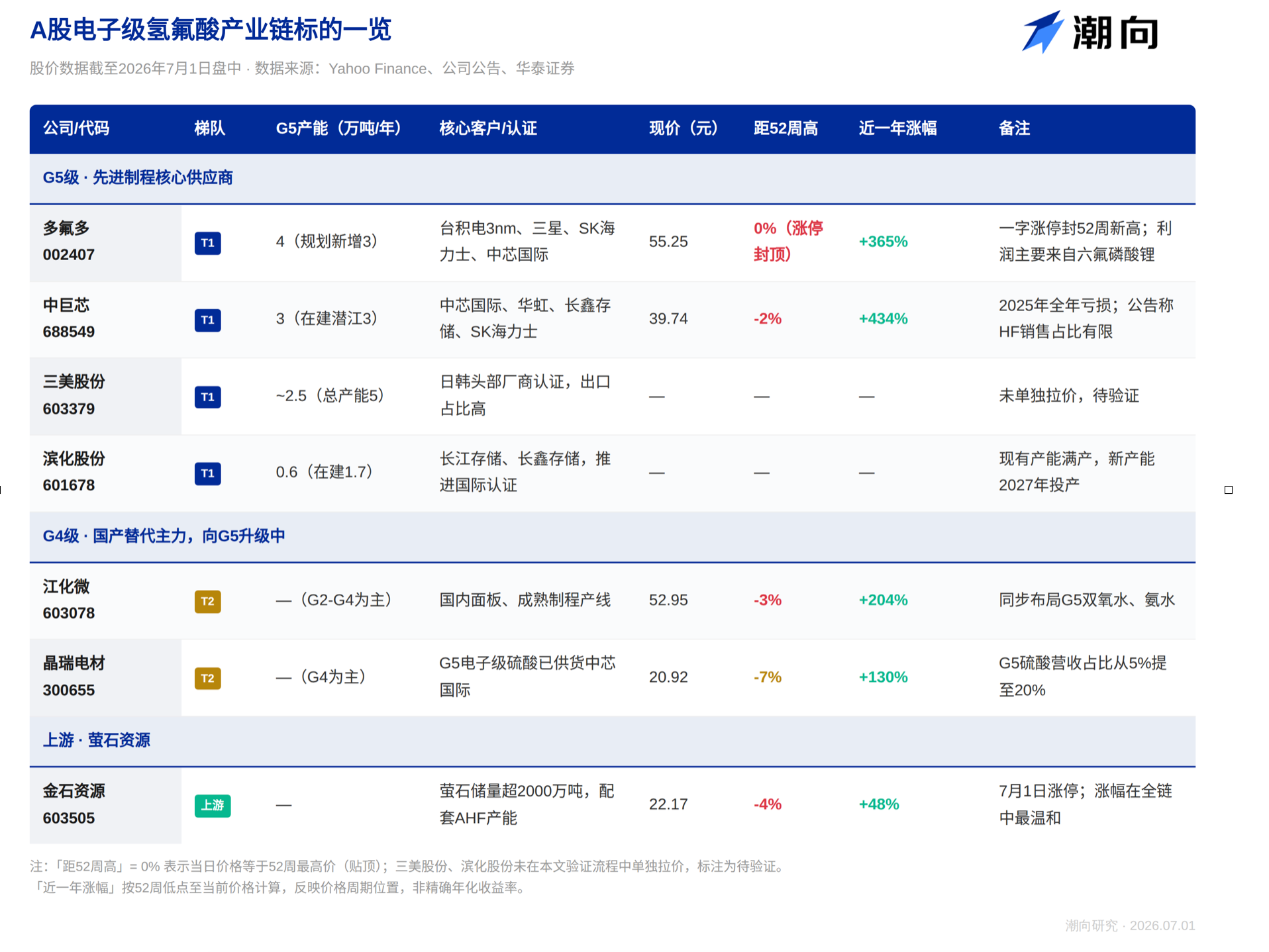
- Do-Fluoride Chemicals (002407) – Largest domestic G5 capacity at 40,000 tons/year. Has certifications from TSMC (3nm), Samsung, SK Hynix, and SMIC. Global market share ~25%.
- Juhua Microelectronics (688549) – G5 capacity of 30,000 tons/year (with an additional 30,000 tons planned at the Qianjiang base). Has investments from Juhua Group and the National IC Fund. Tied to SMIC, Hua Hong, and ChangXin Memory, and has entered SK Hynix's supply chain.
- Sanmei Chemical (603379) – Total electronic-grade hydrofluoric acid capacity of 50,000 tons/year, with G5 accounting for over half. Has certifications from leading Japanese and Korean manufacturers, with a high export ratio.
- Befar Group (601678) – Current G5 capacity of 6,000 tons/year, running at full capacity. An additional 17,000 tons of high-end capacity is under construction and expected to be operational by 2027. Supplies YMTC and ChangXin Memory.
Tier 2: Primarily G4, currently upgrading to G5
- Jianghua Microelectronics (603078) – Established player in wet electronic chemicals. Hydrofluoric acid covers G2 to G4, serving domestic panel and mature process node lines. Also developing G5 capabilities.
- Suzhou Crystal Clear Chemical (300655) – Electronic-grade hydrofluoric acid capacity of 22,000 tons, mainly G4. Its G5-grade electronic-grade sulfuric acid is already supplying SMIC in volume (we'll mention this company again later).
Upstream Resource: Fluorite
- Jinshi Resources (603505) – The only pure-play fluorite resource leader on the A-share market. Reserves exceed 20 million tons, with 300,000 tons of supporting anhydrous hydrogen fluoride capacity. Holds pricing power on the cost side.
In one sentence summarizing the profit model on this chain:
Upstream makes money from resources, midstream from scale, and G5 from its high barriers to entry. In the current price hike cycle, the G5 segment shows the highest profit elasticity and is also the most aggressively traded segment by the market.
Similar Gains, Completely Different Logics
The chart below is quite intuitive; almost all the stocks along the entire chain are trading near their 52-week highs. However, upon closer inspection, the themes and narratives differ significantly.
Do-Fluoride: Real Profits, But Not from Hydrofluoric Acid
Public data shows that Do-Fluoride reported a net profit attributable to parent company of 376 million RMB in Q1 2026 (+480%), and a recurring net profit of 380 million RMB (+1724%), exceeding its total for the full year 2025 in just one quarter.
Hua'an Securities upgraded the stock to a 'Buy' rating, forecasting net profits of 1.724 billion, 2.335 billion, and 3.260 billion RMB for 2026-2028, corresponding to P/E ratios of 29x, 22x, and 16x respectively.
Where does the profit come from?
According to a Sina Finance report, in the first three quarters of 2025, the new energy materials segment (primarily lithium hexafluorophosphate, LiPF6) accounted for 34.97% of revenue, with gross margin soaring from 8.62% to 19.53%, making it the biggest profit engine. **Lithium hexafluorophosphate is a raw material for lithium battery electrolytes** and is unrelated to semiconductors.
The price of LiPF6 rose from 47,000 RMB/ton in July 2025 to 130,000 RMB/ton in Q1 2026. As the world's second-largest supplier (shipments of about 50,000 tons, market share ~20%), Do-Fluoride captured all the elasticity of this price surge. Some brokerages estimate that this single segment alone could contribute over 2 billion RMB in net profit in 2026.
Regarding hydrofluoric acid, Do-Fluoride itself stated on an investor relations platform in November 2025: "The market price of semiconductor-grade hydrofluoric acid is stable, with small fluctuations."
The market bought Do-Fluoride under the label of the "hydrofluoric acid price hike leader," but its Q1 profit explosion was driven by the LiPF6 price increase, which is largely unrelated to semiconductors. Moreover, LiPF6 prices have already started to decline.
Juhua Microelectronics: Up 4x, but the Company Denies Market Labels
Juhua Microelectronics' stock rose from a 52-week low of 7.44 RMB to 39.74 RMB, the biggest gainer across the entire chain. It reported a full-year 2025 loss of 16.59 million RMB. It just turned profitable in Q1 2026, with a net profit attributable to parent of only 6.37 million RMB.
On May 15, the day its stock hit the daily limit up, the company issued an announcement regarding unusual stock movements, stating three key points: "The sales proportion of our electronic-grade hydrofluoric acid business is limited"; "There is no direct business relationship with Samsung Electronics regarding electronic-grade hydrofluoric acid products"; "We have not signed any substantive price increase order agreements with relevant customers for the aforementioned products"...
Juhua Microelectronics' main business is the overall supply of wet electronic chemicals, and hydrofluoric acid is just one of its product categories.
Before production capacity comes online and profits truly materialize, the current price of 39.74 RMB corresponds to a company that earned only 6.37 million in Q1. The gap is entirely filled with expectations.
Jianghua Microelectronics, Suzhou Crystal Clear Chemical: Business Alignment, but Distinguish Who Has Orders and Who is Still Waiting
Jianghua Microelectronics has surged over 200% in the past year. Its main business is wet electronic chemicals, and it is currently laying out G5-grade hydrogen peroxide and ammonia.
Its advantage lies in its broad product line and extensive customer coverage, with domestic panel and mature process node lines using its products. Laying out G5 means it is moving from low-end to high-end, but the G5 products are still in the customer certification stage. Whether it can secure orders for advanced process nodes is currently unconfirmed by public information.
Suzhou Crystal Clear Chemical has risen 130%, about 7% below its 52-week high, making it the least extreme position among this group. It has something that most of its peers lack:
Its **G5-grade electronic-grade sulfuric acid is already supplying SMIC in volume**, with its revenue share rising from 5% to 20%. These are real, landed orders. In an environment where the entire chain is generally pricing based on expectations, companies with actual shipments tend to be more resilient during pullbacks.
As for the remaining stocks, Jinshi Resources is up about 50%, the most moderate on the chain. It is a fluorite mining company that profits from resource price increases, and its connection to the semiconductor industry is indirect. When fluorite prices rise, anhydrous hydrogen fluoride costs increase, which is then passed on to the prices of electronic-grade products, making Jinshi more of a "cost driver" for the whole chain rather than a direct beneficiary of end-user demand.
Data Worth Watching
Short-term pricing of thematic stocks on the A-share market is often disconnected from fundamentals. For the hydrofluoric acid sector, which is already collectively trending at highs, the factors to monitor in the short and medium term are different.
Short-term: Focus on Capital Flows and Sentiment, Not Fundamentals
The recent daily limit-up trading data for Do-Fluoride reveals some interesting points.
On June 11, the stock hit the daily limit (closing at 38.19 RMB) with a turnover of 7.92 billion RMB and a turnover rate of 20.13%. The stock exchange's public information shows institutional-specific seats net sold 179 million RMB, while speculative capital "Chengdu Department" net bought 226 million RMB, and a "Quantitative Market Making" seat net bought 77.14 million RMB.
On June 22, it hit the daily limit again, with a turnover of 7.906 billion RMB. Institutional investors net sold 147 million RMB, while brokerage department seats net bought 490 million RMB. (Data from Shenzhen Stock Exchange public information, all post-market data for the respective dates).
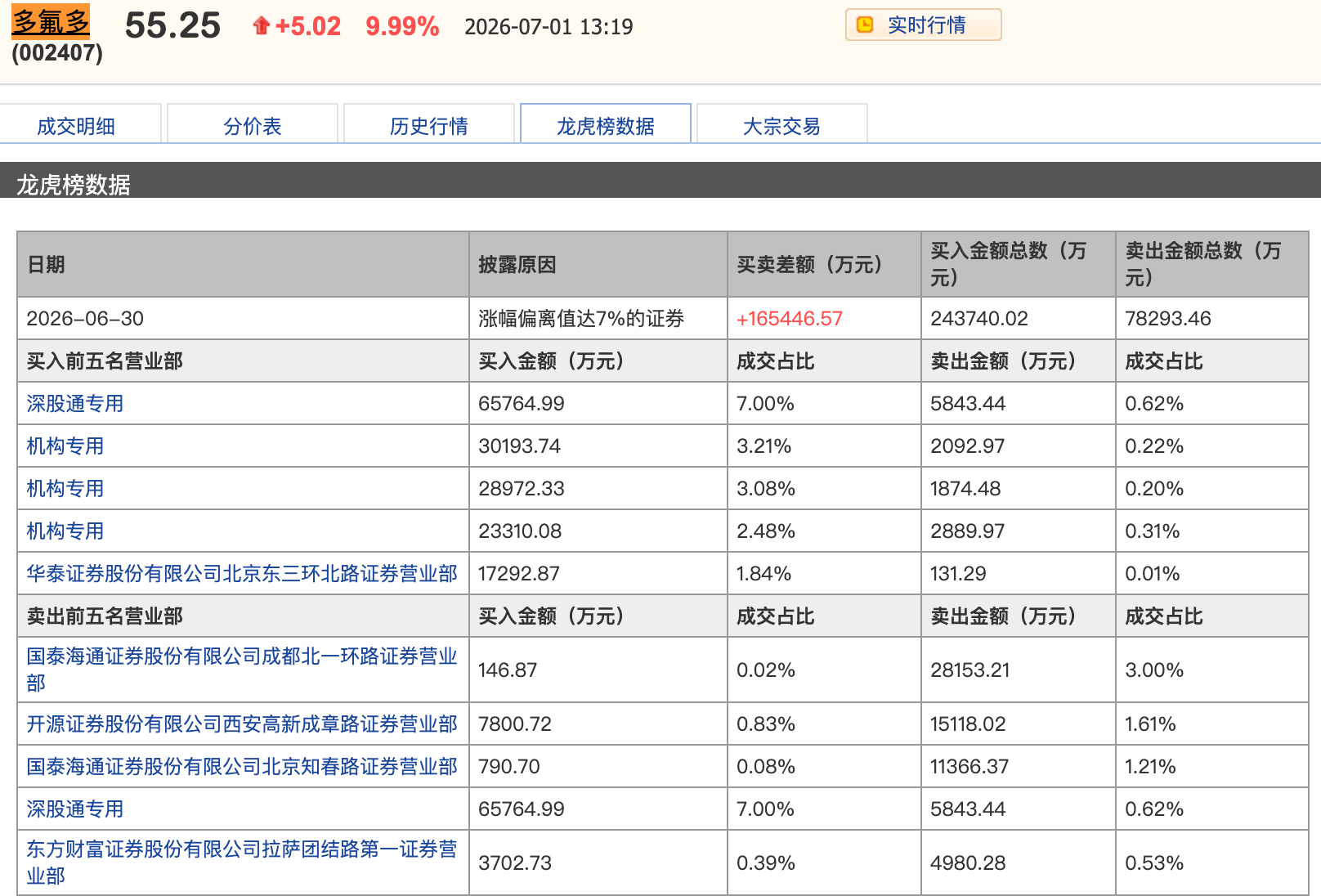
Both daily limit-ups exhibited the same structure: **Institutions selling, speculative capital buying.**
On June 29, Do-Fluoride ranked first on the Flush hot stock list. Today, July 1, it hit its daily limit up again at the opening bell, reaching a new 52-week high.
Experience suggests that when a thematic stock simultaneously meets conditions like "topping the hot stock list," "consecutive daily limit-ups with massive turnover," and "institutional net selling," it often indicates that market sentiment has already reached a high temperature.
Potential upcoming catalyst events include:
Further price increases by South Korean manufacturers in June-July (as anticipated by Korean media), the interim reports of Do-Fluoride and Juhua Microelectronics (around mid-August), and the IPO listing of ChangXin Memory Technologies (expected by the market between mid-July and early August).
If these events can continue to generate buzz, short-term sentiment may be sustained; otherwise, the profit-taking pressure from massive turnover will likely appear quickly.
Trend Analysis
The supply-demand logic underlying this industry chain is solid. AI expansion is driving demand, Japanese companies are not expanding capacity, South Korea relies on imports, and prices are indeed rising.
However, overall stock prices in the sector are already at high levels. Leading stocks have risen 3-5 times. Exchange data shows institutions selling and speculative capital buying. Sentiment indicators (top of hot stock list, massive turnover, ETF premiums) are all maxed out.
At this point, the importance of industry logic is less than the odds. A correct logic can also be priced in to the point of leaving no room.
If one must find a relatively better position within this chain, **Suzhou Crystal Clear Chemical** is still about 7% below


