






1亿资金,撬动万亿市值:币圈玩法正在席卷股市


- 核心观点:当前一级市场(美股、港股、A股)的AI与科技公司IPO普遍呈现“低流通、大叙事、高市值”特征,市场定价正从基于财报的“定价”转向基于叙事的“炒作”,这一模式与加密市场高度相似,并可能面临解禁后的流动性风险。
- 关键要素:
- 低流通盘成为普遍趋势:智谱上市初期流通盘不足4%,SpaceX仅4.3%,纳斯达克为此废除10%最低公众持股门槛,低流通使少量买盘即可大幅拉升股价(首日涨幅67.4% vs 非低流通的47.9%)。
- 传统财报定价框架失灵:智谱、CoreWeave等AI公司收入高速增长但严重亏损(智谱亏损是收入4.4倍,市销率超1200倍),DCF模型因参数敏感度极高而失效,市场转向交易模型、算法等难以量化的“叙事”。
- 各方利益驱动低流通:创始人借此维持控制权并推高账面市值(如SpaceX马斯克持股85%投票权),投行通过小流通盘制造高首日涨幅赢得声誉,基石投资者通过锁定筹码制造稀缺性获利(智谱11家基石拿走70%流通盘)。
- 加密市场低流通教训的复刻:2024年新代币流通量低至6%-20%,但Binance Research警告约1550亿美元代币将在2030年前解锁,2025年84.7%代币价格低于上线估值的现象,预示股价可能面临解禁后的下跌压力。
- 解禁风险与对冲手段:回溯数据显示美股IPO锁定期结束后6个月中位数回报下跌约10%,SpaceX员工已通过零成本领口等期权策略提前对冲,但Michael Burry称做空成本过高,市场做空压力已显拥挤。
Original Author: Jia Liu
Low float, big narrative, high market cap – these are becoming the common characteristics of speculative trading in this financial cycle.
Less than six months after Zhipu AI (智谱) listed on the Hong Kong Stock Exchange, its stock price once surged 25 times. However, examining its share structure reveals a more critical, yet easily overlooked number: in the early stages of listing, the shares truly available for free trading on the market were only about 17.35 million, accounting for less than 4% of the total share capital. A company with a market cap of trillions of Hong Kong dollars essentially had a daily trading pool of only a few hundred billion HKD.
This is a typical, but not unique, case, and could even be called a microcosm of the current market playbook.
Just over ten days ago, SpaceX went public with a valuation of $1.77 trillion, but only 4.3% of its shares were publicly floated. To accommodate its listing, Nasdaq directly abolished the 10% minimum public float requirement that had been in place for decades. SPCX's market cap once exceeded $2 trillion, yet its daily trading volume was only about $100 million.
Cerebras, a US AI chip company, sold only about 15% of its issued shares during its IPO in May, and its stock price doubled on the first day. Figma, which saw its new shares and secondary sales total less than 10% of its total shares, surged 250% on its debut.
Low float, big narrative, high market cap. This structure, which the crypto market has played with for years, is now being fully replicated in the traditional stock market. US, Hong Kong, and A-share markets are simultaneously exhibiting similar structures, with the narrative extending from AI, chips, and large models to include stablecoins.
The Era of Pricing Based on Financial Reports Has Ended Again
In February 2000, a sock puppet dog appeared in a Super Bowl ad. It was a 30-second spot that Pets.com bought for $1.2 million. At the time, its annual revenue was less than $6 million, and its losses exceeded $60 million. Nine months later, the company liquidated, and the sock puppet became the most iconic tombstone of the internet bubble.
The market lesson of that era was written into almost all investment textbooks: valuations without revenue backing are bubbles; narratives cannot replace financial reports.
For the next two decades, this lesson dominated the market. DCF, PE, PEG, discounted free cash flow – pricing methods based on financial statement data became orthodox. Warren Buffett was once again canonized after the 2008 financial crisis. "Buying without looking at financial reports" became synonymous with speculation.
But looking at the new technology tracks from 2025 to 2026 today, we find one fact: the most sought-after companies in these industries are, in fact, all losing money.
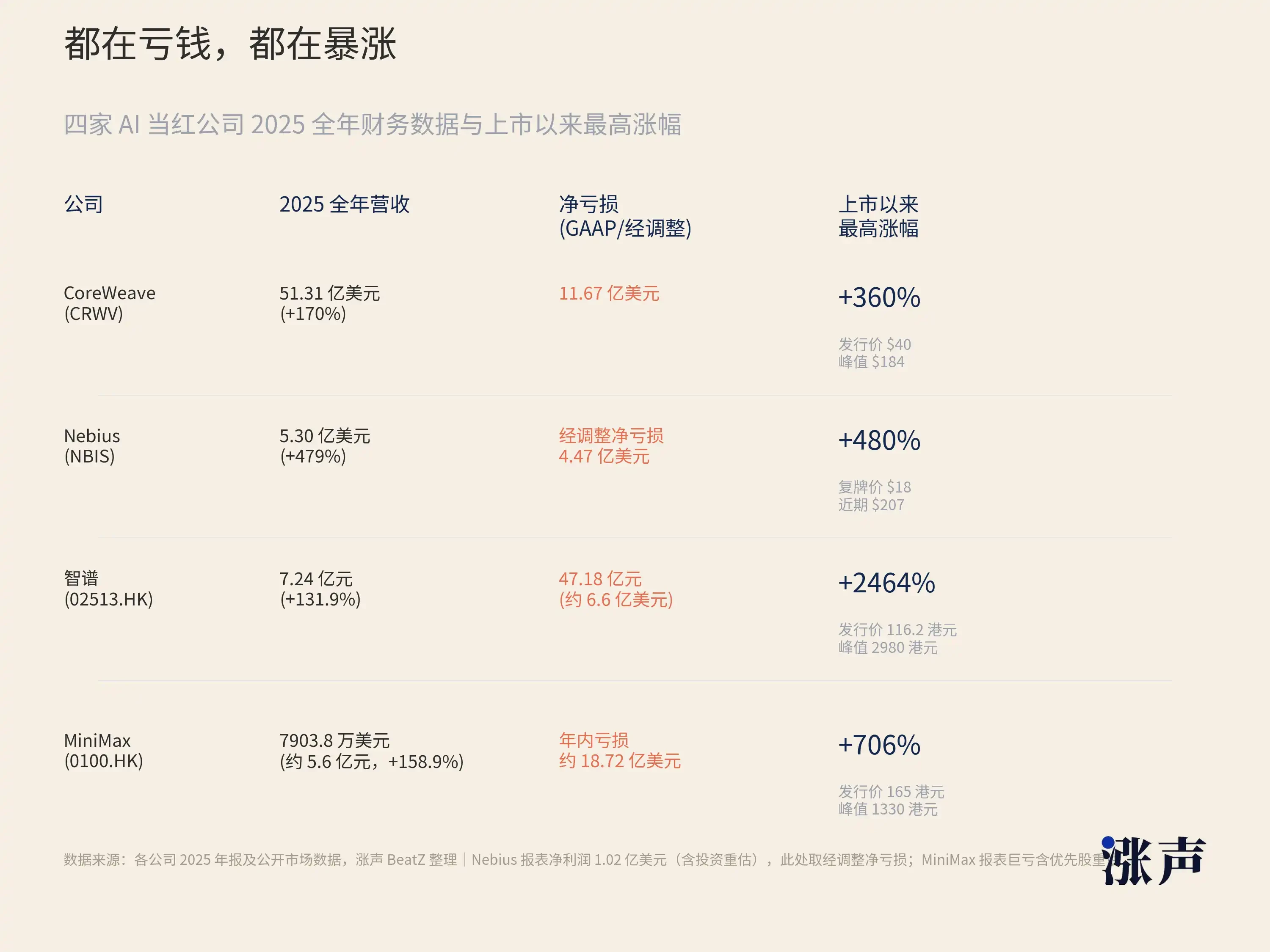
Take CoreWeave, for example. This AI computing infrastructure company, backed by Nvidia, had revenue of $16 million in 2022 and $5.1 billion in 2025 – a more than 300-fold increase in three years. While its revenue growth rate is staggering, its net loss also expanded from $31 million to $1.2 billion. In Q1 2026, the company reported revenue of $2.1 billion and a net loss of $740 million, with a debt-to-equity ratio of 10.7. By traditional banking credit standards, such a balance sheet is not healthy. However, after its IPO, its stock price once surged 190%.
The situation is similar for Nebius. The company, formerly Russia's Yandex, pivoted to AI cloud services after the split. In Q1 2026, it had revenue of $399 million, a 684% year-over-year increase, but still posted an adjusted net loss of $100 million. Its stock price has risen more than 510% over the past 12 months.
Let's turn our focus back to the Chinese market.
Zhipu AI's full-year revenue in 2025 was 724 million yuan, approximately $100 million, but its net loss was 3.182 billion yuan – 4.4 times its revenue. In other words, for every 1 yuan it earns, it spends far more than 1 yuan on computing power and R&D. MiniMax, another Hong Kong-listed AI company from the same batch of IPOs, surged 109% on its first day, later rising over 700%. Its full-year revenue was $79.038 million, approximately 560 million yuan, even lower than Zhipu's.
Similarly, Hong Kong-listed GPU company Biren Technology, A-share domestic GPU manufacturer Moore Threads, and Nasdaq-listed Muxi (MUXI or equivalent) saw first-day gains of 120%, 425%, and 693% respectively. These newly listed stocks with staggering gains are all either deeply loss-making or not yet profitable.
If you use PE to look at these companies, many don't even have a basis for calculation because their profits are negative. Looking at PS, Zhipu is over 1200 times, and SpaceX is roughly 95 times. Using DCF, a slight change in the discount rate or terminal growth rate can change the conclusion from 100 billion to 10 billion; the model is so sensitive that it loses its guiding significance. Damodaran, the author of the DCF textbook, himself valued SpaceX at $1.2 trillion, 30% lower than its IPO price. He also admits that when dealing with this generation of IPOs, parameter adjustments can lead to drastic fluctuations in results.
Some might say that the early internet era didn't look at PE either. Amazon lost money for twenty years before becoming profitable. This isn't new. That's true, but there is one key difference between this cycle and the internet era: the market isn't even using alternative metrics to PE for pricing now; it's trading purely on narrative.
Although investors in the internet era didn't look at PE, they looked at user growth, GMV, and page views. Essentially, they were still using a set of quantifiable intermediate indicators to anchor valuations. Today's AI companies also have metrics like ARR, but ARR cannot explain Zhipu's 1200x price-to-sales ratio. The hype in the supply chain has long broken free from the gravity of financial fundamentals, fully pricing in expectations for the next three to five years into the present.
Old pricing frameworks are starting to fail when faced with a new class of assets. The logic of financial markets and investors worldwide has also undergone tremendous changes.
Model weights, algorithm capabilities, developer ecosystems, and computing power scheduling capabilities – these are the true core assets of AI companies, but none of them can be written into a balance sheet. The programming ability of GLM-5.2 made Vercel's CEO say "almost shocked," but this statement won't appear on Zhipu's income statement. CoreWeave sits on a $100 billion order backlog, but that doesn't change the fact that it is reporting a net loss for the current quarter. Nvidia's GPUs are called the oil of the AI era, and the pricing of oil has never just looked at current quarterly production; it also considers reserves, demand curves, and geopolitics.
The core assumption of traditional pricing methods is that future cash flows can be extrapolated from historical financial data. This assumption works very well in industries like consumer goods, finance, and real estate.
But the revenue curve of AI companies is not linear extrapolation. It depends on sudden jumps in model capabilities, the network effects of the open-source ecosystem, and the abrupt shifts in policy and industrial cycles. After the release of GLM-5.2, Zhipu's narrative status could change overnight. Llama's open-sourcing rapidly amplified Meta's AI influence. US chip restrictions on China turned Biren and Muxi from marginal companies into "domestic alternative leaders." These variables are difficult for any financial model to incorporate in advance.
At the same time, the market's tolerance for narrative-driven dynamics is increasing because, in the past few years, those who believed in the narrative have indeed made money.
Those who bought Nvidia in early 2023 without looking at financial reports made ten times their money. Those who bought Zhipu in early 2026 without looking at financial reports made 24 times their money. When a "wrong" method consistently produces "correct" results, the market will revise its methodology, not the results.
It Doesn't Actually Take Much Money to Prop Up a High Market Cap
A Nasdaq study itself, which looked back at data from 1980 to 2020, found that in the 1980s, the average float of US IPOs was about 30% of total share capital. By 2020, this figure had dropped to about 20%.
A June 2026 report from J.P. Morgan provided a more macro-level figure: the sum of newly issued shares in IPOs and the portion of early investor shares permitted for sale after lock-up periods accounts for only about 1% of the total market capitalization.
The float of IPOs is getting smaller and smaller. This is a trend that has persisted for almost thirty years.
Nasdaq also found a clear inverse relationship between float and first-day gains. In years with smaller floats, first-day gains were larger.

Our own compilation of US IPO samples from 2024-2026 shows the same characteristic. Defining "low float" as "current float / total share capital below 30%," within the sample where first-week performance could be calculated, 67.4% of low-float IPOs rose on the first day, 65.2% were still up on the third trading day, and 63.6% were still up on the fifth trading day.
The corresponding percentages for non-low-float IPOs were only 47.9%, 48.9%, and 49.6%.
With fewer chips available to buy, the same buying power has a greater driving force, and price elasticity is stronger.
The logic is simple. The same $1 billion buy order is a ripple when pushed into a $20 billion float, but a tsunami when pushed into a $3 billion float. A float shrinking from 20% to 3% is not a linear change; it's a qualitative transformation in price elasticity.
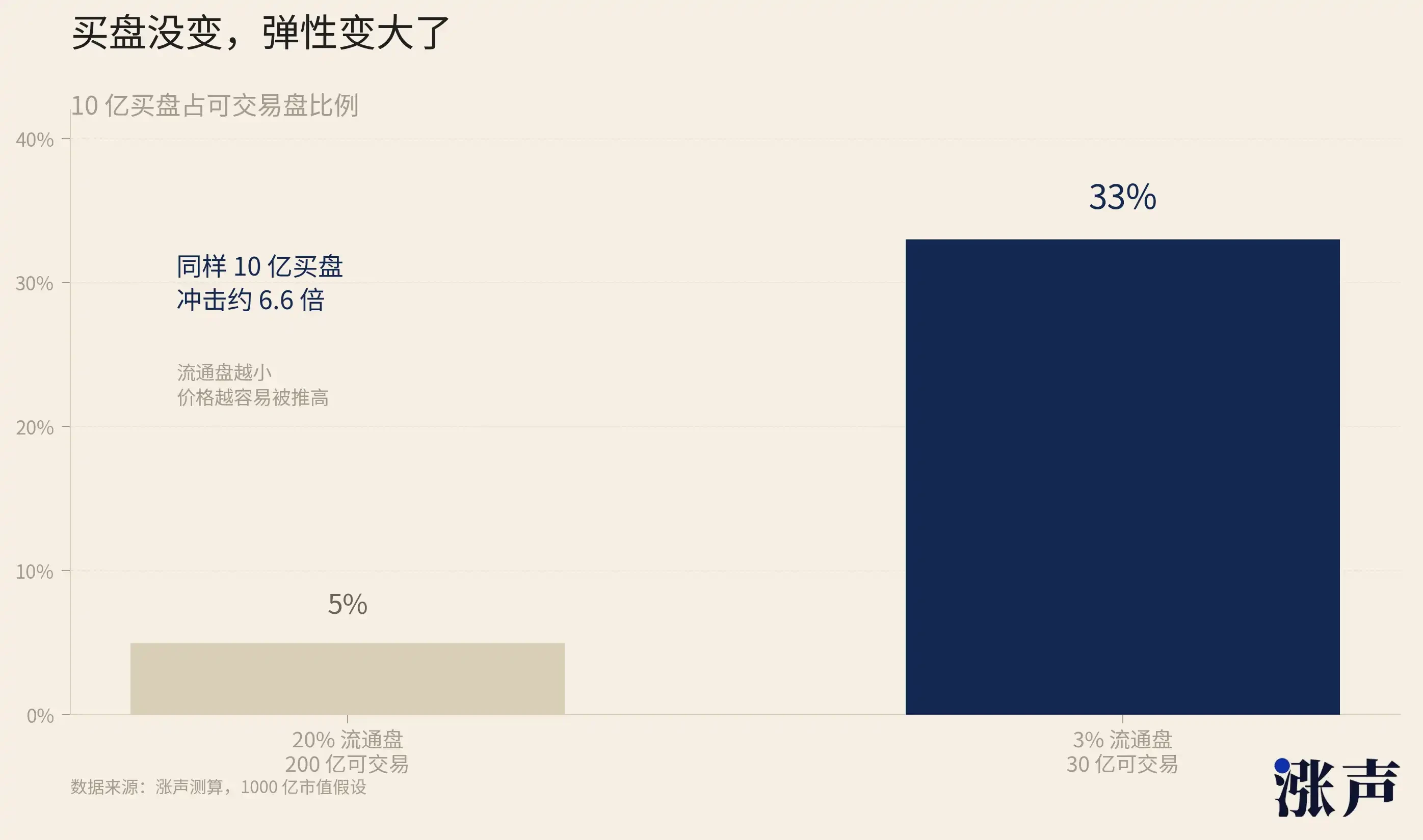
Newly listed companies are increasingly favoring low floats because it's the result of maximizing benefits for all parties involved.
First, look at the founders. The smaller the float, the more stable the control. SpaceX's Musk controls about 85% of the voting power through Class B shares. A public float of 4.3% means outside investors have virtually no governance influence. He can simultaneously serve as CEO, CTO, and Chairman; he can merge xAI into SpaceX without needing shareholder approval; he can keep the company's strategic direction firmly in his own hands. The smaller the float, the weaker the voice of external shareholders, and the greater the founder's freedom.
Scarcity also directly inflates the market cap number. A company's market cap is not determined by all its shares, but by the price of the last transaction multiplied by the total share capital. If only 3% of the chips are trading, and that 3% is chased to an absurdly high price, the entire company's market cap is calculated based on that price.
The book value of the 97% of untraded shares held by founders and early shareholders all inflates accordingly. This inflated market cap can be used for fundraising, as merger currency, and to attract talent. SpaceX went public with a $1.77 trillion valuation, a number that appears in all its recruitment materials and on the table for all partnership negotiations.
This phenomenon is not limited to small-cap stocks.
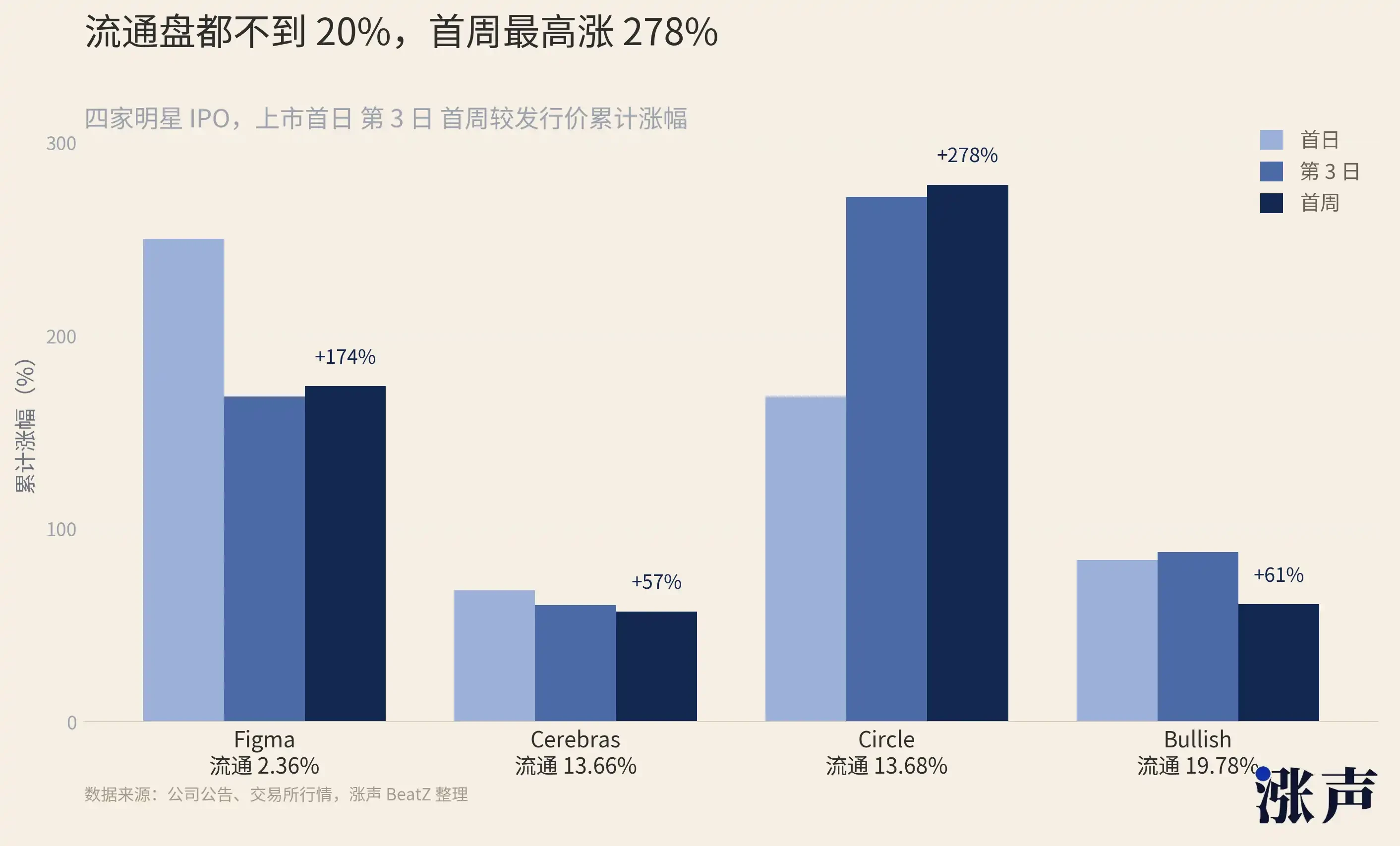
Figma (FIG), a collaborative design software platform, had a public float of only 2.36%. It surged 250% on its first day, 168.48% on the third day, and 173.7% in its first week.
Circle (CRCL), the stablecoin and blockchain financial infrastructure company behind USDC, had a public float of 13.68%. It surged 168.48% on its first day, 271.77% on the third day, and 278.06% in its first week.
Bullish (BLSH), a digital asset trading platform and market infrastructure company, had a public float of 19.78%. It rose 83.78% on its first day, 87.95% on the third day, and 60.84% in its first week.
Cerebras (CBRS), an AI computing infrastructure company, had a public float of 13.66%. It rose 68.15% on its first day, 60.35% on the third day, and 57.13% in its first week.
Next, look at the investment banks. The "first-day gain" of an IPO is a core metric for measuring underwriting success. Media headlines, client evaluations, and the bank's reputation are all tied to this number. The smaller the float, the easier it is to engineer a large first-day gain. Goldman Sachs designed a 4.3% float for SpaceX, which gained 19% on its first day, and everyone called it a great IPO. If the float had been 20%, the same scale of buying power spread across five times the shares might have resulted in only a 4% gain, and the media headlines would have been completely different.
The incentive structure of investment banks naturally leans towards low floats – the smaller the float, the better the first-day gain looks, and the louder the bank's reputation.
Then there are the cornerstone investors. The cornerstone system in Hong Kong is essentially a trade-off: "I help you lock up chips, and you guarantee me an allocation." The cornerstone investor's benefit is getting a confirmed IPO allocation (without worrying about downsizing or balloting), at the cost of a 6-month lock-up period. But this cost often becomes a reward – because the cornerstone locks up most of the float, very few chips are left for trading, and the stock price is easily pushed up.
By the time the lock-up expires 6 months later, if the stock price has already risen several times due to the low float, the cornerstone's returns far exceed a normal IPO. The cornerstone system aligns "helping the company lock up chips" with "making more money for oneself," perfectly aligning the interests of both parties.
The 11 cornerstone investors for Zhipu (including Gaoyi Asset Management, Taikang Life Insurance, GF Fund, etc.) took 70% of the already limited floating shares, resulting in a final public float of less than 4%. All are locked up for 6 months. While helping Zhipu lock up its float, they are also creating a scarcity premium for themselves.
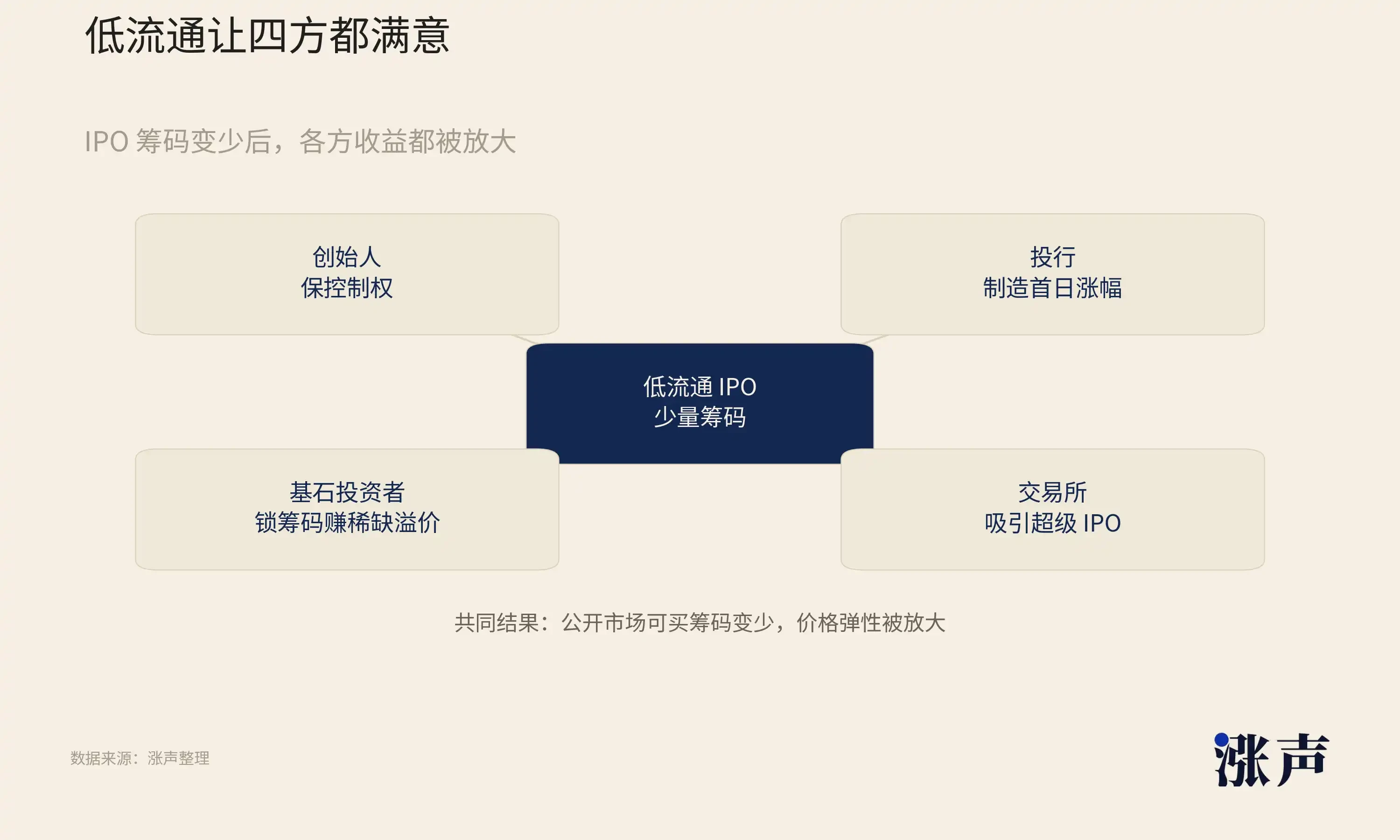
We can even see a systemic turning point from the Nasdaq trading platform itself, with the abolition of the 10% minimum public float requirement.
This rule had existed for decades. A listed company needed at least 10% of its shares in the public's hands to ensure sufficient market liquidity and protect the interests of public investors. The S&P 500 was stricter, requiring a minimum public float level for its constituents. MSCI requires 15%. The Russell series requires 5%.
The precedent-setting effect is profound. If Nasdaq could abolish the 10% threshold for SpaceX, what obstacles remain for the next company wanting to go public with a 3% float? If the largest US trading platform considers low floats acceptable, will other trading platforms follow suit? The HKEX's cornerstone system already allows locking up most IPO chips. If Nasdaq also relaxes its rules, will we see a global competition where trading platforms compete on being friendlier to low floats to attract the best IPO candidates?
Primary Investment, Secondary Hedging: The Stock Market Starts Replicating Crypto's Old Playbook
In the 1990s, as the options market matured, the zero-cost collar became a standard tool for the wealthy. You hold a stock, buy a put option to protect against downside (costs money), and simultaneously sell a call option to earn back the cost (collects money). The two offset, locking in a price range at no upfront cost. Michael Dell used variable prepaid forwards in the late 1990s to cash out part of his Dell shares without triggering taxes, reducing his position, but getting cash early.
But previously, this was used by a small number of ultra-wealthy individuals and founders. Now, after SpaceX's listing, wealth management firms are publicly pushing this strategy to thousands of employees on an entirely different scale. Wealth managers like Bernstein and Mercer now directly publish guides teaching SpaceX employees how to do collars; this level of普及 is unprecedented.
A report from Bernstein contains a sobering set of data. They looked back at all US IPOs raising over $50 million over the past decade and found that six months after the lock-up period ended, the median return was a decline of about 10%. One-tenth of the IPOs fell by at least 62% within six months of the lock-up expiry. The conclusion is direct: if you are a SpaceX employee holding locked-up shares, statistically, the price will likely be lower by the time you can sell them. So you should use derivatives to lock in your gains before the lock-up expires.
Michael Bur


