






Semiconductor stocks have surged 155% – why Bernstein says NVDA and AVGO are still too cheap


- Key Thesis: Bernstein believes AI has become the primary growth driver for the semiconductor sector, with strong fundamentals, but sector valuation and crowding are at historic highs. The report recommends NVDA and AVGO, calling their valuations "ridiculously cheap" as they are the most core beneficiaries in the AI supply chain.
- Key Elements:
- The Philadelphia Semiconductor Index (SOX) rose 155.6% in the past year and 106.6% year-to-date, trading at a 62% premium to the S&P 500. This rally is fundamentally driven (forward EPS up 75%), not a bubble.
- SOX forward P/E is 34.1x (vs. 21x for the S&P 500), but NVDA's target price based on 2027 EPS implies a P/E of just 25x, below the sector average. Bernstein considers this "ridiculously cheap."
- Bernstein upgraded AMD to "Outperform", citing dual benefits from AI/GPU trends and CPU-driven AI adoption. It estimates AMD's 2028 EPS could reach $20.
- Maintained a cautious stance on QCOM, as smartphone shipments declined 3% year-over-year and memory prices rose. Weak consumer electronics leave it without a growth engine, earning a "Market Perform" rating.
- The semiconductor equipment sector (AMAT, LRCX, KLAC) is viewed favorably due to strong demand for capacity buildout. For analog chips (TXN, ADI), while in a recovery cycle, their small data center exposure and expensive valuations lead to a "Market Perform" rating.
- Sector crowding is at historic highs, and inventory days are rising again. If downstream demand weakens, the supply chain faces destocking risk, potentially weakening the pricing power of companies close to bottlenecks.
Original Author: Rita
Introduction
Bernstein released its quarterly review of the semiconductor industry on June 23. Core thesis: AI has become the "only game in town" for the semiconductor sector, with strong fundamentals but valuations and crowding at historical highs. The report recommends both NVDA and AVGO (rated "Outperform"), arguing that despite their relative underperformance this year, they are the core beneficiaries in the AI supply chain and their current valuations are "ridiculously cheap." It upgraded AMD but remains cautious on QCOM due to pressure on its mobile phone business.
AI Demand Drives Record Semiconductor Gains
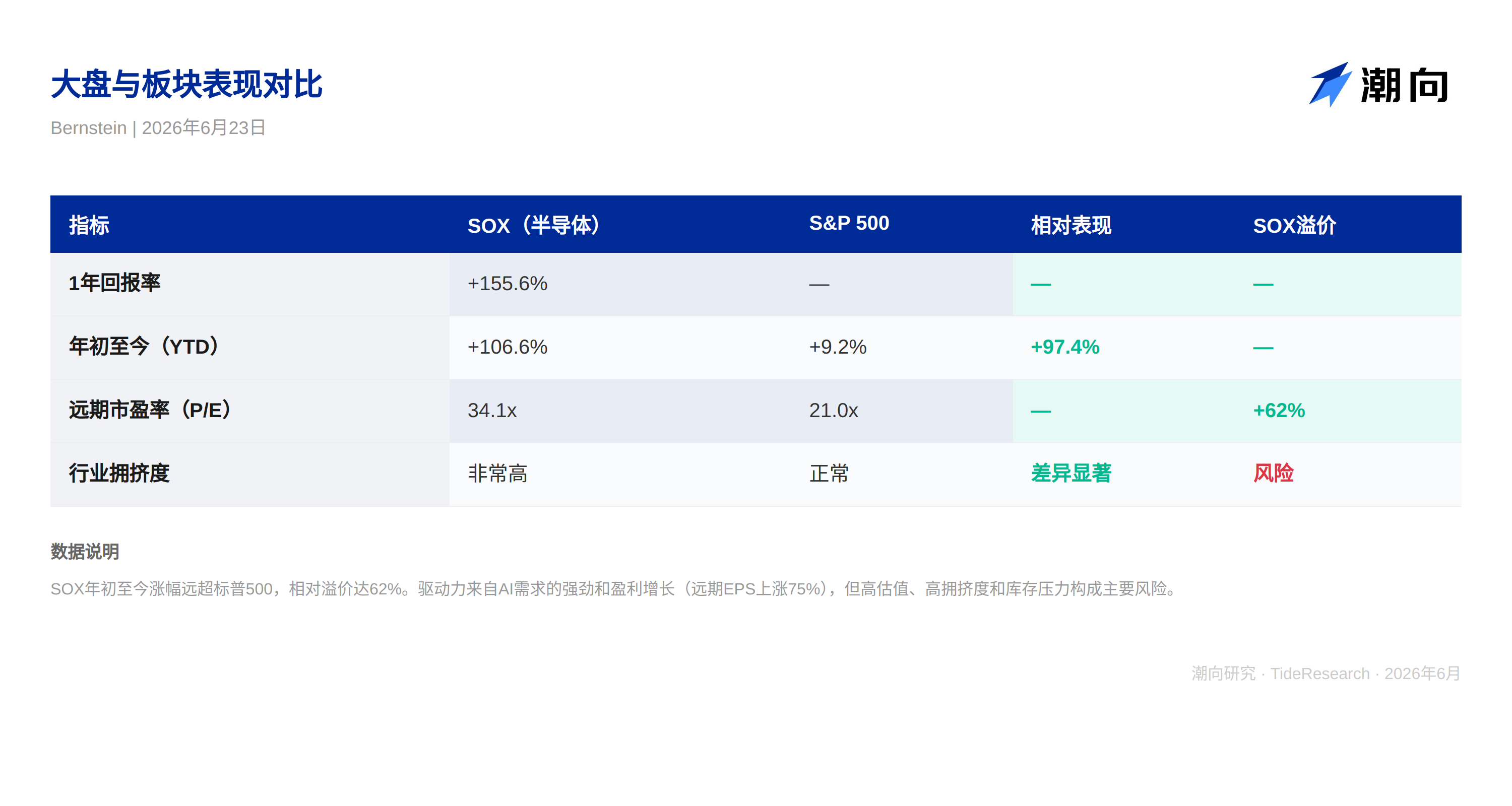
The Philadelphia Semiconductor Index (SOX) has risen 155.6% over the past year and 106.6% year-to-date. Over the same period, the S&P 500 has only gained 9.2%. The premium of the SOX over the S&P 500 has reached 62%.
This rally is driven by fundamentals, not a bubble. Bernstein's data shows that the SOX's forward EPS has increased 75% from the beginning of the year, with only a small portion attributed to multiple expansion.
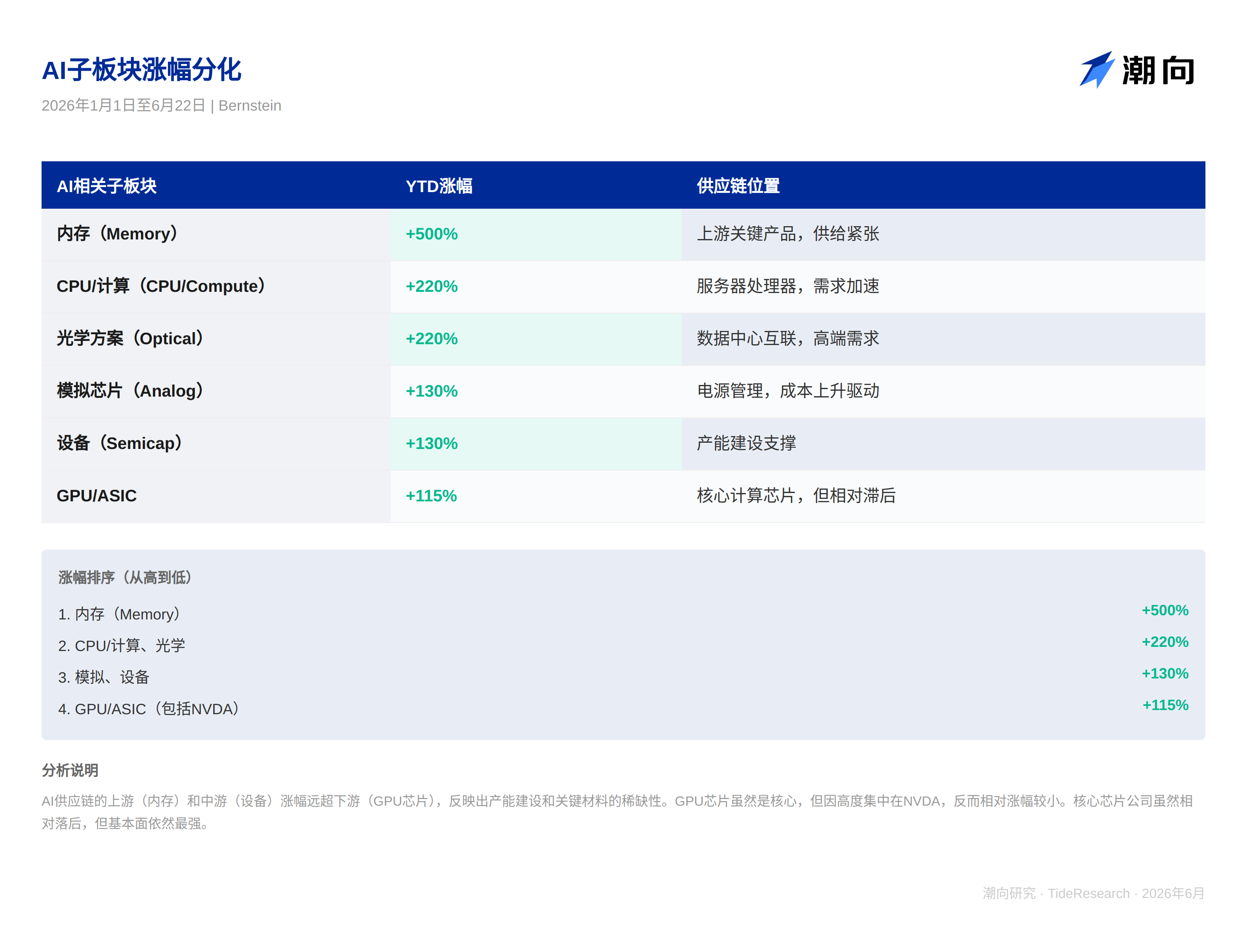
The divergence within the semiconductor sector has reached an extreme level. From the beginning of the year to June 22, memory chips surged 500%, CPUs and optical solutions each rose 220%, while GPUs and ASICs only gained 115%. The entire AI supply chain is profitable, but the segments and magnitude of profitability are uneven. The uppermost and lowermost parts of the supply chain benefit the most; building new production lines requires memory and semiconductor equipment, where supply is relatively tight. GPUs only rose 115%, despite NVDA holding the vast majority of the AI chip market share.
Real Purchasing Power Under High Valuations
The SOX's forward P/E is now 34.1x, compared to 21.0x for the S&P 500, a premium of 62%. This sounds expensive, but it depends on the company. NVDA's adjusted EPS estimate for 2026 is $9.19, and for 2027 it is $12.52. Based on Bernstein's price target of $315, the 2027 P/E is 25x, while the entire sector's forward P/E is 34x. NVDA is not the most expensive; it is relatively cheap.
Bernstein analyst Stacy Rasgon used a specific term: "ridiculously cheap."
His reasoning is direct: NVDA's Blackwell chip series could reach a $1 trillion revenue scale by 2027. The situation is similar for AVGO, with a price target of $550, but if it reaches its $100 billion AI-related revenue target by 2030, the current valuation seems cheap.
This is why Bernstein rates both companies "Outperform." Although they have underperformed this year, they are the most critical links in the AI demand chain. For comparison, Apple's forward P/E is around 28x, Microsoft is at 30x, while NVDA is at 25x. Considering the continuity of the Blackwell and Rubin product generations, and AVGO's monopoly in switch chips, these valuation discounts appear extremely unreasonable. The market is ignoring a core fact: without NVDA and AVGO chips, the entire AI infrastructure cannot function.
CPU's Dual Narrative, QCOM's Single Dilemma
AMD was recently upgraded to "Outperform" by Bernstein. Why the upgrade? Because AMD has opportunities not only in AI/GPU but also in the agentic AI trend for CPUs. CPU shipments began improving sequentially in Q1 2026, slightly outpacing PC shipments. Bernstein believes AMD's fundamentals can support earnings per share of $20 by 2028, and the current stock price still has room to rise relative to this target.
QCOM, however, faces a single dilemma. Smartphone shipments declined 3% year-over-year in Q1 2026. Rising memory chip prices mean higher phone costs, which negatively impacts pricing power for chipset suppliers. Bernstein admits its previous downgrade of QCOM was a "terrible decision" but maintains a "Market Perform" rating. The issue is that weakness in consumer electronics seems certain, making it difficult for QCOM to find new growth engines. Even if future Analyst Day presentations introduce a new data center narrative, QCOM's story is less compelling compared to AMD's dual drivers and the structural positions of chip manufacturers.
Sub-Sector Realities
Semiconductor equipment companies (AMAT, LRCX, KLAC) continue to be viewed favorably. Demand for capacity building remains strong. All three companies are rated "Outperform" with price target upsides ranging from 30% to 70%.
The situation for analog chips (ADI, TXN) is more complex. They are in a recovery cycle, achieving double-digit growth for over a year consecutively, but their data center business exposure remains small, around 10%. TXN and ADI trade at P/E ratios of 30 to 40 times, appearing quite expensive. Bernstein rates both as "Market Perform," choosing to wait and see.
Two Risks: Crowding and Inventory
Bernstein's industry sentiment indicator shows that crowding in the semiconductor sector is at historical highs. Inventory days are rising again, well above the upper limit of the historical normal range. Channel inventory has decreased somewhat but remains above average. What does this mean? It means that if there are any signs of weakness in downstream demand, the entire supply chain will face pressure for active inventory destocking. The PC and consumer segments are already showing weakness, and mobile phones are declining year-over-year. If inventory pressure spreads to data center procurement, the threat of price wars becomes real. At that point, the pricing power of companies close to bottlenecks (NVDA, AVGO) would be significantly weakened.
The strength of AI demand is undoubted, but the current high valuations in the semiconductor sector have already priced in this good news. While NVDA and AVGO are relatively cheap, this premise relies on belief that they can achieve analyst targets. AMD's story is attractive, but execution risks exist. QCOM has become a forgotten player without clear catalysts. Bernstein's stance is selectively bullish; at this point, stock selection has become more important than getting the broad market direction right.


