






Global chip stock crash epicenter: "Various horror stories" behind the South Korean stock market plunge


- Core Viewpoint: The crash of the South Korean stock market triggered panic in the global semiconductor sector. The root cause was not a sudden deterioration in fundamentals, but a confluence of over-extended technicals, minor adjustments in industry expectations, and panic fueled by a series of policy rumors, leading to mechanical selling driven by algorithmic trading, leveraged liquidations, and institutional rebalancing.
- Key Elements:
- South Korea's KOSPI index plunged 10% in a single day, triggering a circuit breaker. Samsung Electronics and SK Hynix plummeted over 12%, accounting for more than 70% of the index's decline. Panic spread to the U.S. stock market, causing Micron Technology to fall 13%.
- SK Hynix is considering slowing down the expansion of HBM4 production, and forecasts for Nvidia's next-generation chip production have been revised downward, shaking demand expectations for AI hardware and the profit structure of the memory chip market.
- Policy rumors that South Korea is discussing the taxation of unrealized stock gains, coupled with its failure to be included in the MSCI Developed Markets list, triggered pre-emptive selling by investors, exacerbating policy uncertainty.
- Leveraged ETFs created a "negative gamma" effect, where selling pressure intensified as the market fell. The total size of leveraged ETFs in South Korea is approximately $30 billion, with regulators warning of side effects and considering tightening measures.
- Margin balances of South Korean retail investors reached a record 38.5 trillion Korean won, triggering forced liquidations in the afternoon. The National Pension Service, whose positions exceeded its limit, net sold $1.5 billion in June, turning a traditional stabilizer into a major seller.
- Global macro pressures intensified: expectations for a Fed rate cut cooled, and market focus turned to Micron Technology's earnings report to test the real health and valuation support of the AI industry chain.
Original Author: Ye Zhen
Original Source: Wall Street News
A violent sell-off in the South Korean stock market is rapidly evolving into a storm sweeping across the global semiconductor sector. This crash is not solely attributable to a deterioration in fundamentals; rather, it is the result of a confluence of overstretched technical indicators, subtle shifts in industry expectations, and panic triggered by a series of policy rumors.
On Tuesday, the Korea Composite Stock Price Index (KOSPI), a bellwether for global memory chips, plummeted 10% in a single day, triggering a circuit breaker. Samsung Electronics and SK Hynix, the index's heavyweight stocks, both plunged over 12%, together accounting for more than 70% of the index's decline. Panic quickly spread to global markets, directly impacting the US semiconductor supply chain. Micron Technology fell 13% on the day, and Western Digital slumped 8.5%.
The immediate catalyst for this selling frenzy was a confluence of a dense stream of bearish news.
Reports from South Korean media suggesting that SK Hynix might slow the expansion of advanced AI memory chip production severely shook market expectations for AI hardware demand. Simultaneously, domestic policy discussions regarding taxes on unrealized stock gains, coupled with regulatory warnings about overheating leveraged ETFs, completely shattered the market's fragile confidence.
Analysts point out that this extreme volatility was driven more by mechanical selling from algorithmic trading, forced liquidations of leveraged retail positions, and institutional rebalancing, rather than a sudden deterioration in fundamentals. Under mounting multi-faceted pressures, global investors are closely watching Micron Technology's upcoming earnings report to assess the true vitality and valuation support of the AI supply chain.
Horror Story 1: HBM Expansion Slowdown and Nvidia Order Cut Speculation
The direct cause of fundamental concerns is a marginal shift in the supply chain strategy for high-end memory chips.
Wall Street News previously reported that SK Hynix is considering slowing the production ramp-up of its 6th generation High Bandwidth Memory (HBM4), delaying some production line transitions, and reallocating resources back towards general-purpose DRAM.
The logic behind this strategic adjustment lies in the reversal of product profit margins.
Currently, the profit margin for general-purpose DRAM is 15% higher than HBM, and Daishin Securities predicts the operating profit margin for general DRAM could peak at 90% this year. Furthermore, media reports, citing sources familiar with the matter, indicate that production forecasts for Nvidia's next-generation "Rubin" chip are being lowered, sparking speculation that expectations for tight HBM supply and surging AI demand may be diminishing.
These concerns are also mirrored at the macro supply chain level.
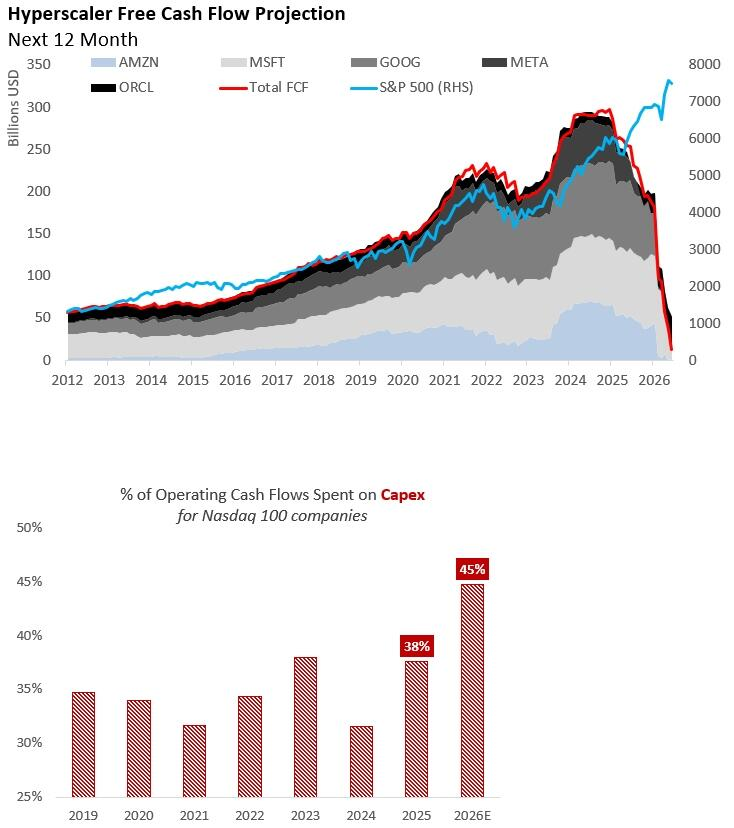
As hyperscale data center operators face surging capital expenditures and expectations of negative free cash flow, markets are beginning to question whether these tech giants, the "source of capital," will compress hardware procurement budgets, thereby constraining the revenue of the entire storage, chip, network, and server supply chain.
Horror Story 2: Policy & Tax "Black Swan" - Panic over Unrealized Gains Tax
Amid diverging opinions on industry fundamentals, a discussion document on tax reform sparked significant panic in South Korea.
According to Yonhap News Agency, lawmakers from multiple political parties jointly held a forum on tax reform, advocating for a shift towards "comprehensive income taxation," which explores incorporating "unrealized gains" (paper profits) from assets like stocks and real estate into the tax system.
Although the proposal includes gradual paths like tax deferral, it is tantamount to a major negative catalyst for an already high-valuation Korean stock market. Experts warn that while taxing gains only upon realization creates a "lock-in effect," the mere anticipation of taxing unrealized gains directly prompts investors to preemptively sell before any policy is enacted.
Furthermore, South Korea's exclusion from the MSCI Developed Markets (DM) watchlist, along with the President's recent comments expressing concern about the "wealth effect" of stock market volatility, further amplified policy uncertainty.
Horror Story 3: Leveraged ETF & Negative Gamma Feedback Loop
From a quantitative and technical perspective, this crash is a classic structural collapse.
According to ZeroHedge, Charlie McElligott, a quantitative strategist at Nomura Securities, noted that massive fund inflows into single-stock and storage-themed leveraged ETFs generated a huge "real and synthetic" Negative Gamma effect.
This market structure led to pro-cyclical and mechanical capital flows — the more the market falls, the heavier the selling pressure. Charlie McElligott pointed out that during the sell-off, Zero Days to Expiry (0-DTE) option traders actively shorted on rallies, completely dismantling dip-buying attempts. Combined with option dealers' position adjustments during the prior uptrend, this further exacerbated the systemic downward spiral.
This effect means that as the market declines, market makers and ETF managers must mechanically sell more shares to maintain balanced risk exposure. Chris Cha, head of Goldman Sachs' high-touch trading desk for Korea, disclosed in a report that the size of leveraged ETFs in South Korea has reached $9.1 billion, while offshore leveraged ETFs tracking SK Hynix and Samsung total a staggering $21 billion.
The shift in attitude from South Korean financial regulators further worsened the technical picture. The head of the Financial Supervisory Service (FSS) publicly expressed regret over failing to prevent the listing of single-stock leveraged ETFs linked to Samsung and SK Hynix, warning that their side effects are intensifying. Discussions by regulators about tightening margin loans and restricting ETF issuance directly undermined the technical buying that had supported the recent rally.
Horror Story 4: Liquidity Crisis - Retail Liquidations & Pension Fund Turncoat
The crash revealed the extreme homogeneity of the buying structure in the Korean stock market.
Alexander Redman, Chief Equity Strategist at CLSA Singapore, noted that the Korean market's rally was almost entirely driven by retail investors, with an unsettling degree of inherent bubble risk. This month, Korean retail investors' margin debt hit a record high of 38.5 trillion won (approximately $25 billion). Seoul-based fund manager Kim Namho stated that the massive margin debt triggered forced liquidations in the afternoon, accelerating the market's freefall.
Meanwhile, the traditional stabilizer became a major source of selling pressure.
When the pension fund shifted from passive support to mechanical supply, combined with foreign investors exiting the market, the marginal liquidity in the market evaporated instantly.
External Macro Pressure: Cooling Rate Cut Expectations & Earnings Season Test
Concurrent with the domestic fundamental and technical headwinds in South Korea, changes in the global macro environment also heightened market fragility.
The unexpected resurgence of expectations for further Fed rate hikes put systemic pressure on high-valuation tech stocks. Aditya Bhave, an analyst at Bank of America, predicts the Fed will resume rate hikes in September, October, and December of this year, cumulatively raising rates by 75 basis points to combat persistent service-sector inflation and wage growth.
Following the extreme market turmoil, investor attention is firmly fixed on Micron Technology's upcoming earnings report. Goldman Sachs notes that market expectations entering the Micron earnings report were already pushed to extremely high levels, providing a motive for profit-taking. Dilin Wu, a strategist at Pepperstone Group, stated that Micron's report card will be the true test of whether the AI hardware investment boom has staying power.
As CLSA strategist Alexander Redman noted, the magnitude of this volatility is closely linked to the market's inherently retail-driven nature and degree of bubble risk. While the medium-term upward cycle for memory chips and the AI demand thesis remain unproven false, global chip stocks are undergoing a painful process of expectation resetting and valuation digestion amidst forced deleveraging and a barrage of rumors.


