






WSJ: Fake websites, fake trades, real promotion – Polymarket's traffic scam


- Core thesis: An investigation by The Wall Street Journal found that the prediction market Polymarket paid creators to conduct fake trades on a simulated website and produce profit-making videos, which were then virally amplified using "paid shills" to attract US users. This practice seriously violates federal advertising regulations, and the displayed trades and profits were entirely fabricated.
- Key findings:
- Polymarket paid dozens of college student creators to conduct fake trades on an official simulation website, "poiymarket.com," and produce profit-making videos without disclosing the paid relationship.
- The investigation analyzed 1,105 videos, showing that 70% of the wagers (totaling $1.9 million) were fake. The $900,000 in prizes displayed in 118 fake profit videos were purely fictional; actual bets would have resulted in losses of over $166,000.
- Polymarket managed a team of "shills" through its marketing contractor, requiring them to repost creator content. The promotion's target audience was required to be at least 60% US users, violating the terms of a 2022 settlement agreement that prohibits offering services to US users.
- Creators were instructed not to disclose the paid relationship, receiving monthly payments of $2,000-$3,000. Video content was reviewed by Polymarket and used catchphrases like "free money" to lure users.
- The fake simulation website had over a dozen differences from the real site, such as buttons displaying "NIR" instead of "NO" and a URL indicating a test environment. The site has since been shut down.
- Polymarket's influencer marketing strategy included collaborations with streamers like Adin Ross to promote videos trading on inside information, raising concerns about market manipulation.
- Polymarket's viral promotion campaign accumulated over 140 million views across TikTok, YouTube, and Instagram, though the platform has since taken restrictive measures against some violating accounts.
Original article from WSJ, by Katherine Long,Caitlin Ostroff,Neil Mehta and Brenna T. Smith
Compiled by Odaily | Qin Xiaofeng (@QinXiaofeng 888 )
Editor's Note: Recently, a Wall Street Journal investigation found that the prediction market platform Polymarket hired dozens of creators to produce fake trading and profit videos on simulated websites, and used a "bot army" on social media for viral distribution, all in an effort to attract U.S. users. None of these videos disclosed the paid relationship as required by federal regulations, and the displayed "lucrative returns" were completely fabricated. Polymarket stated that it is committed to maintaining accurate, fair, and transparent markets and plans to conduct a comprehensive audit of its promotional content.
The following is the investigative article from The Wall Street Journal, compiled by Odaily. Enjoy~
————————
Judging from George Makihara's videos, he appears to have a lucrative side hustle betting on Polymarket.
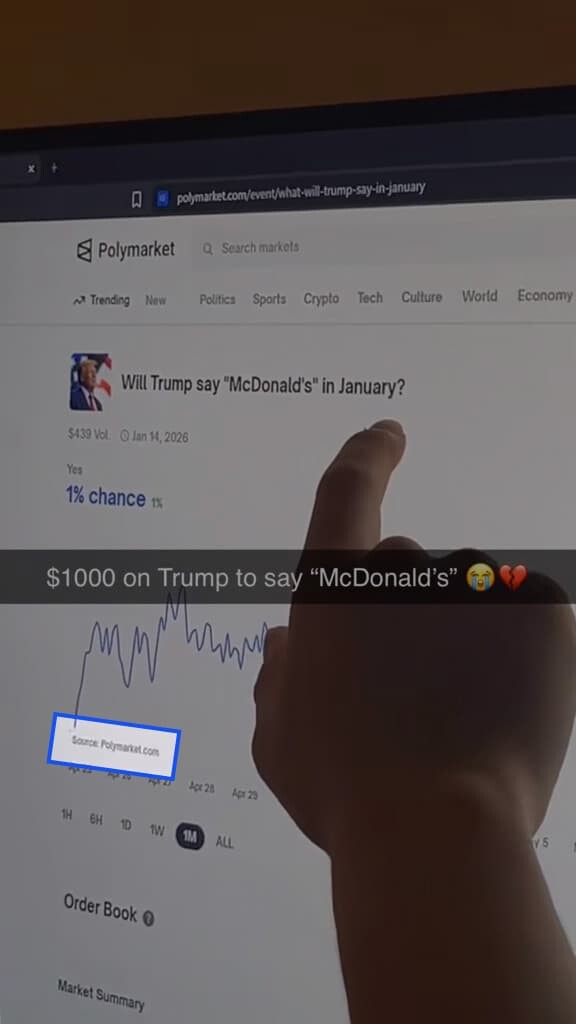
In January, this college student posted a video showing him winning $100,000 for betting that President Trump would publicly say the word "McDonald's" that month.
According to his video, from January to mid-May, George Makihara seemed to have placed 145 bets on the Polymarket site—totaling nearly $410,000.
But according to a Wall Street Journal investigation, none of these transactions were real.
George Makihara jumps up when Trump says the word "McDonald's"; Trump never publicly said the word that month, and this video was filmed two months prior
Based on an analysis of over 1,100 videos by The Wall Street Journal, related teaching materials, and interviews with creators who have worked with the company, George Makihara is one of dozens of creators paid by Polymarket, mostly college students, who film themselves making fake trades, sometimes showing fictitious profits. George Makihara declined to comment.
Public data shows that on Polymarket's actual website, more than 50 accounts participated in betting on "McDonald's" in January. All these accounts lost money.
To attract users to its unregulated platform, Polymarket flooded social media with videos like George Makihara's, which at first glance appear very realistic. In reality, Polymarket created near-perfect clones of its website, then instructed creators to conduct simulated trades on these fake sites and conceal that they were being paid by Polymarket.
To make the videos go viral, Polymarket recruited a social media "army" to copy and repost creator content. Although this New York-based company has been banned from offering its core crypto platform services in the U.S. since 2022, these social media creators were paid to target American users specifically—even though U.S. users can still access the site via a VPN.
Polymarket stated in a press release, "The company is committed to maintaining accurate, fair, and transparent markets. We are part of a rapidly growing industry and are constantly evaluating how to improve how we engage and earn the trust of our audience." The company said it plans to conduct a thorough review of its existing promotional content.
Polymarket hired and worked closely with a marketing contractor to promote the site. In a message reviewed by The Wall Street Journal, this contractor told its social media "army" to focus on reposting content from ten Polymarket creators, one of whom was George Makihara. These creators initially did not label themselves as paid partners of Polymarket, though one had a $20 promotional code in their bio. It was only after The Wall Street Journal began asking the company about its marketing operations that these creators started adding an "@polymarket partner" tag to their bios.
The Wall Street Journal reviewed 1,105 videos posted between December 2025 and mid-May from ten creators endorsed by Polymarket's contractor. In 70% of the videos, the creators placed bets; clues within the videos indicated that all these bets — totaling $1.9 million — were fake. Most videos simply showed the process of placing a bet, but 118 videos showed creators reacting to a win, claiming nearly $900,000 in winnings— all fictitious; had they actually placed the bets, the losses would have exceeded $166,000. (Note: Polymarket has a data partnership with Dow Jones & Company, publisher of The Wall Street Journal. The WSJ used only public data in this analysis.)
According to creators who have collaborated with the company, Polymarket instructed them not to disclose that they were being paid. They said compensation typically ranged from $2,000 to $3,000 per month.
Investigating the Fake Trades
One of the earliest videos showing signs of fake trades was posted to social media in June 2025, filmed at Polymarket's New York office. The video showed someone betting $100,000 that Powell would say "good afternoon" at a press conference, with the caption calling the bet a "valid masculinity test."
The Wall Street Journal's investigation found over a dozen differences between the real Polymarket website and the simulated one.
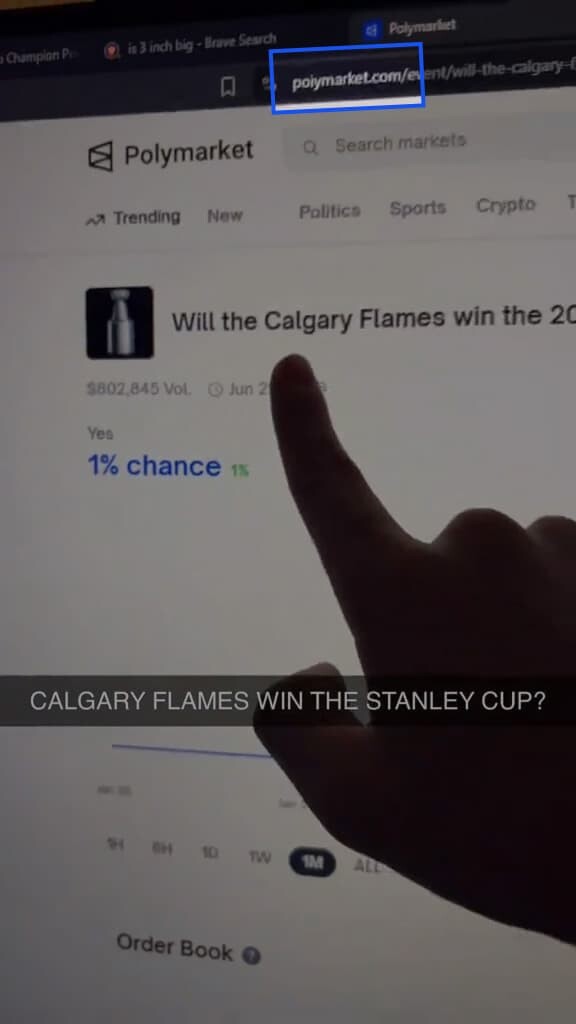
The fake simulated site was called "poiymarket.com"; when the "i" is capitalized, it is indistinguishable from polymarket.com. According to a person familiar with the matter, the site was set up by Polymarket. The price charts on the site listed the source as "Polymarket.com". However, Polymarket's actual official website does not display any source information.
Additionally, the fake site sometimes displayed errors. For instance, buttons would show "YES" and "NIR", while the real site uses "YES" and "NO".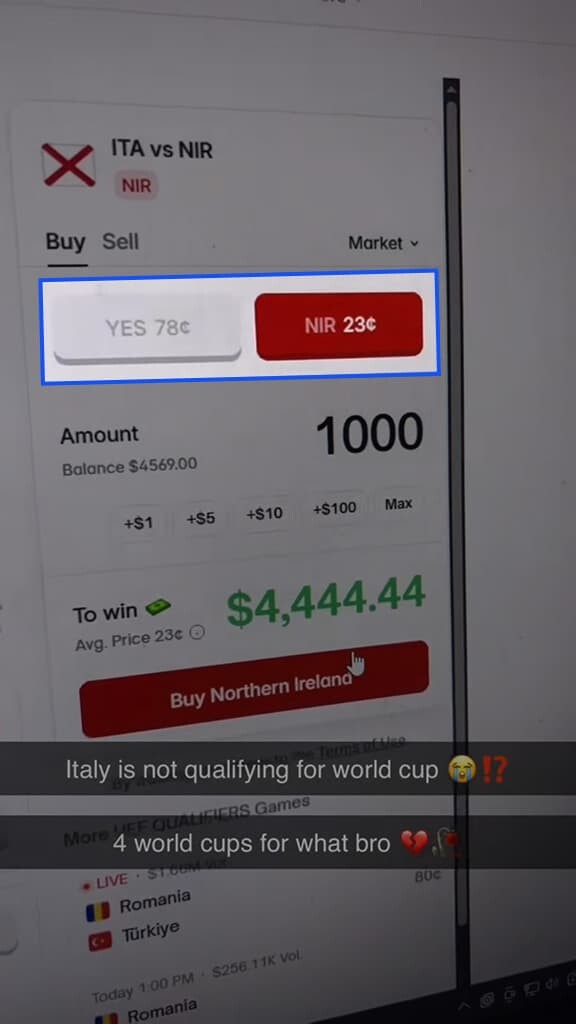
Several videos reviewed by The Wall Street Journal also briefly flashed URL addresses, revealing these sites were test environments for Polymarket engineers. After The Wall Street Journal contacted Polymarket for comment, the fake "poiymarket" site was taken down.
Federal advertising laws require brands to be truthful about their promotional content and require individuals paid to endorse a product to disclose that relationship; though there are still some gray areas regarding what is permissible. Commodity laws that govern prediction markets also prohibit deceptive and misleading conduct.
A spokesperson for the Federal Trade Commission, which enforces advertising laws, declined to comment on The Wall Street Journal's findings, citing the agency's policy of not commenting on potential investigations.
Razeen Khan, a California college student who worked as a Polymarket creator for several months until March, compared the videos to fast-food ads—where the food looks more appealing than it is in reality.
"We're showing what is actually happening," he said. "You're still going to buy the burger."
Creators said they would send their finished videos to Polymarket for review. If the videos were not engaging enough or showed obvious signs of being fake, Polymarket would ask them to be re-shot.
Haian Nguyen, one of Polymarket's top-performing creators, filmed herself trading on the platform from her bedroom in San Francisco. In a video posted on Instagram, Haian Nguyen celebrated winning $60,000 after betting that Trump would say "Olympics."
Another video of her dancing on a beach near the Golden Gate Bridge was overlaid with the text "Polymarket funds my life."
Haian Nguyen declined to comment and deleted all videos from her personal page after being contacted by The Wall Street Journal.
These promotional videos all followed the same template: the creator opens Polymarket, places a bet, and calls the profit "free money." Dozens of social media creators posted videos with nearly identical formats. According to creators who have worked with the company and a recruitment website, Polymarket would send creators talking points as guidance.
Common catchphrases used in Polymarket user-generated content videos are as follows:
Nearly 25% of the videos used the word "free." Common phrases included "free bread," "free money," and "it's free."
- "Bro, if this trend continues, it's free bread." — 27 videos
- "Wait, what?" — 223 videos
- Free — 278 videos
- "Isn't this free money?"
- "If I bet a thousand dollars on Canada winning, isn't that basically free?" — 35 videos
- "Am I missing something?" — 237 videos
- "Bro, what?" — 166 videos
- "Wait" — 100 videos
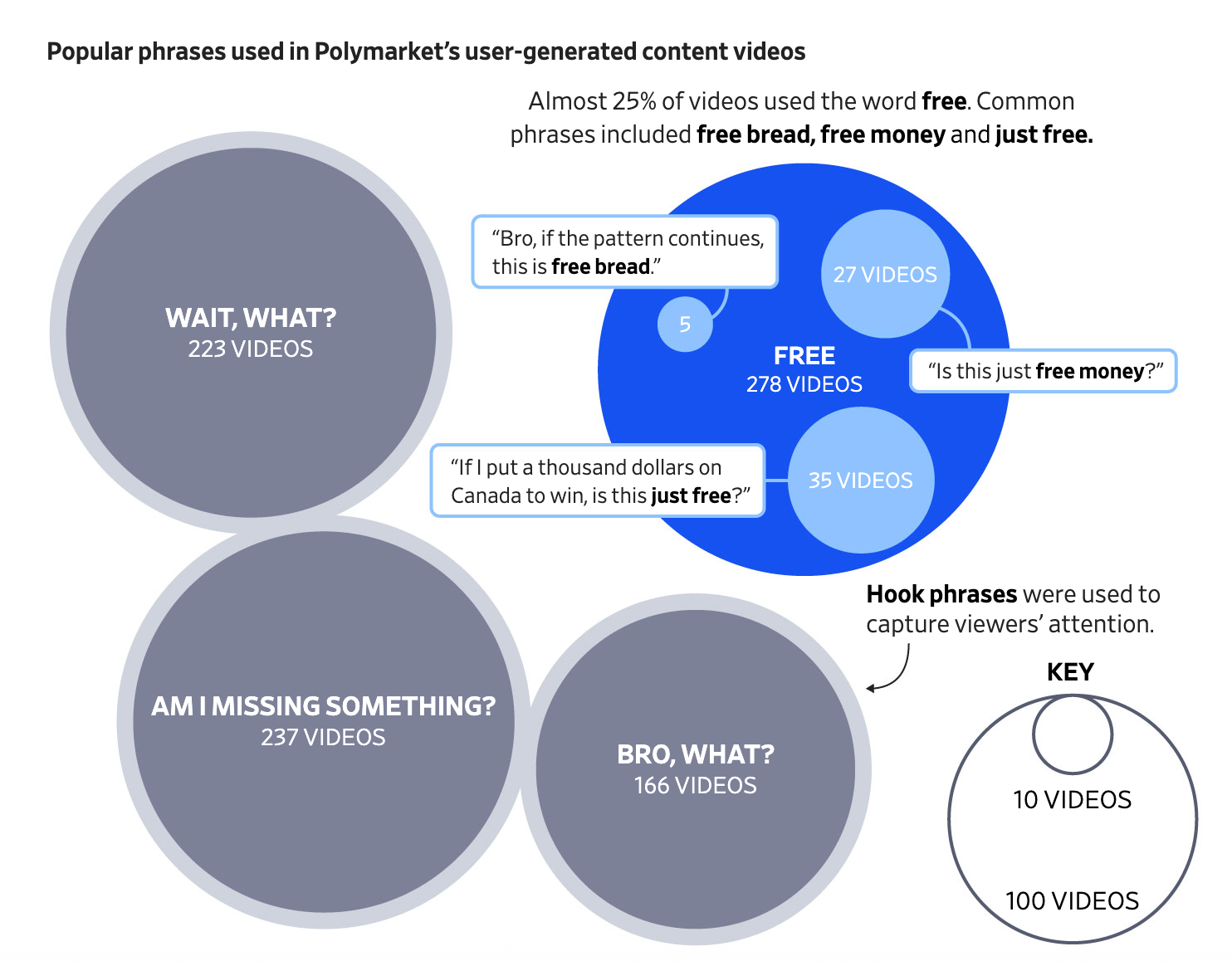
Source: Wall Street Journal analysis of 1,105 Polymarket creator videos on TikTok
The U.S. Commodity Futures Trading Commission (CFTC), which regulates prediction markets, has previously taken enforcement action against companies that used simulated trading to market products with unrealistic profit promises.
The Trump administration has taken a lenient approach to regulating prediction markets. The CFTC has filed multiple lawsuits to prevent states from regulating and taxing prediction markets. Trump recently posted on Truth Social that it is "vital" for the CFTC to have exclusive jurisdiction over prediction markets to allow them to thrive, and called politicians who want states to regulate prediction markets "scumbags." Trump's son, Donald Trump Jr., is an investor in Polymarket and a paid advisor to competitor Kalshi.
A White House spokesperson stated there is no conflict of interest and that Trump's actions are in the best interest of the American public. A CFTC spokesperson, responding to The Wall Street Journal's report, said it is important to bring offshore prediction markets back to the U.S. so regulators can oversee them more effectively.
The Hype Machine
For Polymarket, going viral is everything.
According to two people familiar with his thinking, founder Shayne Coplan told Polymarket's growth team to make the company impossible to ignore online. His close friend since high school, Matthew Modabber, serves as the Chief Marketing Officer responsible for Polymarket's growth.

In 2024, Matthew Modabber (left) with Polymarket founder Shayne Coplan (right)
Polymarket is striving to attract more trading volume than its main competitor—the U.S.-regulated prediction market Kalshi. Polymarket initially led; for most of 2025, they grew in tandem; but in recent months, Kalshi has taken the lead. According to data provider The Block, Kalshi's trading volume last month was roughly double that of Polymarket.
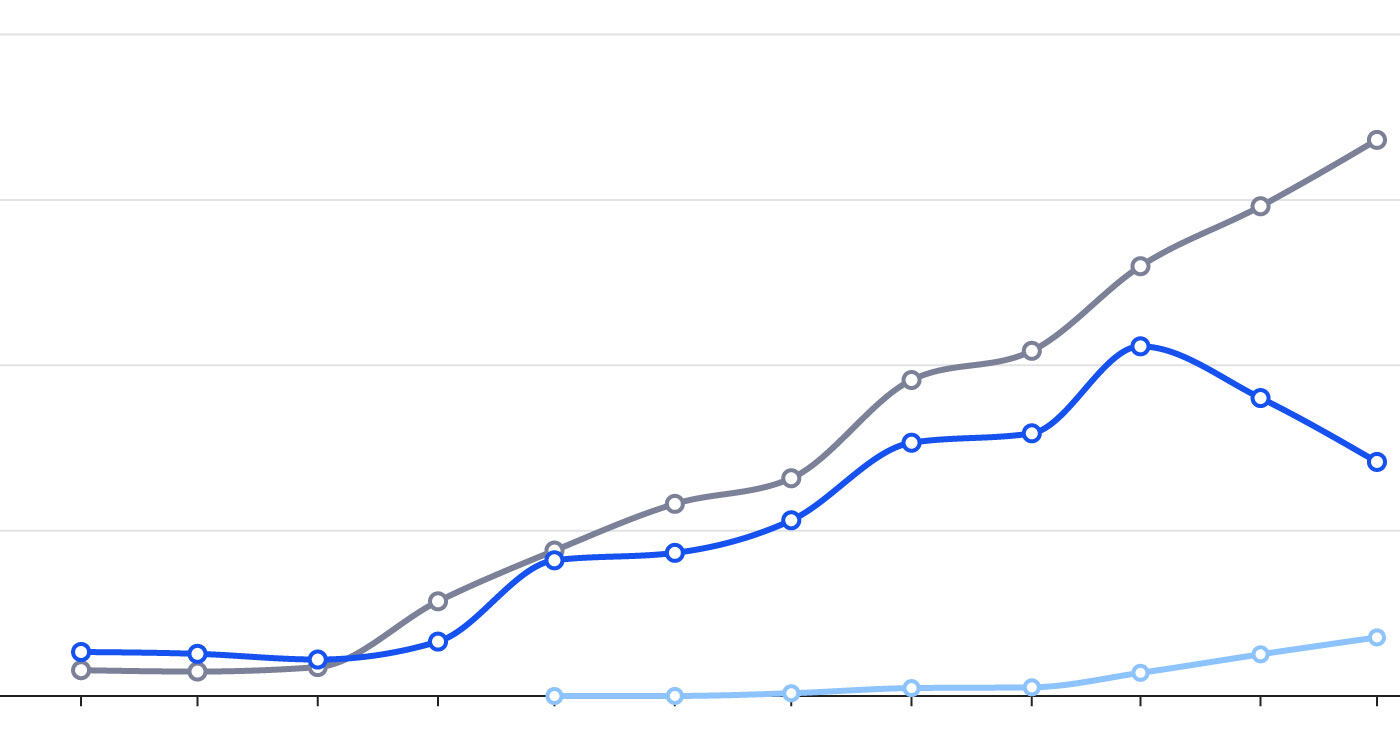
Monthly Trading Volume of Prediction Markets, Data as of end of May 2026; Source: The Block
In 2022, Polymarket settled charges of operating an unregistered options exchange, agreed to stop offering its crypto-based trading services to U.S. customers, and formally re-registered in Panama. Late last year, it launched a regulated U.S. version, available only as a mobile app. The app's trading volume is just a fraction of the offshore crypto exchange.
According to a person familiar with the matter, Polymarket is currently seeking to overturn the outcome of the 2022 settlement and bring its crypto platform back to the U.S.
Meanwhile, it is turning to social media to funnel Americans into Polymarket.
Polymarket's Social Media "Army"
Polymarket's strategy utilizes three groups of social media producers to generate viral attention by portraying the platform as a source of quick, easy money.
- Streamers: Influencers broadcast live on platforms like Twitch and Kick, discussing Polymarket, and sometimes trading, for hours at a time.
- Creators: Social media users, mostly college students, who produce short videos talking about Polymarket or trading on it.
- Editors (known as "slicers" domestically): People around the world—especially teenagers in Asia—who repost videos from streamers and creators.
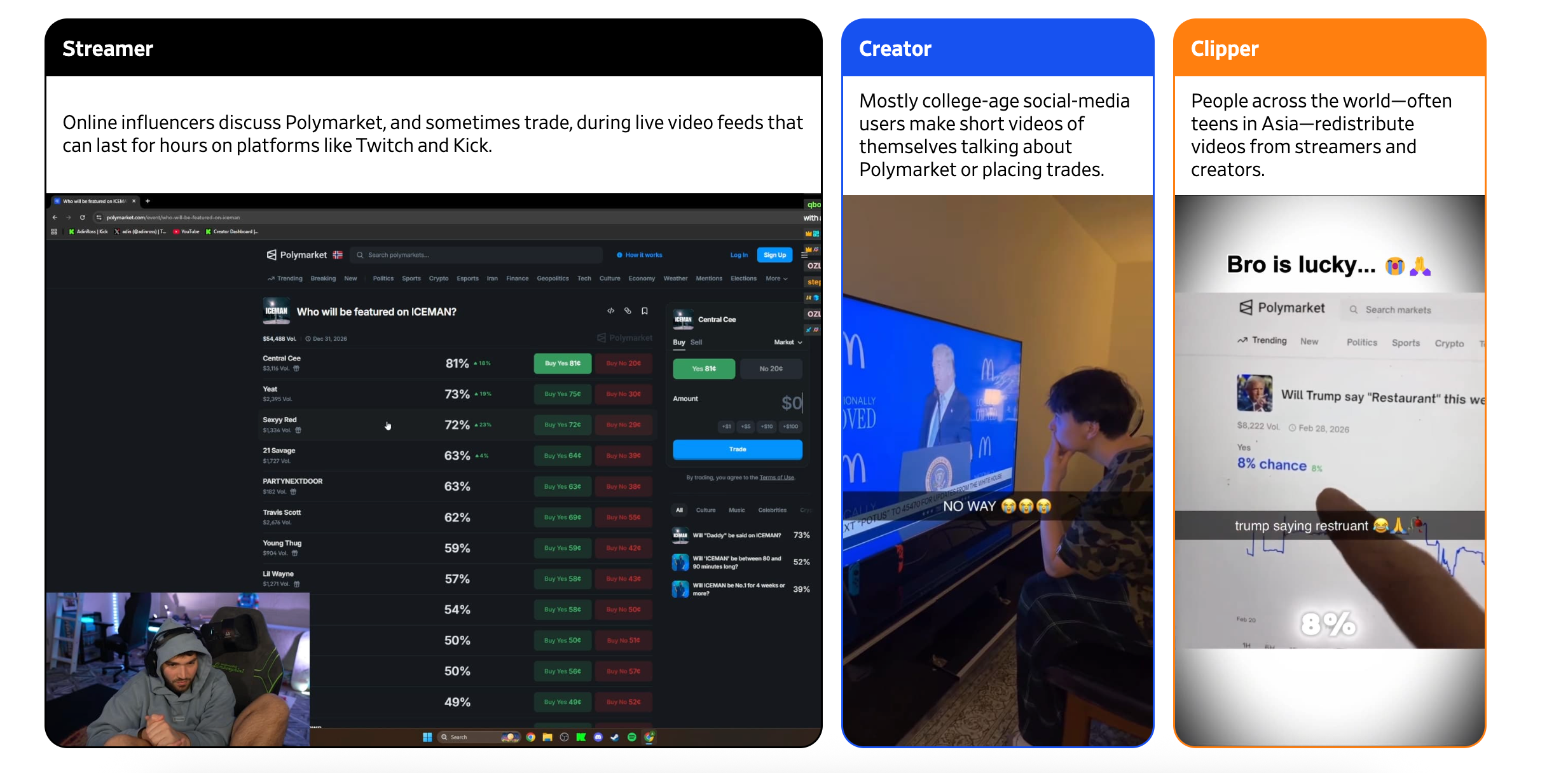
Polymarket hired the marketing company Virality to manage the "slicer" team. Their promotional activities were targeted at Americans: according to teaching materials, as of early June, slicers were only paid if at least 60% of their audience was in the U.S.
Polymarket publicly distanced itself from these ads. Based on The Wall Street Journal's review of nearly 20,000 messages in Polymarket's online content creator contractor chat groups, as well as teaching documents and videos prepared for them, Virality required slicer team posts to appear "personal and organic."
"Guys, if your account name has 'Polymarket' in it, please rename and delete it as soon as possible," a Virality employee said in a group chat to a group of slicers. "Continued use will violate our guidelines and may lead to submission rejection. Don't even keep 'poly,' change that too." Virality declined to comment.
Virality's clip promotion campaign yielded significant results.
A video posted by one Polymarket creator on TikTok had only received 151 views by mid-May. The slicer team reposted his video using secondary accounts, but most reposts received almost no traction, with very few views. However, Polymarket works with many video editors to increase the odds of a video going viral. Eventually, one video would always take off.
According to data from analytics provider Tubular, Polymarket's viral clip promotion campaign garnered over 140 million cumulative views on TikTok, YouTube, and Instagram.
A TikTok U.S. spokesperson said that several accounts identified by The Wall Street Journal and other related accounts have been restricted for violating platform rules. A YouTube spokesperson stated that creators and brands must comply with legal obligations, or YouTube may take action against them. A Meta spokesperson said that while the platform requires creators to disclose if they are paid to promote or endorse products, it could not confirm whether this specific content violated its policies because it had not independently verified whether these creators were paid by Polymarket.
Influencer Live Streaming Promotions
Polymarket and Virality targeted dozens of videos by Adin Ross for promotion. Ross, a 25-year-old "manosphere" influencer with millions of followers. According to


