






智谱都一万亿了,Anthropic的估值该怎么算?


- 核心观点:市场通过智谱的重估、链上Pre-IPO价格及ARR倍数三种方式推算Anthropic估值,分别得出十万亿、1.72万亿及8200亿-2.36万亿美元的结果,但三者均非精确答案,Anthropic的最终估值取决于收入增速、推理成本下降及商业场景落地等多重关键条件能否同时成立。
- 关键要素:
- 智谱商业化对标Anthropic,其万亿港币市值基于数百倍PS(2025年收入约1亿美元),若套用到Anthropic(年化收入超300亿美元),理论估值达十万亿美元,明显失真。
- Binance上Anthropic Pre-IPO合约按10亿股估算,当前隐含总市值约1.72万亿美元,但该市场流动性极低(24小时交易量仅100万美元),不代表普通股真实价格。
- Anthropic估值更依赖ARR倍数:到2026年底,买方预期Anthropic+OpenAI合计ARR达1400-2000亿美元以上,若Anthropic占59%份额,其ARR约820-1180亿美元。
- 按10-20倍ARR估算,Anthropic估值区间为8200亿至2.36万亿美元,这是相对可靠的框架,但前提是收入持续高增、推理成本下降、毛利率向软件公司靠拢。
- 三种估值方法各有局限:智谱反映稀缺溢价与情绪,Pre-IPO受流动性制约,ARR倍数依赖多个不确定条件(如Agent和代码助手场景的收入质量)。
TL;DR
After Zhipu's stock price revaluation, the market used it to back-calculate a $10 trillion valuation for Anthropic, but their revenue bases and scarcity premiums differ.
- Based on an estimated share count of 1 billion shares, Binance's Anthropic Pre-IPO perp currently implies a total market capitalization of approximately $1.7 trillion, but this cannot be equated to a true clearing price for common stock.
- Related assets: Anthropic, Zhipu, Amazon, Google, AI private asset trading platforms, RWA / tokenized stocks sector.
- Domestic large model player Zhipu has been the absolute market focus in recent days. After a continuous rally without correction, it just reached the milestone of 1 trillion Hong Kong dollars on the Hong Kong Stock Exchange.
Zhipu's commercialization path is entirely benchmarked against Anthropic, as stated by CEO Zhang Peng. A few months ago, Anthropic just completed a $65 billion funding round, with a post-money valuation of approximately $965 billion.
So, a few months later, can we use Zhipu's surge to calculate how much Anthropic is worth?
Let's Start with the PS Calculation
According to SCMP reports, Zhipu's 2025 revenue was 724.33 million RMB, a 131.9% year-over-year increase, with a total loss of 4.72 billion RMB and an adjusted net loss of 3.18 billion RMB. It is still in a phase with a low revenue base and significant losses. The substantial revaluation of its stock price and market cap in 2026 is driven not only by current income statements but also by progress in domestic large model capabilities, substitution expectations created by restricted overseas access to models like Claude Fable and Mythos, the scarcity of AI targets on the Hong Kong Stock Exchange, and the amplification of hot assets by public market liquidity.
Based on Zhipu's 2025 revenue of about $100 million, its market cap once corresponded to a PS (Price-to-Sales) multiple of several hundred times. This multiple is far higher than traditional high-growth software companies and exceeds the valuation framework most mature tech stocks can withstand.
Apply this multiple to Anthropic.
Based on Anthropic's annualized revenue run rate of over $30 billion to $47 billion, a theoretical valuation of several hundred times revenue would enter the tens of trillions of dollars, far exceeding the price given by current private market funding.
But ten trillion dollars is obviously quite distorted.
On-Chain Pre-IPO Has Prices, But Also Rights Gaps
On-chain Pre-IPO assets are tradable entry points provided by platforms in token form. Currently, the most well-known trading venue for Anthropic's Pre-IPO assets is Binance.
When Binance Futures launched the ANTHROPICUSDT contract on June 2nd, it disclosed that the contract uses 1 billion shares and explicitly stated that this share count is for reference only, does not represent the actual share count post-IPO, nor does it constitute Binance's endorsement of the implied valuation.
Based on the latest price on June 22nd, ANTHROPIC is trading at approximately 1718 USDT. With the platform's estimated share count of 1 billion shares, a rough calculation suggests the on-chain contract price implies a total market capitalization for Anthropic of roughly $1.72 trillion. The problem is extremely low liquidity, with only $1 million in 24-hour trading volume.
Anthropic's Anchor is in Revenue Velocity and Cost Curve
Besides the $10 trillion from the PS calculation and the $1.72 trillion from low liquidity, is there another method?
For instance, focusing on the two most critical variables for AI companies: Can revenue continue to grow at a high rate? Can costs continue to decline?
Traditional software companies are often priced using revenue multiples because their marginal cost is very low. Selling to the millionth customer doesn't linearly increase additional costs. But large model companies are different. Every user call to a model consumes computing power, electricity, chip depreciation, and cloud resources—this is the inference cost (the compute cost of using the model).
If inference costs don't decrease fast enough, higher revenue could also mean higher cash burn. This is why Anthropic's ARR (Annualized Revenue Run Rate) and gross margin are more important than revenue alone. ARR isn't the audited revenue for the past year; it's the annualized revenue based on the most recent month or quarter, used to gauge the company's current commercialization velocity.
Valuation can start from a simple formula: Anthropic's ARR multiplied by a revenue multiple, then discounted or given a premium based on gross margin and cloud costs.
Looking only at the IPO window, the core variable is what ARR Anthropic can achieve before listing. Overseas buyers' mainstream expectations for the combined ARR of Anthropic and OpenAI by the end of 2026 are concentrated in the range of $140 billion to over $200 billion. If Anthropic maintains its current revenue share of approximately 59%, its corresponding ARR would be roughly $82 billion to over $118 billion. At 10x ARR, that corresponds to over $820 billion to $1.18 trillion; at 15x, over $1.23 trillion to $1.77 trillion; at 20x, over $1.64 trillion to $2.36 trillion.
This is a relatively reliable valuation algorithm for Anthropic currently.
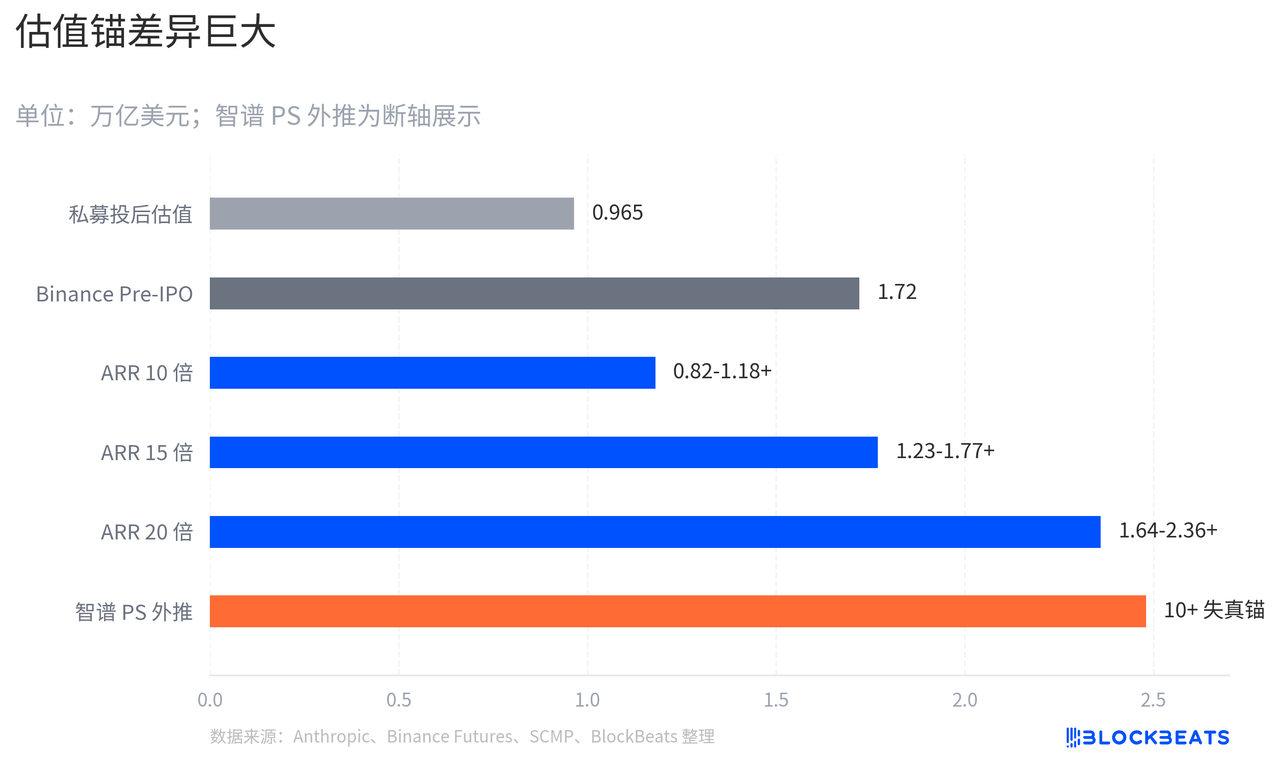
The market's willingness to grant Anthropic a private valuation approaching $1 trillion is essentially a bet on three things happening simultaneously: continued growth in demand for Claude from enterprises and developers; scenarios like Agents and code assistants generating high-quality revenue; and a sufficiently fast decline in inference costs, bringing gross margins from early low levels closer to those of software companies.
None of the Three Anchors is the Answer
So, back to the initial question. Zhipu, Pre-IPO, and ARR multiples – three methods can each produce a number, but none alone can be the answer.
Zhipu represents the emotional ceiling. It shows the market is willing to pay a very high premium for scarce AI targets, but directly applying it to Anthropic yields clearly distorted results like $10 trillion.
Binance provides a trading price. The $1.72 trillion looks closer to reality, but it corresponds to a low-liquidity Pre-IPO contract, not the true clearing price for common stock.
The ARR multiple is relatively more reliable, but it is still just a framework. Whether Anthropic's valuation post-IPO can hold ultimately depends on whether several conditions can be simultaneously true: continued high revenue growth, stable recurring demand from enterprises and developers, high-quality revenue from Agents and code assistants, and sufficiently fast declines in inference and cloud costs.
If these conditions are all met, a valuation approaching or exceeding $1 trillion has support. If any one of them falters, the market will re-price Anthropic instead of continuing to believe in a single, attractive valuation anchor.


