






不管你懂不懂球,买平就是这届世界杯最佳策略?


- 核心观点:在世界杯小组赛阶段,基于Polymarket预测数据执行“每场买平局”的策略,收益率高达105%,表明低概率平局的高赔率收益远高于频繁命中强队获胜的累积亏损。
- 关键要素:
- 截至40场小组赛,平局命中13场,总投入40000美元,净赚约41914美元,收益率近105%,显示平局策略的盈利潜力。
- 平局策略的关键在于“中得值”:低概率平局(如西班牙vs佛得角平局概率5.5%)命中后结算倍数高达18倍,一次命即可覆盖多次亏损。
- 典型爆冷案例:用户@betoor619在西班牙vs佛得角比赛中买入西班牙获胜(92美分),因0:0平局亏损99.9万美元,凸显热门球队陷阱。
- 平局集中在1-1(如加拿大vs波黑、巴西vs摩洛哥等7场)和0-0(如西班牙vs佛得角、厄瓜多尔vs库拉索),0-0的结算收益更高,如西班牙场1000美元投入可获约18182美元。
- G组4场3平(比利时1-1埃及、伊朗2-2新西兰、比利时0-0伊朗),显示平局是小组赛博弈常态,受弱队保守和强队谨慎策略推动。
Original: Odaily (@OdailyChina)
Author: Asher (@Asher_0210)

As the World Cup group stage progresses, an increasingly counterintuitive phenomenon is becoming clear: Betting on favorites doesn't guarantee profit; betting on underdogs can be nerve-wracking to hold; but blindly betting on a draw in every single match might actually be the most profitable strategy.
According to Polymarket's pre-match prediction data, if $1,000 was placed on a "draw" for every match, as of the first 36 games, there have been 11 draws (see chart below). This means a total stake of $36,000 would yield a settlement of $73,214, resulting in a net profit of $37,214 after deducting the principal – a return rate exceeding 100%. 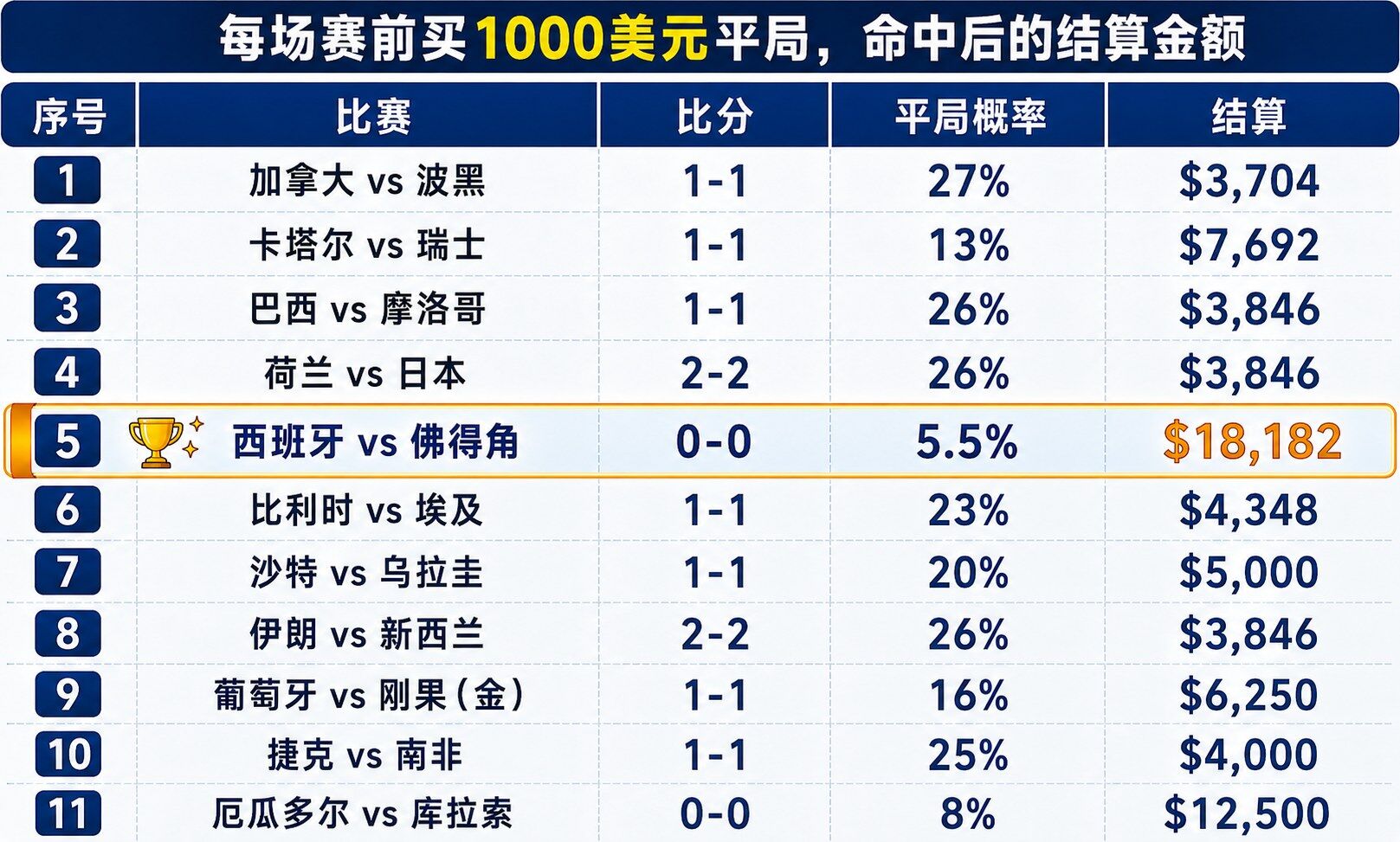
Even more striking, if the same strategy of "$1,000 on a draw per match" (total stake of $4,000) was applied to today's 4 matches based on Polymarket's pre-match data, the results show that while stakes were lost on Spain 4-0 Saudi Arabia and New Zealand 1-3 Egypt, draws were hit in Belgium 0-0 Iran and Uruguay 2-2 Cape Verde, with a total settlement amount of approximately $8,700. This means that even with only 2 correct predictions out of 4 matches, today's net profit would still be around $4,700.
Including today's 4 matches, among the 40 World Cup group stage games, 13 ended in draws. A total stake of $40,000 would result in settlements totaling approximately $81,914 for the winning predictions. After deducting all stakes, the net profit would be around $41,914, representing a return rate of nearly 105%.
A hit rate of 13/40 is not particularly high, but the key to the draw strategy has never been about "how many you win," but rather "how valuable the wins are." The lower the pre-match probability of a draw, the higher the settlement multiple after it hits. For matches like Spain vs. Cape Verde (5.5% draw probability), Ecuador vs. Curaçao (8% draw probability), or Qatar vs. Switzerland (13% draw probability), hitting just a few of these can transform a strategy from small losses into massive profits.
Cape Verde's Draw Against Spain: The Ultimate "Liquidation Event" of the World Cup So Far
The group stage match between Spain and Cape Verde wasn't just a jackpot for the draw strategy; it was also a nightmare for pre-match favorites bettors.
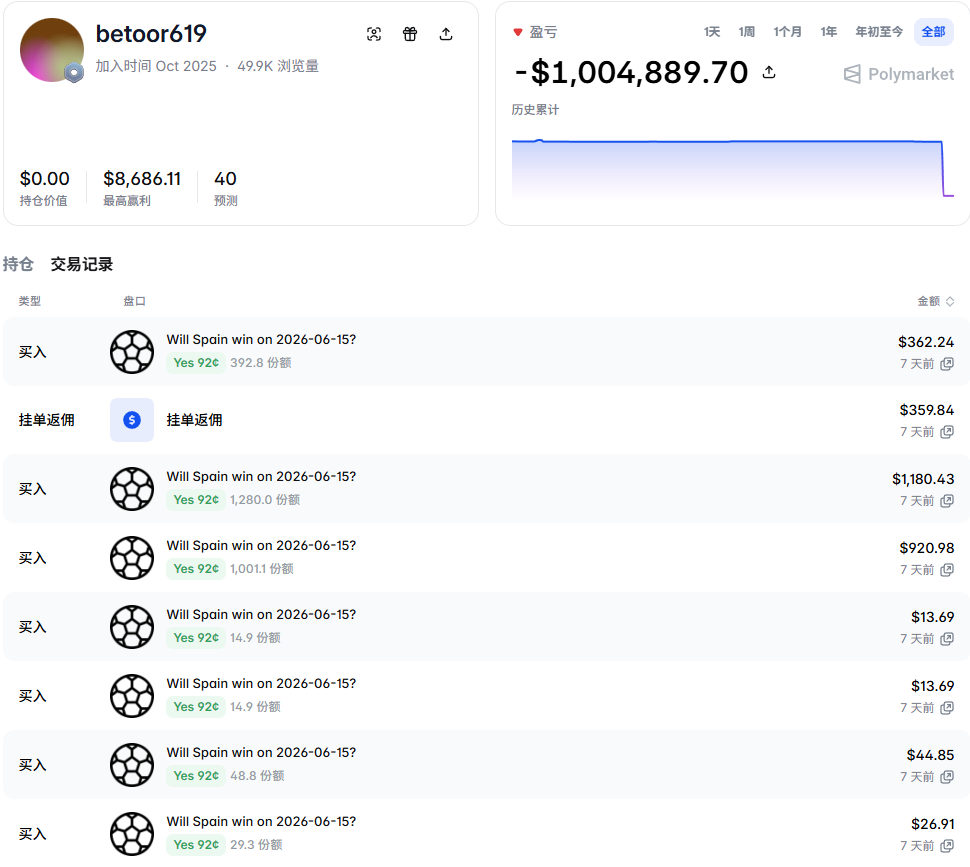
Spain's win probability was as high as 92% before this group match. Polymarket data reveals that a user, @betoor619 (address: 0x70088c990ffae782c699b9250f5aa6cbe4e3c666), bet on Spain to win this World Cup group stage match. The match ended 0-0, resulting in a loss of $999,000 for the user.
Notably, the user placed the trade when the price was at 92 cents, staking $1 million principal for a potential profit of just $85,000. It seemed like a sure win, but the shocking upset was sealed due to Cape Verde's 40-year-old goalkeeper making 7 incredible saves and their rock-solid defense.
0-0 and 1-1: The Emerging Themes of This World Cup
Looking at the matches that have ended in draws, the group stage draws of this World Cup haven't been random occurrences. They are concentrated around a few specific scorelines.
The most common is 1-1. Canada vs. Bosnia, Qatar vs. Switzerland, Brazil vs. Morocco, Belgium vs. Egypt, Saudi Arabia vs. Uruguay, Portugal vs. DR Congo, Czech Republic vs. South Africa – all ended with this score. What these matches share is that neither side was completely out of the game, nor was it simply a case of the weaker team parking the bus until the end. More often, it's the stronger team failing to convert dominance into victory, while the weaker team seizes its chance to respond. The games seem back-and-forth, but ultimately, neither team can truly break down the other.
For traders, the value of 1-1 lies in its stability. It isn't the most extreme source of profit, but its high frequency makes it the foundation of the "bet on a draw every match" strategy.
The real driver of profits, however, is the 0-0 draw.
Spain vs. Cape Verde is the most typical example. Spain was the overwhelming favorite, with a pre-match draw probability of only 5.5%. Yet the match ended 0-0. A $1,000 bet on a draw would have resulted in a settlement of approximately $18,182. The logic is similar for Ecuador vs. Curaçao. The draw probability was just 8%, but the match also ended 0-0, with a $1,000 stake yielding a settlement of $12,500.
Therefore, the real money in the draw strategy isn't made by predicting every draw correctly; it's made because when a few low-probability draws hit, the settlement multiples are extraordinarily high. This is especially true for 0-0 games, which often feature the favorite team constantly attacking and the weaker team's goalkeeper and defense repeatedly clearing the danger.
Group G is Even More Extreme: 3 Draws in 4 Matches
If Spain vs. Cape Verde is the poster child for low-probability draws, then Group G seems to epitomize the "draw density" of this group stage.
In their first 4 matches, Group G has already witnessed 3 draws. In the first round, Belgium drew 1-1 with Egypt, and Iran drew 2-2 with New Zealand. In the second round, Belgium drew 0-0 with Iran. The only match that produced a winner was New Zealand vs. Egypt, but this doesn't change the fact that the group's overall rhythm has been completely slowed down by draws.
Belgium, in particular, has drawn both of their group stage matches. For the team, this means the pressure to qualify is maintained. But for those who bet on Belgium to win outright before the tournament, the outcome of both matches was the same – they didn't lose the game, but their positions were wiped out.
This is where draws are often underestimated in prediction markets. The market prefers to bet on favorites because it seems more intuitive. However, the real logic of group stage play isn't that "favorites must win." Many teams are content with just 1 point. Weaker teams don't want to lose, and stronger teams don't want to take unnecessary risks too early. Once a match reaches a stalemate, a draw becomes a very realistic outcome.
With 3 draws in Group G's first 4 matches, it shows that draws are not just accidental upsets, but a calculated part of the group stage game. Especially when points haven't been clearly separated, every team starts doing the math – winning is of course the best, but avoiding defeat is often the safer and more strategic choice.
Summary
In this World Cup, the strong teams are, of course, the main protagonists.
Spain will win, Brazil will win, and there will be matches where favorites dominate completely. But if we look strictly at trading returns, the most profitable script in the group stage so far isn't necessarily the mighty winning big; it's those recurring 1-1, 0-0, and 2-2 scorelines.
Those betting on the favorites are waiting for goals; those betting on draws are waiting for the final whistle. And so far, the latter are laughing louder.


