






Polymarket ครบรอบ 6 ปี: จากห้องน้ำ สู่การลี้ภัย และการกลับบ้าน


- ประเด็นหลัก: Polymarket ในวาระครบรอบ 6 ปีของการเปิดตัว ได้เติบโตจากการทดลองชายขอบที่เริ่มต้นในห้องน้ำระหว่างการล็อกดาวน์ช่วงโควิดในนิวยอร์ก สู่การเป็นตลาดพยากรณ์ที่มีผู้จับตามองมากที่สุดในโลก โดยได้รับการลงทุนจาก ICE, ได้รับใบอนุญาตจาก CFTC และถูกนำเสนอใน The Wall Street Journal, ลีกกีฬาหลัก และรายการโทรทัศน์สด แต่เส้นทางสู่ความสำเร็จของมันเต็มไปด้วยความขัดแย้งด้านกฎระเบียบและการเดินทางกลับบ้านที่คดเคี้ยว
- องค์ประกอบสำคัญ:
- จุดเริ่มต้นทางเทคนิคและการพิสูจน์แนวคิดในช่วงแรก: เปิดตัวในเดือนมิถุนายน 2020 ใช้ Polygon และ USDC เพื่อลดแรงเสียดทานในการทำธุรกรรม และพิสูจน์ศักยภาพในการเป็นสัญญาณของเหตุการณ์สาธารณะเป็นครั้งแรกผ่านตลาดการเลือกตั้งสหรัฐฯ ปี 2020 (ปริมาณการซื้อขาย 8 ล้านดอลลาร์)
- การถูกกำกับดูแลอย่างหนักและการลี้ภัยในต่างประเทศ: ในเดือนมกราคม 2022 CFTC กล่าวหาว่าดำเนินการตลาดไบนารี่ออปชั่นที่ไม่ได้รับการจดทะเบียน นำไปสู่การปรับ 1.4 ล้านดอลลาร์และถูกบังคับให้บล็อกผู้ใช้ในสหรัฐฯ เข้าสู่ช่วงเกือบสามปีของการดำเนินงานในต่างประเทศที่ซบเซา
- การระเบิดที่ขับเคลื่อนโดยเหตุการณ์สาธารณะ: เหตุการณ์เรือดำน้ำ Titan ในปี 2023 และวงจรการเลือกตั้งสหรัฐฯ ปี 2024 ทำให้แพลตฟอร์มได้รับความสนใจจากกระแสหลัก โดยมีปริมาณการซื้อขายสะสมหลายพันล้านดอลลาร์ และสามารถสะท้อนเหตุการณ์ทางการเมืองสำคัญ เช่น การถอนตัวของ Biden จากการเลือกตั้งได้สำเร็จล่วงหน้า
- การประนีประนอมด้านกฎระเบียบและหนทางการกลับมา: DOJ และ CFTC ของสหรัฐฯ ไม่ได้ยื่นข้อกล่าวหาในปี 2025 Polymarket ได้รับช่องทางเข้าสู่กรอบการกำกับดูแลของสหรัฐฯ โดยการซื้อ QCX ซึ่งเป็นตลาดหลักทรัพย์ที่จดทะเบียนกับ CFTC และได้รับหนังสือ no-action letter จาก CFTC ในปีเดียวกัน
- การยอมรับในระดับสถาบันและการสร้างรายได้: ICE (บริษัทแม่ของ NYSE) เข้าลงทุนเชิงกลยุทธ์สูงถึง 2 พันล้านดอลลาร์ ส่งผลให้มูลค่าประเมินเพิ่มขึ้นเป็น 1.5 แสนล้านดอลลาร์; แพลตฟอร์มเซ็นสัญญาความร่วมมือพิเศษกับลีกกีฬา เช่น NHL, UFC, MLB และทดลองเรียกเก็บค่าธรรมเนียมการทำธุรกรรม โดยคาดการณ์รายได้ต่อปีเกิน 2 ร้อยล้านดอลลาร์
- ข้อโต้แย้งและความท้าทายในอนาคต: แพลตฟอร์มยังคงเผชิญกับพื้นที่สีเทาทางกฎระเบียบและข้อโต้แย้งทางศีลธรรม (เช่น การนำเหตุการณ์ภัยพิบัติมาทำเป็นตลาด) คาดว่าจะมีการออกโทเค็นและแอร์ดร็อป และผู้ใช้ในสหรัฐฯ ยังคงสามารถเข้าถึงได้ผ่านเว็บไซต์ต่างประเทศ
On June 17, Polymarket celebrated its sixth anniversary since launch.
In the crypto world, six years is a long time. Long enough for a narrative to go from a bubble to rubble, and long enough for a product to evolve from a fringe experiment into mainstream infrastructure. Six years ago, Polymarket was just a prediction market built by a young founder in his bathroom during New York's COVID lockdown. Six years later, it has entered the balance sheets of Google, the WSJ, sports leagues, the CFTC's regulatory framework, and ICE (the parent company of the New York Stock Exchange), becoming the world's most-watched "information market."
If you only look at today, Polymarket seems like a classic success story: explosive trading volume, soaring valuation, its founder joining the ranks of the youngest self-made billionaires, and prediction markets moving from the crypto niche into mainstream media and live sports broadcasts. But pull the timeline back, and the story is far from smooth. It’s not a product history of continuous growth, but an adventure of constantly getting kicked out the back door, only to try and return through the front.
Polymarket's original proposition was simple: When the world is full of uncertainty, can prices get closer to the truth faster than media, experts, and polls? COVID, the US election, the Titan submersible, Biden's withdrawal, the Trump Whale, the FBI raid, CFTC approval, ICE investment. Over these six years, it has repeatedly turned real-world events into markets, and just as repeatedly been pushed back by the rules of the real world.
So, the significance of Polymarket's sixth anniversary lies in witnessing how a crypto product born in a bathroom came to stand at the crossroads of finance, media, sports, and regulation. This article from BlockBeats aims to tell the story of Polymarket's six years: how it survived, how it was driven out of the US, and how it bought its ticket back home.
The Gambler in the Bathroom
In October 2013, an email landed in the inbox of the U.S. Securities and Exchange Commission.
The sender was Shayne Coplan, 14 years old, still a high school student in Manhattan. According to a version he later shared, the email came from a teenager who had read "Flash Boys" and was captivated by electronic trading networks. The email was short, but the tone had a specific adolescent mixture: part naivete, part confidence.
He first introduced himself, saying he was a sophomore in high school in Manhattan working on a stock exchange based on ECN (Electronic Communication Network). His first order of business was to confirm that the idea was "completely legal" and could comply with SEC regulations.

Shayne Coplan
On December 2, 2024, Coplan shared this old email on X with only the caption: "What people call an 'overnight success' takes a decade." Looking back more than a decade later, the email seems like an overly neat foreshadowing. Coplan certainly didn't know back then that what he would eventually build wouldn't be a traditional stock exchange, but a prediction market allowing the world to bet on the future with prices. Nor did he know that this market would later be forced out of the US due to regulatory issues, only to try and walk back through the front door a few years later.
Pre-Polymarket History
Coplan grew up in Manhattan, raised by his mother, while his father was a film professor at NYU. He attended public school in Hell's Kitchen, not an elite preparatory school for Wall Street progeny. The impression he later gave wasn't that of someone trained in the traditional financial system. He seemed more like a kid raised at the intersection of internet culture, cryptocurrency, startup biographies, and the streets of New York.

Coplan attributes his high school graduation to "SparkNotes, caffeine, and Wikipedia." Photo: Shayne Coplan/Facebook
During those years, he started dabbling in cryptocurrency. According to media reports, the entry point had a touch of early internet serendipity: while downloading pirated music, he stumbled upon crypto, started researching it, and even tried assembling mining rigs. For many his age, the internet was for games, music, and social platforms; for Coplan, it was more like a staircase leading directly to a hidden basement. Following this staircase, he saw a new financial world with no teachers, no admission tickets, and no age requirements.
In 2014, the Ethereum presale began. Coplan bought ETH at around $0.30 per coin. This early investment later became the seed funding for his entrepreneurial journey.
Around the same time, he applied for a job at the lyrics website Genius. After sending many unanswered emails, he showed up directly at their office door. NYMag later described Coplan at that time as having a mop of curly hair and an encyclopedic knowledge of billionaire tech entrepreneurs. Genius eventually gave him an internship.
This experience is important to the Polymarket story because it shows Coplan wasn't initially studying finance, but rather "how people turn an internet idea into reality." He annotated pages about Zuckerberg, Travis Kalanick, and others on Genius, as if sketching a blueprint for his own future. A teenager repeatedly reading these people's stories, dissecting them repeatedly, was essentially learning a path: how a fringe idea enters the mainstream.
He later enrolled at NYU for Computer Science but dropped out after just one semester to focus full-time on crypto startups. Between 2018 and 2019, he bought the domain union.market and built a product called Union Market, focused on yield-generating digital assets. This project didn't really take off.
But failure didn't steer him away from the "market" concept. During that time, he read economist Robin Hanson's papers on futarchy. The core idea of futarchy is radical: If markets can aggregate information, can prediction markets help society make decisions? In other words, can prices reflect not just asset values, but the probability of future events?
Coplan wrote to Hanson, saying he wanted to build prediction markets. Hanson didn't take it too seriously. The reason was simple: prediction markets weren't a new concept. There had been many attempts over the decades, with far more failures than successes. The field always sounded right in theory, but the reality was it was always difficult to truly enter public life.
By the end of 2019, Coplan had become completely disillusioned with crypto. He was 21, had dropped out two and a half years prior, hadn't achieved anything significant enough, and was running out of money. Looking back at Polymarket's birth, it's easy to tell a story of a "genius founder discovering an opportunity." But on the real timeline, it looks more like someone at a low point in his life, searching for a way out within an old idea.
What truly changed everything was 2020.
COVID Breaks the Mold
In March 2020, New York City became the epicenter of the COVID-19 pandemic in the United States.
Times Square emptied, Broadway closed, restaurants upturned their chairs, and subway cars held only a few masked passengers. The sound of ambulances became the city's background noise. Every morning, the first thing people checked wasn't the weather, but the new case counts, hospitalizations, death tolls, gubernatorial press conferences, and new lockdown rules.
For most New Yorkers, the lockdown meant fear, stagnation, and endless waiting. Some lost jobs, some left the city, others were trapped in small apartments, endlessly refreshing news feeds.
Everyone was asking the same types of questions: When will lockdown end? Will cases keep rising? When will a vaccine come? Will the presidential election be rewritten by the pandemic? But traditional information channels provided unstable answers. Experts, media, government, social platforms – every voice sounded certain, yet every certainty was quickly overturned by new realities.
This was the perfect environment for prediction markets. Not because people suddenly loved to gamble, but because life presented too many unavoidable and unpredictable realities. The pandemic turned the "future" from an abstract concept into something everyone had to face daily. Everyone was predicting, but most predictions had no price attached.
Coplan saw this opportunity.
He developed the product in the bathroom of his apartment on Manhattan's Lower East Side. He would later repeatedly refer to it as his "makeshift bathroom office."
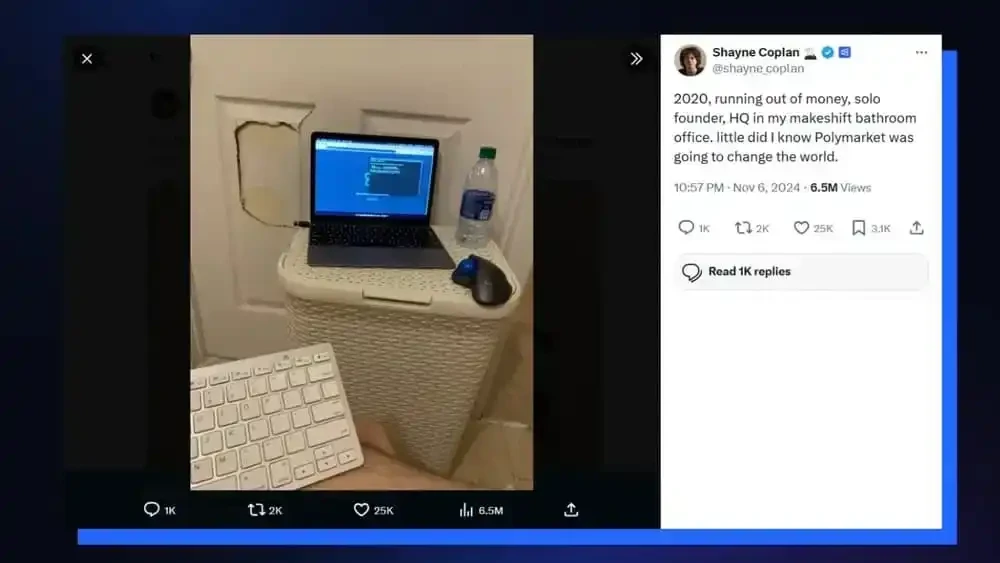
A young man with almost no resources, amidst the world's greatest chaos, trying to build a market to price that chaos. The pandemic had made everyone a forecaster, and Coplan wanted to compress the judgments scattered across chat groups, comment sections, expert interviews, and traders' screens into a single tradable price.
He had no co-founder, money was running out, and he needed to inventory his apartment possessions to see what he could sell for rent. The product's name was also in flux: Union.market, Union Marketplace, finally becoming Polymarket. The name sounds obvious now, but initially, it was just a new entry point growing out of the wreckage of an old project.

Polymarket founder Shayne Coplan, Source: CBS "60 Minutes"
In June 2020, Polymarket officially launched. Technically, it used Polygon and USDC for settlement, offering lower fees, faster speeds, and a user experience closer to a standard internet product compared to early Ethereum mainnet prediction markets like Augur.
The early markets were straightforward: ETH price, US COVID-19 case trajectory, the 2020 election. These markets seemed disparate but pointed to the same core question: When the world is surrounded by uncertainty, are people willing to use real money to express their judgment about the future?
Four months later, an answer began to emerge.
In October 2020, the US presidential election entered its final stretch. The pandemic wasn't over, mail-in ballots became a new battleground, the echoes of racial justice protests still reverberated on streets and television debates, and the shadow of the recession weighed on household bills and market expectations. Trump tried to prove he could lead the country out of the crisis, while Biden framed the election as a chance to "return to normal."
That autumn, every part of American society was being pulled by politics. TV stations played polls on a loop, hosts pored over red and blue maps; social media was full of conspiracy theories, partisan mobilization, and arguments over mail-in ballots; Wall Street tried to gauge the direction of taxes, regulation, and fiscal policy; ordinary people sought some certainty amidst the pandemic and the election. Everyone was asking: Did Trump still have a chance? Was Biden's lead stable? If the count was delayed, would the markets crash first?
At launch, Polymarket was a niche crypto tool, but the election gave it its first real public test. In October, Polymarket closed a $4 million seed round led by Polychain Capital, with participation from Naval Ravikant, Nick Tomaino of 1confirmation, and others.
For a product just out of the bathroom, this funding was more than just capital; it was a signal that at least some crypto investors believed prediction markets could become useful again.
In November, the Biden vs. Trump showdown reached its climax. Polymarket's market price had been consistently pointing to a Biden victory for weeks before the election. The "Will Trump win?" market saw over $8 million in trading volume. In hindsight, $8 million is small, incomparable to the tens of billions seen during the 2024 election cycle. But at the time, it was enough to prove one thing: some people were willing to put their political judgments into on-chain markets for trading.
This $8 million wasn't the end point of a commercial success, but the beginning of a product thesis. It proved Polymarket was more than just a temporary pandemic toy or a self-amusing experiment within the crypto bubble. It provided the first visible sample to answer the question: "Can market prices serve as real-time signals for public events?"
Of course, the Polymarket of 2020 was still very small. It felt more like a tool for a small crypto circle than a reference source for mainstream political media. Coplan himself managed his social media accounts, sending direct messages to investors asking for shares and likes. Vitalik Buterin tried Polymarket around the same time and praised its user-friendliness for non-crypto users on Twitter. This was important because one of the biggest past failures of prediction markets was having a great concept but a product that was too difficult to use.
Getting Hit by Regulation
In 2021, Polymarket evolved from a personal project into a company with over a dozen employees. Users grew from thousands to tens of thousands of MAUs. A more complete team formed around it: some focused on product, some on market, some on community, some on handling the constant stream of settlement disputes. It was no longer just a page built by Coplan in his bathroom; it was a real trading venue producing prices, disputes, and news material.
The internal culture was very "rebel/maverick," carrying the typical crypto startup ethos: build the thing first, let the market run, sort out rules and boundaries later.
That was the 2021 crypto bull market. Almost everyone believed speed mattered more than order. DeFi, NFTs, DAOs, GameFi – every day brought a new narrative, each challenging the old rules. Polymarket thrived in this atmosphere.
Coplan was also accumulating social capital within crypto culture. Under the alias ethsquiat, he collected numerous NFTs, supporting crypto artists like FEWOCiOUS early on. This wasn't the main product line for Polymarket, but it helps understand Coplan. For this generation of entrepreneurs, identity, capital, taste, and product are often intertwined. A wallet address can sometimes tell more about you than a business card.
But Polymarket was different from most crypto products. NFTs could be called art, DeFi a financial experiment, DAOs organizational innovation. Prediction markets, once they start dealing with real-world events, directly hit the boundaries of financial regulation. Polymarket could call itself an information market, but regulators saw something else: users betting money on event outcomes, which looked like unregistered event contracts trading.
So, the CFTC's questions became specific. The issue was no longer "Is your product interesting?" but "Are you qualified to offer these contracts?" The more markets Polymarket listed, the sharper the questions became. ETH price, COVID cases, presidential elections, policy events – these markets were information to users, but binary options in regulatory documents.
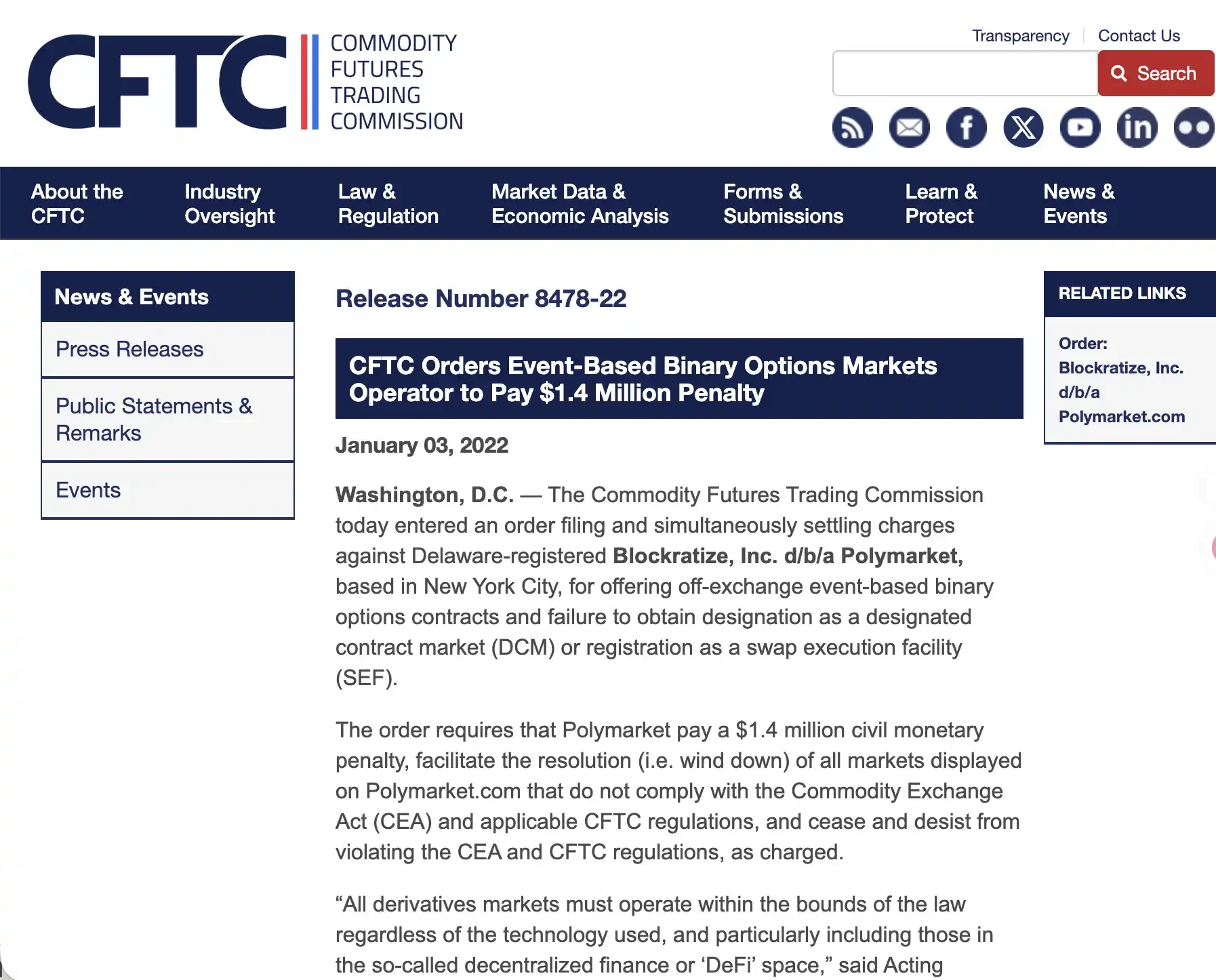
On January 3, 2022, the CFTC issued a cease and desist order against Polymarket, alleging that it operated unregistered event-based binary options markets, specifically off-exchange binary options contracts not offered on a designated contract market. The penalty included a $1.4 million civil monetary fine, requiring the wind-down of non-compliant markets and cessation of the violations. The CFTC also noted that Polymarket received a reduced penalty for substantial cooperation. By that time, Polymarket had offered over 900 event markets.
Following the penalty, Polymarket began geoblocking US users.
A platform still operating from New York, still run by its American founder, still serving global political and financial events, was forced to shift its core trading outside the US, even though many of the events it discussed were still based in America.
Exile and Explosion
After the CFTC penalty, Polymarket entered a strange state. It didn't die, but it was no longer whole. It continued running, serving international users, listing various markets, but it had lost its most crucial and symbolic domestic market.
For a New York company, this was an awkward position. It wasn't a complete failure because the product was still alive; it wasn't a true success because US users were locked out. It felt more like an exile: the company was in the US, but the product had to pretend the US didn't exist.
In May 2022, former CFTC Chairman J. Christopher Giancarlo joined Polymarket's advisory board as chairman. Known as "CryptoDad" in the crypto community, this appointment's signal was clear: after being hit by regulation, Polymarket was starting to build its compliance narrative.
But a compliance narrative couldn't immediately change the situation. An advisory board isn't a license, and a former regulator's name doesn't automatically reopen the US market. From 2022 to 2023, Polymarket entered a slump. Operating purely overseas, its scale shrank. By the end of 2023, cumulative total trading volume was around $73 million. This number was presentable then, but compared to the explosion of the 2024 election cycle, it felt like another era.
Slumps are the hardest to write about and often overlooked because they lack a single iconic photo, a headline-worthy tweet, or the drama of a regulatory raid. But for a startup, true destiny is often forged during these times: no applause, growth not fast enough, external narratives gone cold, and the team still having to fix the product daily, handle markets, explain settlements, and maintain liquidity.
Coplan didn't give up. The team continued iterating the product, improving the mobile experience, making the interface lighter, making order placement smoother, reducing the chance of non-crypto users being intimidated by wallets, gas fees


