






越涨越危险?SpaceX估值狂飙背后的系统性风险


- 核心观点:文章质疑当SpaceX的估值主要由期权对冲、动量资金等市场机制驱动,而非基本面时,资本市场的价格发现功能已失效。其潜在的系统性风险在于,若估值继续膨胀至数万亿美元,它将强制进入被动指数和退休账户,从高估值股票演变为整个市场的系统性变量。
- 关键要素:
- SpaceX盘后市值突破3万亿美元,超过亚马逊和微软,但其年亏损数十亿美元,收入远低于二者,显示估值与基本面严重脱节。
- 炒作由“伽马挤压”(Gamma Squeeze)驱动:做市商因对冲看涨期权被迫买入股票,形成自我强化的上涨反馈循环。
- 期权交易首日成交超50万张合约,深度虚值看涨期权(行权价380美元)成为最热门交易标的,进一步放大价格扭曲。
- 估值本身成为看涨逻辑,价格不再反映价值而是制造价值,基本面被边缘化。
- 若SpaceX市值达10万亿美元(约美国GDP的1/3),将被强制纳入ETF、养老金等被动投资组合,使泡沫演变为系统性风险。
- 马斯克个人财富因此可能膨胀至极高水平,远超其他亿万富豪,引发对财富集中度的担忧。
Original Title: SpaceX Could Get Dangerously Systemic
Original Author: Quoth The Raven
Original Translation: Peggy, BlockBeats
Editor's Note: After SpaceX's market cap surpassed $3 trillion in after-hours trading, this article raises a sharper question than "what is it really worth": When a company can add hundreds of billions of dollars in market value in a single day through the combined forces of a limited float, options trading, and market sentiment, is the capital market still engaged in price discovery, or has it already become a self-reinforcing speculative machine?
The author's core judgment does not deny SpaceX's commercial prospects. SpaceX may still be one of the world's most important space infrastructure companies, and may have enormous long-term potential. But this article's real focus is on another aspect: If a stock price is primarily driven by call option buying, market maker hedging, momentum chasing, and passive fund allocation, then valuation is no longer just "reflecting value" – it starts to "create value." The price increase itself becomes a new reason to be bullish, pushing fundamentals to the sidelines.
The gamma squeeze mentioned repeatedly in the article – the feedback loop where option market makers are forced to buy the stock as a hedge, further pushing up the price – is key to understanding this piece. Similar mechanisms have repeatedly played out with Tesla, certain meme stocks, and high-momentum tech stocks in recent years. The author worries that if SpaceX follows this path, amplified by its strong narrative, limited float, and Elon Musk's personal influence, it could evolve from a high-valuation stock into a systemic variable for the entire market.
The more dangerous part involves indexation and passive investing. When a company becomes large enough, it gets included in major indices and is passively held by ETFs, pension funds, retirement accounts, sovereign wealth funds, and institutional portfolios. At that point, the bubble is no longer just the gamble of a few traders; it enters the long-term asset allocation of ordinary investors. The higher it rises, the harder it is for the market to ignore it; and the harder it is to ignore, the more capital tends to flow towards it.
Therefore, this article isn't really about whether SpaceX will become a $5 trillion or $10 trillion company. It's about a structural paradox of modern capital markets: When market mechanisms can amplify narrative, leverage, and liquidity to the point of overwhelming fundamentals, can so-called "price discovery" still hold true? SpaceX is just an extreme case, but the problem it exposes may be more universal – in today's U.S. stock market, systemic risk sometimes doesn't start with bad companies, but with the most popular, most unavoidable ones.
The following is the original text:
"Things just get weirder and weirder and weirder, until eventually, they get so weird that people have to start talking about just how weird they are."
— Terence McKenna
For the past few years, I've been asking: How absurd does it have to get before we admit the stock market is fundamentally broken? Seeing SpaceX's massive surge in after-hours trading today, I think the answer is clear: The market has been broken for a long time. The real question is just how ridiculous it needs to become before others take notice.
SpaceX's market cap surpassed $3 trillion in after-hours trading. This means its valuation now exceeds that of Amazon and Microsoft. Microsoft generates hundreds of billions in revenue annually, with over $100 billion in yearly profit. Amazon's annual revenue exceeds $700 billion, with profit in the tens of billions. And now, SpaceX is assigned a higher valuation than either of them.
SpaceX's relatively limited float makes it a prime candidate for a manipulated short squeeze. Near the end of after-hours trading, its stock price approached $230 per share. In a single day, a company still losing billions of dollars annually added roughly $650 billion in market cap.
$650 billion. Not in a year. Not in a decade. In one day. And tomorrow, options on SpaceX will begin trading. As I predicted before, I bet it could be squeezed even further.
This is what's truly unsettling. Because I've written for years about what happens when options activity becomes the primary driver of price movements.
We've seen this script before: Call buyers pile in, market makers are forced to hedge, the stock rises, momentum traders chase, more calls are bought, and the cycle reinforces itself.
As of 10:30 AM Eastern Time, on the first day of SpaceX options trading, over 500,000 contracts had exchanged hands, representing a notional size of approximately 50 million shares.
The call option expiring in two days with a $380 strike price – the deepest out-of-the-money contract currently available – was the second most popular strike for options expiring this week and was the most actively traded strike in the morning session.
At some point, price stops measuring value and starts creating it. Valuation itself becomes the bullish thesis. The company's industry and fundamentals become completely irrelevant. At this point, the market officially begins doing what it's not supposed to do.
This is why tomorrow matters. Options will begin trading on a company that has already shown strong squeeze characteristics. And a similar situation occurred with its "sister company."
I've written for years that modern markets are increasingly driven by mechanical forces rather than fundamental analysis. Tomorrow could provide one of the clearest examples of this thesis.
My expectation is that the launch of $SPCX options trading will not improve price discovery but will further distort it. If aggressive call buying emerges, market makers' hedging behavior could create a reflexive feedback loop, similar to the mechanism that drove Tesla and other momentum stocks to spectacular, yet completely illogical, rallies over the past decade.
At that point, price movements will have nothing to do with business fundamentals and everything to do with market structure. If SpaceX experiences the kind of gamma squeeze many traders openly anticipate, I believe it will be further proof that modern markets have become useless and dangerously fragile for ordinary people's retirement accounts.
Because the market is supposed to allocate capital. It's supposed to facilitate price discovery. It's supposed to connect valuations – however imperfectly – to economic reality. The market shouldn't become a self-reinforcing feedback machine that can add hundreds of billions or trillions of dollars to a company's market cap based purely on mechanical flows.
The problem isn't whether SpaceX is a good company. The problem is whether the market structure surrounding it is healthy.
Because if a company with only a fraction of the revenue and profit of Microsoft or Amazon can become more valuable than them, and could surpass Nvidia tomorrow, then what is the limiting factor? What stops it from becoming a $5 trillion company? And what stops it from becoming a $10 trillion company?
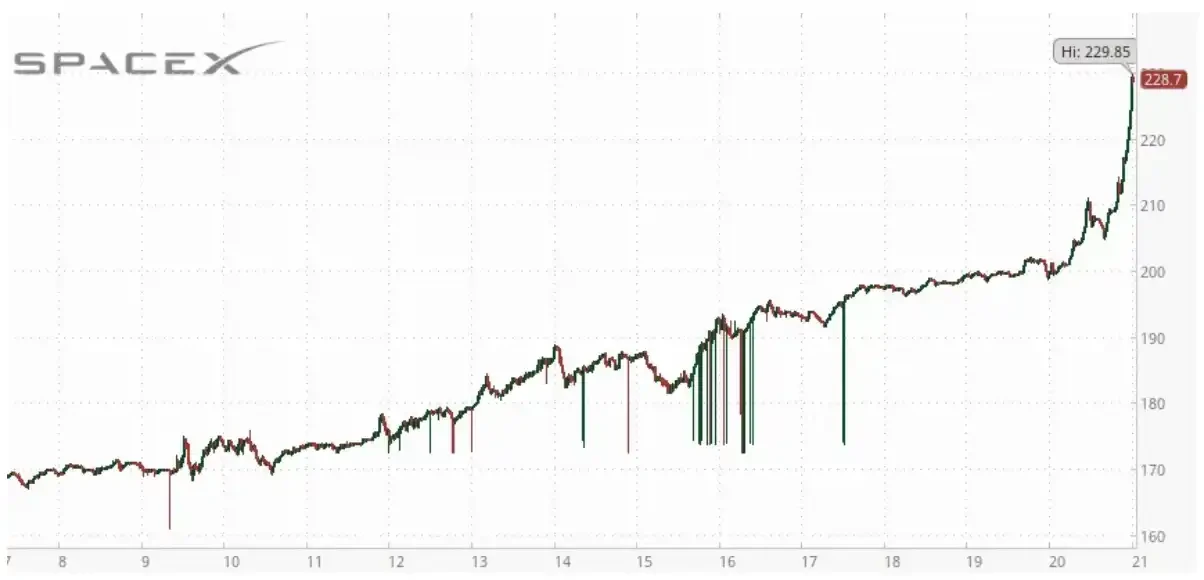
Image Source: Zero Hedge Twitter
If the same option-driven feedback loop that propelled Tesla's post-late 2019 rally appears here, then these numbers are no longer as unimaginable as they once seemed. And this is the part no one wants to discuss.
Everyone wants to talk about how high SpaceX can go. No one wants to talk about what happens if it actually gets there.
If SpaceX's market cap reaches $10 trillion, it would mean one company's valuation is roughly one-third of U.S. GDP. It would be large enough to dominate passive indices, retirement accounts, ETFs, pension funds, and institutional portfolios. Its every rise and fall would increasingly dictate the performance of the entire market – all while it isn't even profitable. It would become the greatest and most dangerous hype machine in human history.
And think about what this means for Elon Musk. If SpaceX's valuation hits $10 trillion, Musk's personal wealth would enter a range never seen in modern history. His net worth is already equivalent to 40% of all currency in circulation.
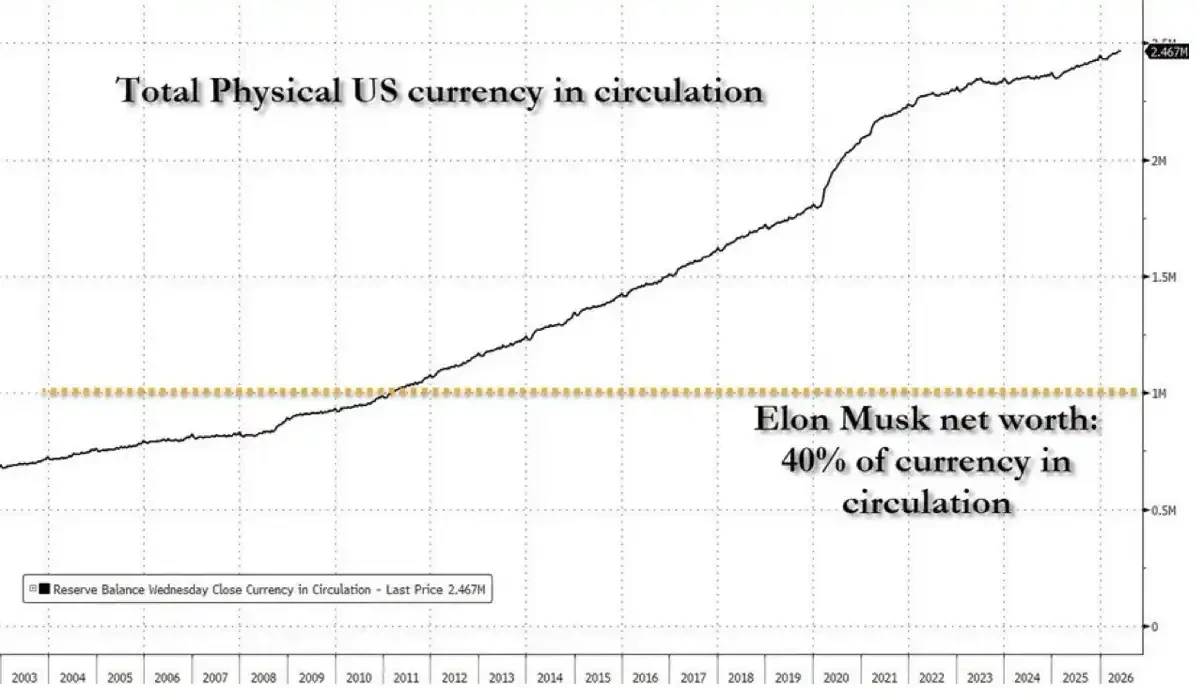
Image Source: Zero Hedge
Moreover, he isn't just richer than the second-richest person. He could soon be about ten times wealthier.
The gap between Musk and other billionaires could exceed the total wealth of some developed countries. At that point, we are no longer discussing wealth creation in any ordinary sense.
What would happen if SpaceX's market cap, driven by some sort of gamma squeeze anomaly, actually hit $28 trillion? That would be roughly equivalent to America's annual economic output. Would people finally start questioning the market? Or would they continue to find new reasons to rationalize it all?
Because every bubble in history works this way. Every new high is taken as proof that the previous high was too low. Every bout of speculative frenzy is packaged as innovation – just ask "innovation expert" Cathie Wood. Every squeeze is explained away as genius. Every warning becomes evidence that "the skeptics don't understand the future."
The most astonishing thing about SpaceX breaking $3 trillion is not the valuation itself.
It's that if it continues to rise, it will become too large to ignore. At some point, we must stop discussing SpaceX itself and instead discuss the system that created it: a speculative machine completely detached from its original function.
The danger is that once a company reaches a sufficient size, the distortion itself becomes a systemic risk. Every passive fund must hold it. Every major index depends on it. Pension funds, retirement accounts, sovereign wealth funds, insurance companies, and institutional portfolios will all become increasingly exposed to the same trade. The higher it rises, the more unavoidable it becomes.
This is the part no one truly understands.
If SpaceX eventually reaches $10 trillion through a combination of hype, narrative, mechanical flows, and option-driven feedback loops, it will no longer just be a story about SpaceX. It will become the market. Its movements will increasingly dictate the performance of indices, ETFs, and retirement accounts across the entire financial system. The market will essentially become a referendum on a single stock.
This is how a bubble becomes a systemic risk. Not when it's small enough to be ridiculed, but when it becomes so large that everyone is forced to participate. The same mechanisms driving prices higher today will ultimately create the conditions for instability tomorrow. When trillions of dollars of wealth are tied to a valuation that has never truly been anchored to fundamentals, even a modest correction could have consequences that extend far beyond the stock itself.


